
Wristwatches · Wristwatch
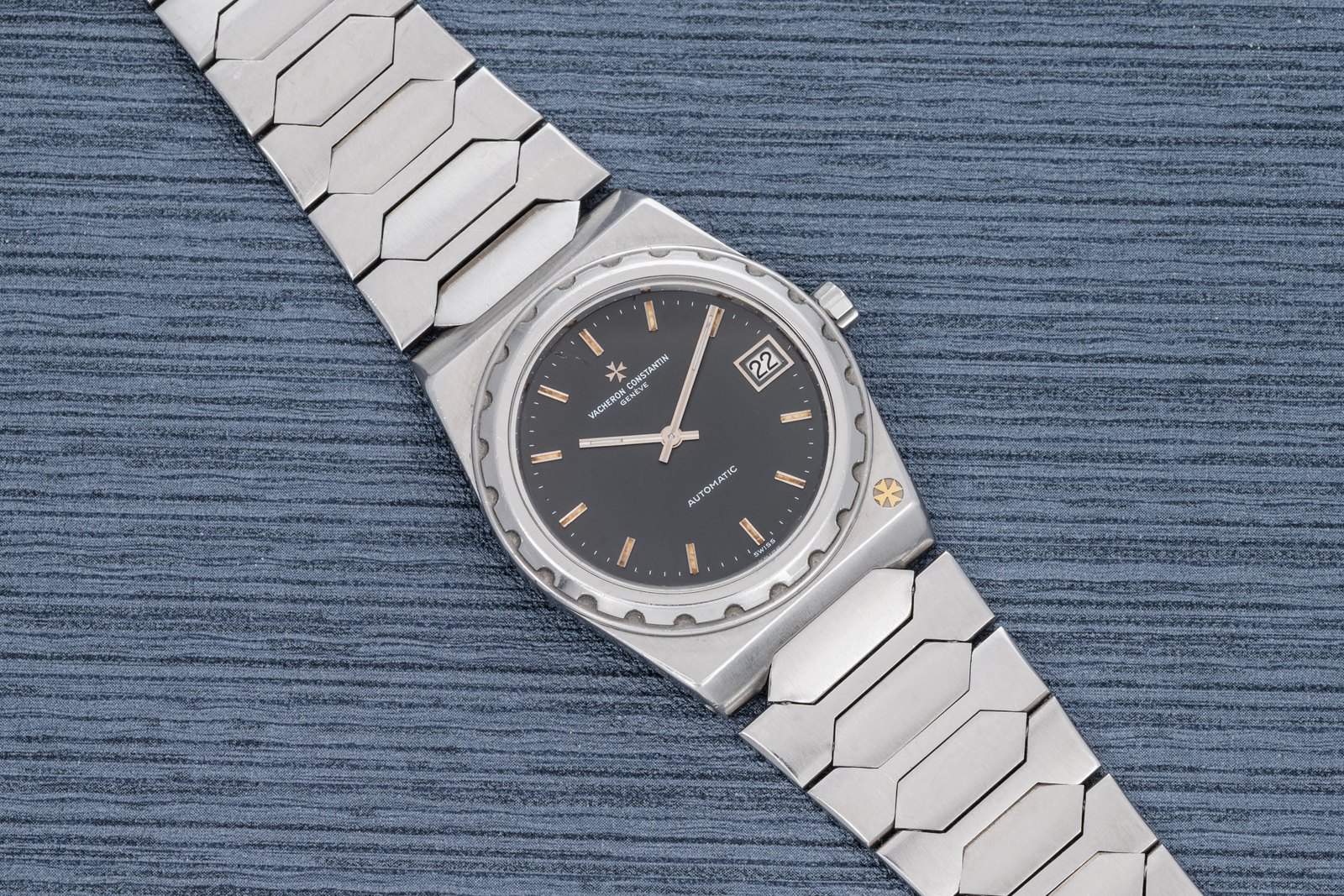
Vacheron Constantin 222 'Jumbo', c. 1978
- Maker / attribution
- Vacheron Constantin (maker)
- Date
- c. 1978
- Historical period
- Quartz Revolution (1969 – 1990)
- Country of origin
- Switzerland
- Object type
- Wristwatch
- Dimensions
- Case 37 mm
- Stock no.
- 40990558
- Credit line
- Dealer listing, Analog/Shift (40990558)
- Catalogue title (original)
- Vacheron Constantin 222 'Jumbo' (English)
View the source record (dealer listing) ↗ (opens another website in a new tab)Suggest a correction
Record summary
Catalogued by Analog/Shift (dealer), New York (stock number 40990558), this is a wristwatch by Vacheron Constantin, made in Switzerland, dated c. 1978. The Atlas places it in the Quartz Revolution period (1969 – 1990) of its Wristwatches collection. Recorded dimensions: Case 37 mm. The record is illustrated with 6 photographs.
Assembled from the source record's structured fields. Dates and attributions are given as the source states them; where a field is missing the Atlas leaves it blank rather than estimating.
Catalogue description
Dealer description — Analog/Shift
For the watch industry, the 1970s was a decade of great change — from within as well as without — and even Vacheron Constantin, stalwart member of the Big Three, wasn’t immune. The 1969 introduction of the Seiko Astron, the world’s first commercially available quartz wristwatch, sent tremors throughout the industry. Though quartz in and of itself was not a new technology, the Astron’s application of it was revolutionary. Both visually and internally, the Astron was something the industry hadn’t seen before, with a distinctive case shape to house the quartz movement. Attempts by big Swiss manufacturers to release a quartz watch of their own — the Beta 21 — met with failure. As sales of Swiss watches dipped and as a looming oil crisis gripped the worldwide economy, Swiss manufacturers realized that they had to develop something truly unique if they wished to stay afloat. Thus Audemars Piguet tapped the brilliant mind of Gérald Genta to design the Royal Oak in 1972, while Patek Philippe followed suit with the Nautilus in 1976. That left Vacheron Constantin to try its hand at the “luxury sports watch.” To celebrate the manufacture’s 222nd anniversary, Vacheron brought out the 222. For its distinctive design, Vacheron Constantin leaned on a young maverick designer in their stable by the name of Jorg Hysek. The watch that Hysek designed bore a thin, angular case with an integrated bracelet. It was the birth of a new modern look for a classic atelier. Though similar to the Royal Oak, the serrated bezel of the 222 and its clean, elegant dial was entirely unique to Vacheron Constantin. The 222 saw production in limited numbers: 500 in steel, 100 in 18k gold, and 120 in gold and stainless steel, and was discontinued in 1985, making it exceedingly rare. The particular 222 that we have here dates to circa 1978 and features a 37mm stainless steel case with a matching integrated bracelet, a signed Maltese cross crown, a sapphire crystal, a stylized bezel, and a dark grey tritium dial with a stick handset. A legendary reference, it remains in good condition showing honest wear despite its age. These pieces are incredibly hard to come by, with far less of these being produced than its rivals from the era. That is — until spring of 2022 when Vacheron released an excellent reissue in solid 18k yellow gold. Don’t miss your chance to own one of the original luxury sports watches — in steel, no less!
Historical context
Quartz Revolution (1969 – 1990)
Seiko's Astron begins mass quartz timekeeping; traditional industries contract sharply.
Quartz and digital watches transformed the market after 1969. Swiss employment collapsed, Japanese and Hong Kong production soared, and the Swatch (1983) helped the Swiss industry recover; mechanical watches survived as luxury goods.
Read the period in the timelineMore wristwatches from this periodEarlier: Modern Mechanical Horology
Atlas type guide
Wristwatches
Bracelet watches were worn by women from the early nineteenth century — Breguet made one for Caroline Murat, Queen of Naples, in 1810–12 — but the wristwatch only became a man's instrument with military use and aviation in the early twentieth century. Between the World Wars it overtook the pocket watch; the 1920s and 1930s brought rectangular Art Deco cases, water-resistant cases and the first automatic winding systems.
After 1945 the wristwatch became a carrier of identity — dress watches, sports and dive watches, chronographs, calendars — produced by Swiss, American, Japanese, German, Soviet and Chinese industries. The quartz revolution after 1969 and the mechanical renaissance since the 1990s, including the rise of independent watchmakers, complete the story.
What to look for
- The reference number (between the lugs or inside the case back) and serial number, the starting point for dating.
- The calibre: its maker and number are often stamped under the dial or on the bridge.
- Originality of dial, hands and crown — refinished ('redial') dials are common.
- Case material marks: 18K/750, 14K/585, stainless steel, gold-filled, plated.
Dating clues
- Wire-lug cases: before c. 1925.
- Water-resistant screw-down cases: from 1926.
- Quartz movements: from 1969; sapphire crystals widespread after c. 1980.
General guidance written by the Atlas editors about this kind of object. It is not a statement about this particular piece; for that, rely on the source record above and on physical examination.
Related records
Pocket Watches · c. 1896
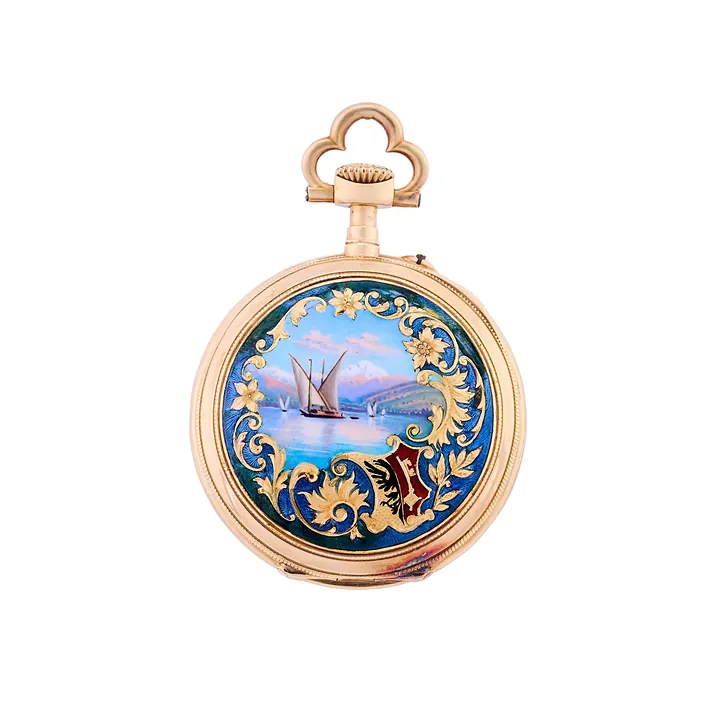
Vacheron Constantin “grand TIR de L’exposition Nationale, Genève 1896, c. 1896
Antiquorum auction archive, Geneva
Pocket Watches · c. 1940
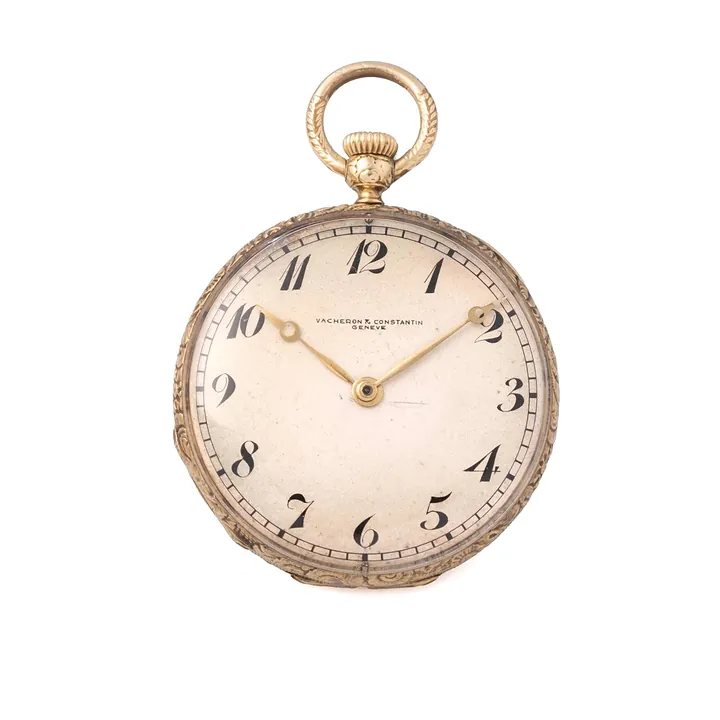
Vacheron Constantin pocket watch, ref. 345, c. 1940
Antiquorum auction archive, Geneva
Pocket Watches · c. 1945
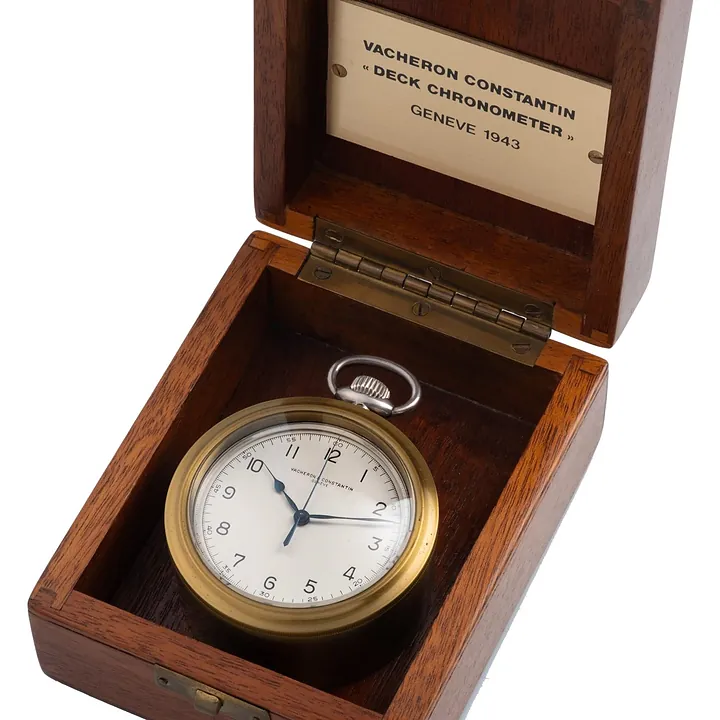
Vacheron Constantin pocket chronometer, c. 1945
Antiquorum auction archive, Geneva
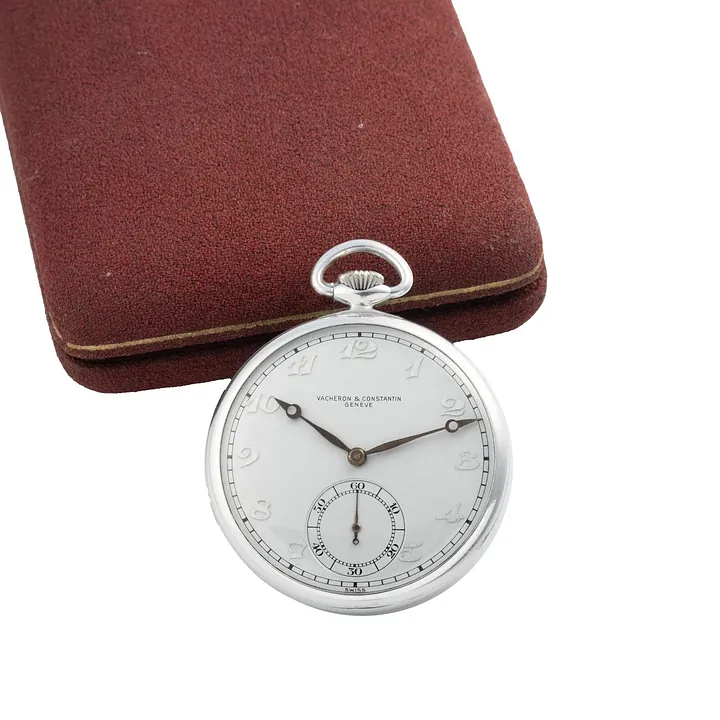
Pocket Watches · c. 1945
Vacheron Constantin watch, c. 1945
Antiquorum auction archive, Geneva

Wristwatches · 1970
Wristwatch by Heno, Switzerland, 1970
Museum Rotterdam

Wristwatches · 1960–1986
'Tri-Compax' calendar chronograph wristwatch in gold case, by Universal, Geneva, Switzerland, 1960–1986.
Science Museum Group, London

Wristwatches · 1969–1970
Beta 21 Quartz wristwatch movement, made in Switzerland, 1970.
Science Museum Group, London

Wristwatches · c. 1969
Omega Speedmaster Moonwatch, ref. 145022-69st, c. 1969
Antiquorum auction archive, Geneva