
Wristwatches · Wristwatch
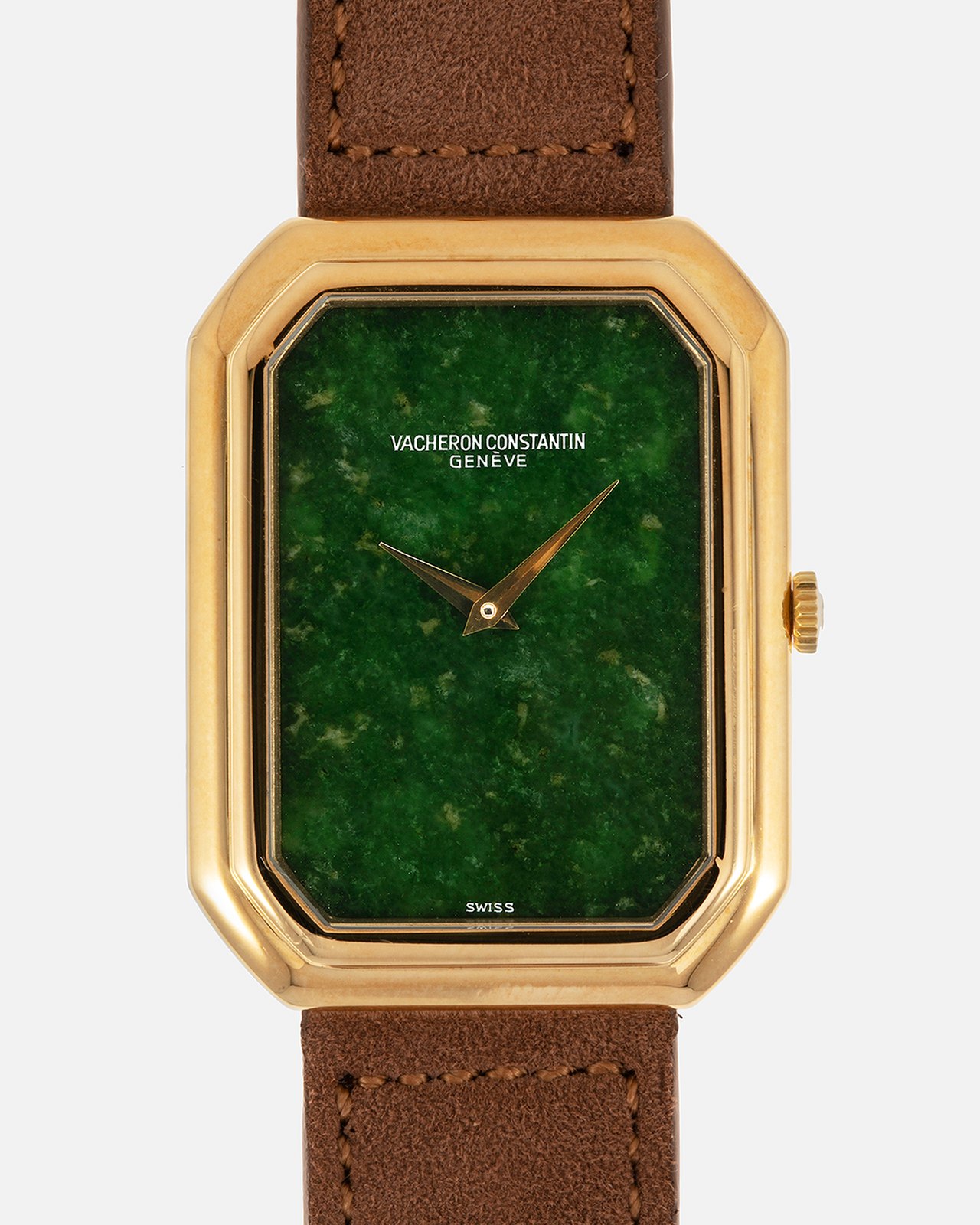
Vacheron Constantin 2077 Jade Dial 'Cristallor' Large, 1970s
- Maker / attribution
- Vacheron Constantin (maker)
- Date
- 1970s
- Historical period
- Quartz Revolution (1969 – 1990)
- Country of origin
- Switzerland
- Object type
- Wristwatch
- Dimensions
- Case 38 mm
- Stock no.
- Product 7363749511255
- Credit line
- Dealer listing, S.Song Watches (product 7363749511255)
- Catalogue title (original)
- Vacheron Constantin 2077 Jade Dial 'Cristallor' Large (English)
View the source record (dealer listing) ↗ (opens another website in a new tab)Suggest a correction
Record summary
Catalogued by S.Song Watches (dealer), Seattle (stock number Product 7363749511255), this is a wristwatch by Vacheron Constantin, made in Switzerland, dated 1970s. The Atlas places it in the Quartz Revolution period (1969 – 1990) of its Wristwatches collection. Recorded dimensions: Case 38 mm. The record is illustrated with 6 photographs.
Assembled from the source record's structured fields. Dates and attributions are given as the source states them; where a field is missing the Atlas leaves it blank rather than estimating.
Catalogue description
Dealer description — S.Song Watches
Watches with stone dials are among the most captivating—and, to some extent, polarizing—design categories in watchmaking. You see, there is a true art to crafting these dials, as ensuring they are thin enough to avoid adding unnecessary heft while maintaining durability is a delicate balancing act. Achieving this without cracking the precious stone itself is a tremendous challenge, and as a result, watches with stone dials are often quite fragile. The high failure rates in producing these delicate dials naturally drive up costs, making them inherently expensive. Nevertheless, interest in stone dials has been steadily growing in recent years. Vintage examples are gradually being rediscovered and gaining popularity, while many modern brands are also embracing the craft, incorporating stone dials into their contemporary designs and offerings. What we have here today is a rare example from one of the "Holy Trinity" brands of watchmaking: this is the Vacheron Constantin Ref. 2077, featuring a stunning jade dial encased within an exceptional ‘Cristallor’ case in 18-carat yellow gold. It is worth mentioning that while there are several variations of the Ref. 2077, this particular configuration with a jade dial is incredibly scarce, as we have yet to find any other examples like it currently available on the market. In terms of sizing, the Ref. 2077 is a modest 38mm x 29mm, making it highly wearable by modern standards. The design is elegantly simple: the watch features a striking green jade dial with no markers, except for the gold dauphine hands, the Maison’s logo, and discreet ‘Swiss’ text at 6:00. This minimalist approach allows the jade dial to truly take center stage, with its ample negative space. As mentioned earlier, the jade dial is beautifully complemented by a luxurious 18-carat yellow gold 'Cristallor' style case, characterized by its seemingly large vertical form, stepped bezel, and flushed lugs—a flawless and refined pairing, if I may say so myself. Powering the Ref. 2077 from within is the exquisitely finished Vacheron Constantin Cal. K1014- a manual-winding movement from the 1970s that is fundamentally based on the Jaeger-LeCoultre Cal. 818. It holds a power reserve of approximately 38 hours on a full wind. Overall, when it comes to rare and extraordinary specimens like this, words often fall short in capturing its aesthetic allure and exuberance. Therefore, I shall let the pictures speak for themselves.
Historical context
Quartz Revolution (1969 – 1990)
Seiko's Astron begins mass quartz timekeeping; traditional industries contract sharply.
Quartz and digital watches transformed the market after 1969. Swiss employment collapsed, Japanese and Hong Kong production soared, and the Swatch (1983) helped the Swiss industry recover; mechanical watches survived as luxury goods.
Read the period in the timelineMore wristwatches from this periodEarlier: Modern Mechanical Horology
Atlas type guide
Wristwatches
Bracelet watches were worn by women from the early nineteenth century — Breguet made one for Caroline Murat, Queen of Naples, in 1810–12 — but the wristwatch only became a man's instrument with military use and aviation in the early twentieth century. Between the World Wars it overtook the pocket watch; the 1920s and 1930s brought rectangular Art Deco cases, water-resistant cases and the first automatic winding systems.
After 1945 the wristwatch became a carrier of identity — dress watches, sports and dive watches, chronographs, calendars — produced by Swiss, American, Japanese, German, Soviet and Chinese industries. The quartz revolution after 1969 and the mechanical renaissance since the 1990s, including the rise of independent watchmakers, complete the story.
What to look for
- The reference number (between the lugs or inside the case back) and serial number, the starting point for dating.
- The calibre: its maker and number are often stamped under the dial or on the bridge.
- Originality of dial, hands and crown — refinished ('redial') dials are common.
- Case material marks: 18K/750, 14K/585, stainless steel, gold-filled, plated.
Dating clues
- Wire-lug cases: before c. 1925.
- Water-resistant screw-down cases: from 1926.
- Quartz movements: from 1969; sapphire crystals widespread after c. 1980.
General guidance written by the Atlas editors about this kind of object. It is not a statement about this particular piece; for that, rely on the source record above and on physical examination.
Related records
Pocket Watches · c. 1896
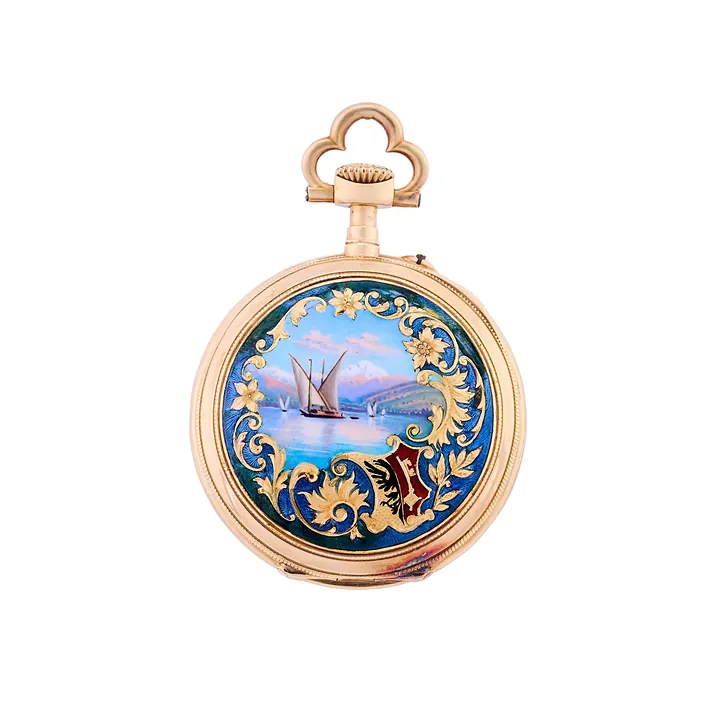
Vacheron Constantin “grand TIR de L’exposition Nationale, Genève 1896, c. 1896
Antiquorum auction archive, Geneva
Pocket Watches · c. 1940
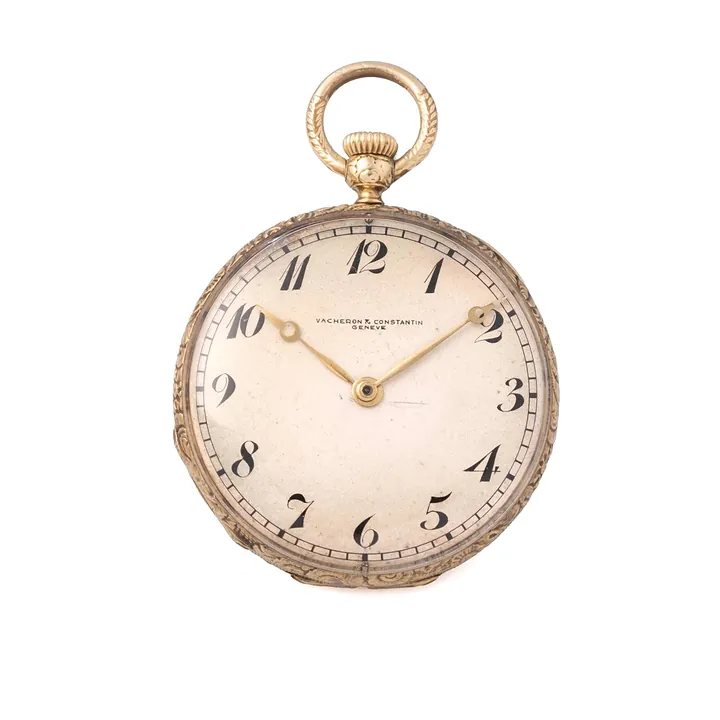
Vacheron Constantin pocket watch, ref. 345, c. 1940
Antiquorum auction archive, Geneva
Pocket Watches · c. 1945
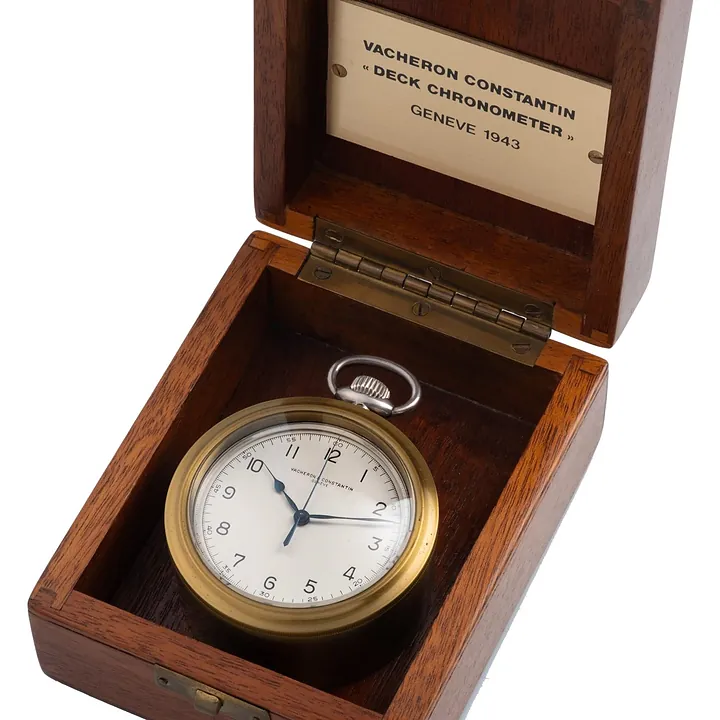
Vacheron Constantin pocket chronometer, c. 1945
Antiquorum auction archive, Geneva
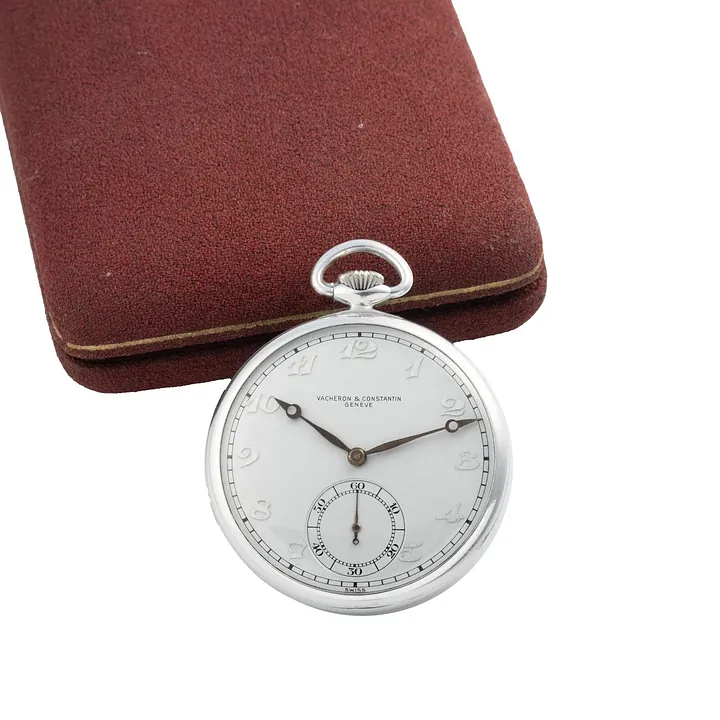
Pocket Watches · c. 1945
Vacheron Constantin watch, c. 1945
Antiquorum auction archive, Geneva

Wristwatches · 1970
Wristwatch by Heno, Switzerland, 1970
Museum Rotterdam

Wristwatches · 1960–1986
'Tri-Compax' calendar chronograph wristwatch in gold case, by Universal, Geneva, Switzerland, 1960–1986.
Science Museum Group, London

Wristwatches · 1969–1970
Beta 21 Quartz wristwatch movement, made in Switzerland, 1970.
Science Museum Group, London

Wristwatches · c. 1969
Omega Speedmaster Moonwatch, ref. 145022-69st, c. 1969
Antiquorum auction archive, Geneva