
Wristwatches · Wristwatch
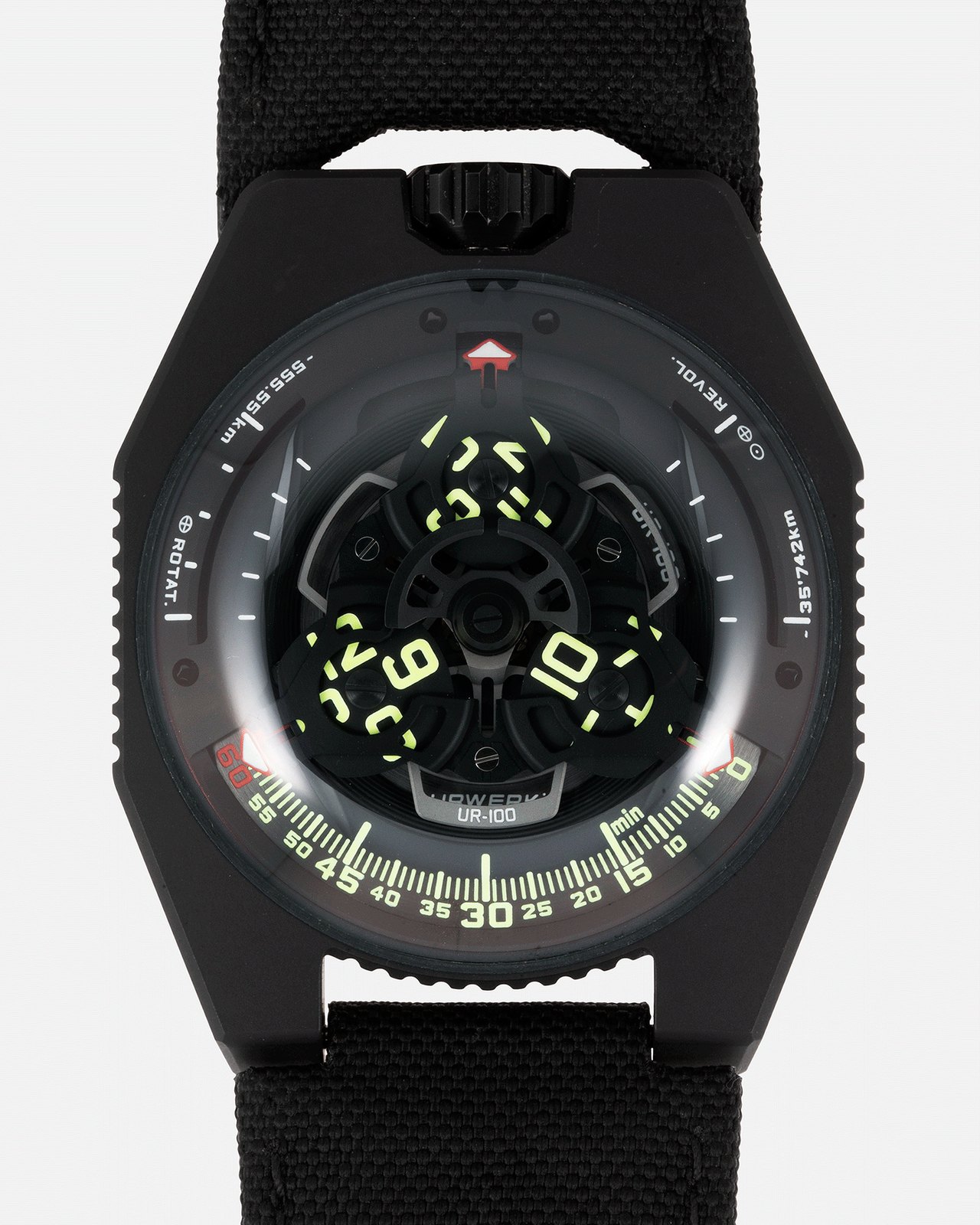
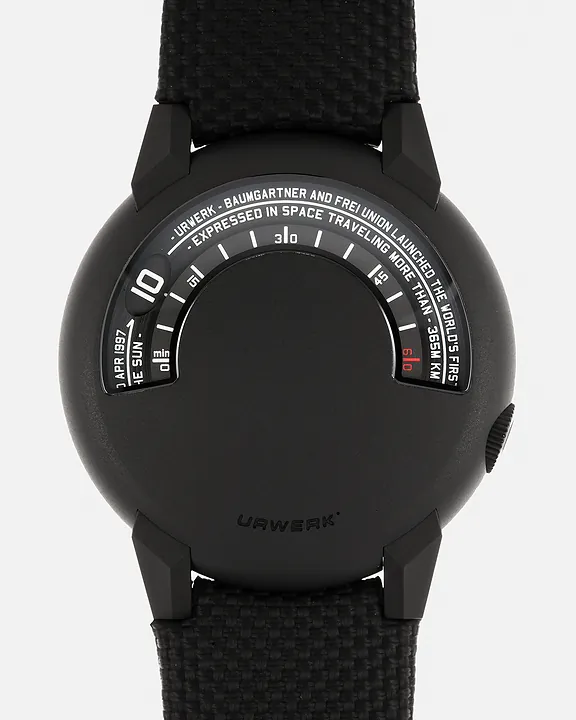
Urwerk UR100 Spacetime, 2019
- Maker / attribution
- Urwerk (maker)
- Date
- 2019
- Historical period
- Contemporary Horology (2010 – Present)
- Country of origin
- Switzerland
- Object type
- Wristwatch
- Dimensions
- Case 41 mm
- Stock no.
- Product 6615391764567
- Credit line
- Dealer listing, S.Song Watches (product 6615391764567)
- Catalogue title (original)
- Urwerk UR100 Spacetime (English)
View the source record (dealer listing) ↗ (opens another website in a new tab)Suggest a correction
Record summary
Catalogued by S.Song Watches (dealer), Seattle (stock number Product 6615391764567), this is a wristwatch by Urwerk, made in Switzerland, dated 2019. The Atlas places it in the Contemporary Horology period (2010 – Present) of its Wristwatches collection. Recorded dimensions: Case 41 mm. The record is illustrated with 6 photographs.
Assembled from the source record's structured fields. Dates and attributions are given as the source states them; where a field is missing the Atlas leaves it blank rather than estimating.
Catalogue description
Dealer description — S.Song Watches
Founded in 1997 by Martin Frei and Felix Baumgartner, Urwerk is one of the independent watchmaking industry's most prolific brands with a sense of watchmaking that fuses the traditional with futuristic design and a somewhat novel appreciation for the very concept of time. As such, Urwerk's timepieces are outside of the ordinary regarding their mechanical operation and their aesthetic design. Representing the basis of their offerings is the UR-100 Spacetime collection, blending their quirky aesthetic with stunning craftsmanship. First released in 2019, the UR-100 Spacetime collection features a pair of interesting astronomical complications that build upon its solar and celestial-inspired design origins while simultaneously pushing Urwerk's watchmaking credentials even further into the ether of Haute Horlogerie. As referenced by the collection's name, these complications are fundamentally tied to space. They are the distance the earth has travelled through space during its orbit of the sun and the distance we have travelled on earth as it rotates. Displayed at 10 o'clock and 2 o'clock, these two 20 minute sections of the dial mark out a 555.55km distance, and a 35,742km distance, with the three satellite hour markers jumping from the end of one to the start of the next every hour in a hypnotic display of exuberance that only a brand like Urkwerk could pull off, thanks to their Urwerk cal. 12.01, which features a planetary flat turbine that is showcased behind the exhibition caseback. Limited to 25 pieces, the UR-100 Spacetime Black is an avant-garde piece of horological design that calls back to the Urwerk timepieces of old. With its domed sapphire crystal feeding into its heritage-inspired aesthetic, the UR-100's most compelling piece of design is its unconventional yet rather wearable 41mm PVD-coated titanium case that measures a not-too-large 49.7mm from lug to lug. Coloured black thanks to its PVD coating, as referenced by the model's name, the UR-100's monochromatic aesthetic is emboldened by its dark display and contrasting green numerals and markings. These combine to create an aesthetic that manages to reflect the dark unknown of the cosmos through its physical construction – quite an apt piece of design given the UR-100's functions and the brand's inspiration.
Historical context
Contemporary Horology (2010 – Present)
Silicon components, connected watches, optical-lattice research clocks and a thriving independent scene.
Smartwatches became the world's best-selling watches, while mechanical watchmaking focuses on craft, innovation (silicon components, new escapements) and independent makers.
Read the period in the timelineMore wristwatches from this periodEarlier: Mechanical Renaissance
Atlas type guide
Wristwatches
Bracelet watches were worn by women from the early nineteenth century — Breguet made one for Caroline Murat, Queen of Naples, in 1810–12 — but the wristwatch only became a man's instrument with military use and aviation in the early twentieth century. Between the World Wars it overtook the pocket watch; the 1920s and 1930s brought rectangular Art Deco cases, water-resistant cases and the first automatic winding systems.
After 1945 the wristwatch became a carrier of identity — dress watches, sports and dive watches, chronographs, calendars — produced by Swiss, American, Japanese, German, Soviet and Chinese industries. The quartz revolution after 1969 and the mechanical renaissance since the 1990s, including the rise of independent watchmakers, complete the story.
What to look for
- The reference number (between the lugs or inside the case back) and serial number, the starting point for dating.
- The calibre: its maker and number are often stamped under the dial or on the bridge.
- Originality of dial, hands and crown — refinished ('redial') dials are common.
- Case material marks: 18K/750, 14K/585, stainless steel, gold-filled, plated.
Dating clues
- Wire-lug cases: before c. 1925.
- Water-resistant screw-down cases: from 1926.
- Quartz movements: from 1969; sapphire crystals widespread after c. 1980.
General guidance written by the Atlas editors about this kind of object. It is not a statement about this particular piece; for that, rely on the source record above and on physical examination.
Related records
Wristwatches · 2014
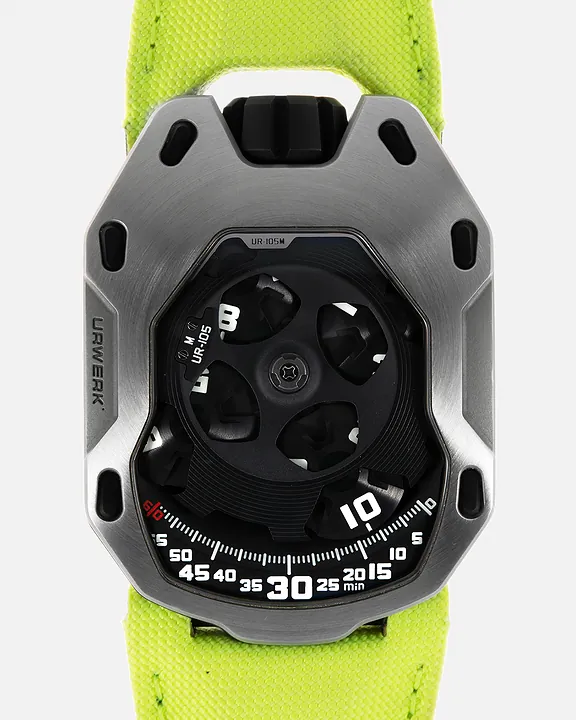
Urwerk UR105M Iron Knight, 2014
S.Song Watches (dealer), Seattle
Wristwatches · 2007
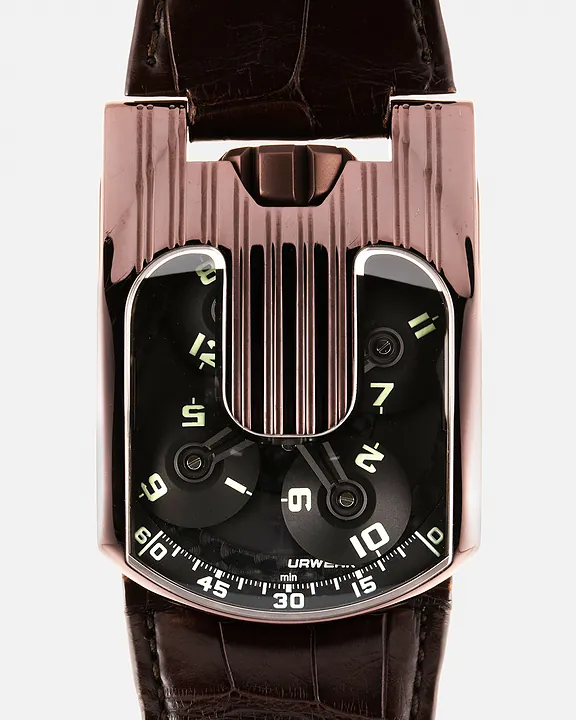
Urwerk UR103.08 TiAlN, 2007
S.Song Watches (dealer), Seattle
Wristwatches · 2021
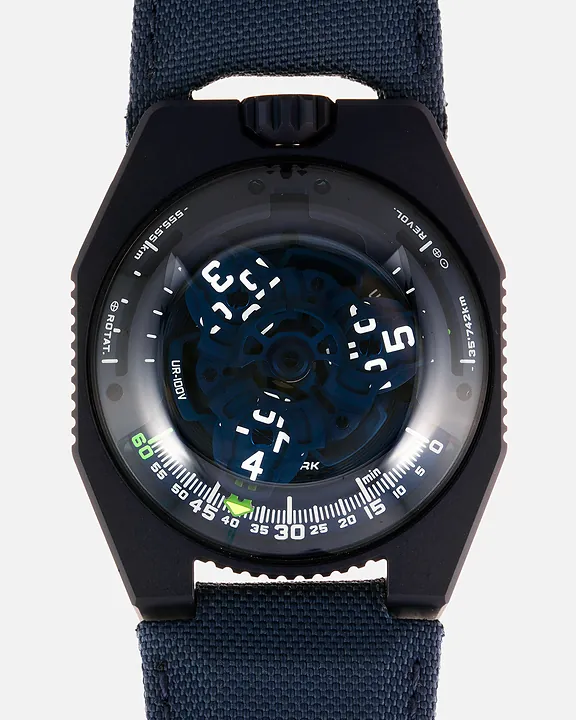
Urwerk UR100 Blue Planet, 2021
S.Song Watches (dealer), Seattle
Wristwatches · 2023
Urwerk UR102 Reloaded Black, 2023
S.Song Watches (dealer), Seattle

Wristwatches · c. 2010s
Breguet Type XXI, ref. 3810, c. 2010s (Antiquorum Lot 381-24)
Antiquorum auction archive, Geneva

Wristwatches · c. 2010s
Breguet Type XXI, ref. 3810, c. 2010s (Antiquorum Lot 386-229)
Antiquorum auction archive, Geneva

Wristwatches · Sold in September 2010
Breitling Cosmonaute, ref. A 22322, Sold in September 2010
Antiquorum auction archive, Geneva

Wristwatches · c. 2010
Corum Bubble Chrono, ref. 396.150.20, c. 2010
Antiquorum auction archive, Geneva