
Clocks · Clock
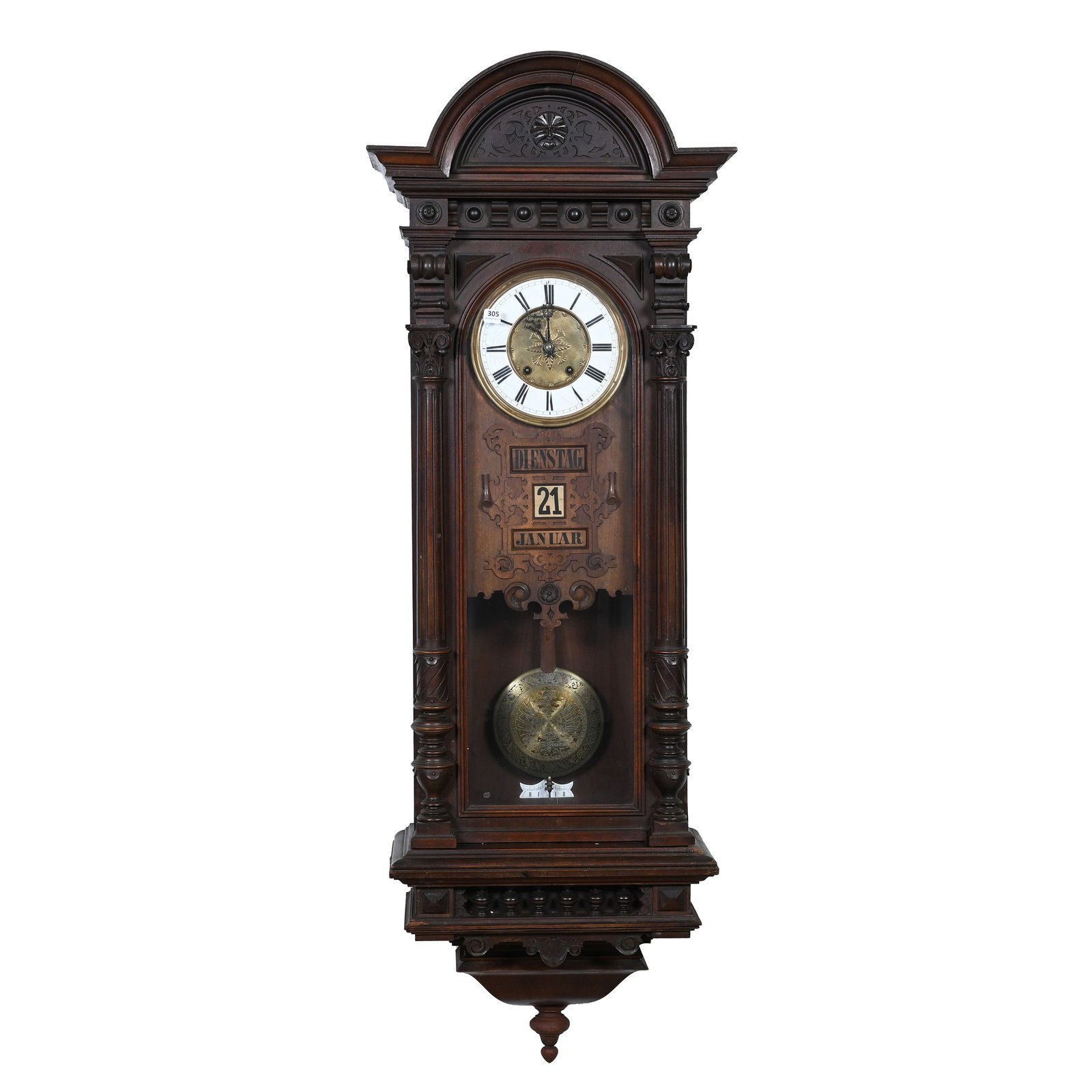
Unusual Two Spring German Calendar Clock, Altdeutsch Vienna Regulator Style Case, circa 1880
- Maker / attribution
- Unrecorded in source
- Date
- c. 1880
- Historical period
- Industrial Revolution (1850 – 1900)
- Country of origin
- Germany
- Object type
- Clock
- Auction house
- LiveAuctioneers auction archive
- Lot
- Item 191249267
- Credit line
- Auction lot record: lot 305, 12-7-2024 - High Quality Art Glass & Antiques, Woody Auction LLC (2024), via LiveAuctioneers
- Catalogue title (original)
- Unusual Two Spring German Calendar Clock, Altdeutsch Vienna Regulator Style Case, Circa 1880 (English)
View the source record (auction lot) ↗ (opens another website in a new tab)Suggest a correction
Record summary
Catalogued by LiveAuctioneers auction archive (lot Item 191249267), this is a clock, made in Germany, dated c. 1880. The Atlas places it in the Industrial Revolution period (1850 – 1900) of its Clocks collection. The record is illustrated with 4 photographs.
Assembled from the source record's structured fields. Dates and attributions are given as the source states them; where a field is missing the Atlas leaves it blank rather than estimating.
Catalogue description
Lot description — Woody Auction LLC
Unusual Two Spring German Calendar Clock, Altdeutsch Vienna Regulator Style Case, Circa 1880, 52" x 18", Dark Finish, Engraved Gilt Face, Beautiful Engraved Bob With Latin Inscribed "Veritatem Aperit Dies", The Calendar Provides Day Of The Week, Day Of The Month, Month Of The Year, The Sides Of The Door Have Corinthian Columns, Missing Five Finials, This Clock Had Been Professionally Packed And Stored For Over 20 Years, The Crate Is Available To Buyer Upon Request, Free Of Charge. Woody Auction Cannot Ship This Item, It Must Be Picked Up In Person In Douglass, KS Or Shipped Via A Professional Shipper By November 22, 2024. We Recommend Researching Shippers Now By Checking Our Shipper List At slkt.io/YiEi, Paul A. Davis Collection, Arizona. UPDATED 11-7-24: Upon Mechanical Advancement Of The Numbered Silk Ribbon, It Tore, See Additional Photo, Also Added Additional Shipping Information.
Historical context
Industrial Revolution (1850 – 1900)
American interchangeable-parts manufacture; railroad time standards; Swiss and German factory systems.
Factory production transformed the clock into an everyday object. American makers (Seth Thomas, Ansonia, Waterbury) and German factories (Junghans, Gustav Becker, Lenzkirch) sold millions of shelf, wall and alarm clocks worldwide; France produced standardised Paris movements and carriage clocks; electric time distribution began.
Read the period in the timelineMore clocks from this periodEarlier: Precision & Scientific Horology
Atlas type guide
Regulators, wall and Vienna clocks
A regulator is a precision pendulum clock used as a time standard in observatories, workshops and railway offices. Typical features are a deadbeat or Graham escapement, a temperature-compensated pendulum (mercury jar, gridiron or later invar), maintaining power and a regulator dial that separates hours, minutes and seconds. George Graham's deadbeat escapement (c. 1715) and his mercury pendulum, together with Harrison's gridiron, set the pattern for two centuries.
Wall clocks span a much wider range: the elegant Viennese Laterndluhr and Dachluhr of the Biedermeier period, the Dutch stoelklok and staartklok, English 'dial' clocks used in schools, offices and railway stations, and mass-produced spring and weight wall clocks from Germany (Gustav Becker, Junghans, Kienzle) and America.
What to look for
- Deadbeat escapement and compensated pendulum (gridiron rods, mercury jar or wood rod).
- A regulator dial with a large central minute hand and separate hour and seconds dials.
- Vienna regulators: glazed cases, slender pendulum, small weights, enamel two-piece dials.
- German factory trademarks stamped on the backplate (e.g. Gustav Becker anchor and crown, Junghans star).
Dating clues
- Graham-type deadbeat regulators: from c. 1720.
- Viennese Laterndluhr: c. 1800–1850.
- German factory 'Vienna-style' regulators: c. 1870–1930; Gustav Becker serial numbers allow close dating.
General guidance written by the Atlas editors about this kind of object. It is not a statement about this particular piece; for that, rely on the source record above and on physical examination.
Read next:Deadbeat escapementAnchor (recoil) escapementGrasshopper escapement
Related records
Clocks · c. 1850
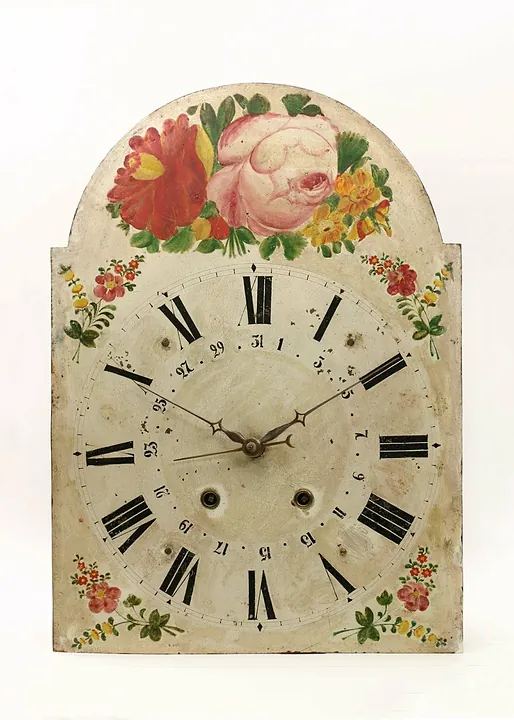
Cuckoo / black forest clock, Germany, c. 1850
German Clock Museum
Clocks · 1850
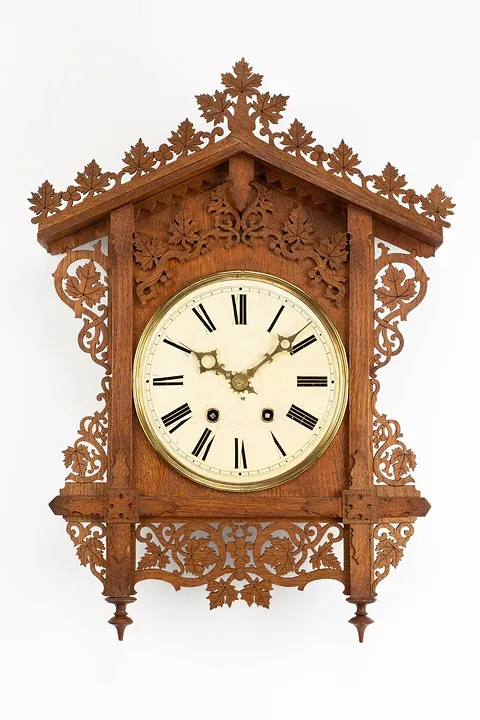
Wall clock by Glatz und Co. Kreuzer, Germany, 1850
German Clock Museum
Clocks · 1858
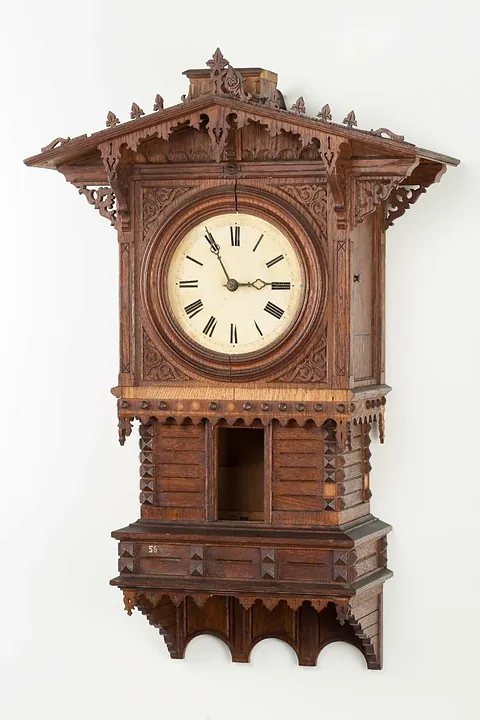
Clock by Jacob Bäuerle, Germany, 1858
German Clock Museum
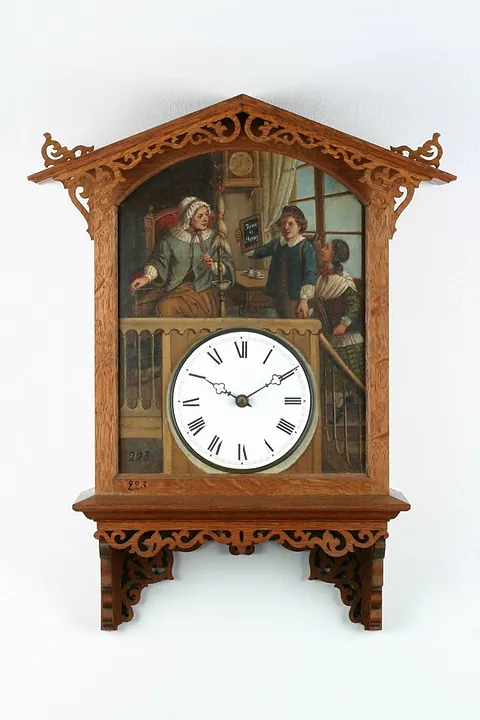
Clocks · 1860
Clock by August Tritschler, Germany, 1860
German Clock Museum
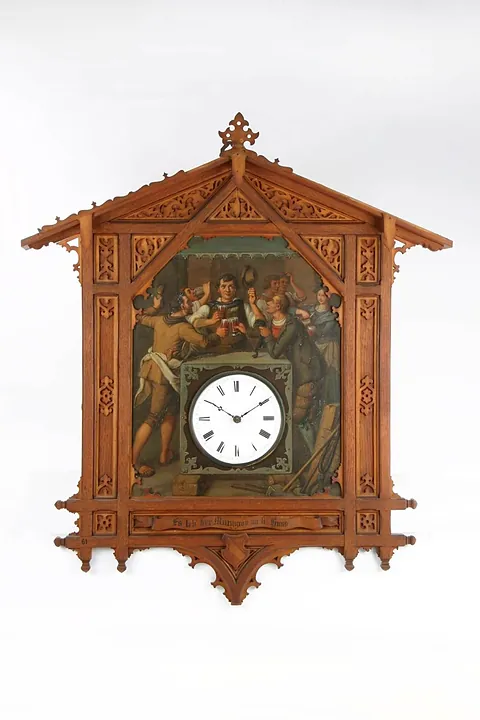
Clocks · 1860
Clock by Großherzoglich Badische Uhrmacherschule, Germany, 1860
German Clock Museum
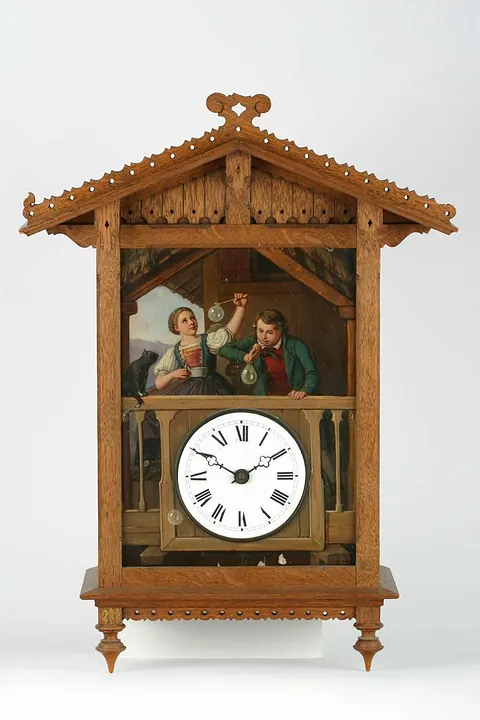
Clocks · c. 1860
Clock by Heinrich Frank, Germany, c. 1860
German Clock Museum
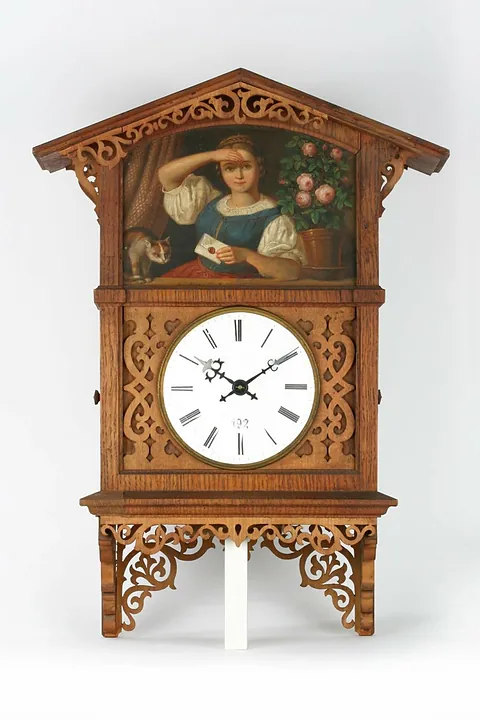
Clocks · c. 1860
Clock by M. Schuhmacher, Germany, c. 1860
German Clock Museum

Clocks · c. 1860
Clock by Martens und Cie., Germany, c. 1860 (no. 57930)
German Clock Museum