
Wristwatches · Wristwatch
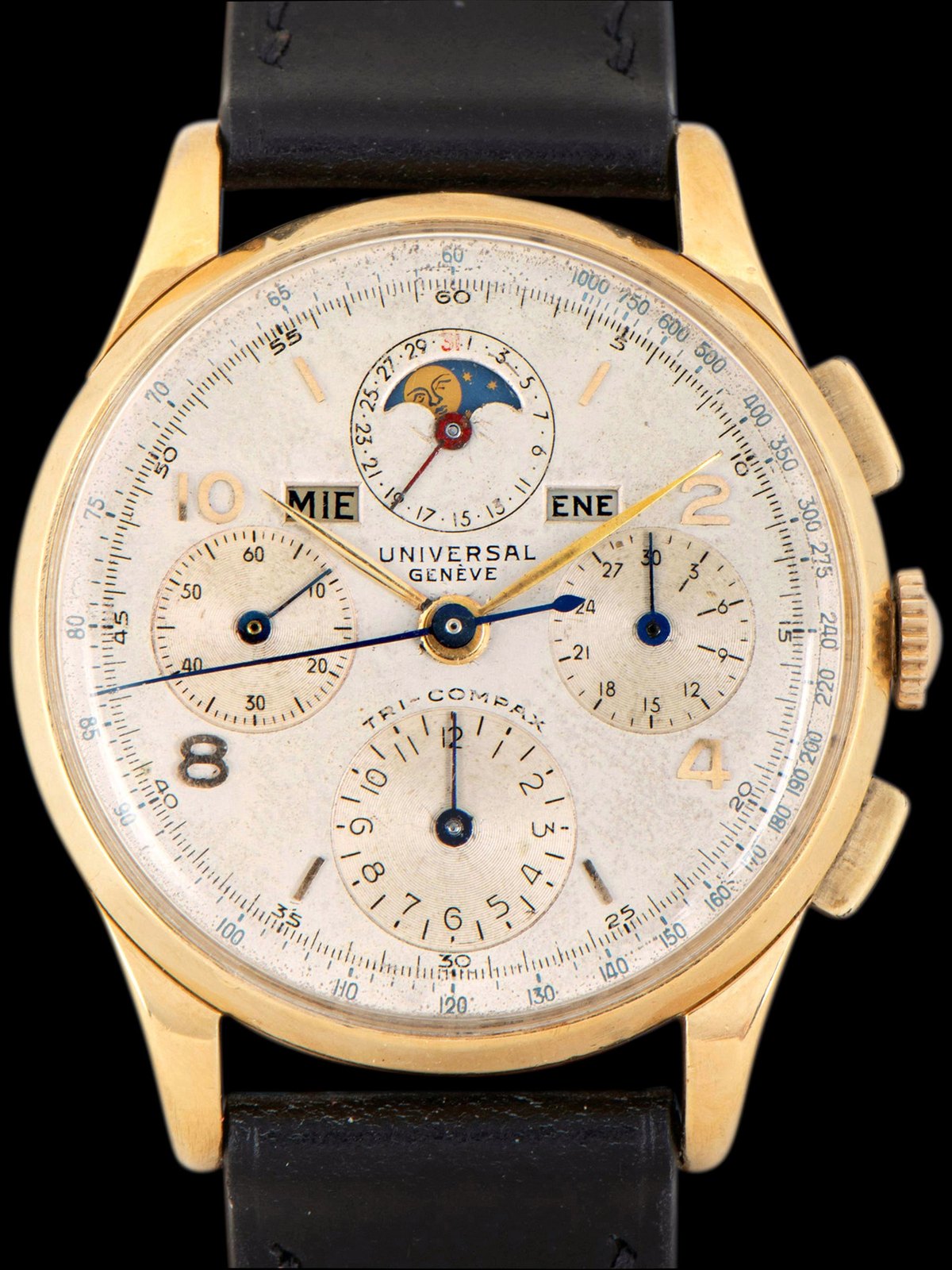
Universal Genève Tri-Compax (Ref. 12552) 18K YG, 1940s
- Maker / attribution
- Universal Geneve (maker)
- Date
- 1940s
- Historical period
- Golden Age of Mechanical Watchmaking (1900 – 1945)
- Country of origin
- Switzerland
- Object type
- Wristwatch
- Stock no.
- UGTC12552
- Credit line
- Dealer listing, Craft & Tailored (UGTC12552)
- Catalogue title (original)
- 1940s Universal Genève Tri-Compax (Ref. 12552) 18K YG (English)
View the source record (dealer listing) ↗ (opens another website in a new tab)Suggest a correction
Record summary
Catalogued by Craft & Tailored (dealer), Los Angeles (stock number UGTC12552), this is a wristwatch by Universal Geneve, made in Switzerland, dated 1940s. The Atlas places it in the Golden Age of Mechanical Watchmaking period (1900 – 1945) of its Wristwatches collection. The record is illustrated with 6 photographs.
Assembled from the source record's structured fields. Dates and attributions are given as the source states them; where a field is missing the Atlas leaves it blank rather than estimating.
Catalogue description
Dealer description — Craft & Tailored
Universal Genève created its first chronograph i n 1917 and roughly 18 years later, they launched their first “Compax” in which many variations were to follow. Vintage Universal Genève’s sports watches are particularly sought after thanks to their variety, unique designs, and larger sports watch case sizing. Although Universal Geneve created a variety of very notable and collectible watches, they are most known for their esteemed chronographs, and of those chronographs, the Tri-Compax stands out as being their most recognizable model. The Tri-Compax was created in 1944 in celebration of the company's 50th anniversary, as was introduced as the new flagship mainstay for Universal Geneve. Featuring not only a full three-register chronograph, but the Tri-Compax also impressively houses both a triple calendar and moon phase complications into a relatively compact design. It's the blend between the mechanically complex design melded with a sophisticated dial presentation that has made the Tri-Compax so beloved and cherished by collectors today. SPECS Stock # UGTC12552 Brand Universal Geneve Style Tri-Compax Model 12552 Serial 124XXXX Size Men's Material 18K Yellow Gold Dial Silver "Aged" Millimeters 36.5 Strap 2pc Handmade Leather Strap CASE & BRACELET The large-for-the-era 18K yellow gold case is exceptionally well-preserved and minimally polished, featuring deep hallmarks with extremely thick and symmetrical lugs. The case retains its original square pushers while the crown appears to be an early replacement which is common to see in this era. The case back retains extremely deep factory markings with minimal signs of wear. The watch comes supplied on a 2pc handmade shell cordovan leather strap. DIAL & HANDS The original, impressively well-preserved, and beautiful Tri-Compax dial features an unmatched vintage aesthetic and color palette. While the watch does exhibit minimal distressing, which is expected for the age of the watch, what's unexpected is how minimal the age present actually is and how it is presented in a way that enhances the watch's appearance. The hands all remain original to the watch and in excellent condition, with the blued chronograph hands adding a striking touch of color. ACCESSORIES
Historical context
Golden Age of Mechanical Watchmaking (1900 – 1945)
The wristwatch displaces the pocket watch; waterproof cases, self-winding and grand complications.
The wristwatch overtook the pocket watch. Military use in the First World War, aviation, water-resistant cases (1926), automatic winding (1923–31), rectangular Art Deco designs and early chronographs and calendars defined the period.
Read the period in the timelineMore wristwatches from this periodEarlier: Industrial Revolution
Atlas type guide
Wristwatches
Bracelet watches were worn by women from the early nineteenth century — Breguet made one for Caroline Murat, Queen of Naples, in 1810–12 — but the wristwatch only became a man's instrument with military use and aviation in the early twentieth century. Between the World Wars it overtook the pocket watch; the 1920s and 1930s brought rectangular Art Deco cases, water-resistant cases and the first automatic winding systems.
After 1945 the wristwatch became a carrier of identity — dress watches, sports and dive watches, chronographs, calendars — produced by Swiss, American, Japanese, German, Soviet and Chinese industries. The quartz revolution after 1969 and the mechanical renaissance since the 1990s, including the rise of independent watchmakers, complete the story.
What to look for
- The reference number (between the lugs or inside the case back) and serial number, the starting point for dating.
- The calibre: its maker and number are often stamped under the dial or on the bridge.
- Originality of dial, hands and crown — refinished ('redial') dials are common.
- Case material marks: 18K/750, 14K/585, stainless steel, gold-filled, plated.
Dating clues
- Wire-lug cases: before c. 1925.
- Water-resistant screw-down cases: from 1926.
- Quartz movements: from 1969; sapphire crystals widespread after c. 1980.
General guidance written by the Atlas editors about this kind of object. It is not a statement about this particular piece; for that, rely on the source record above and on physical examination.
Related records
Wristwatches · 1970s
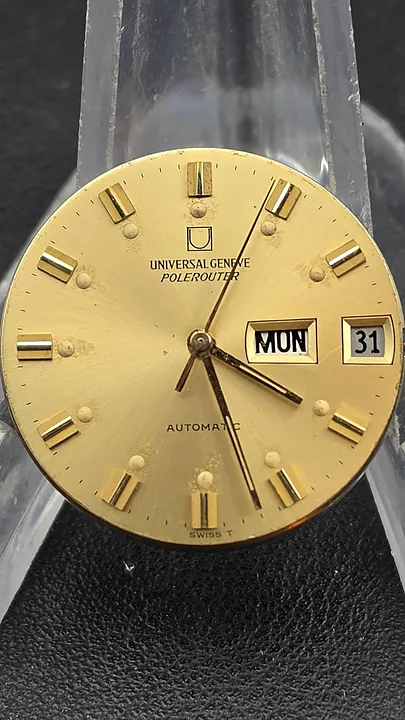
1970s Universal Geneve Polerouter Day-Date Movement Dial Cal 72 Microtor 17J 29mm Auto
LiveAuctioneers auction archive
Wristwatches · 1960s
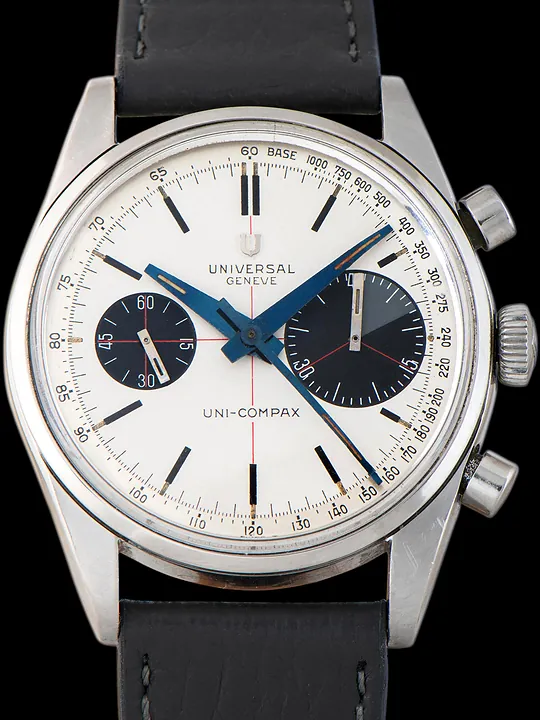
Universal Geneve Uni- Compax (Ref. 884100/02) “Big Eye”, 1960s
Craft & Tailored (dealer), Los Angeles
Wristwatches · 1960s
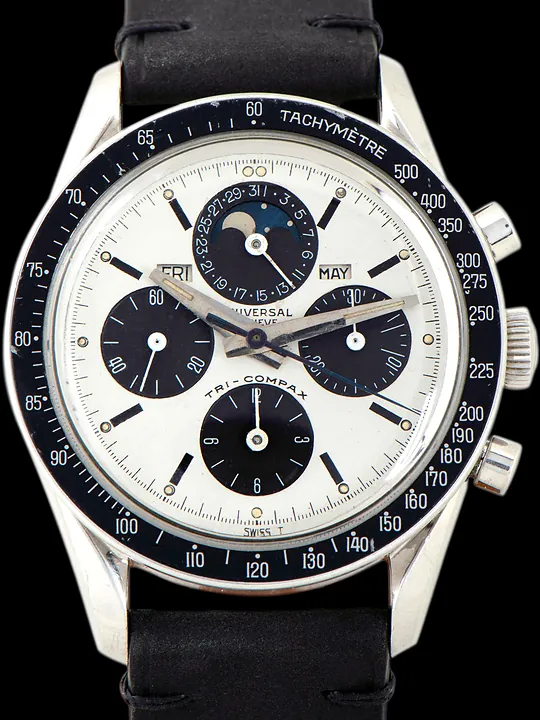
Universal Genève Tri-Compax (Ref. 881101/01) "Eric Clapton", 1960s
Craft & Tailored (dealer), Los Angeles
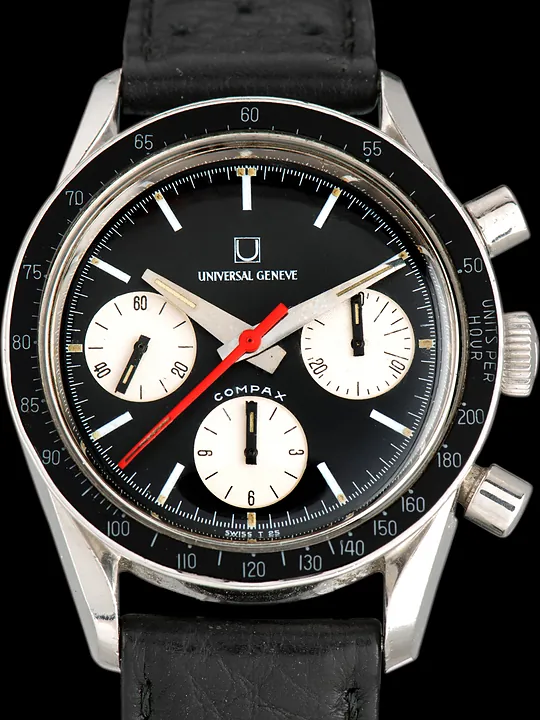
Wristwatches · 1960s
Universal Geneve Compax (Ref. 885103/01) "Evil Nina" W/ Base 200 UPH Bezel, 1960s
Craft & Tailored (dealer), Los Angeles

Wristwatches · 1931
Rolex 'Oyster Perpetual' rotor self-winding wrist-watch, lever escapement, in steel case with glass in back, Montres Rolex SA, Geneva, Switzerland, 1931
Science Museum Group, London

Wristwatches · 1900–1999
Wristwatch by Certina, Switzerland, 1900–1999
Nordic Museum Foundation
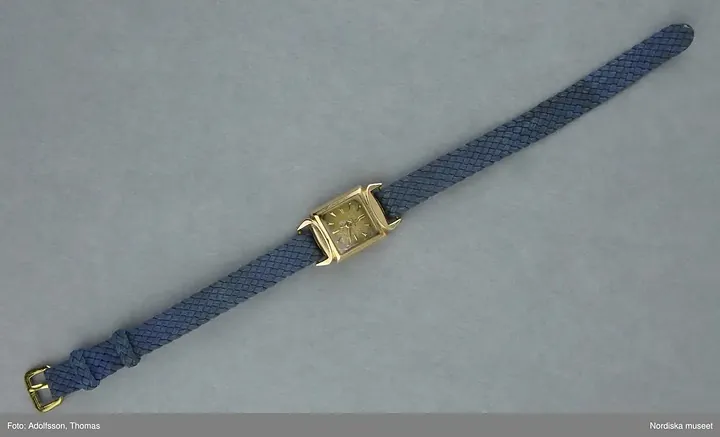
Wristwatches · 1900–1999
Wristwatch by Omega, Västerås, 1900–1999
Nordic Museum Foundation
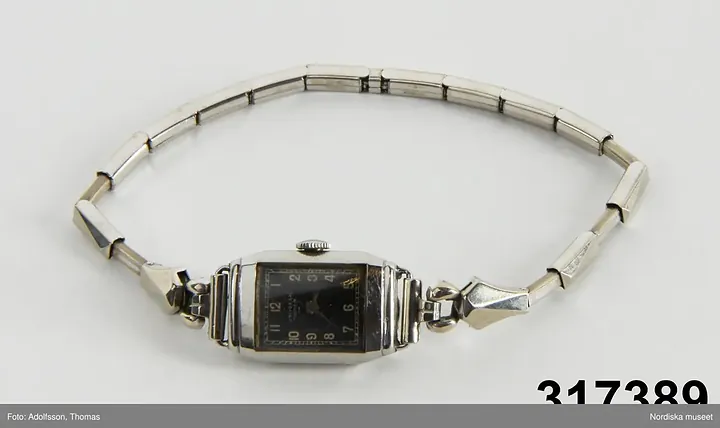
Wristwatches · 1900–1999
Wristwatch by Universal, Switzerland, 1900–1999
Nordic Museum Foundation