
Wristwatches · Wristwatch
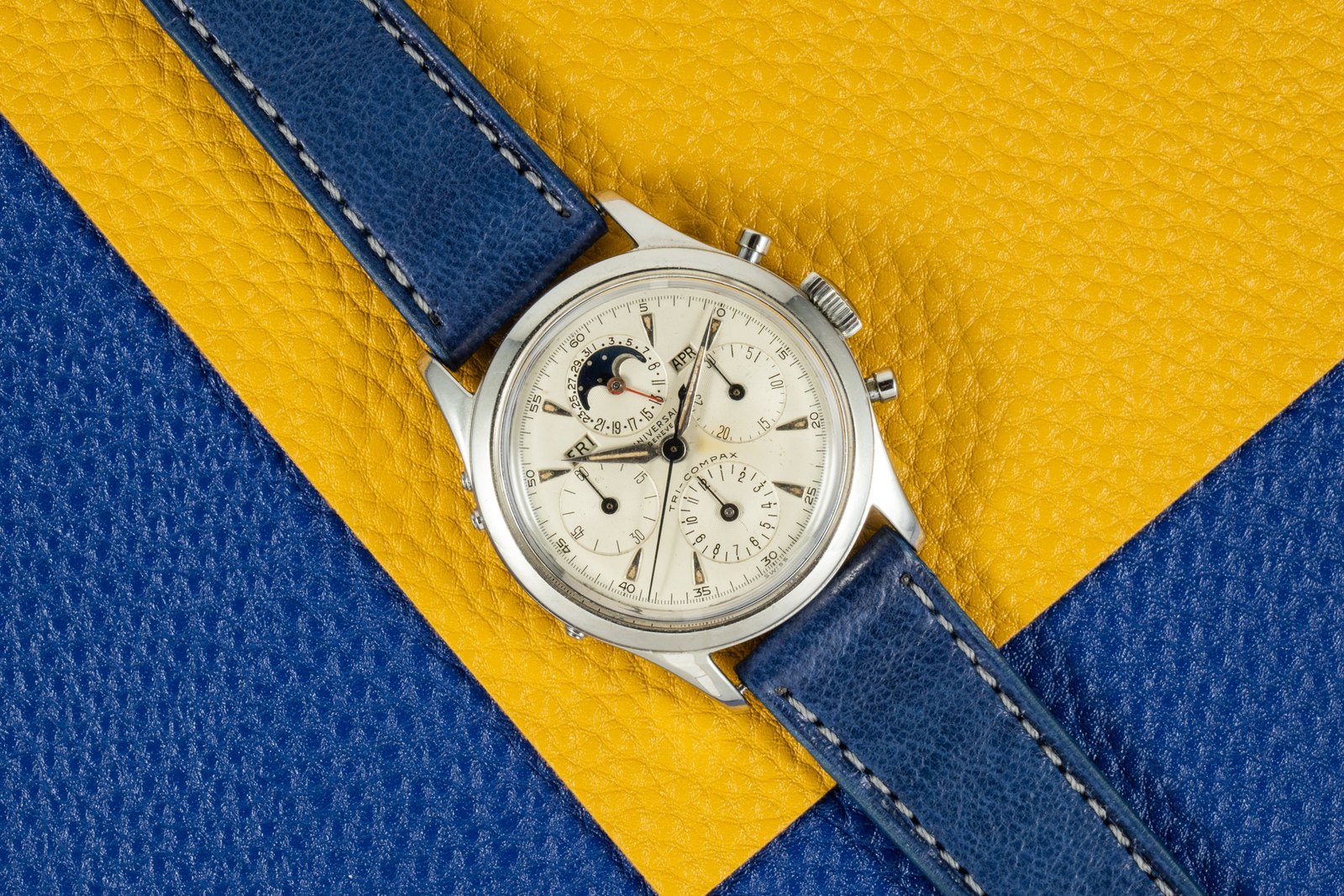
Universal Geneve Tri-Compax Moonphase, early 1950s
- Maker / attribution
- Universal Geneve (maker)
- Date
- early 1950s
- Historical period
- Modern Mechanical Horology (1945 – 1969)
- Country of origin
- Switzerland
- Object type
- Wristwatch
- Stock no.
- 40990076
- Credit line
- Dealer listing, Analog/Shift (40990076)
- Catalogue title (original)
- Universal Geneve Tri-Compax Moonphase (English)
View the source record (dealer listing) ↗ (opens another website in a new tab)Suggest a correction
Record summary
Catalogued by Analog/Shift (dealer), New York (stock number 40990076), this is a wristwatch by Universal Geneve, made in Switzerland, dated early 1950s. The Atlas places it in the Modern Mechanical Horology period (1945 – 1969) of its Wristwatches collection. The record is illustrated with 6 photographs.
Assembled from the source record's structured fields. Dates and attributions are given as the source states them; where a field is missing the Atlas leaves it blank rather than estimating.
Catalogue description
Dealer description — Analog/Shift
Why We Love It Featuring a full calendar plus a moonphase complication, the Tri-Compax was one of the most advanced chronograph wristwatches of the era, and certainly one of the highest quality. It’s no coincidence that the U.S. distributor for UG was the Henri Stern Watch Agency. And what was the sole other brand distributed by H. Stern? That would be Patek Philippe. This example of the Tri-Compax, Reference 22297, dates to the early 1950s and features a stunningly crisp steel case with a silver-toned dial, lightly patinated to a beautiful cream color and accented by luminescent dart indices. With four subsidiary registers, moonphase display, and two calendar apertures, the watch sounds on paper like it would have an overly busy dial, but the beauty of the Tri-Comapx is how aesthetically pleasing and legible a watch it is. Instead of coming off as a busy mess, the Tri-Compax is a gorgeous example of mid-century watch design, and its style holds up better then most from the era. The Story Universal’s later Compax sport models, like the Nina Rindt ( HERE ) and Evil Nina ( HERE ), have spiked in value and received more than their fair share of attention recently, but as any vintage chronograph nerd will tell you, the Tri-Compax Moonphase is UG’s true flagship model. The in-house, manually-wound Calibre 281 chronograph movement was a great achievement for UG, especially when most of their competitors relied on outsourced movements for their watches. With few exceptions, the Tri-Compax caliber was just about as fine a chronograph as consumers could buy at the time, and that’s in no small part why they’ve become so highly collectible today. If you’re a chronograph fan, its incumbent upon you to have a Tri-Compax in your collection. Given UG’s ascent to the upper tiers of collectability, it is getting harder to find honest original examples, but that's just what we've managed to do here.
Historical context
Modern Mechanical Horology (1945 – 1969)
Tool watches for divers, pilots and astronauts; electric watches anticipate the electronic age.
The classic era of the mechanical wristwatch: dive watches, chronographs for motor racing and space flight, GMT watches for jet travel, slim dress watches, automatic calendars, and the rise of Japanese manufacturers alongside Swiss, American, German and Soviet industries.
Read the period in the timelineMore wristwatches from this periodEarlier: Golden Age of Mechanical Watchmaking
Atlas type guide
Calendar, moon-phase and perpetual calendar watches
Calendar complications range from a simple date to the perpetual calendar, which automatically allows for months of different lengths and leap years until 2100. Pocket watches with perpetual calendars were made in the eighteenth and nineteenth centuries; Patek Philippe made the first perpetual calendar wristwatch in 1925, and series production followed in 1941. The annual calendar (Patek Philippe, 1996) needs correction only once a year.
Moon-phase displays use a disc with two moons and 59 teeth advanced daily, approximating the 29.5-day lunation; more precise trains reduce the error to one day in over a century.
What to look for
- Apertures or subsidiary dials for day, date, month and leap year.
- Moon disc under a 'bosom' shaped aperture.
- Recessed correctors on the case band for setting the calendar.
Dating clues
- Triple-date wristwatches: popular c. 1940–1955.
- Perpetual calendar wristwatches: from 1925 (unique) and 1941 (series).
General guidance written by the Atlas editors about this kind of object. It is not a statement about this particular piece; for that, rely on the source record above and on physical examination.
Related records
Wristwatches · 1970s
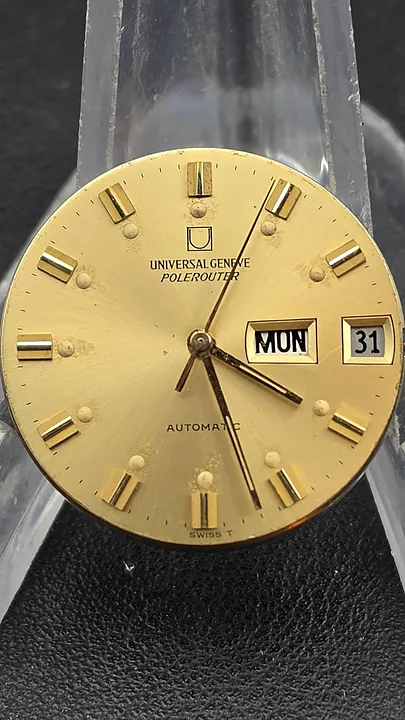
1970s Universal Geneve Polerouter Day-Date Movement Dial Cal 72 Microtor 17J 29mm Auto
LiveAuctioneers auction archive
Wristwatches · 1960s
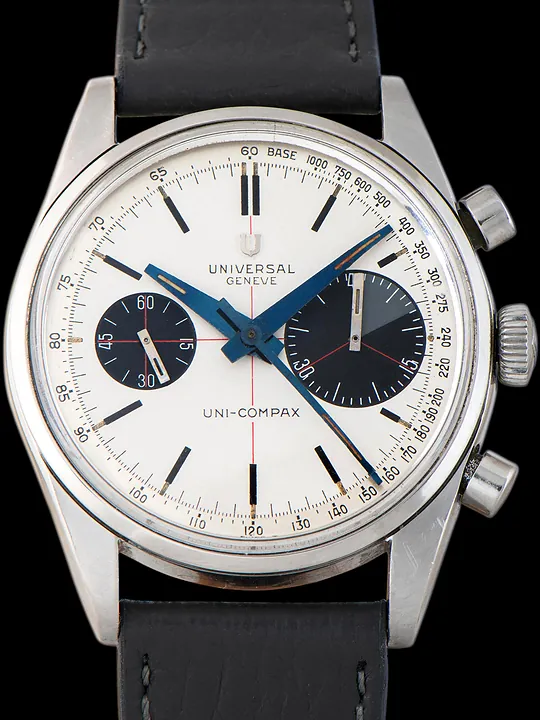
Universal Geneve Uni- Compax (Ref. 884100/02) “Big Eye”, 1960s
Craft & Tailored (dealer), Los Angeles
Wristwatches · 1960s
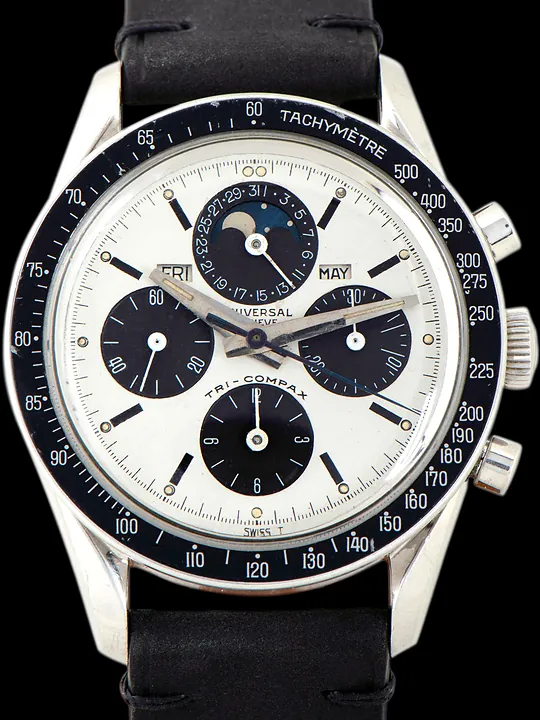
Universal Genève Tri-Compax (Ref. 881101/01) "Eric Clapton", 1960s
Craft & Tailored (dealer), Los Angeles
Wristwatches · 1960s
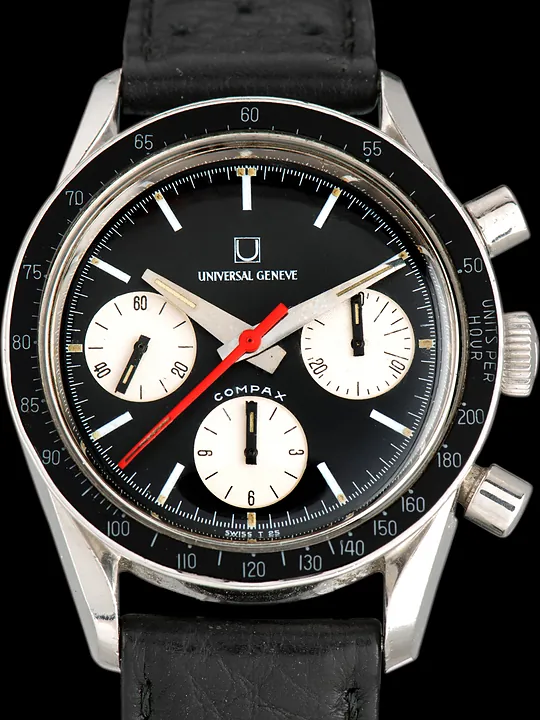
Universal Geneve Compax (Ref. 885103/01) "Evil Nina" W/ Base 200 UPH Bezel, 1960s
Craft & Tailored (dealer), Los Angeles

Wristwatches · 1945
Wristwatch by Eterna, 1945
Museum Rotterdam

Wristwatches · c. 1945
Breitling Premier, ref. 790, c. 1945
Antiquorum auction archive, Geneva

Wristwatches · c. 1945
Universal Genève Uni-Compax, ref. 22492, c. 1945
Antiquorum auction archive, Geneva

Wristwatches · c. 1950s
Baume & Mercier wristwatch, c. 1950s
Antiquorum auction archive, Geneva