
Wristwatches · Wristwatch
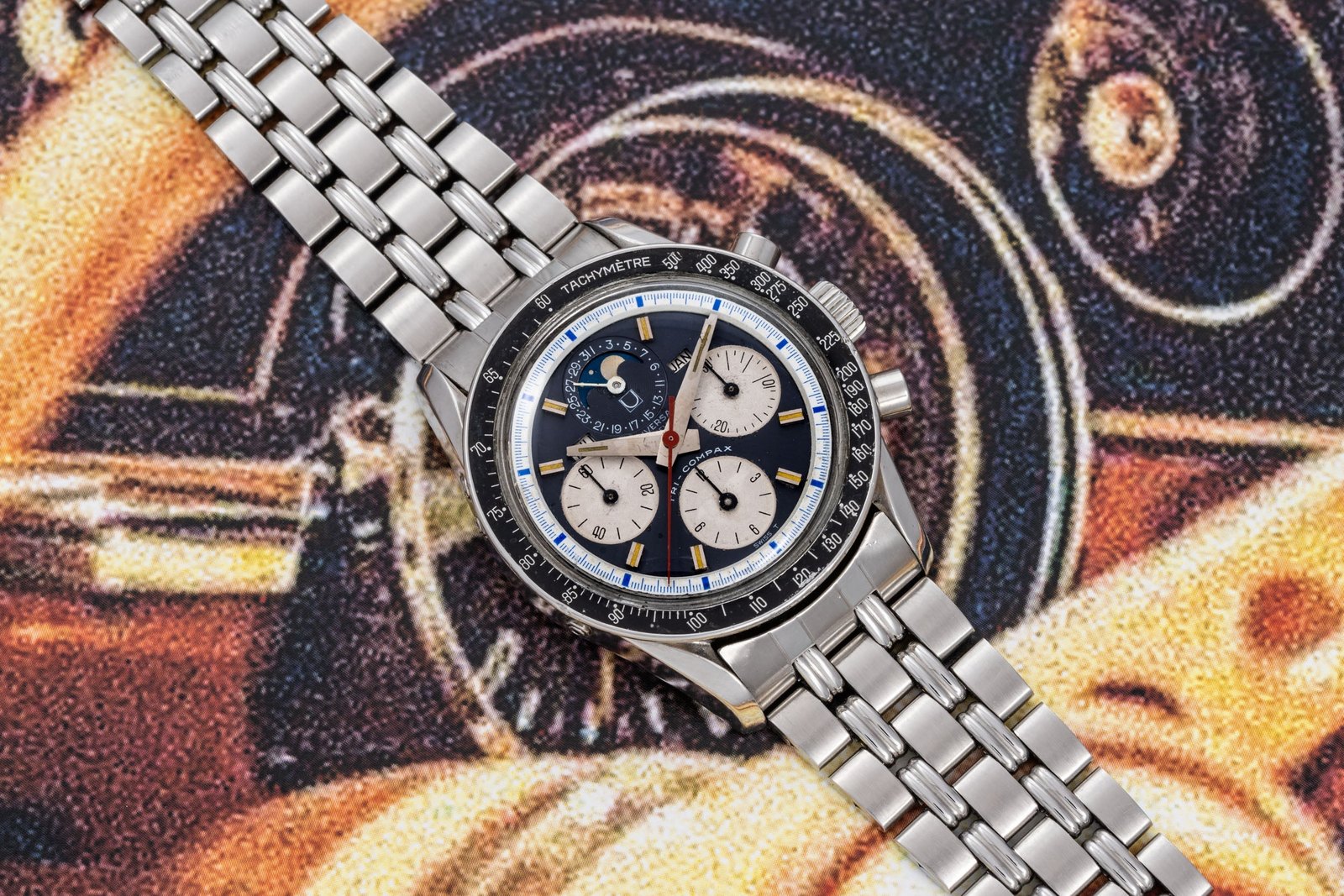
Universal Genève Tri-Compax Moonphase, 1960s
- Maker / attribution
- Universal Geneve (maker)
- Date
- 1960s
- Historical period
- Modern Mechanical Horology (1945 – 1969)
- Country of origin
- Switzerland
- Object type
- Wristwatch
- Dimensions
- Case 36 mm
- Stock no.
- 40991251
- Credit line
- Dealer listing, Analog/Shift (40991251)
- Catalogue title (original)
- Universal Genève Tri-Compax Moonphase (English)
View the source record (dealer listing) ↗ (opens another website in a new tab)Suggest a correction
Record summary
Catalogued by Analog/Shift (dealer), New York (stock number 40991251), this is a wristwatch by Universal Geneve, made in Switzerland, dated 1960s. The Atlas places it in the Modern Mechanical Horology period (1945 – 1969) of its Wristwatches collection. Recorded dimensions: Case 36 mm. The record is illustrated with 6 photographs.
Assembled from the source record's structured fields. Dates and attributions are given as the source states them; where a field is missing the Atlas leaves it blank rather than estimating.
Catalogue description
Dealer description — Analog/Shift
The term 'Grail' in wristwatch collecting suggests a stature of rarity, excellence, historical significance, and an emotional 'X-Factor' that blurs the lines between reason and heart. Most of the time, however, the word is overused and applied simply to expensive watches that are hard to get new at retail. This is not one of those times. The Universal Genève Tri-Compax line is one of the most desirable series of complicated vintage models ever made. Debuting before the Second World War, the Tri-Compax combines high-end manufacture with outstanding designs that evolved with the times, and offers the wearer chronograph, calendar, and moonphase functionality. While brands such as Patek Philippe and Vacheron Constantin may take the prize for the most expensive calendar chronographs, the mid-century offerings from Universal are absolutely mouth-watering. The piece we have offered here is a Reference 881101/03, dating from the 1960s. It combines the signature HF twisted lug case design popularized by watches such as the Omega Speedmaster and Universal Genève 'Nina Rindt' chronographs with a complete calendar moonphase movement in the form of the Calibre .281. Sized at approximately 36mm, it sports an exceedingly rare and stunning navy sunburst dial with contrasting white subsidiary registers and an outer tachymètre bezel. Depending on lighting conditions the dial comes off as radiant blue to light grey, and offers a visual feast. Furthermore, there is a three-dimensionality to this reference that isn't as identifiable on others, with recessed sub-registers, day & month indicators, and moonphase, alongside raised luminous indices and a raised inner chapter ring with blue markings. Add on an acrylic crystal, correct Gay Freres multi-link bracelet with signed clasp, and a perfect level of patination, and you've got yourself a genuine, bonafide grail watch. This outstanding piece once belonged in the personal collection of our Founder, and is an all-time favorite of our Timepiece Specialist. There is no saying when or where another in this condition will surface again, so dont miss it!
Historical context
Modern Mechanical Horology (1945 – 1969)
Tool watches for divers, pilots and astronauts; electric watches anticipate the electronic age.
The classic era of the mechanical wristwatch: dive watches, chronographs for motor racing and space flight, GMT watches for jet travel, slim dress watches, automatic calendars, and the rise of Japanese manufacturers alongside Swiss, American, German and Soviet industries.
Read the period in the timelineMore wristwatches from this periodEarlier: Golden Age of Mechanical Watchmaking
Atlas type guide
Calendar, moon-phase and perpetual calendar watches
Calendar complications range from a simple date to the perpetual calendar, which automatically allows for months of different lengths and leap years until 2100. Pocket watches with perpetual calendars were made in the eighteenth and nineteenth centuries; Patek Philippe made the first perpetual calendar wristwatch in 1925, and series production followed in 1941. The annual calendar (Patek Philippe, 1996) needs correction only once a year.
Moon-phase displays use a disc with two moons and 59 teeth advanced daily, approximating the 29.5-day lunation; more precise trains reduce the error to one day in over a century.
What to look for
- Apertures or subsidiary dials for day, date, month and leap year.
- Moon disc under a 'bosom' shaped aperture.
- Recessed correctors on the case band for setting the calendar.
Dating clues
- Triple-date wristwatches: popular c. 1940–1955.
- Perpetual calendar wristwatches: from 1925 (unique) and 1941 (series).
General guidance written by the Atlas editors about this kind of object. It is not a statement about this particular piece; for that, rely on the source record above and on physical examination.
Related records
Wristwatches · 1970s
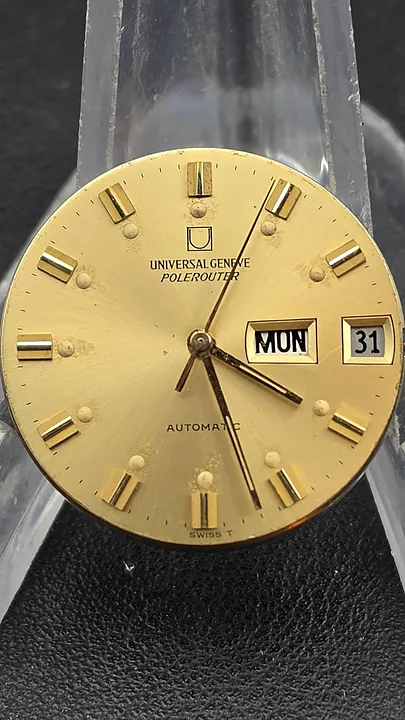
1970s Universal Geneve Polerouter Day-Date Movement Dial Cal 72 Microtor 17J 29mm Auto
LiveAuctioneers auction archive
Wristwatches · 1960s
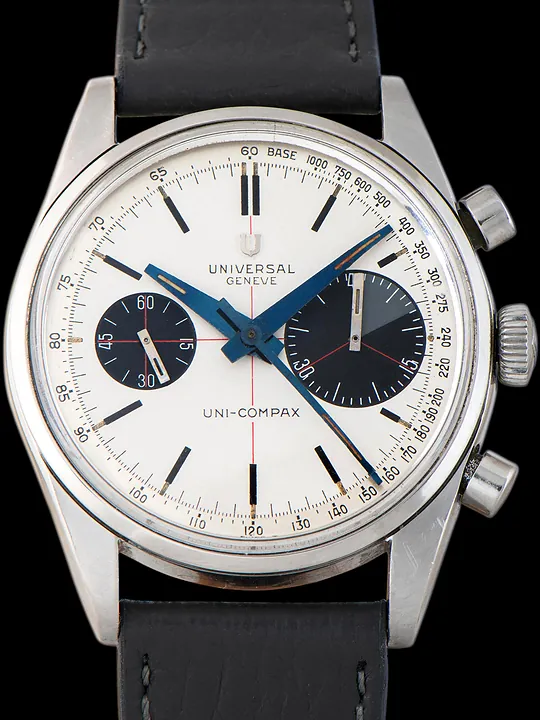
Universal Geneve Uni- Compax (Ref. 884100/02) “Big Eye”, 1960s
Craft & Tailored (dealer), Los Angeles
Wristwatches · 1960s
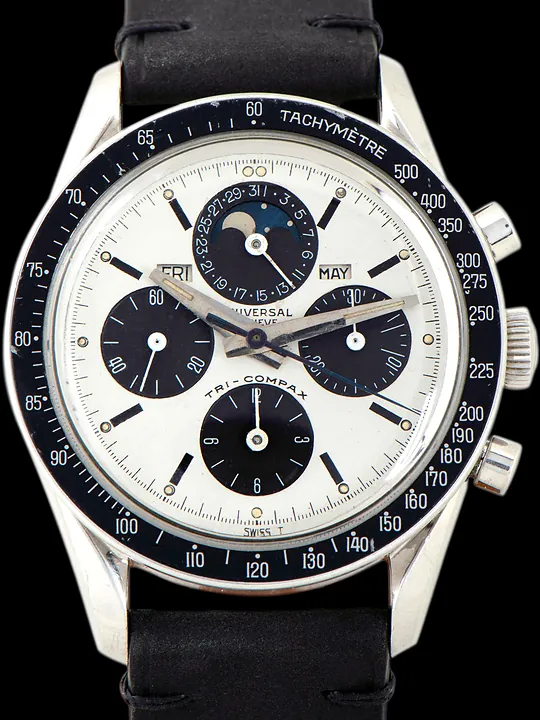
Universal Genève Tri-Compax (Ref. 881101/01) "Eric Clapton", 1960s
Craft & Tailored (dealer), Los Angeles
Wristwatches · 1960s
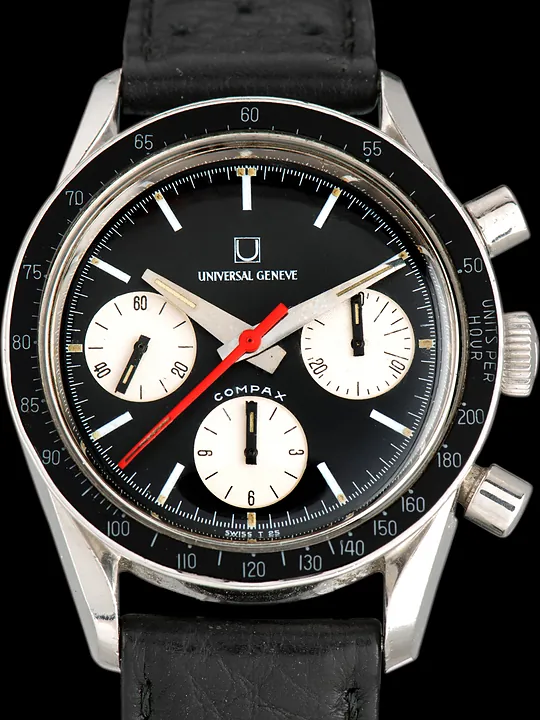
Universal Geneve Compax (Ref. 885103/01) "Evil Nina" W/ Base 200 UPH Bezel, 1960s
Craft & Tailored (dealer), Los Angeles

Wristwatches · 1945
Wristwatch by Eterna, 1945
Museum Rotterdam

Wristwatches · c. 1945
Breitling Premier, ref. 790, c. 1945
Antiquorum auction archive, Geneva

Wristwatches · c. 1945
Universal Genève Uni-Compax, ref. 22492, c. 1945
Antiquorum auction archive, Geneva

Wristwatches · c. 1950s
Baume & Mercier wristwatch, c. 1950s
Antiquorum auction archive, Geneva