
Wristwatches · Wristwatch
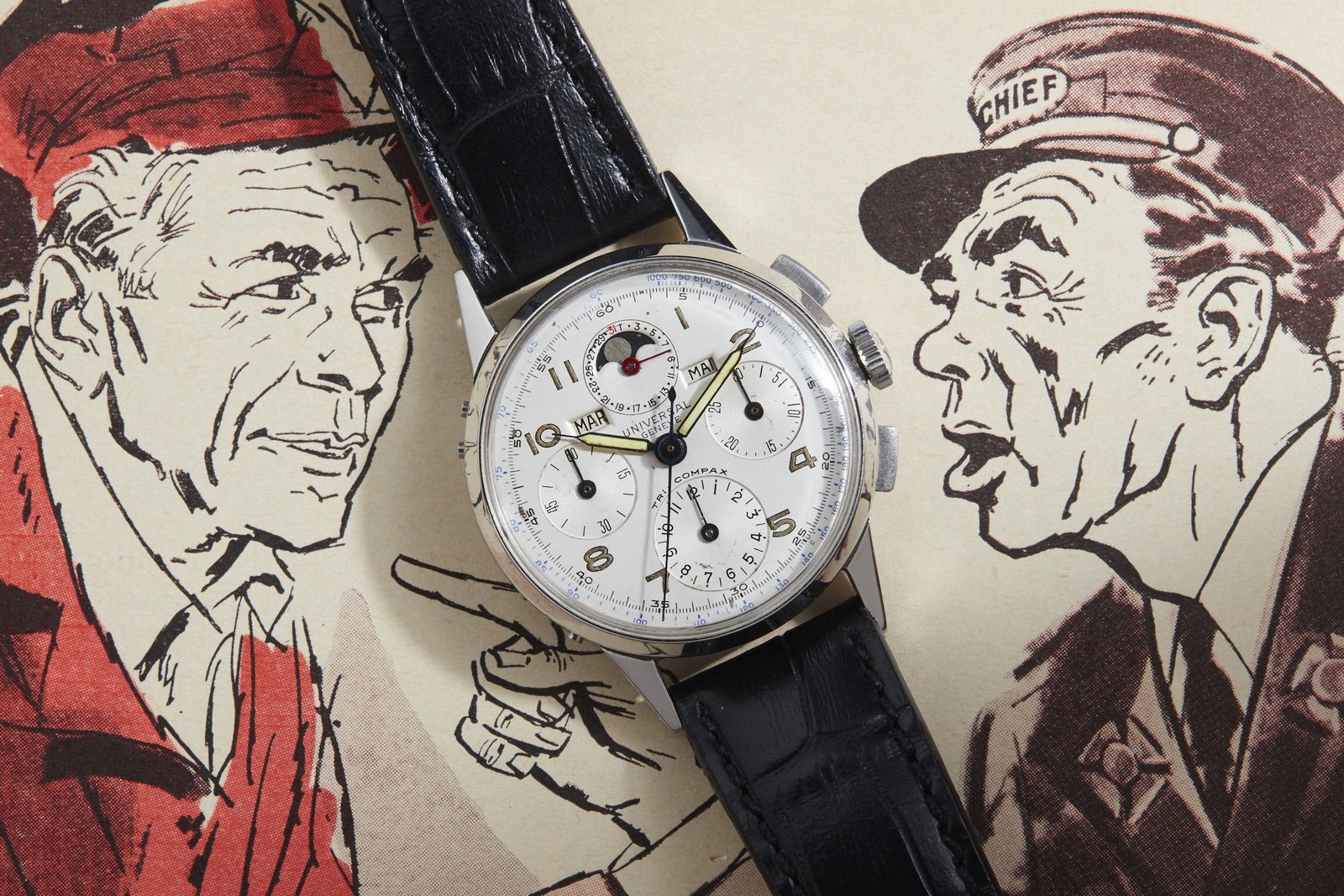
Universal Genève Tri-Compax, mid 1940s
- Maker / attribution
- Universal Geneve (maker)
- Date
- mid 1940s
- Historical period
- Golden Age of Mechanical Watchmaking (1900 – 1945)
- Country of origin
- Switzerland
- Object type
- Wristwatch
- Stock no.
- Product 8319280193
- Credit line
- Dealer listing, Analog/Shift (product 8319280193)
- Catalogue title (original)
- Universal Genève Tri-Compax (English)
View the source record (dealer listing) ↗ (opens another website in a new tab)Suggest a correction
Record summary
Catalogued by Analog/Shift (dealer), New York (stock number Product 8319280193), this is a wristwatch by Universal Geneve, made in Switzerland, dated mid 1940s. The Atlas places it in the Golden Age of Mechanical Watchmaking period (1900 – 1945) of its Wristwatches collection. The record is illustrated with 6 photographs.
Assembled from the source record's structured fields. Dates and attributions are given as the source states them; where a field is missing the Atlas leaves it blank rather than estimating.
Catalogue description
Dealer description — Analog/Shift
A triple calendar chronograph--where day, date, and month, along with the shorter intervals of time that comprise them, are all displayed on the dial--catalogs daily existence. Eternity is captured with just one depression of a pusher. In an age when humankind contains the sum total of knowledge in devices that fit in our pockets, a triple calendar is imminently timely. More than that, if one were to give the gift of a watch to someone--a close friend, family member, or even a long-time business associate--a triple calendar chronograph makes an excellent choice. The gift of a watch, in general, speaks of a lifetime of committed service, which is why so many companies have given watches to their employees upon retirement. But a triple calendar chronograph, with its implication of eternity, takes it one step further. The triple calendar chronographs Universal Genève produced from 1944 to the 1960s under the model name "Tri-Compax" are perhaps the best-known and most sought after. While the brand produced other types of wristwatches, it's their chronographs that would make their reputation. The Tri-Compaxes--so called because it contains three complications, chronograph, moon-phase, and calendar--of the 1960s, with their storied connection to celebrities like model Nina Rindt and musician Eric Clapton, are the most desired. But the earliest iterations of the Tri-Compax, dating from the late 40s, are an exercise in understated elegance and craftsmanship--and variety. All Tri-Compaxes from this period had rectangular pushers, but even within the same reference number there could be a panoply of dial and hand configurations. Those from the 1940s often featured luminescent Arabic numerals and hands, and, if one peered closely at the moon-phase, one could often see the face of the man in the moon (a feature which did not appear in all 1940s Tri-Compaxes, and which Universal Genève phased out in the late 1940s before discontinuing it altogether in the 1950s). This expression of Tri-Compax dates from the mid-1940s and bears lovely luminescent syringe hands and thick Arabic numerals. Like other examples of early Tri-Compaxes, the case has a snap-back. It's the case back that really makes this watch unique--or, rather, the inscription on the case back. "To Fred B. from Fred K., July '48." We've seen many Tri-Compaxes with personal inscriptions on the back, but this is perhaps one of the most intriguing. While we're not sure of the identity of the two Freds, just think of the regard in which Fred B. must have held Fred K. to want to give him a watch like this. Were they colleagues, perhaps, or just good friends who met at school? It's inscriptions like these, with the stories they tell (without really saying anything at all) that set an already-exceptional watch apart from the rest.
Historical context
Golden Age of Mechanical Watchmaking (1900 – 1945)
The wristwatch displaces the pocket watch; waterproof cases, self-winding and grand complications.
The wristwatch overtook the pocket watch. Military use in the First World War, aviation, water-resistant cases (1926), automatic winding (1923–31), rectangular Art Deco designs and early chronographs and calendars defined the period.
Read the period in the timelineMore wristwatches from this periodEarlier: Industrial Revolution
Atlas type guide
Wristwatches
Bracelet watches were worn by women from the early nineteenth century — Breguet made one for Caroline Murat, Queen of Naples, in 1810–12 — but the wristwatch only became a man's instrument with military use and aviation in the early twentieth century. Between the World Wars it overtook the pocket watch; the 1920s and 1930s brought rectangular Art Deco cases, water-resistant cases and the first automatic winding systems.
After 1945 the wristwatch became a carrier of identity — dress watches, sports and dive watches, chronographs, calendars — produced by Swiss, American, Japanese, German, Soviet and Chinese industries. The quartz revolution after 1969 and the mechanical renaissance since the 1990s, including the rise of independent watchmakers, complete the story.
What to look for
- The reference number (between the lugs or inside the case back) and serial number, the starting point for dating.
- The calibre: its maker and number are often stamped under the dial or on the bridge.
- Originality of dial, hands and crown — refinished ('redial') dials are common.
- Case material marks: 18K/750, 14K/585, stainless steel, gold-filled, plated.
Dating clues
- Wire-lug cases: before c. 1925.
- Water-resistant screw-down cases: from 1926.
- Quartz movements: from 1969; sapphire crystals widespread after c. 1980.
General guidance written by the Atlas editors about this kind of object. It is not a statement about this particular piece; for that, rely on the source record above and on physical examination.
Related records
Wristwatches · 1970s
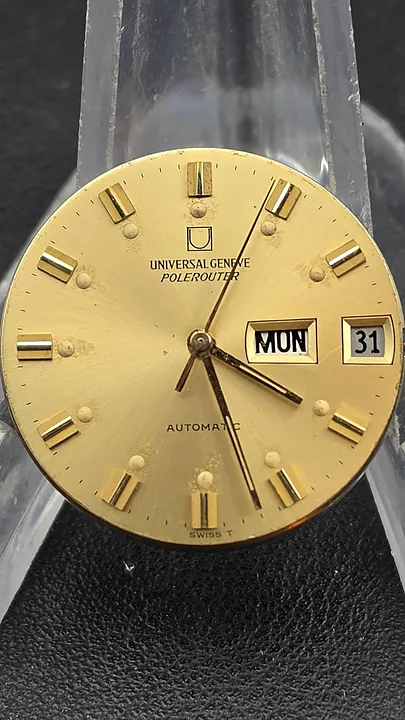
1970s Universal Geneve Polerouter Day-Date Movement Dial Cal 72 Microtor 17J 29mm Auto
LiveAuctioneers auction archive
Wristwatches · 1960s
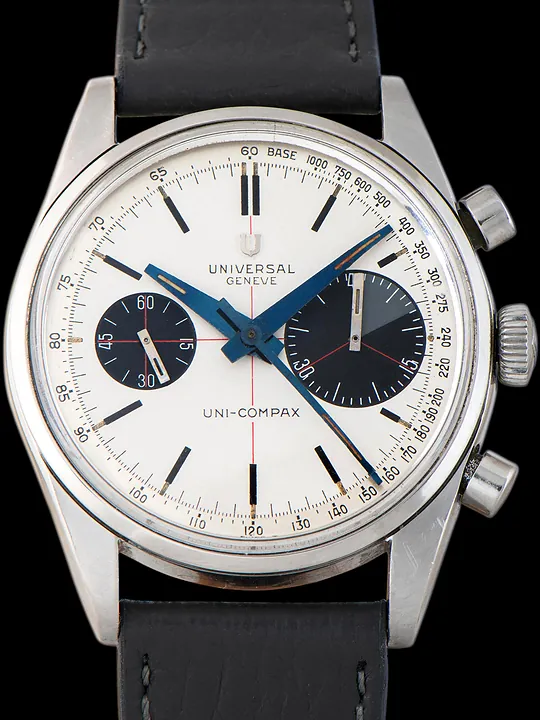
Universal Geneve Uni- Compax (Ref. 884100/02) “Big Eye”, 1960s
Craft & Tailored (dealer), Los Angeles
Wristwatches · 1960s
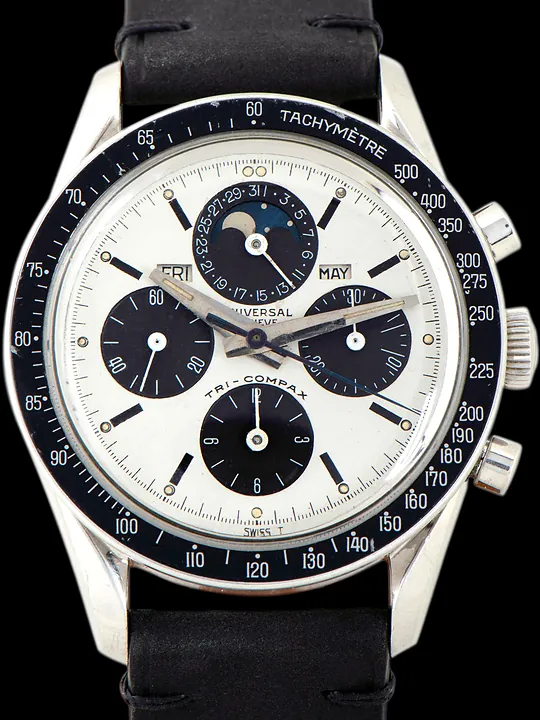
Universal Genève Tri-Compax (Ref. 881101/01) "Eric Clapton", 1960s
Craft & Tailored (dealer), Los Angeles
Wristwatches · 1960s
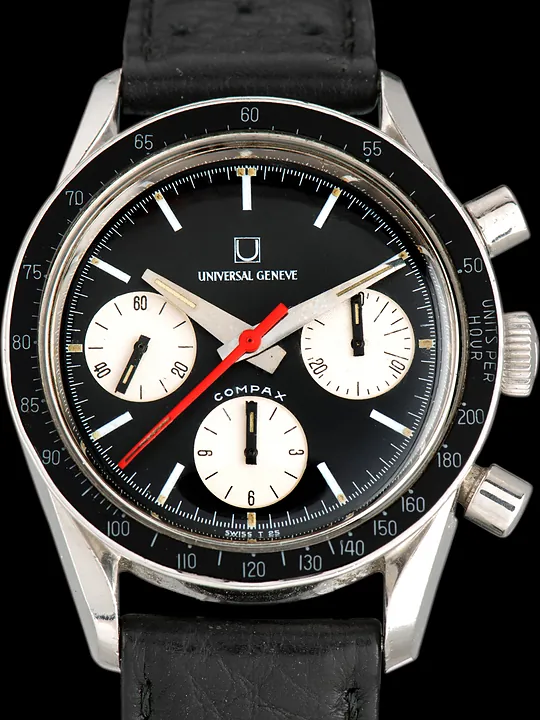
Universal Geneve Compax (Ref. 885103/01) "Evil Nina" W/ Base 200 UPH Bezel, 1960s
Craft & Tailored (dealer), Los Angeles

Wristwatches · 1931
Rolex 'Oyster Perpetual' rotor self-winding wrist-watch, lever escapement, in steel case with glass in back, Montres Rolex SA, Geneva, Switzerland, 1931
Science Museum Group, London

Wristwatches · 1900–1999
Wristwatch by Certina, Switzerland, 1900–1999
Nordic Museum Foundation

Wristwatches · 1900–1999
Wristwatch by Omega, Västerås, 1900–1999
Nordic Museum Foundation

Wristwatches · 1900–1999
Wristwatch by Universal, Switzerland, 1900–1999
Nordic Museum Foundation