
Wristwatches · Wristwatch
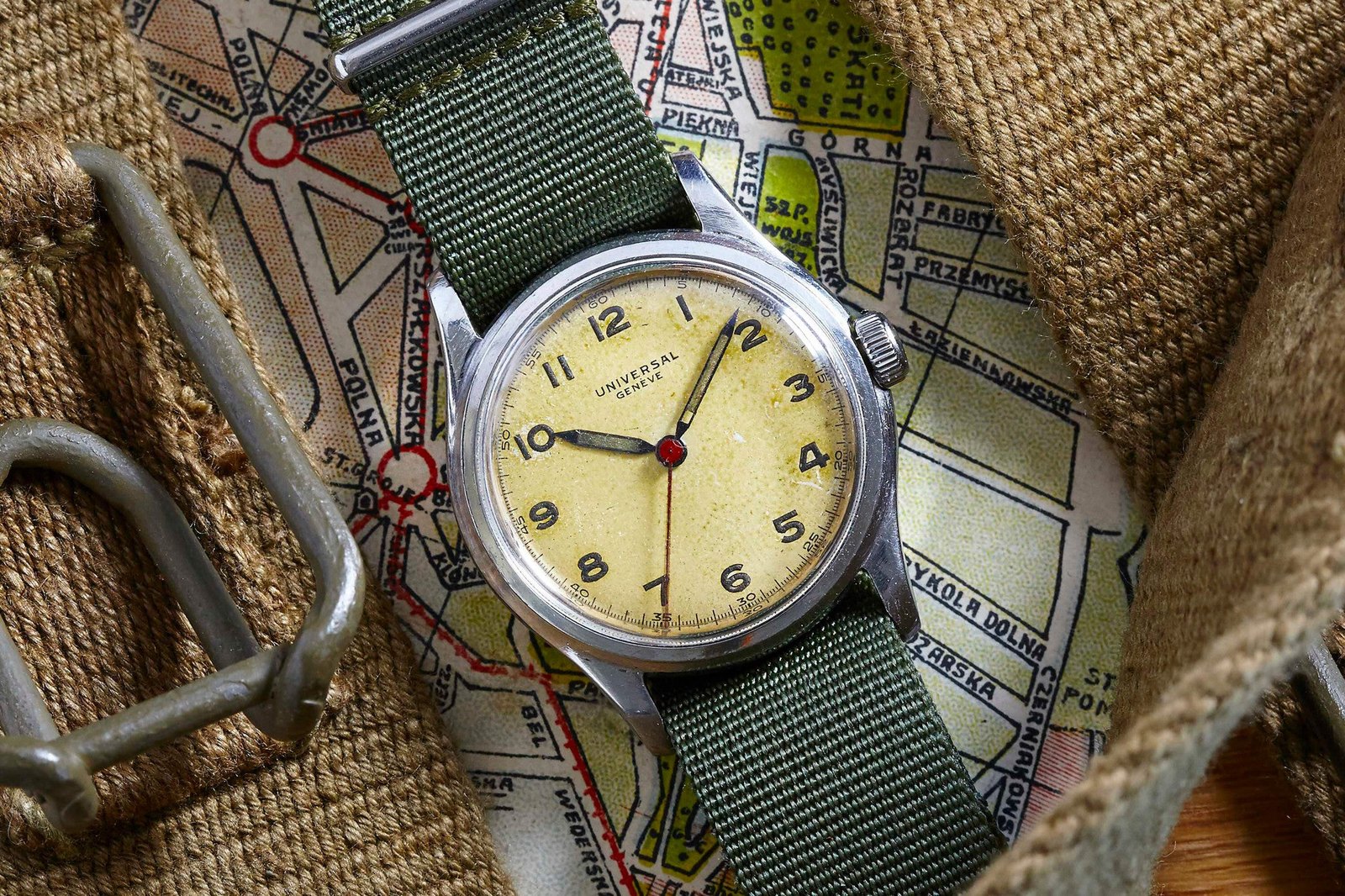
Universal Genève Military, c. 1943
- Maker / attribution
- Universal Geneve (maker)
- Date
- c. 1943
- Historical period
- Golden Age of Mechanical Watchmaking (1900 – 1945)
- Country of origin
- Switzerland
- Object type
- Wristwatch
- Dimensions
- Case 31.5 mm
- Stock no.
- Product 2190820097
- Credit line
- Dealer listing, Analog/Shift (product 2190820097)
- Catalogue title (original)
- Universal Genève Military (English)
View the source record (dealer listing) ↗ (opens another website in a new tab)Suggest a correction
Record summary
Catalogued by Analog/Shift (dealer), New York (stock number Product 2190820097), this is a wristwatch by Universal Geneve, made in Switzerland, dated c. 1943. The Atlas places it in the Golden Age of Mechanical Watchmaking period (1900 – 1945) of its Wristwatches collection. Recorded dimensions: Case 31.5 mm. The record is illustrated with 6 photographs.
Assembled from the source record's structured fields. Dates and attributions are given as the source states them; where a field is missing the Atlas leaves it blank rather than estimating.
Catalogue description
Dealer description — Analog/Shift
We’ve joined forces with our friends at 10:25 Vintage, a New York-based operation with a shared enthusiasm for interesting vintage timepieces, to bring you a robust handpicked collection that is both exceptional and affordable. Perfect for the discerning collector on a budget, these pieces provide an excellent entry point to the joys of vintage watches. Universal Genève is a true vintage watch nerd's type of brand, and we're happy to see it's been growing in popularity and getting the recognition we feel it deserves. Dating back to 1894, Universal earned its reputation by building beautiful watches powered by their innovative in-house movements, rather than using off-the-shelf parts like many of their Swiss counterparts. They were an early pioneer of chronographs with their Compax line in the 30's and 40's, brought us the timeless Polerouter in the 1950's, and put the world's thinnest automatic movement into the stunning White Shadow in the 1960's. That's quite a track record, but there is so much more to UG than just those models, and we're happy to bring you this affordable entry into such a storied brand. Dating to circa 1943, this simple, straightforward piece bears a striking resemblance to military-issued Universal Genève models of the era, including those worn by the Dutch Royal Army in World War II. The 31.5mm case cradles a beautifully patinated dial, blued steel hands, and a Caliber 263 movement, built fully in house by Universal Genève. Small in size but big in character, this piece provides an excellent jumping-off place for the enterprising collector looking for something just a little bit different.
Historical context
Golden Age of Mechanical Watchmaking (1900 – 1945)
The wristwatch displaces the pocket watch; waterproof cases, self-winding and grand complications.
The wristwatch overtook the pocket watch. Military use in the First World War, aviation, water-resistant cases (1926), automatic winding (1923–31), rectangular Art Deco designs and early chronographs and calendars defined the period.
Read the period in the timelineMore wristwatches from this periodEarlier: Industrial Revolution
Atlas type guide
Military, pilot and travel watches
The wristwatch owes much of its adoption by men to warfare and aviation. Wristlets — small pocket watches soldered with lugs and worn on a strap — were used in colonial campaigns and became standard equipment in the First World War, with protective grilles over the crystal ('shrapnel guards'). Louis Cartier's Santos (1904), designed for the aviator Alberto Santos-Dumont, is often cited as an early purpose-made pilot's watch.
In the Second World War governments specified watches in detail: the German B-Uhr observation watches, the American A-11, and the British 'W.W.W.' (the 'Dirty Dozen' set of 1945). After the war, jet travel brought GMT and world-time watches, which show two or more time zones at once — Louis Cottier's world-time mechanism and the Rolex GMT-Master (1955) are examples.
What to look for
- Military markings on the case back: broad arrow, issue numbers, 'W.W.W.', 'A.T.P.'
- High-legibility black dials with luminous Arabic numerals; oversized crowns for gloved hands.
- 24-hour hands and rotating 24-hour bezels or city rings on GMT/world-time watches.
- Wire lugs on early wristlets converted from pocket watches.
Dating clues
- Wire-lug wristlets: c. 1900–1925.
- Military specifications of the Second World War: 1939–1945.
- GMT and world-time wristwatches: mainly after 1950.
General guidance written by the Atlas editors about this kind of object. It is not a statement about this particular piece; for that, rely on the source record above and on physical examination.
Related records
Wristwatches · 1970s
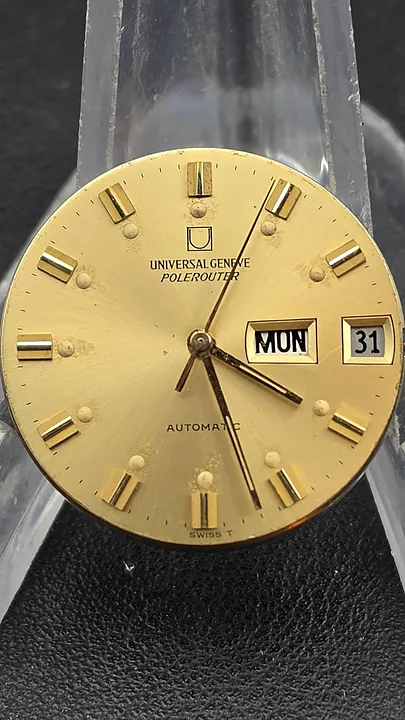
1970s Universal Geneve Polerouter Day-Date Movement Dial Cal 72 Microtor 17J 29mm Auto
LiveAuctioneers auction archive
Wristwatches · 1960s
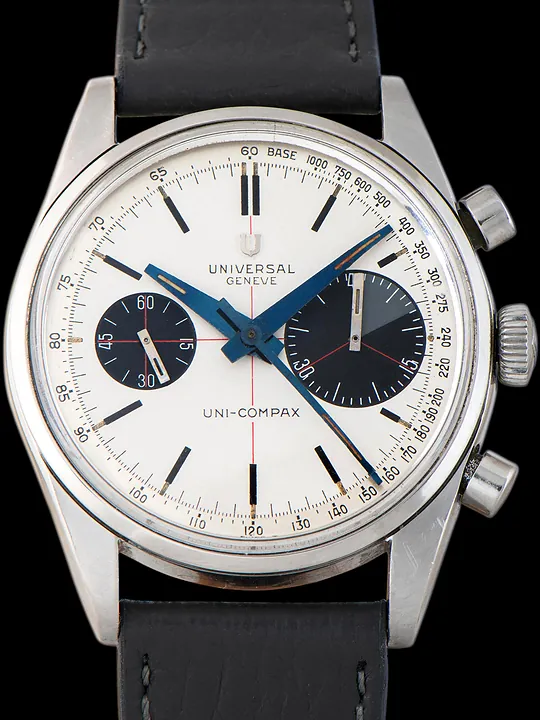
Universal Geneve Uni- Compax (Ref. 884100/02) “Big Eye”, 1960s
Craft & Tailored (dealer), Los Angeles
Wristwatches · 1960s
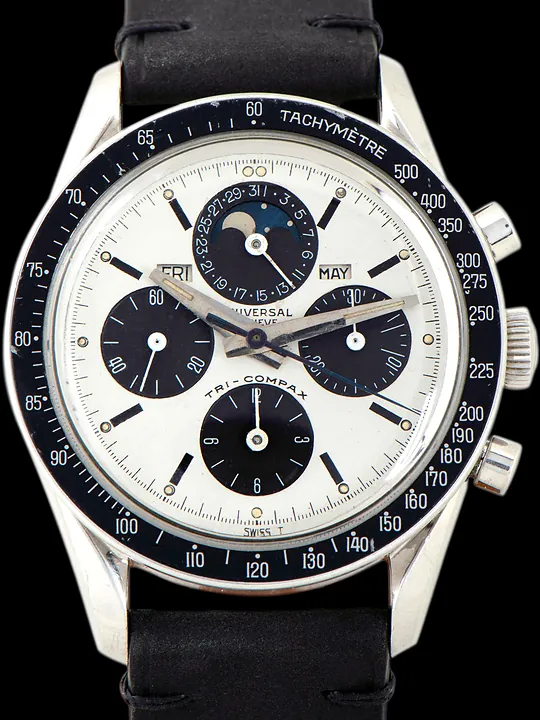
Universal Genève Tri-Compax (Ref. 881101/01) "Eric Clapton", 1960s
Craft & Tailored (dealer), Los Angeles
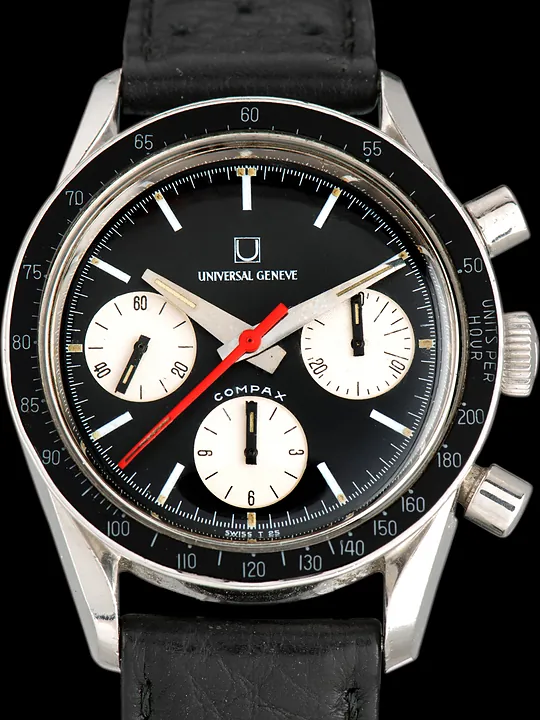
Wristwatches · 1960s
Universal Geneve Compax (Ref. 885103/01) "Evil Nina" W/ Base 200 UPH Bezel, 1960s
Craft & Tailored (dealer), Los Angeles

Wristwatches · 1931
Rolex 'Oyster Perpetual' rotor self-winding wrist-watch, lever escapement, in steel case with glass in back, Montres Rolex SA, Geneva, Switzerland, 1931
Science Museum Group, London

Wristwatches · 1900–1999
Wristwatch by Certina, Switzerland, 1900–1999
Nordic Museum Foundation
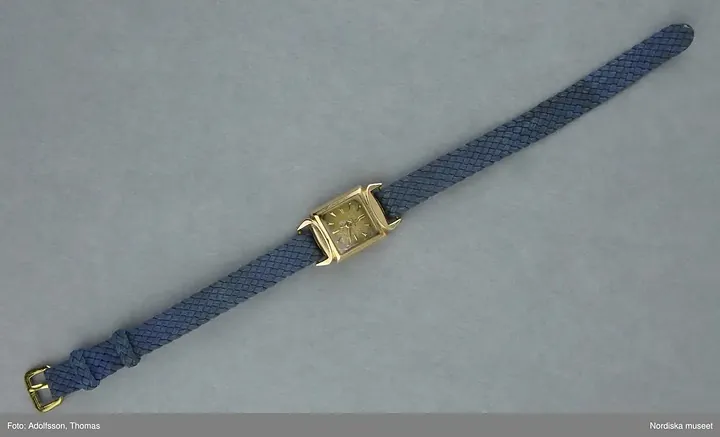
Wristwatches · 1900–1999
Wristwatch by Omega, Västerås, 1900–1999
Nordic Museum Foundation
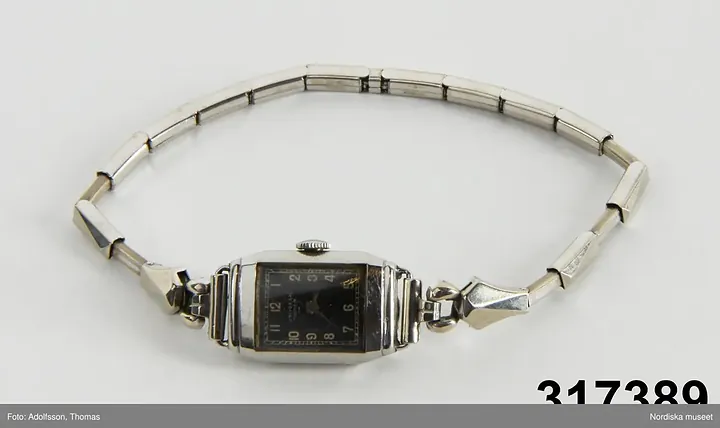
Wristwatches · 1900–1999
Wristwatch by Universal, Switzerland, 1900–1999
Nordic Museum Foundation