
Wristwatches · Wristwatch
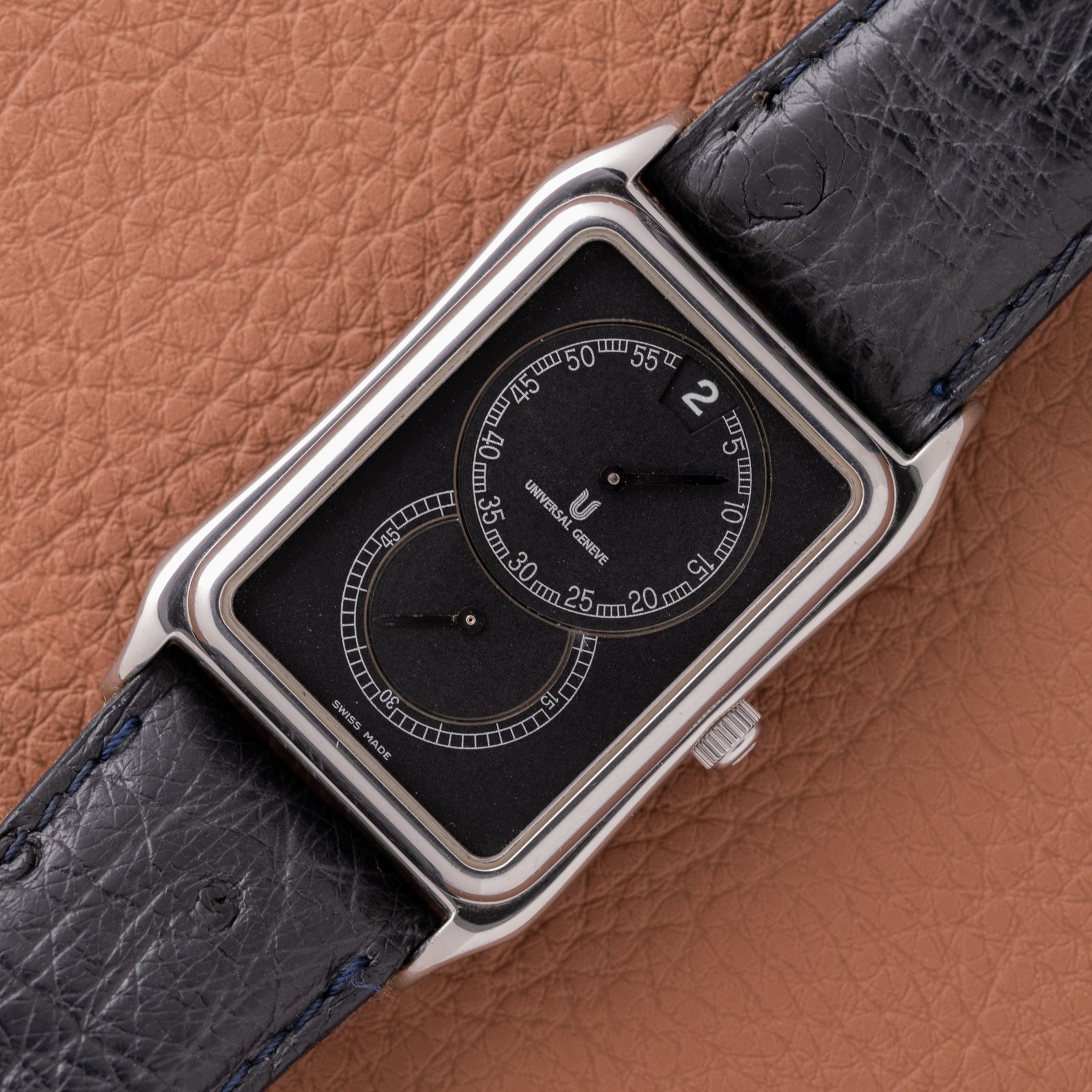
Universal Genève Jump Hour (Ref. 825.125), 1990s
- Maker / attribution
- Universal Genève (maker)
- Date
- 1990s
- Historical period
- Mechanical Renaissance (1990 – 2010)
- Country of origin
- Switzerland
- Object type
- Wristwatch
- Dimensions
- Case 26 mm
- Stock no.
- Product 15887088484535
- Credit line
- Dealer listing, Huntington Company (product 15887088484535)
- Catalogue title (original)
- 1990s Universal Genève Jump Hour (Ref. 825.125) (English)
View the source record (dealer listing) ↗ (opens another website in a new tab)Suggest a correction
Record summary
Catalogued by Huntington Company (dealer) (stock number Product 15887088484535), this is a wristwatch by Universal Genève, made in Switzerland, dated 1990s. The Atlas places it in the Mechanical Renaissance period (1990 – 2010) of its Wristwatches collection. Recorded dimensions: Case 26 mm. The record is illustrated with 6 photographs.
Assembled from the source record's structured fields. Dates and attributions are given as the source states them; where a field is missing the Atlas leaves it blank rather than estimating.
Catalogue description
Dealer description — Huntington Company
History and Significance Universal Genève has one of the most fascinating histories in Swiss watchmaking, having produced everything from important chronographs to remarkably creative dress watches. Founded in 1894, the manufacturer became especially well known for its Compax chronographs and the celebrated Polerouter, but its history extends far beyond those familiar collections. Throughout the twentieth century, Universal Genève demonstrated a willingness to experiment with unconventional displays and case designs, creating watches that often departed from traditional Swiss watchmaking aesthetics. The reference 825.125 is a particularly interesting example of this creative approach, combining a jumping-hour display with an unusual arrangement of the minutes and seconds. It is a watch that feels entirely different from the conventional dress watches typically associated with the period. Jumping-hour watches have a history stretching back well over a century, with early examples appearing in pocket watches before the complication was adapted for wristwatches. Rather than displaying the hour through a continuously moving hand, a jumping-hour mechanism advances a numbered disc at the completion of each hour. The resulting display allows the hour to be read through a small aperture, creating an entirely different relationship between the movement and the dial. Although the complication has appeared in watches from numerous prestigious manufacturers, it has never become particularly common. Its mechanical character and unusual appearance have made jumping-hour watches an especially interesting category for collectors who appreciate unconventional time displays. The reference 825.125 takes this concept a step further through its distinctive dial arrangement. The jumping-hour aperture sits at twelve o'clock, positioned above a large circular minute display that occupies the upper portion of the dial. A smaller subsidiary seconds display sits directly beneath it, creating a vertical arrangement of two overlapping circular registers. This unusual composition gives the watch an almost instrument-like appearance, with the white railroad-style tracks standing out dramatically against the black dial. The absence of conventional hour markers allows the different displays to remain the focus, creating a design that is both highly unusual and surprisingly easy to understand. The rectangular stainless steel case introduces another interesting element to the reference 825.125. Its softly rounded corners and stepped bezel give the watch a distinctive architectural quality, while the polished surfaces provide an attractive contrast to the dark dial. The design recalls the geometric experimentation that became an important part of twentieth-century watchmaking, particularly as manufacturers explored alternatives to traditional round cases. Despite its unusual appearance, the watch maintains a relatively restrained overall design, allowing the jumping-hour complication to remain the centerpiece. The reference 825.125 demonstrates how a manufacturer can create something genuinely distinctive without relying on elaborate decoration or unnecessary complications. Writer’s Thoughts The most interesting thing about the Universal Genève reference 825.125 is how confidently it ignores the conventions of a traditional wristwatch. The hour appears in a window, the minutes occupy a large circular display, and the seconds sit in their own register beneath it. There is almost nothing familiar about the arrangement, yet the result feels remarkably coherent. The black dial and white printing give the watch a strong graphic identity, making the unusual display even more compelling. It has the kind of personality that is difficult to achieve with a conventional three-hand dress watch. The reference 825.125 is also a reminder that Universal Genève's history includes far more than the chronographs and Polerouters that dominate discussions of the brand. This is a completely different expression of the manufacturer's creativity, with a design that feels almost experimental. The combination of a rectangular steel case and unusual jumping-hour display gives the watch a distinctive character that stands apart from most watches of the 1990s. It is the sort of reference that can introduce an entirely new direction to a collection, particularly alongside more traditional vintage watches. Our Promise Every watch is thoroughly vetted, carefully described with complete transparency, and guaranteed authentic. Each piece is offered in honest condition, ensuring collectors receive a timepiece that reflects both originality and integrity. Specifications Brand: Universal Genève Model: Jump Hour Reference: 825.125 Year: 1990s Case Material: Stainless Steel Case Size: 26mm Dial: Black Dial with Jumping Hour at 12, Central Minute Display, and Subsidiary Seconds at 6 Movement: Mechanical Jumping-Hour Movement Strap/Buckle: Original Universal Genève Black Leather Strap Buckle/Clasp: Stainless Steel Pin Buckle Contents: Watch only Condition Case: Stainless steel case shows light surface wear consistent with age and use. The case retains its attractive overall shape. Dial: Black dial remains in excellent condition with well-preserved white printing and clear jumping-hour numerals. Hands: Hands remain in good condition with light signs of aging. Crystal: Crystal remains in good condition with light surface wear consistent with use. Strap/Buckle: Original black leather strap shows visible creasing and wear consistent with age and use. Buckle/Clasp: Stainless steel pin buckle remains in good condition with light surface wear.
Historical context
Mechanical Renaissance (1990 – 2010)
Mechanical watches return as cultural objects; independent watchmaking flourishes.
Mechanical watches returned as cultural and luxury objects. Complications, tourbillons and new materials proliferated; independent watchmakers such as George Daniels, F.P. Journe and Philippe Dufour revived artisanal watchmaking; collecting vintage watches became a major field.
Read the period in the timelineMore wristwatches from this periodEarlier: Quartz Revolution
Atlas type guide
Wristwatches
Bracelet watches were worn by women from the early nineteenth century — Breguet made one for Caroline Murat, Queen of Naples, in 1810–12 — but the wristwatch only became a man's instrument with military use and aviation in the early twentieth century. Between the World Wars it overtook the pocket watch; the 1920s and 1930s brought rectangular Art Deco cases, water-resistant cases and the first automatic winding systems.
After 1945 the wristwatch became a carrier of identity — dress watches, sports and dive watches, chronographs, calendars — produced by Swiss, American, Japanese, German, Soviet and Chinese industries. The quartz revolution after 1969 and the mechanical renaissance since the 1990s, including the rise of independent watchmakers, complete the story.
What to look for
- The reference number (between the lugs or inside the case back) and serial number, the starting point for dating.
- The calibre: its maker and number are often stamped under the dial or on the bridge.
- Originality of dial, hands and crown — refinished ('redial') dials are common.
- Case material marks: 18K/750, 14K/585, stainless steel, gold-filled, plated.
Dating clues
- Wire-lug cases: before c. 1925.
- Water-resistant screw-down cases: from 1926.
- Quartz movements: from 1969; sapphire crystals widespread after c. 1980.
General guidance written by the Atlas editors about this kind of object. It is not a statement about this particular piece; for that, rely on the source record above and on physical examination.
Related records
Clocks · c. 1960-1970s
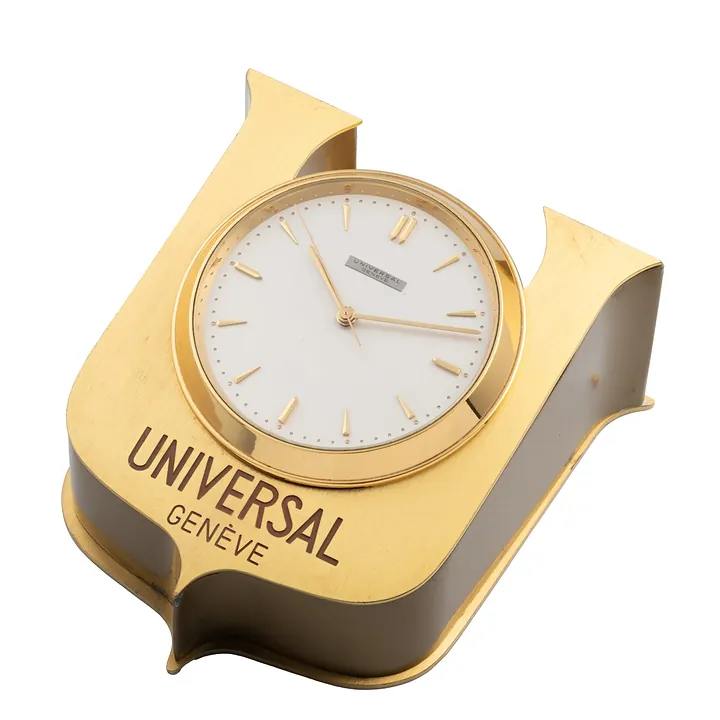
Universal Genève clock, ref. 999.116.01, c. 1960-1970s
Antiquorum auction archive, Geneva
Pocket Watches · c. 1950s
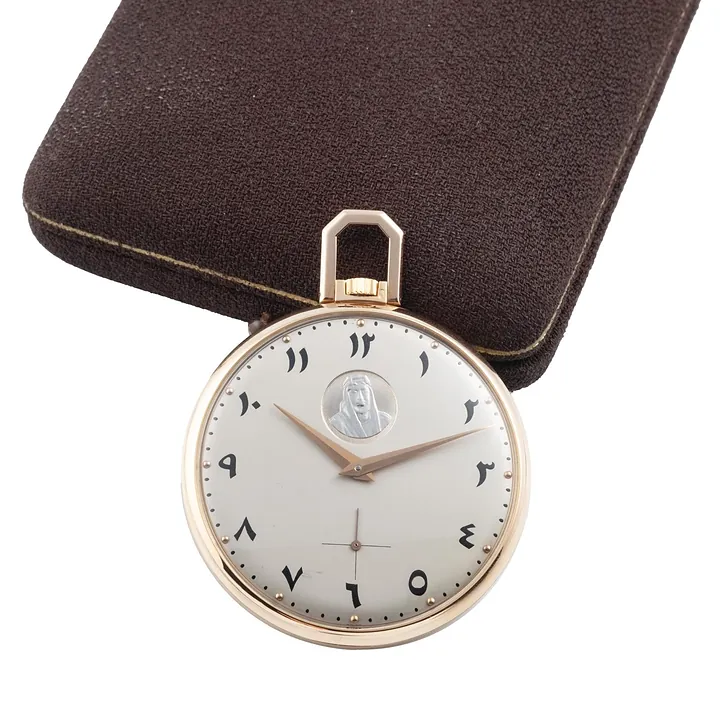
Universal Genève pocket watch, ref. 11746 3/ 11746 1, c. 1950s
Antiquorum auction archive, Geneva
Wristwatches · c. 1941
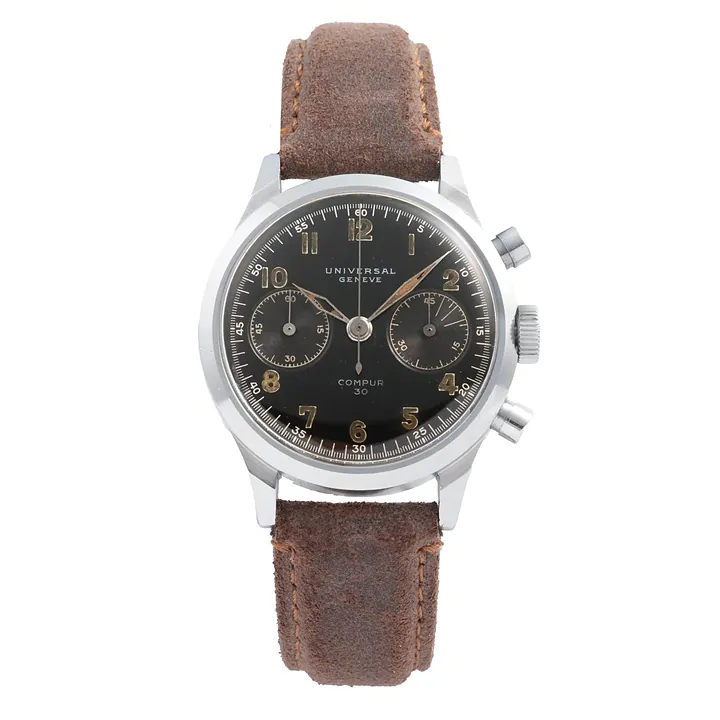
Universal Genève Compur 30, ref. 22409, c. 1941
Antiquorum auction archive, Geneva

Wristwatches · c. 1945
Universal Genève Uni-Compax, ref. 22492, c. 1945
Antiquorum auction archive, Geneva

Wristwatches · 2008
Wristwatch by Breitling?, 2008
Museum Rotterdam

Wristwatches · c. 1990s
Audemars Piguet Bamboo, c. 1990s
Antiquorum auction archive, Geneva

Wristwatches · c. 1990
Audemars Piguet Huitieme Perpetual Calendar, ref. 25696PT, c. 1990
Antiquorum auction archive, Geneva

Wristwatches · c. 1990
Breitling Chronomat, ref. b13050.1, c. 1990
Antiquorum auction archive, Geneva