
Wristwatches · Wristwatch
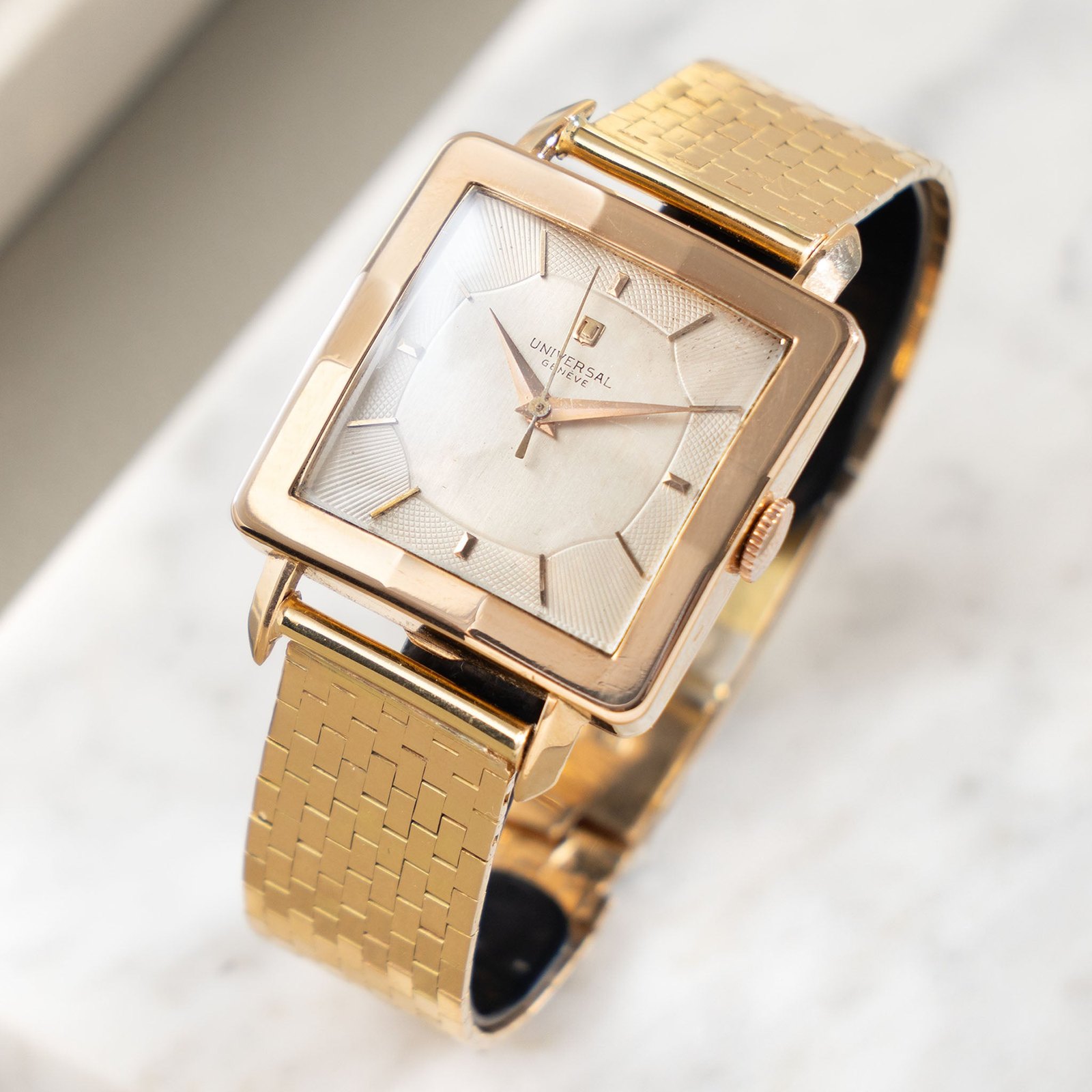
Universal Genève “Cioccolatone“ 18k Rose Gold Oversized Dress-watch with unique Guilloché Dial on Brick Style Bracelet ref. 10228 2, 1950s
- Maker / attribution
- Universal Geneve (maker)
- Date
- 1950s
- Historical period
- Modern Mechanical Horology (1945 – 1969)
- Country of origin
- Switzerland
- Object type
- Wristwatch
- Materials / technique
- 18k rose gold
- Dimensions
- Case 30 mm
- Stock no.
- W-3416
- Credit line
- Dealer listing, Bulang & Sons (W-3416)
- Catalogue title (original)
- Universal Genève “Cioccolatone“ 18k Rose Gold Oversized Dress-watch with unique Guilloché Dial on Brick Style Bracelet ref. 10228 2 (English)
View the source record (dealer listing) ↗ (opens another website in a new tab)Suggest a correction
Record summary
Catalogued by Bulang & Sons (dealer), Copenhagen (stock number W-3416), this is a wristwatch by Universal Geneve, made in Switzerland, dated 1950s. The Atlas places it in the Modern Mechanical Horology period (1945 – 1969) of its Wristwatches collection. Materials and techniques recorded by the source: 18k rose gold. Recorded dimensions: Case 30 mm. The record is illustrated with 6 photographs.
Assembled from the source record's structured fields. Dates and attributions are given as the source states them; where a field is missing the Atlas leaves it blank rather than estimating.
Catalogue description
Dealer description — Bulang & Sons
Today, we have a unique offering: an 18k rose gold Universal Genève “Cioccolatone”!! The most defining feature is the distinctive curved square—or pillow-shaped—case, often described as a "curved square" or "quadrilateral." The name Cioccolatone is Italian for "big chocolate," referring to the case's resemblance to a square of Swiss chocolate. These oversized cases were mostly used from the 1940s until around 1960 by brands like Vacheron Constantin, Omega, Longines, and others. However, the design never really took off at the time—likely because square cases were more difficult to waterproof. Round watches could more easily accommodate screw-down case backs, whereas square watches couldn't. As a result, these designs were produced in limited quantities, making superb examples like this one incredibly rare today. In hand, we have a truly exceptional Universal Genève. Universal Genève (UG) was founded in 1894 as Universal Watch in Le Locle, Switzerland, by Numa Descombes and Ulysse Perret. The brand specialized in both watch movements and cases. After relocating to Geneva in 1919, UG gained prominence for its high-quality chronographs. and time only pieces like the iconic Compax and Polerouter models—and for its innovative micro-rotor automatic movements. The brand’s fortunes declined after the quartz crisis of the 1970s, but in 2023, the name was acquired by Breitling, signaling a potential revival and return to its legacy of excellence. This oversized 30 x 30 mm case (which wears even larger than the numbers suggest!) is crafted in 18k rose gold and features a striking sloped bezel—we’ve truly never seen another case like it. The snap-on case back retains both its serial and reference numbers, still fully readable and sharp. The second star of the show is the exquisite guilloché dial. Finished in a warm cream tone, it features two different guilloché techniques—almost giving it a sunray-like appearance. There’s no lume on the dial, and the sharp dauphine hands complete this elegant mid-century design perfectly. We’ve never seen another one like it—and perhaps we can even conclude this is a piece unique? The watch is paired with an 18k yellow gold brick-style bracelet with nine rows. While the bracelet is yellow gold (not rose), we love the look—it feels very period correct. It fits wrists up to 19 cm. Surprisingly, this is an automatic watch—powered by UG’s hammer automatic Caliber 138SS. This super-elegant dress watch has been fully serviced by our watchmaker. If we could keep a watch for ourselves, this would definitely be a contender, in hand it will blow one’s mind. A smart collector should snap this up—one would never regret owning such a beautiful piece! Specifications Universal Genève reference 10228 2 Dress-watch Rare 30x30 mm steel 18 k pink gold “Cioccolatone” case Serial 161xxxx dates to 1950s Non lume guilloché “sun-ray “ cream colour dial, applied logo, Dauphine hands UG Calibre 138SS hammer automatic wind movement 18 k yellow gold nine rows brick style bracelet Fully serviced by our watchmaker Includes a handmade leather watch pouch
Historical context
Modern Mechanical Horology (1945 – 1969)
Tool watches for divers, pilots and astronauts; electric watches anticipate the electronic age.
The classic era of the mechanical wristwatch: dive watches, chronographs for motor racing and space flight, GMT watches for jet travel, slim dress watches, automatic calendars, and the rise of Japanese manufacturers alongside Swiss, American, German and Soviet industries.
Read the period in the timelineMore wristwatches from this periodEarlier: Golden Age of Mechanical Watchmaking
Atlas type guide
Wristwatches
Bracelet watches were worn by women from the early nineteenth century — Breguet made one for Caroline Murat, Queen of Naples, in 1810–12 — but the wristwatch only became a man's instrument with military use and aviation in the early twentieth century. Between the World Wars it overtook the pocket watch; the 1920s and 1930s brought rectangular Art Deco cases, water-resistant cases and the first automatic winding systems.
After 1945 the wristwatch became a carrier of identity — dress watches, sports and dive watches, chronographs, calendars — produced by Swiss, American, Japanese, German, Soviet and Chinese industries. The quartz revolution after 1969 and the mechanical renaissance since the 1990s, including the rise of independent watchmakers, complete the story.
What to look for
- The reference number (between the lugs or inside the case back) and serial number, the starting point for dating.
- The calibre: its maker and number are often stamped under the dial or on the bridge.
- Originality of dial, hands and crown — refinished ('redial') dials are common.
- Case material marks: 18K/750, 14K/585, stainless steel, gold-filled, plated.
Dating clues
- Wire-lug cases: before c. 1925.
- Water-resistant screw-down cases: from 1926.
- Quartz movements: from 1969; sapphire crystals widespread after c. 1980.
General guidance written by the Atlas editors about this kind of object. It is not a statement about this particular piece; for that, rely on the source record above and on physical examination.
Related records
Wristwatches · 1970s
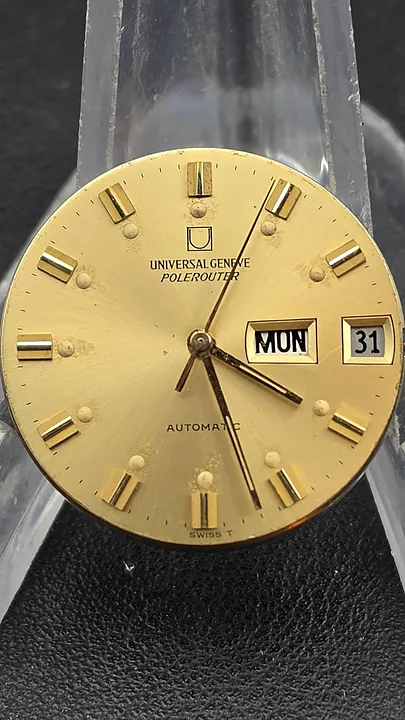
1970s Universal Geneve Polerouter Day-Date Movement Dial Cal 72 Microtor 17J 29mm Auto
LiveAuctioneers auction archive
Wristwatches · 1960s
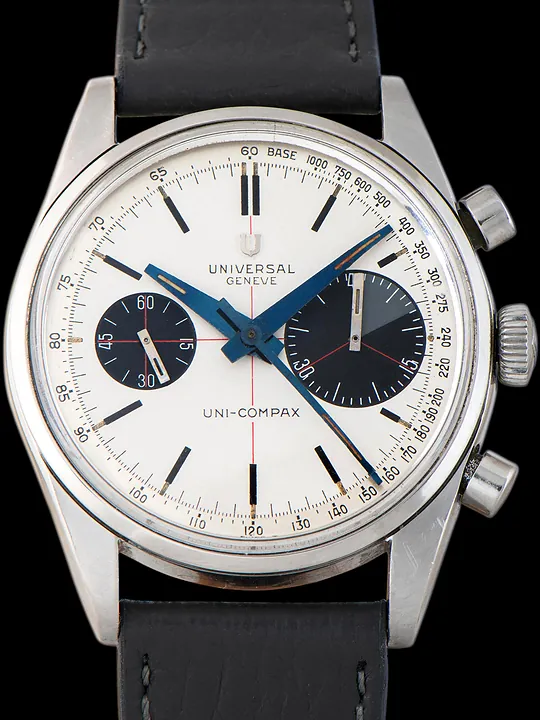
Universal Geneve Uni- Compax (Ref. 884100/02) “Big Eye”, 1960s
Craft & Tailored (dealer), Los Angeles
Wristwatches · 1960s
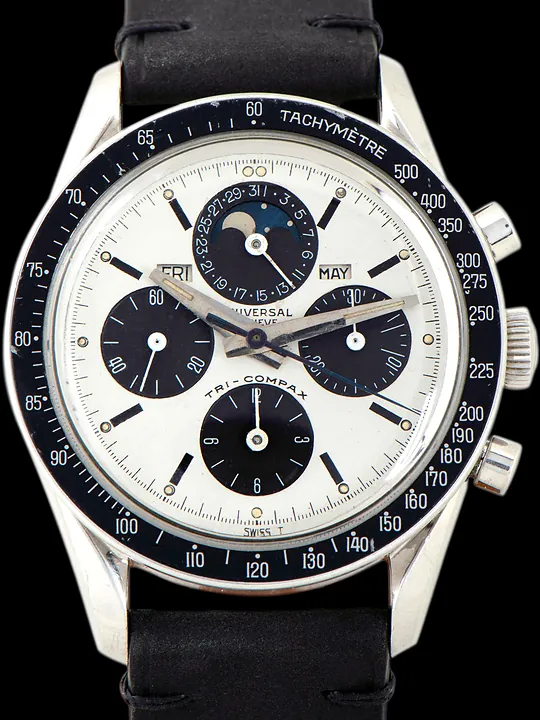
Universal Genève Tri-Compax (Ref. 881101/01) "Eric Clapton", 1960s
Craft & Tailored (dealer), Los Angeles
Wristwatches · 1960s
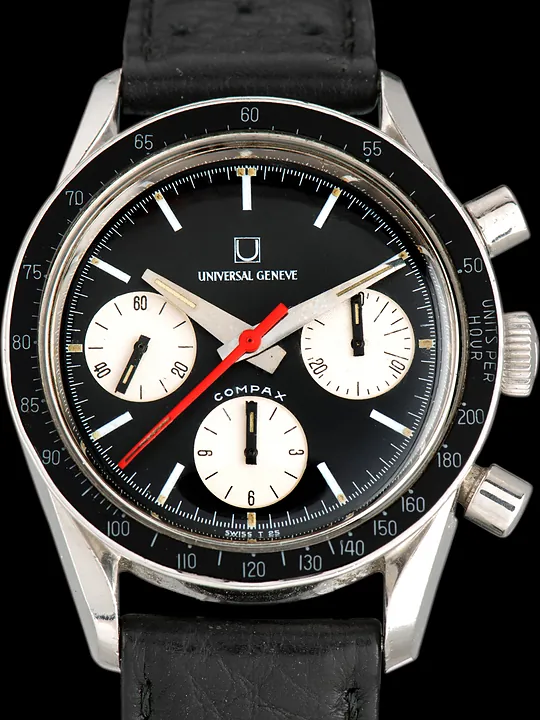
Universal Geneve Compax (Ref. 885103/01) "Evil Nina" W/ Base 200 UPH Bezel, 1960s
Craft & Tailored (dealer), Los Angeles

Wristwatches · 1945
Wristwatch by Eterna, 1945
Museum Rotterdam

Wristwatches · c. 1945
Breitling Premier, ref. 790, c. 1945
Antiquorum auction archive, Geneva

Wristwatches · c. 1945
Universal Genève Uni-Compax, ref. 22492, c. 1945
Antiquorum auction archive, Geneva

Wristwatches · c. 1950s
Baume & Mercier wristwatch, c. 1950s
Antiquorum auction archive, Geneva