
Wristwatches · Wristwatch
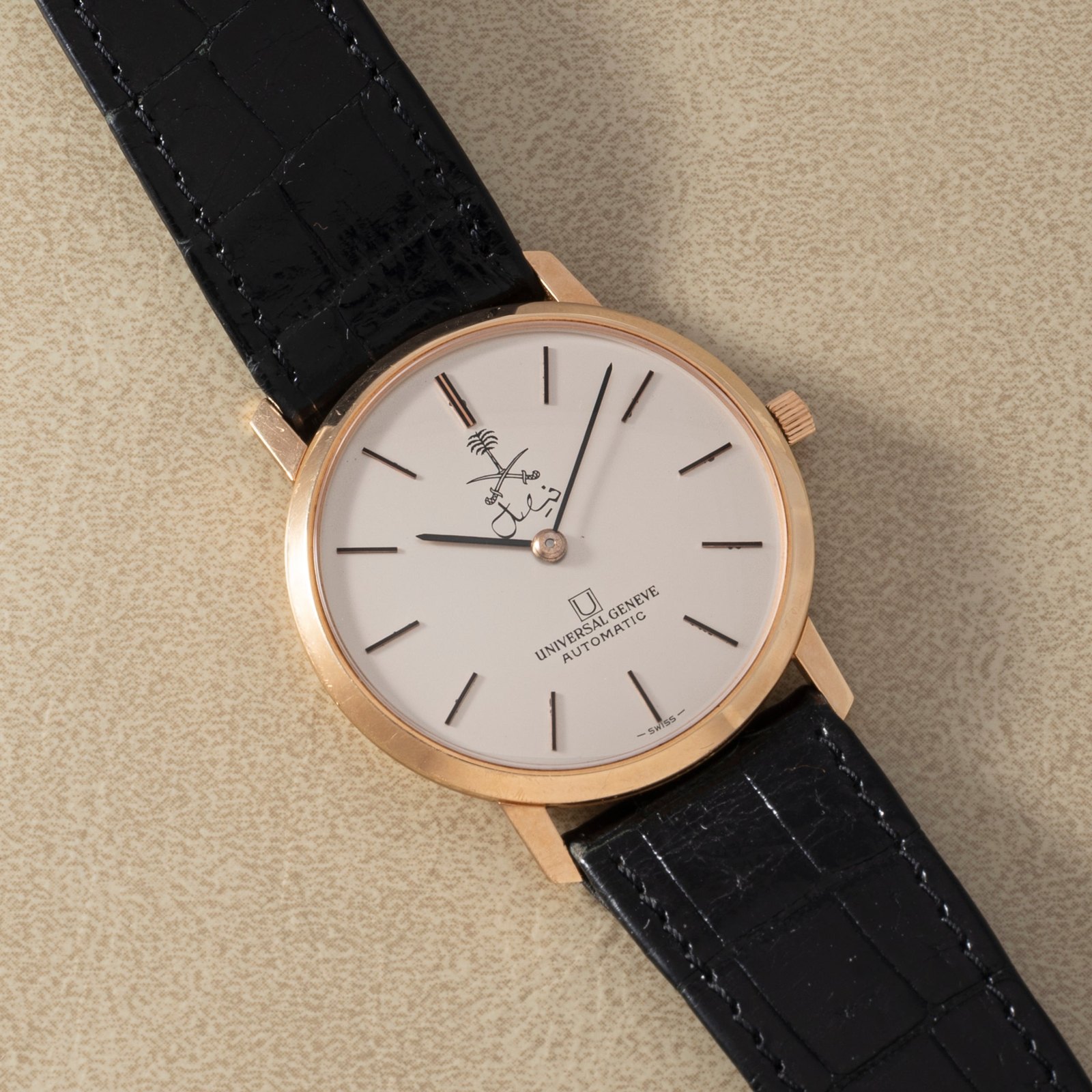
Universal Genève Automatic 'King Faisal', 1960s
- Maker / attribution
- Universal Geneve (maker)
- Date
- 1960s
- Historical period
- Modern Mechanical Horology (1945 – 1969)
- Country of origin
- Switzerland
- Object type
- Wristwatch
- Dimensions
- Case 32 mm
- Stock no.
- 40992920
- Credit line
- Dealer listing, Analog/Shift (40992920)
- Catalogue title (original)
- Universal Genève Automatic 'King Faisal' (English)
View the source record (dealer listing) ↗ (opens another website in a new tab)Suggest a correction
Record summary
Catalogued by Analog/Shift (dealer), New York (stock number 40992920), this is a wristwatch by Universal Geneve, made in Switzerland, dated 1960s. The Atlas places it in the Modern Mechanical Horology period (1945 – 1969) of its Wristwatches collection. Recorded dimensions: Case 32 mm. The record is illustrated with 6 photographs.
Assembled from the source record's structured fields. Dates and attributions are given as the source states them; where a field is missing the Atlas leaves it blank rather than estimating.
Catalogue description
Dealer description — Analog/Shift
There are certain vintage watches that don’t just come with provenance, they come with atmosphere. This Universal Genève Automatic is one of them. Rendered in 18K yellow gold and dating to the 1960s, it’s an already-compelling dress watch made extraordinary by what appears on its dial: the Saudi Royal Family coat of arms, paired with the name of the late King Faisal. It’s a detail that immediately shifts the watch from “beautiful” to “historical.” We believe this piece was most likely presented as a gift from King Faisal to a member of his forces, a token of recognition delivered not in the form of a medal, but as something far more personal. A wristwatch is intimate. It’s carried through daily life, worn close to the pulse, and in this case, it becomes a quiet emblem of service and status. The watch itself is everything you’d want from Universal Genève at mid-century. The 32mm case is elegant and perfectly proportioned, and the non-luminous dial remains in outstanding condition, allowing the royal insignia and signature to take center stage without distraction. The hands are a particularly striking touch: black steel hour and minute hands that create sharp contrast and lend the piece a graphic, almost ceremonial clarity. Inside beats an automatic Universal Genève movement fitted with the brand’s signature gold micro-rotor, a technical calling card that helped define the Polerouter line and made UG one of the most important names in 20th-century watchmaking. It comes fitted to a black crocodile leather strap with a signed Universal Genève pin buckle, completing the look with the right level of formality. Even better, this piece is accompanied by a box, travel pouch, papers, and an original note card whose translation reads: “By order, His Majesty King Faisal Al-Azam, Head of Royal Ceremonies, with best regards.” It’s the kind of ephemera that turns a great watch into a complete story. Universal Genève has always been beloved for its design language and mechanical ingenuity. But every so often, a watch like this appears, and reminds you that the most captivating watches are the ones that lived in the world. Not just in catalogs, but in history.
Historical context
Modern Mechanical Horology (1945 – 1969)
Tool watches for divers, pilots and astronauts; electric watches anticipate the electronic age.
The classic era of the mechanical wristwatch: dive watches, chronographs for motor racing and space flight, GMT watches for jet travel, slim dress watches, automatic calendars, and the rise of Japanese manufacturers alongside Swiss, American, German and Soviet industries.
Read the period in the timelineMore wristwatches from this periodEarlier: Golden Age of Mechanical Watchmaking
Atlas type guide
Automatic (self-winding) watches
Self-winding watches use the wearer's motion to wind the mainspring. Abraham-Louis Perrelet and Breguet made 'perpétuelle' pocket watches with oscillating weights in the late eighteenth century, but the principle only became practical in the wristwatch. John Harwood patented a bumper automatic in 1923; Rolex's Perpetual rotor (1931) winding in one direction, and later bidirectional rotors (Eterna, Felsa Bidynator), established the modern form. Micro-rotors (Universal Genève, Buren) and peripheral rotors made automatic watches thinner.
What to look for
- A semicircular rotor turning 360° over the movement, or a 'bumper' weight that rebounds between springs.
- 'Automatic', 'Perpetual' or 'Self-winding' on the dial.
- A sealed screw-back case, since automatic watches are wound less often by the crown.
Dating clues
- Bumper automatics: 1923–c. 1955.
- Full rotors: from 1931 (Rolex); widespread after c. 1950.
- Micro-rotors: from 1954–1958.
General guidance written by the Atlas editors about this kind of object. It is not a statement about this particular piece; for that, rely on the source record above and on physical examination.
Related records
Wristwatches · 1970s
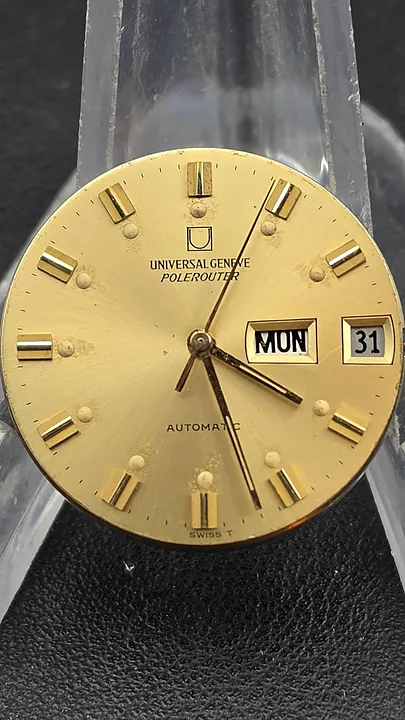
1970s Universal Geneve Polerouter Day-Date Movement Dial Cal 72 Microtor 17J 29mm Auto
LiveAuctioneers auction archive
Wristwatches · 1960s
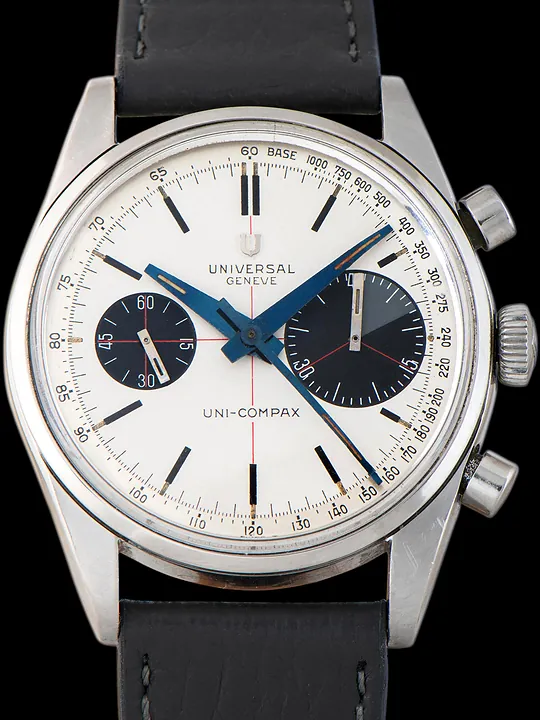
Universal Geneve Uni- Compax (Ref. 884100/02) “Big Eye”, 1960s
Craft & Tailored (dealer), Los Angeles
Wristwatches · 1960s
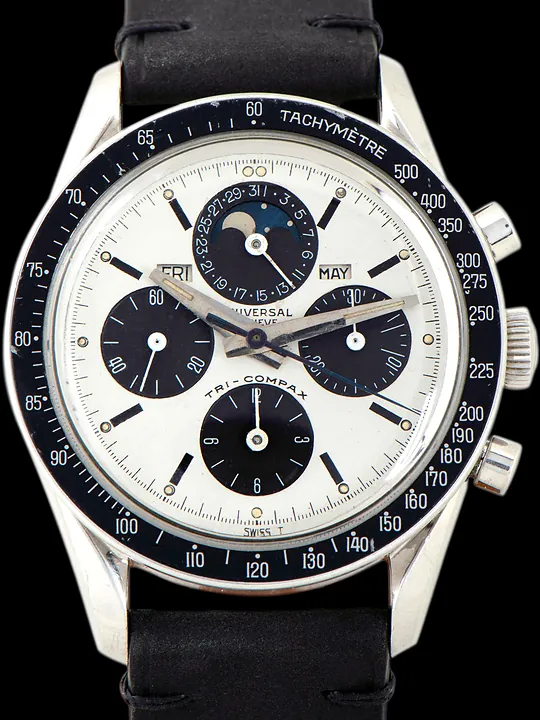
Universal Genève Tri-Compax (Ref. 881101/01) "Eric Clapton", 1960s
Craft & Tailored (dealer), Los Angeles
Wristwatches · 1960s
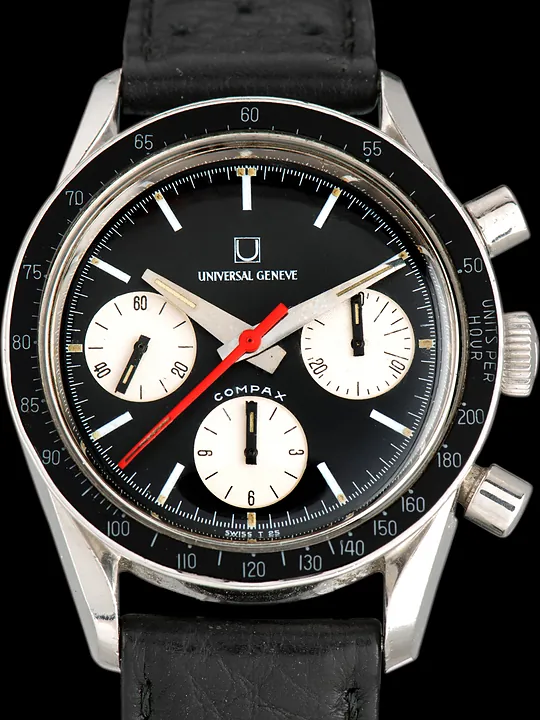
Universal Geneve Compax (Ref. 885103/01) "Evil Nina" W/ Base 200 UPH Bezel, 1960s
Craft & Tailored (dealer), Los Angeles

Wristwatches · 1945
Wristwatch by Eterna, 1945
Museum Rotterdam

Wristwatches · c. 1945
Breitling Premier, ref. 790, c. 1945
Antiquorum auction archive, Geneva

Wristwatches · c. 1945
Universal Genève Uni-Compax, ref. 22492, c. 1945
Antiquorum auction archive, Geneva

Wristwatches · c. 1950s
Baume & Mercier wristwatch, c. 1950s
Antiquorum auction archive, Geneva