
Wristwatches · Wristwatch
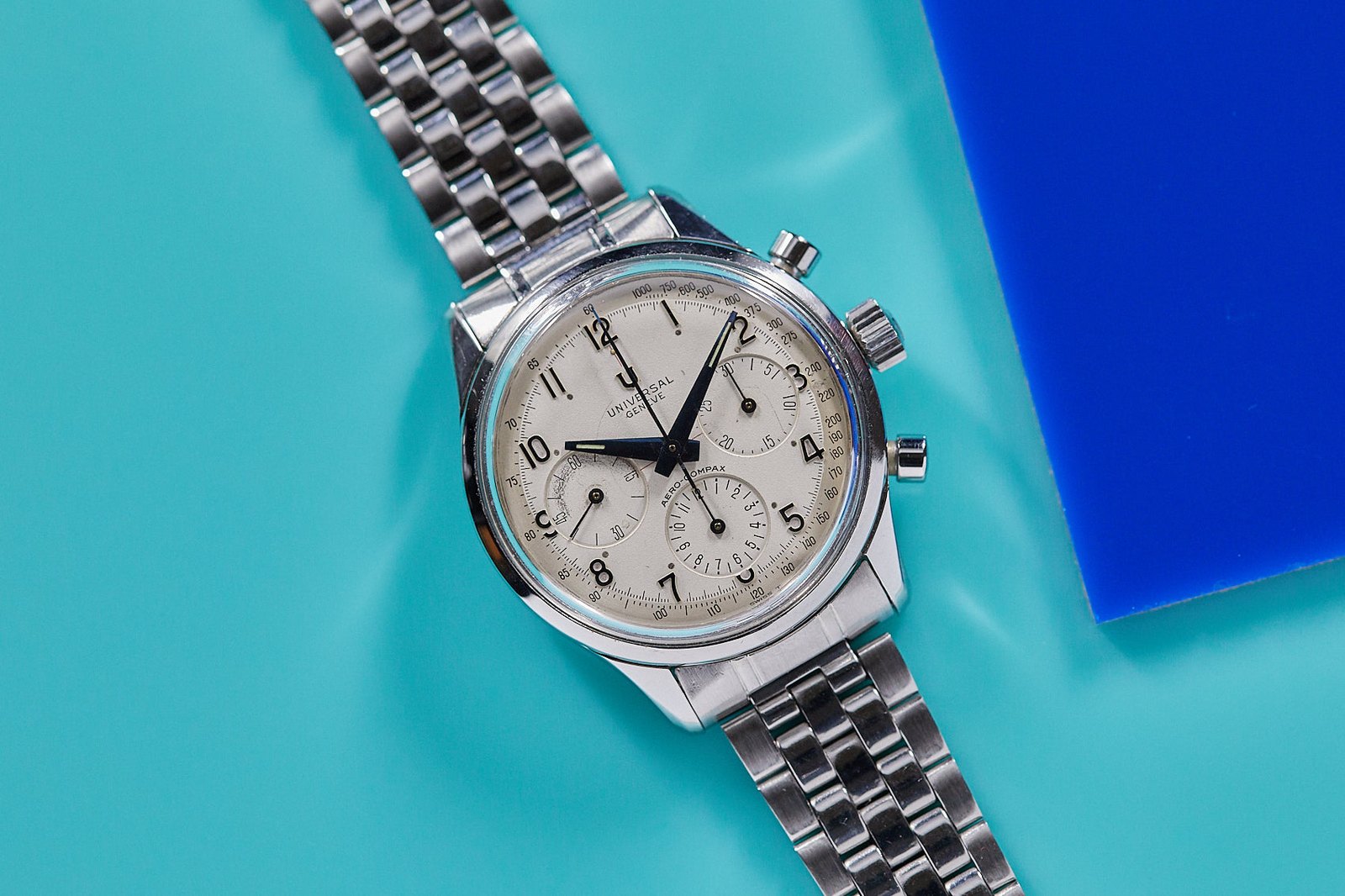
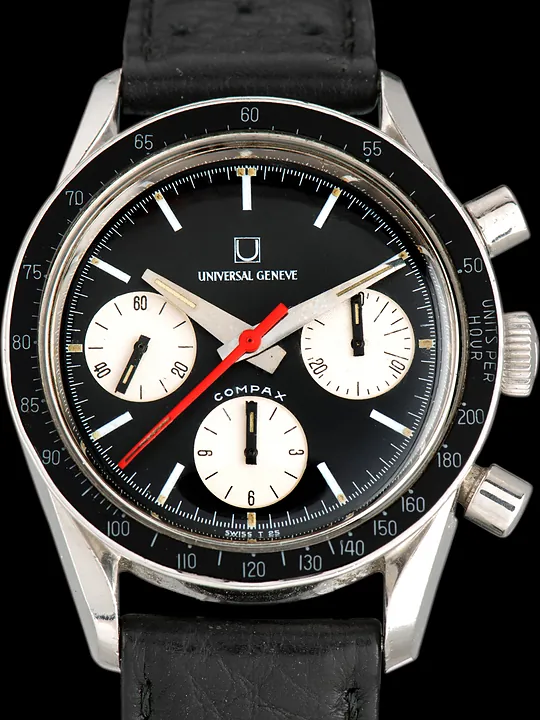
Universal Genève Aero-Compax, 1950s
- Maker / attribution
- Universal Geneve (maker)
- Date
- 1950s
- Historical period
- Modern Mechanical Horology (1945 – 1969)
- Country of origin
- Switzerland
- Object type
- Wristwatch
- Dimensions
- Case 37.5 mm
- Stock no.
- Product 760756174935
- Credit line
- Dealer listing, Analog/Shift (product 760756174935)
- Catalogue title (original)
- Universal Genève Aero-Compax (English)
View the source record (dealer listing) ↗ (opens another website in a new tab)Suggest a correction
Record summary
Catalogued by Analog/Shift (dealer), New York (stock number Product 760756174935), this is a wristwatch by Universal Geneve, made in Switzerland, dated 1950s. The Atlas places it in the Modern Mechanical Horology period (1945 – 1969) of its Wristwatches collection. Recorded dimensions: Case 37.5 mm. The record is illustrated with 6 photographs.
Assembled from the source record's structured fields. Dates and attributions are given as the source states them; where a field is missing the Atlas leaves it blank rather than estimating.
Catalogue description
Dealer description — Analog/Shift
Why We Love It This is not your average Aero-Compax. What we offer here is a Reference 22704/3, or “Type B”. Dating from the 1950s or early 1960s, this Aero-Compax’s was produced shortly before the model would receive a major redesign in the mid-1960s. Without the fourth register at 12 o’clock that would define the earliest models, or the rotating bezel of the latest, the “Type B” nevertheless has a lot going for it. Take the case for instance—at 37.5mm it’s large enough to be considered “jumbo” for the era, which happens to be the perfect size for the modern wrist. Touches like the blued steel hands with luminous pips provide an artful contrast to the lightly-patinated dial. Sure, this might have been designed as a tool watch, but it packs a helluva punch visually speaking. The Story Introduced in the 1940, the Aero-Compax’s claim to fame was an unusual dial layout. Unlike conventional chronographs, which possess two or three registers, early examples of Aero-Compax featured four. The upper-most register at 12 o’clock was a secondary time display, with two hands that could be set by the crown at 9 o’clock. This complication, for which Universal Genève received two patents, functioned in much the same way as a silent alarm. For example, if a pilot had orders to rendezvous with his squadron at 8:00, then he would set the hands in the upper-most register to that time. Independent of the main time display, the hands in the upper register would remain affixed at that time, serving as a visual reminder. The Aero-Compax underwent several redesigns throughout its life. Major changes included a major one in the 1960s that saw the addition of a rotating external bezel (which allowed the wearer to track a second timezone), conversion to a 24-hour dial layout, and the removal of that fourth register at 12 o’clock. However, the Aero-Compax that we feature here is a lesser-known reference, making it highly desirable.
Historical context
Modern Mechanical Horology (1945 – 1969)
Tool watches for divers, pilots and astronauts; electric watches anticipate the electronic age.
The classic era of the mechanical wristwatch: dive watches, chronographs for motor racing and space flight, GMT watches for jet travel, slim dress watches, automatic calendars, and the rise of Japanese manufacturers alongside Swiss, American, German and Soviet industries.
Read the period in the timelineMore wristwatches from this periodEarlier: Golden Age of Mechanical Watchmaking
Atlas type guide
Wristwatches
Bracelet watches were worn by women from the early nineteenth century — Breguet made one for Caroline Murat, Queen of Naples, in 1810–12 — but the wristwatch only became a man's instrument with military use and aviation in the early twentieth century. Between the World Wars it overtook the pocket watch; the 1920s and 1930s brought rectangular Art Deco cases, water-resistant cases and the first automatic winding systems.
After 1945 the wristwatch became a carrier of identity — dress watches, sports and dive watches, chronographs, calendars — produced by Swiss, American, Japanese, German, Soviet and Chinese industries. The quartz revolution after 1969 and the mechanical renaissance since the 1990s, including the rise of independent watchmakers, complete the story.
What to look for
- The reference number (between the lugs or inside the case back) and serial number, the starting point for dating.
- The calibre: its maker and number are often stamped under the dial or on the bridge.
- Originality of dial, hands and crown — refinished ('redial') dials are common.
- Case material marks: 18K/750, 14K/585, stainless steel, gold-filled, plated.
Dating clues
- Wire-lug cases: before c. 1925.
- Water-resistant screw-down cases: from 1926.
- Quartz movements: from 1969; sapphire crystals widespread after c. 1980.
General guidance written by the Atlas editors about this kind of object. It is not a statement about this particular piece; for that, rely on the source record above and on physical examination.
Related records
Wristwatches · 1970s
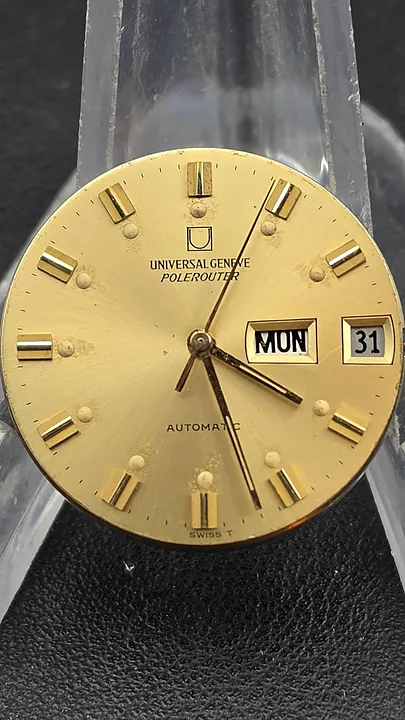
1970s Universal Geneve Polerouter Day-Date Movement Dial Cal 72 Microtor 17J 29mm Auto
LiveAuctioneers auction archive
Wristwatches · 1960s
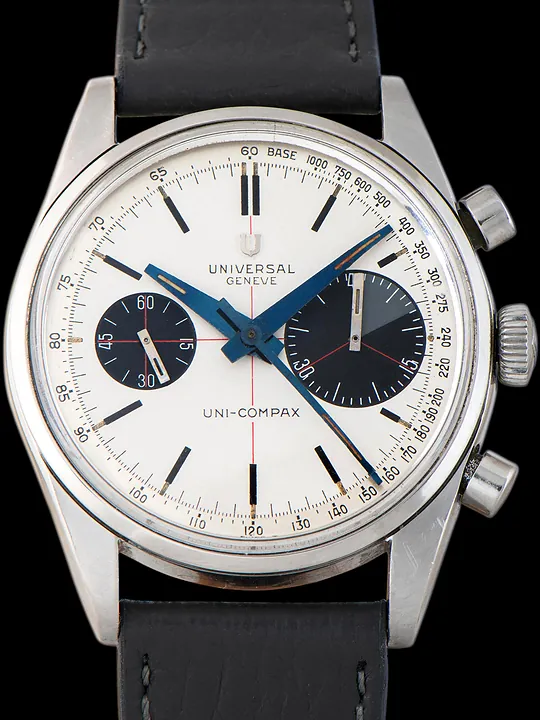
Universal Geneve Uni- Compax (Ref. 884100/02) “Big Eye”, 1960s
Craft & Tailored (dealer), Los Angeles
Wristwatches · 1960s
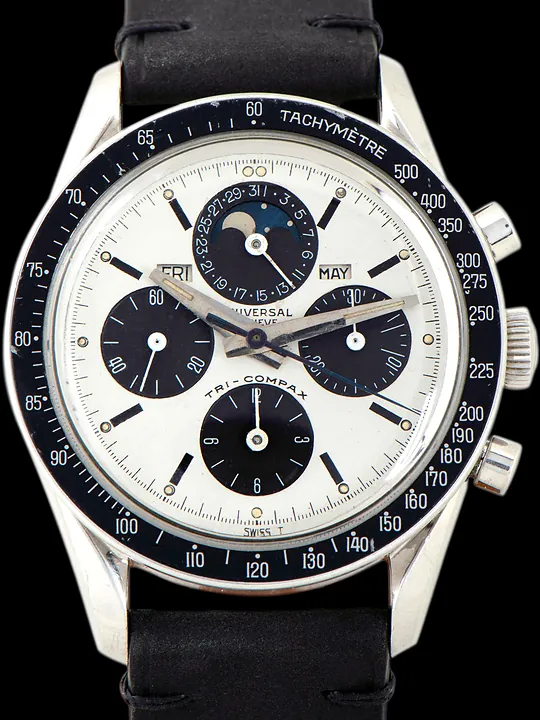
Universal Genève Tri-Compax (Ref. 881101/01) "Eric Clapton", 1960s
Craft & Tailored (dealer), Los Angeles
Wristwatches · 1960s
Universal Geneve Compax (Ref. 885103/01) "Evil Nina" W/ Base 200 UPH Bezel, 1960s
Craft & Tailored (dealer), Los Angeles

Wristwatches · 1945
Wristwatch by Eterna, 1945
Museum Rotterdam

Wristwatches · c. 1945
Breitling Premier, ref. 790, c. 1945
Antiquorum auction archive, Geneva

Wristwatches · c. 1945
Universal Genève Uni-Compax, ref. 22492, c. 1945
Antiquorum auction archive, Geneva

Wristwatches · c. 1950s
Baume & Mercier wristwatch, c. 1950s
Antiquorum auction archive, Geneva