
Clocks · Turret clock
Turret Clock - James Murray, National Model & Training School, Melbourne, 1854
- Maker / attribution
- Mr James Murray (Maker)
- Date
- 1854
- Historical period
- Industrial Revolution (1850 – 1900)
- Country of origin
- Unrecorded in source
- Place
- Melbourne, Greater Melbourne, Victoria, Australia
- Object type
- Turret clock
- Holding institution
- Museums Victoria, Melbourne
- Accession / object no.
- ST 19014
- Catalogue title (original)
- Turret Clock - James Murray, National Model & Training School, Melbourne, 1854 (English)
View the source record ↗ (opens another website in a new tab)Suggest a correction
Record summary
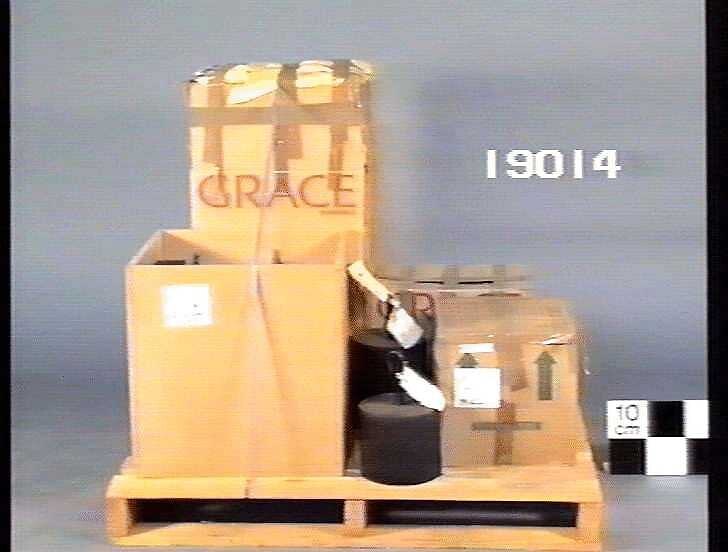
Held and catalogued by Museums Victoria, Melbourne (object number ST 19014), this is a turret clock by Mr James Murray, made in Melbourne, Greater Melbourne, Victoria, Australia, dated 1854. The Atlas places it in the Industrial Revolution period (1850 – 1900) of its Clocks collection. The record is illustrated with 3 photographs.
Assembled from the source record's structured fields. Dates and attributions are given as the source states them; where a field is missing the Atlas leaves it blank rather than estimating.
Catalogue description
Summary — Museums Victoria
Turret clock from the National Model & Training School, East Melbourne. Made by James Murray, Melbourne and London. Consists of movement and clock face. The National Model & Training School was established on the northeast corner of Spring and Albert Streets, Melbourne in 1854. It became Victoria's first secondary school in 1905, and moved to South Yarra in 1927, renamed Melbourne Boy's High School. The building was demolished in 1933 to make way for the College of Surgeons in 1935. James Murray & Co was a London clockmaking firm with a Melbourne office from 1861.
Physical description — Museums Victoria
Movement in wooden box, clock face on metal stand, weights and box of parts. Weight driven; anchor escapement.
Inscriptions & marks
Dial marked 'James Murray, G. Bourke St, Melbourne'.
Provenance
Donation from Victoria: Education Victoria, 25 Jan 1933
Historical context
Industrial Revolution (1850 – 1900)
American interchangeable-parts manufacture; railroad time standards; Swiss and German factory systems.
Factory production transformed the clock into an everyday object. American makers (Seth Thomas, Ansonia, Waterbury) and German factories (Junghans, Gustav Becker, Lenzkirch) sold millions of shelf, wall and alarm clocks worldwide; France produced standardised Paris movements and carriage clocks; electric time distribution began.
Read the period in the timelineMore clocks from this periodEarlier: Precision & Scientific Horology
Atlas type guide
Turret, tower and public clocks
The first mechanical clocks of the late thirteenth and fourteenth centuries were large iron striking clocks in towers, monasteries and cathedrals, driven by falling weights and controlled by a verge escapement with a foliot or wheel balance. They struck a bell rather than displaying the time, and only gradually acquired dials. Public clocks ordered civic life, regulating markets, work and worship.
From the seventeenth century the pendulum and then the anchor and pinwheel escapements made turret clocks far more accurate. In the nineteenth century firms such as Dent, Smith of Derby, Gillett & Johnston, J. F. Weule and Collin made cast-iron flatbed movements, and Edmund Beckett Denison's gravity escapement for the Great Clock of Westminster (1859) became the standard for accurate tower clocks.
What to look for
- Frame construction: early wrought-iron 'birdcage' or posted frames versus later cast-iron flatbed or plate-and-spacer frames.
- The escapement: verge and foliot, anchor, pinwheel or double three-legged gravity escapement.
- Striking and chiming trains with count wheels or rack striking.
- Maker's plates and dates cast or engraved on the frame.
Dating clues
- Wedged and riveted wrought-iron frames generally predate 1700.
- Flatbed cast-iron movements date from about 1840 onward.
- Electrical synchronisation and electric winding appear from about 1900.
General guidance written by the Atlas editors about this kind of object. It is not a statement about this particular piece; for that, rely on the source record above and on physical examination.
Read next:Verge escapementFoliot
Related records
Clocks · 1830–1870
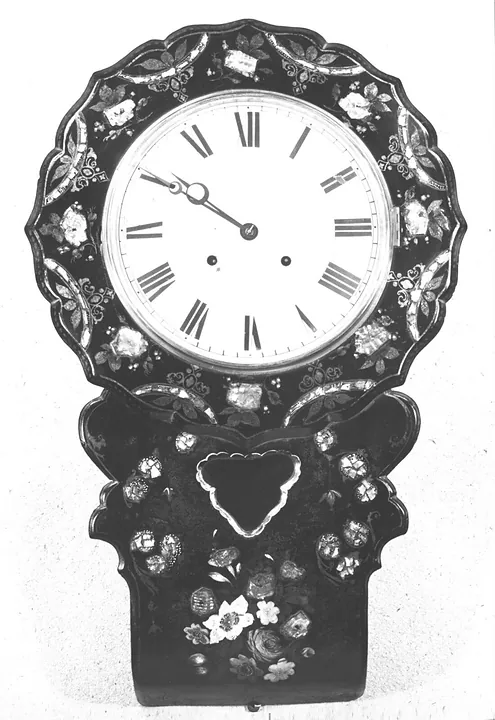
Wall clock in a papier mâché case with painted decoration. English, mid 19th century.
Victoria and Albert Museum, London
Clocks · 1840–1900
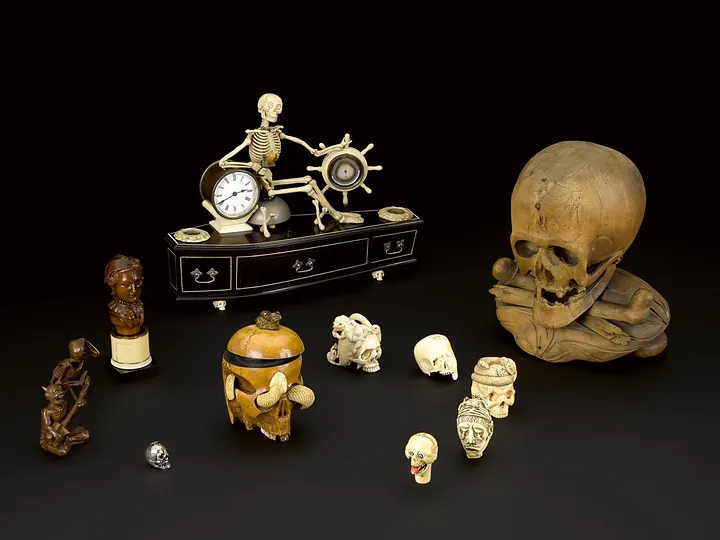
Alarm clock, mounted on model of coffin with skeleton, probably English, 1840–1900
Science Museum Group, London
Clocks · 1840–1880
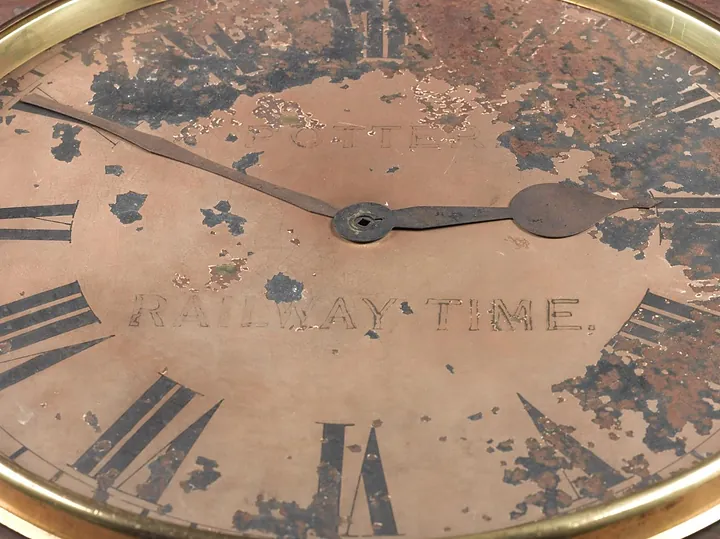
Clock dial marked "Potter, Railway Time" with two hands, unknown maker, British, 1840–1880
Science Museum Group, London
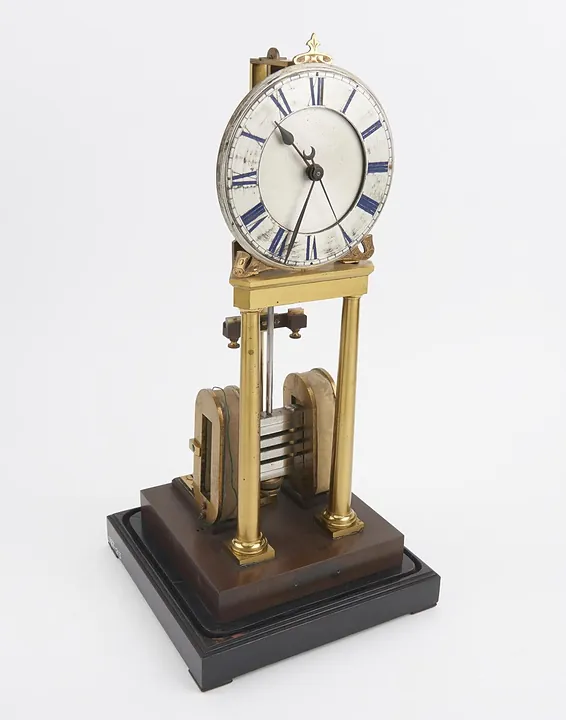
Clocks · 1840–1877
Electric clock of the Bain type
Science Museum Group, London
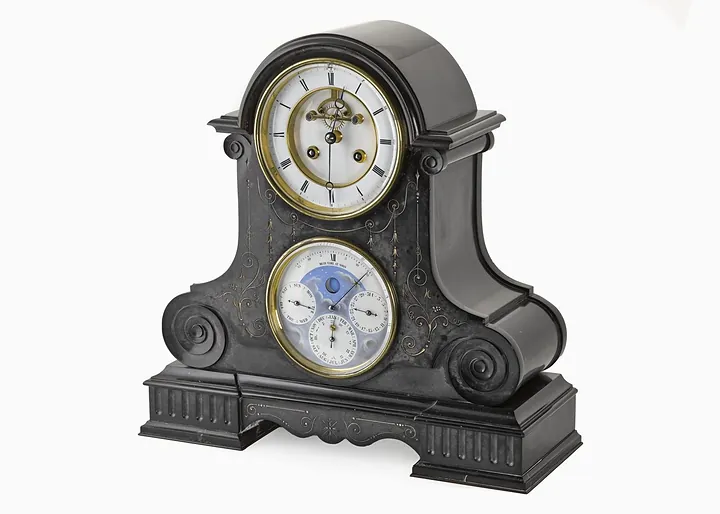
Clocks · 1840–1878
Mantel clock by A. Brocot, France, 1840–1878
Science Museum Group, London
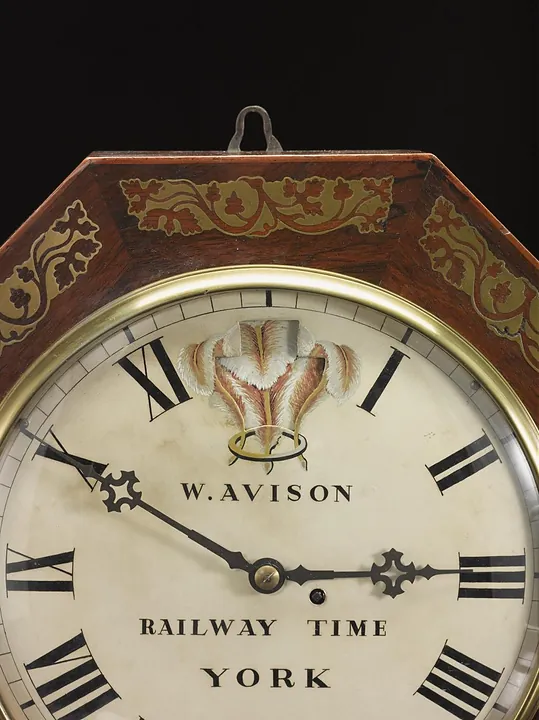
Clocks · 1840–1880
Wall Clock in octagonal case with Prince of Wales Feathers above makers name "W. Avison, Railway Time, York", made by William Avison, England, 1840–1880.
Science Museum Group, London
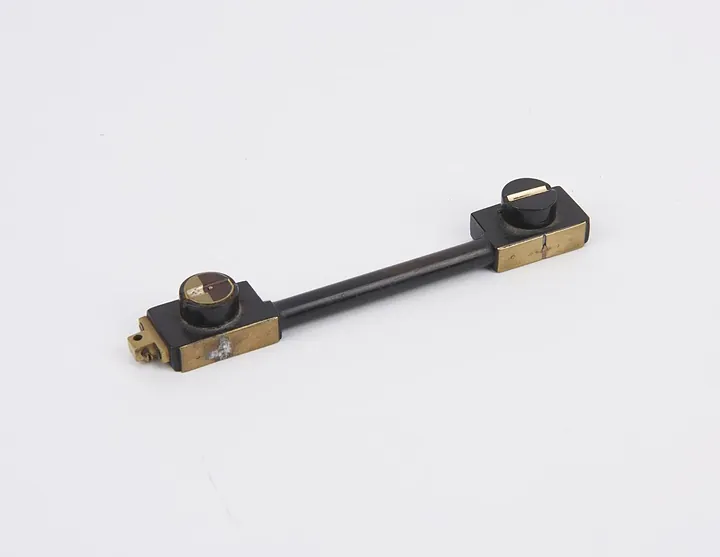
Clocks · 1841–1870
Contact bar from electric clock, unsigned, London, England, 1841–1870
Science Museum Group, London
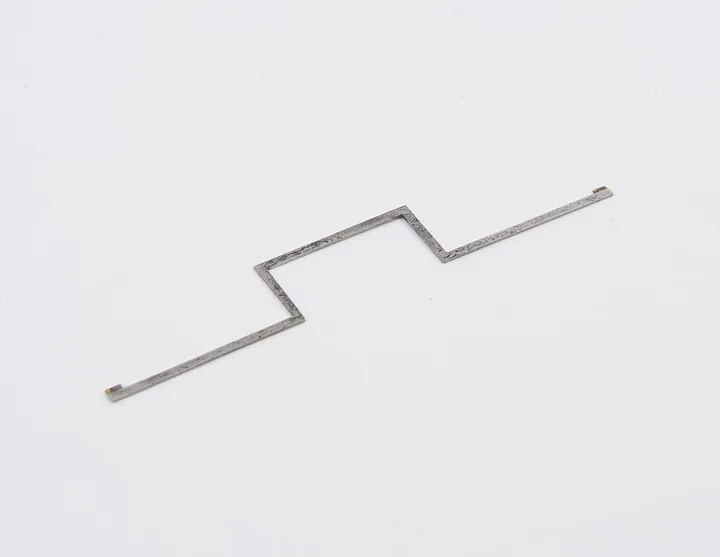
Clocks · 1841–1870
Contactor from electric clock, unsigned, London, England, 1841–1870
Science Museum Group, London