
Wristwatches · Wristwatch
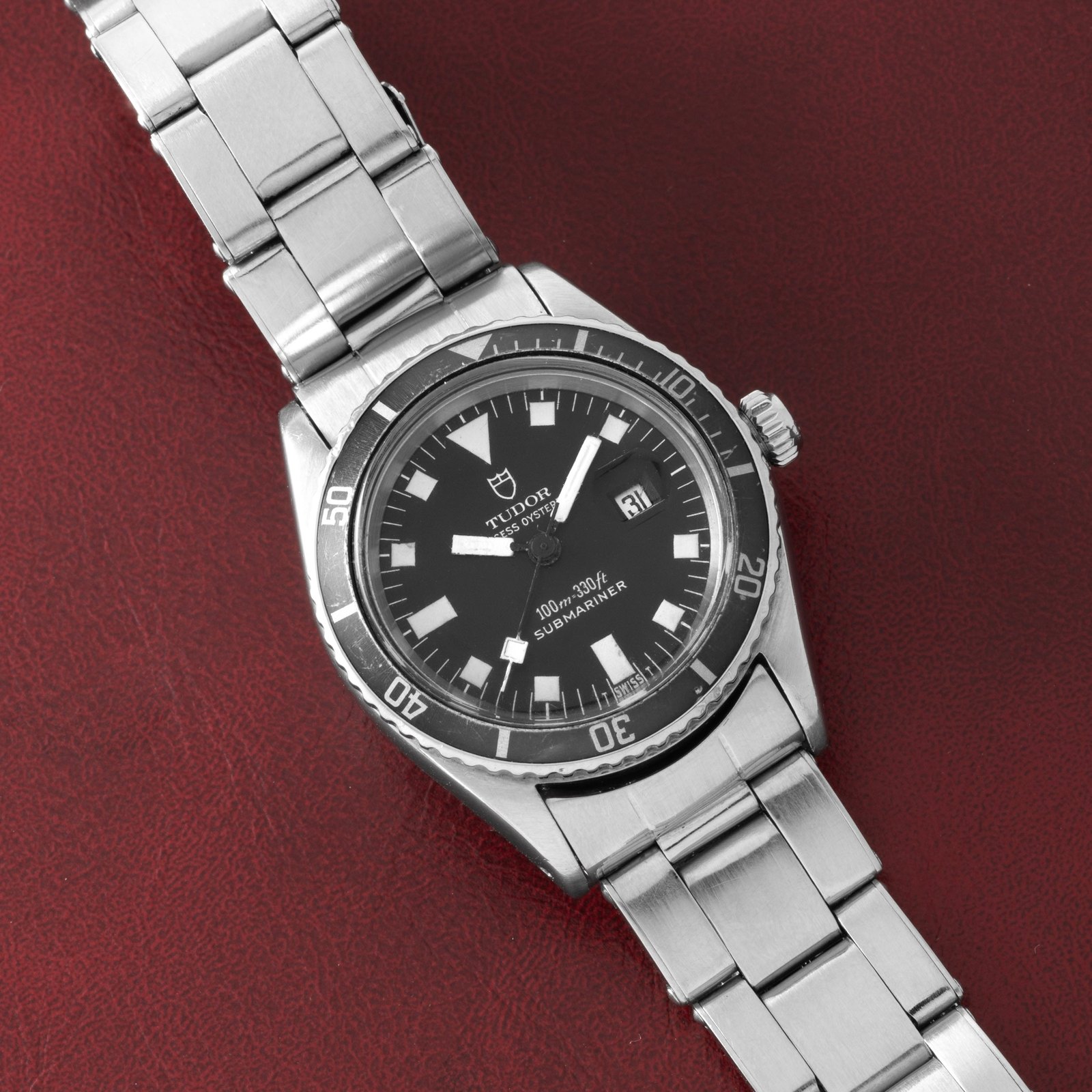
Tudor Submariner 'Mini Sub', c. 1977
- Maker / attribution
- Tudor (maker)
- Date
- c. 1977
- Historical period
- Quartz Revolution (1969 – 1990)
- Country of origin
- Switzerland
- Object type
- Wristwatch
- Dimensions
- Case 31 mm
- Stock no.
- 40992483
- Credit line
- Dealer listing, Analog/Shift (40992483)
- Catalogue title (original)
- Tudor Submariner 'Mini Sub' (English)
View the source record (dealer listing) ↗ (opens another website in a new tab)Suggest a correction
Record summary
Catalogued by Analog/Shift (dealer), New York (stock number 40992483), this is a wristwatch by Tudor, made in Switzerland, dated c. 1977. The Atlas places it in the Quartz Revolution period (1969 – 1990) of its Wristwatches collection. Recorded dimensions: Case 31 mm. The record is illustrated with 6 photographs.
Assembled from the source record's structured fields. Dates and attributions are given as the source states them; where a field is missing the Atlas leaves it blank rather than estimating.
Catalogue description
Dealer description — Analog/Shift
It is perhaps one of the greatest injustices in horology that women's wristwatches have not historically received the same respect as their larger cased counterparts, resulting in far fewer executions worth collecting. This is truly a shame - but fortunately, Rolex got the memo long before most, and have been producing outstanding ladies watches for over 50 years. And we're talking about the real thing - not those that utilize faux-gold, not-so-precious stones and batteries - Rolex's offerings are mechanical, functional, wearable art. This thinking even extended to sport models under Rolex's sibling brand, Tudor! Like Rolex, Tudor really seems to get their smaller-wristed clientele, offering watches that are simply scaled-down versions of their most popular men’s models. Tudor had its genesis as a subsidiary of Rolex. It's watches were Rolexes in all but name: same Rolex Oyster case, same crowns, and Rolex crystals. The only difference was what beat inside the Oyster cases — Swiss ETA movements rather than movements that Rolex built in-house. Take this particular piece for example, a Sumbariner 'Mini Sub' Reference 9091/0 . It dates to circa 1977 and features a 31mm stainless steel Oyster case with holey lugs , a Rolex signed crown, a rotating dive timing bezel with a beautiful black insert, and a gorgeous black Tritium dial with a matching handset. Powered by a roust and proven ETA automatic winding movement, this piece comes fitted to a correct stainless steel Oyster bracelet with a signed blade clasp. Lovely! This is easily one of the cleanest Mini-Sub's that we have come across - and is the perfect choice for the smaller-wristed individual for whom 39mm is too large, and 28mm is too small.
Historical context
Quartz Revolution (1969 – 1990)
Seiko's Astron begins mass quartz timekeeping; traditional industries contract sharply.
Quartz and digital watches transformed the market after 1969. Swiss employment collapsed, Japanese and Hong Kong production soared, and the Swatch (1983) helped the Swiss industry recover; mechanical watches survived as luxury goods.
Read the period in the timelineMore wristwatches from this periodEarlier: Modern Mechanical Horology
Atlas type guide
Dive and water-resistant watches
Keeping water and dust out of a wristwatch was a long-standing challenge. Rolex's screw-down Oyster case (1926) and Omega's Marine (1932) were landmarks; in the early 1950s Blancpain's Fifty Fathoms and Rolex's Submariner defined the professional dive watch with rotating bezels for timing dives, luminous dials and high water resistance. The ISO 6425 standard (1982) later codified what a 'diver's watch' must do.
Dive watches became icons of post-war design and exploration, and their evolution — helium escape valves, ceramic bezels, saturation-diving depth ratings — records the history of underwater work.
What to look for
- Unidirectional or bidirectional rotating bezel with minute markings.
- Screw-down crown and case back; depth rating printed on the dial.
- Luminous hands and markers (radium before c. 1960, tritium c. 1960–1998, then Super-LumiNova).
- Reference numbers on the case between the lugs or inside the back.
Dating clues
- Screw-down Oyster cases: from 1926.
- Professional dive watches: from 1953.
- Tritium 'T' marks on dials: c. 1960–1998.
General guidance written by the Atlas editors about this kind of object. It is not a statement about this particular piece; for that, rely on the source record above and on physical examination.
Related records
Wristwatches · c. 1973
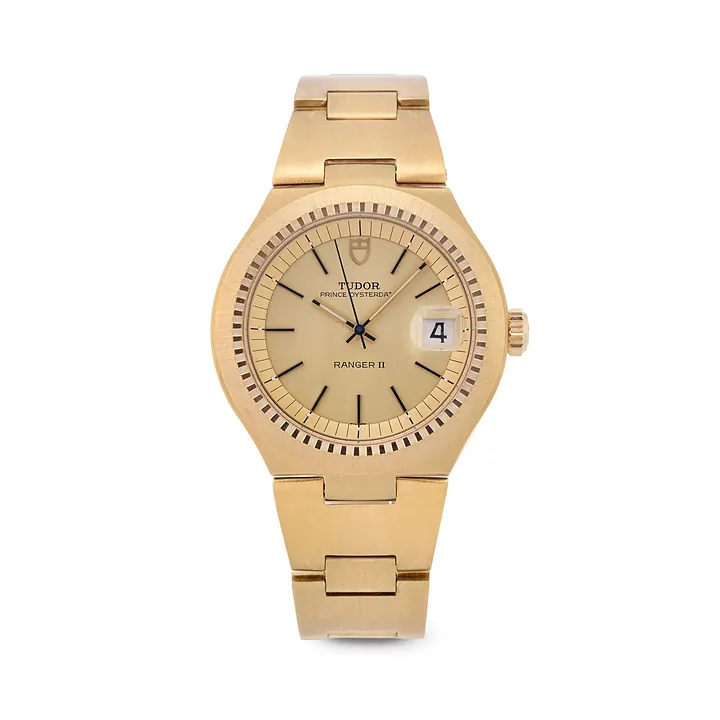
Tudor Prince Oysterdate Ranger II, ref. 9101/1, c. 1973
Antiquorum auction archive, Geneva
Wristwatches · c. 1973
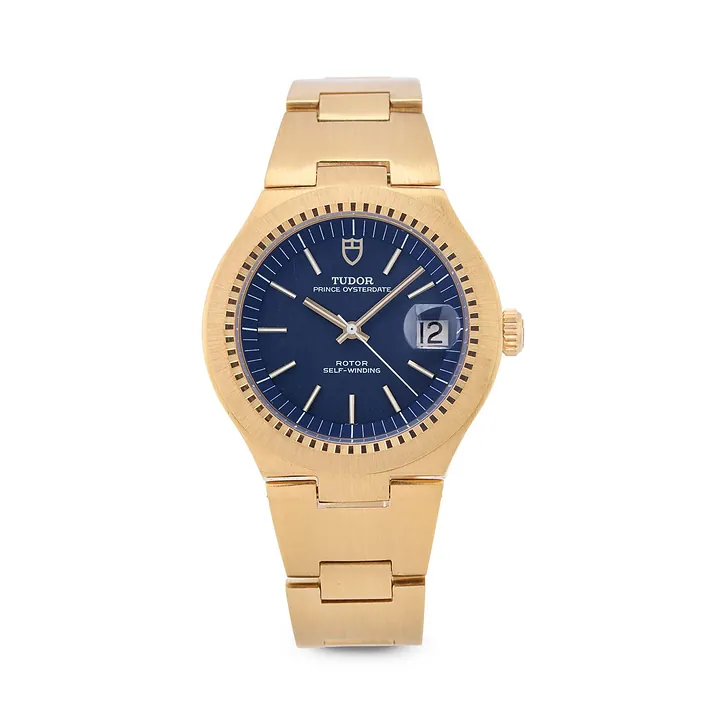
Tudor Prince Oysterdate, ref. 9101/1, c. 1973 (Antiquorum Lot 389-114)
Antiquorum auction archive, Geneva
Wristwatches · c. 1973
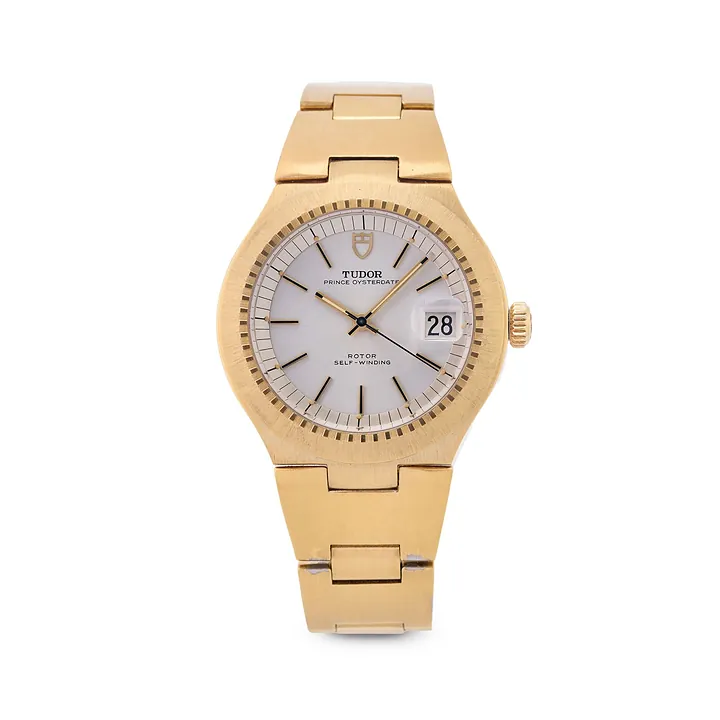
Tudor Prince Oysterdate, ref. 9101/1, c. 1973 (Antiquorum Lot 389-115)
Antiquorum auction archive, Geneva
Wristwatches · c. 1974
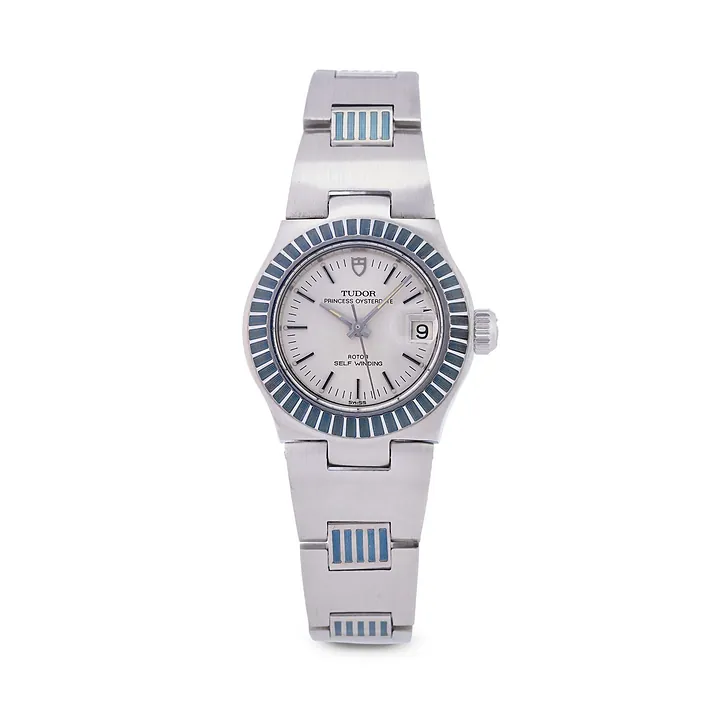
Tudor Princess Oysterdate, ref. 9311/0, c. 1974
Antiquorum auction archive, Geneva

Wristwatches · 1970
Wristwatch by Heno, Switzerland, 1970
Museum Rotterdam

Wristwatches · 1960–1986
'Tri-Compax' calendar chronograph wristwatch in gold case, by Universal, Geneva, Switzerland, 1960–1986.
Science Museum Group, London

Wristwatches · 1969–1970
Beta 21 Quartz wristwatch movement, made in Switzerland, 1970.
Science Museum Group, London

Wristwatches · c. 1969
Omega Speedmaster Moonwatch, ref. 145022-69st, c. 1969
Antiquorum auction archive, Geneva