
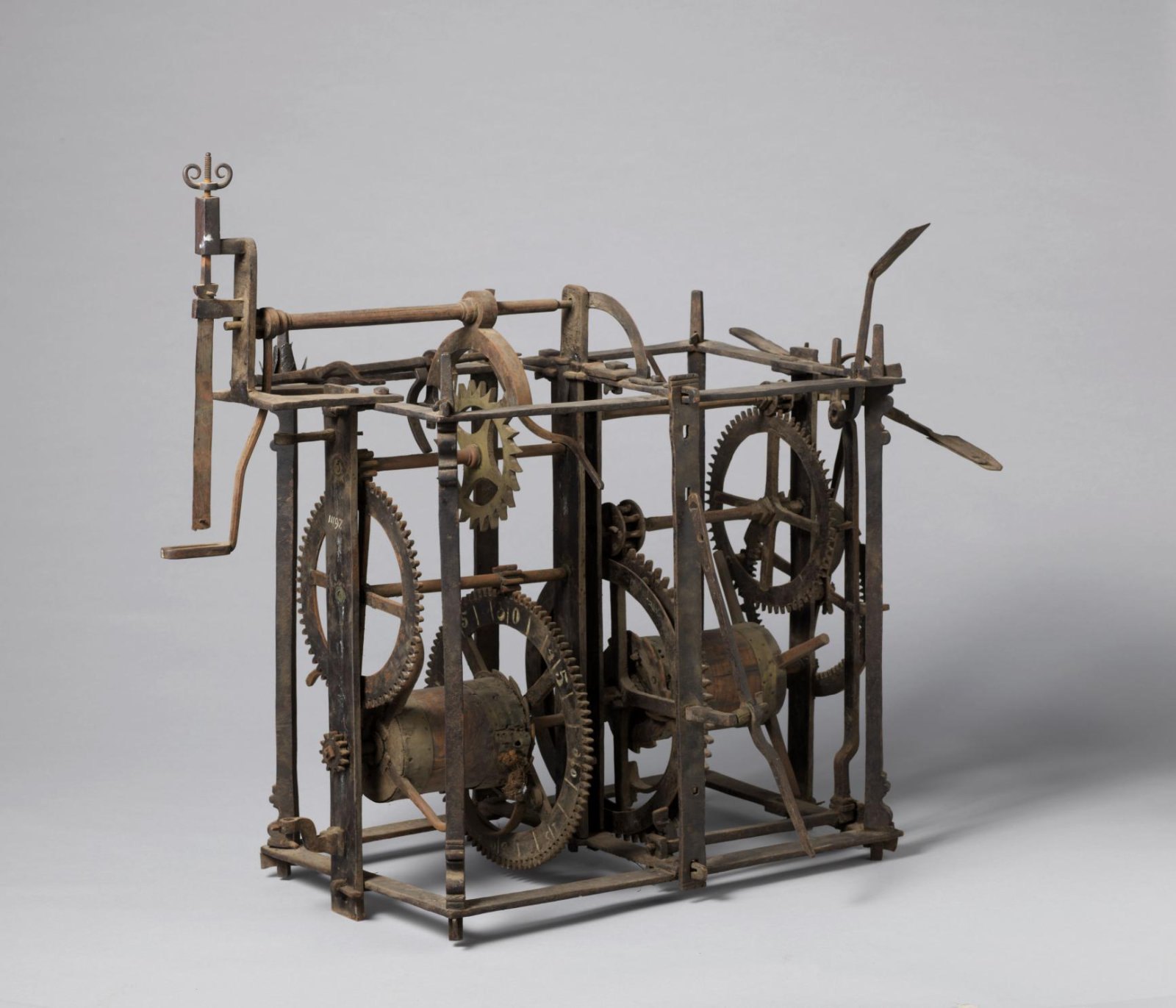
Movements & Components · Tower clock movement
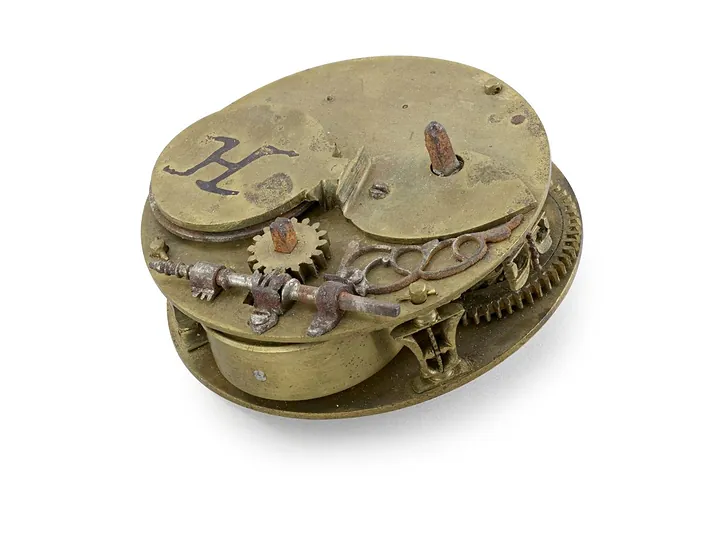
Tower clock movement, c. 1585 - c. 1615
- Maker / attribution
- Unrecorded in source
- Date
- c. 1585 - c. 1615
- Historical period
- Early Modern Horology (1600 – 1750)
- Country of origin
- Unrecorded in source
- Object type
- Tower clock movement
- Materials / technique
- iron (metal)
- Dimensions
- height 95 cm x width 110 cm x depth 60 cm
- Holding institution
- Rijksmuseum
- Accession / object no.
- BK-NM-11197
- Credit line
- Gift of the City of Gorinchem
- Catalogue title (original)
- Torenuurwerk afkomstig van de afgebroken Waterpoort te Gorinchem (Dutch)
View the source record ↗ (opens another website in a new tab)Suggest a correction
Record summary
Held and catalogued by Rijksmuseum (object number BK-NM-11197), this is a tower clock movement, dated c. 1585 - c. 1615. The Atlas places it in the Early Modern Horology period (1600 – 1750) of its Movements & Components collection. Materials and techniques recorded by the source: iron (metal). Recorded dimensions: height 95 cm x width 110 cm x depth 60 cm. The record is illustrated with 1 photograph.
Assembled from the source record's structured fields. Dates and attributions are given as the source states them; where a field is missing the Atlas leaves it blank rather than estimating.
Catalogue description
Description — Rijksmuseum (Dutch)
Uurwerk met losse hamer, behorende bij een bronzen klok, afkomstig uit de toren van de afgebroken Waterpoort te Gorinchem. De klok is gedateerd: 1581. De becijfering op het grondrad van het gaand werk diende om het uurwerk op tijd te zetten. Deze getallen moesten in overeenstemming met de stand van de wijzer staan. Ten opzichte van een markering, of eventueel de ingrijping van het kleine tandwiel aan de bovenzijde kon men binnen de wijzer in de juiste stand zetten. De uurwijzer was wel niet zo nauwkeurig af te lezen, maar voor het slagwerk moest het wel nauwkeurig zijn. Door het anker uit het gangrad te schuiven kunnen de tandwielen vrij draaien en kan de wijzer op tijd gezet worden. Het kleine tandwiel aan de buitenzijde van het gaand werk heeft 12 tanden en gaat eenmaal in de 2 uur rond, dit is te zien aan de becijfering op het grondrad van het gaand werk, die geeft tweemaal 60 minuten. Op het grondrad zitten 2 nokken die het slagwerk aan de gang brengen. Hij slaat dus tweemaal per 2 uur. Ook aan de sluitschijf is te zien dat er geen halfuursslag is. Onder het tandwiel is de lagersteun voor de verticale as naar de wijzers hoger in de toren. Het tandwiel dat hierdoor aangedreven wordt moet 72 tanden bevatten (verhouding 1 : 6), zodat deze as eenmaal in de 12 uur ronddraait, gelijk aan de kleine en enige wijzer. Minuutwijzers zijn pas van aanzienlijk latere tijd. Indien het tandwiel minder tanden heeft zit er nog ergens een overbrenging met ongelijke tandwielen om er voor te zorgen dat de wijzer eenmaal in de 12 uur rond gaat.
Shown in the original language of the source catalogue. An editor-reviewed English translation has not yet been published; we do not publish machine translations as authoritative text.
Historical context
Early Modern Horology (1600 – 1750)
Huygens' pendulum and balance spring transform accuracy; English makers develop the anchor and deadbeat escapements.
The pendulum, anchor escapement and balance spring transformed movement design; English makers introduced jewelled bearings (1704).
Read the period in the timelineMore movements & components from this periodEarlier: Renaissance Horology
Atlas type guide
Clock and watch movements
The movement is the mechanism of a clock or watch, without its case and dial. It consists of the power source (weight or mainspring in its barrel, sometimes with a fusee), the going train of wheels and pinions, the escapement and oscillator, the motion work that drives the hands, and in many cases additional trains for striking or complications.
From the eighteenth century watch movements were increasingly produced in stages: Swiss and French ébauche makers supplied rough movements that finishers, repasseurs and retailers completed and signed. Calibre numbers — first used systematically by American and Swiss factories in the nineteenth century — make it possible to identify movements, find spare parts and date watches.
What to look for
- Plate and bridge layout: full plate, three-quarter plate, Lépine bar calibre, bridges and cocks.
- Jewel count and whether jewels are set in chatons or rubbed in.
- Signatures, calibre and serial numbers on the plate or under the dial.
- Finishing: Geneva stripes (Côtes de Genève), perlage, bevelled edges, blued screws.
- Fusee and chain, going barrel, or electrical components.
Dating clues
- Full-plate English movements dominate before c. 1850; three-quarter plate and Lépine calibres after.
- Jewelled movements spread after Facio and Debaufre's patent of 1704, mainly in English work until c. 1800.
- Calibre numbers and factory serials allow close dating for industrial production after c. 1850.
General guidance written by the Atlas editors about this kind of object. It is not a statement about this particular piece; for that, rely on the source record above and on physical examination.
Related records
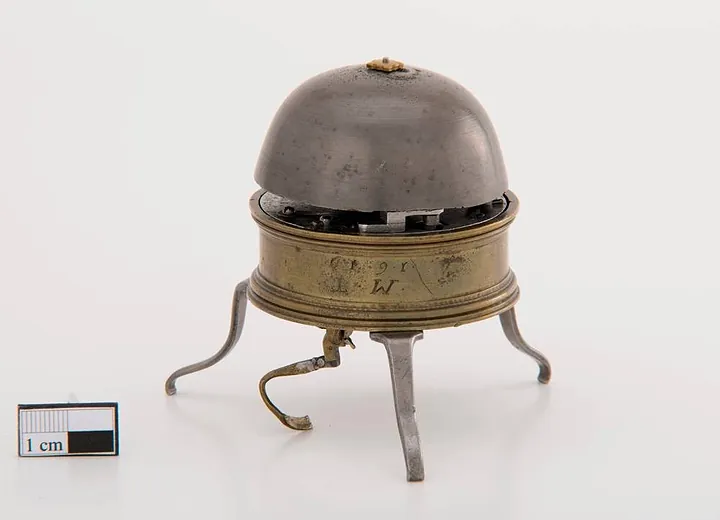
Movements & Components · 1600–1699
Clock movement, Germany, 1600–1699
Dresden State Art Collections. Royal Cabinet of Mathematical and Physical Instruments
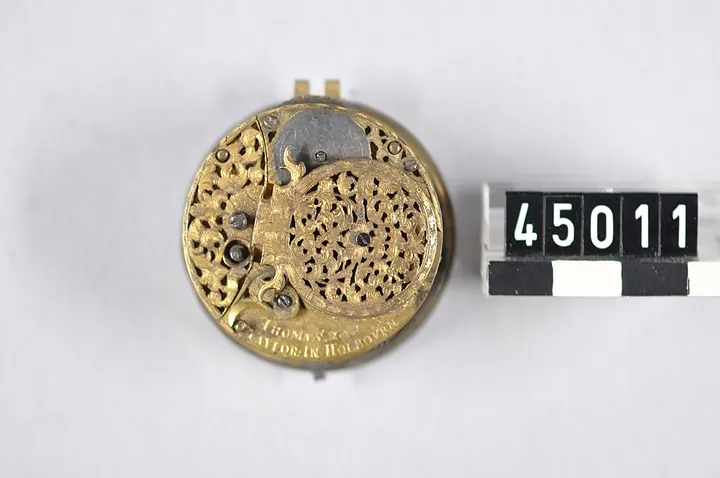
Movements & Components · 1600–1699
Watch movement by Thomas Tylor, 1600–1699
Swedish National Museum of Science and Technology
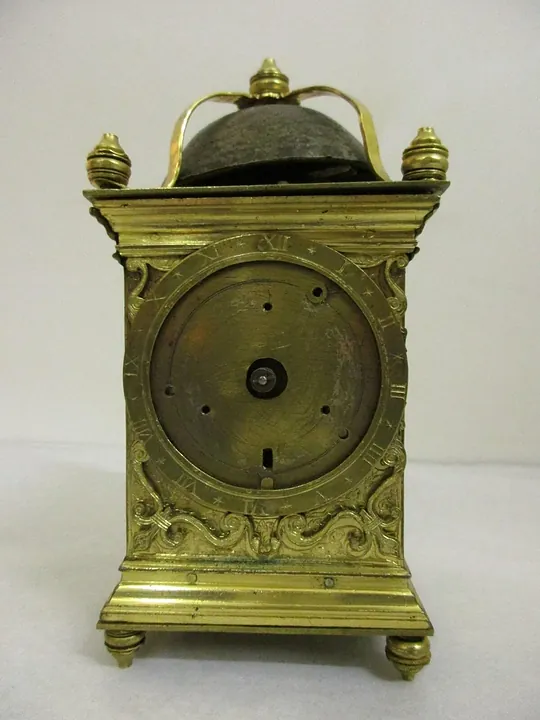
Movements & Components · 1620
Tabernacle clock, engraved with figures of Mercury, Minerva, and Venus with Cupid, German, about 1620.
Victoria and Albert Museum, London
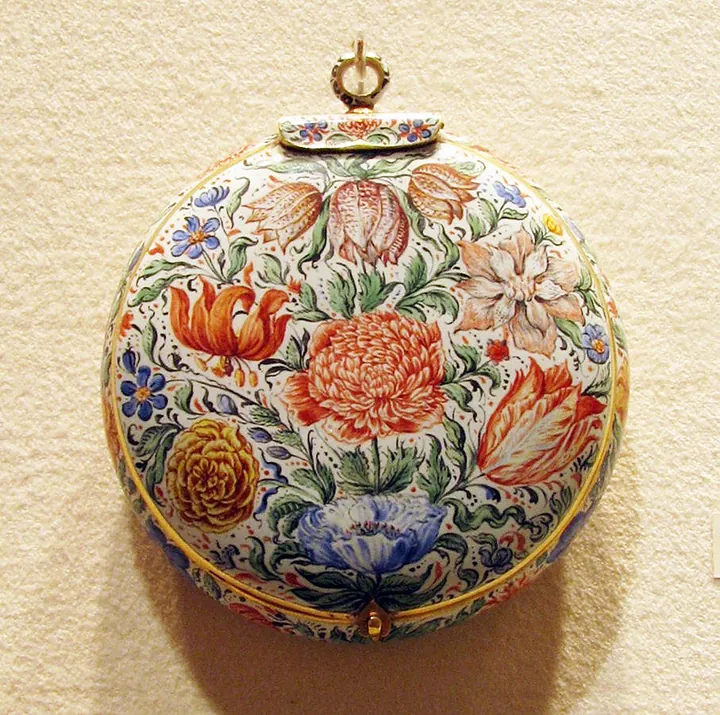
Movements & Components · c. 1645–50
Watch case by Christophe Morliêre, c. 1645–50
The Metropolitan Museum of Art, New York
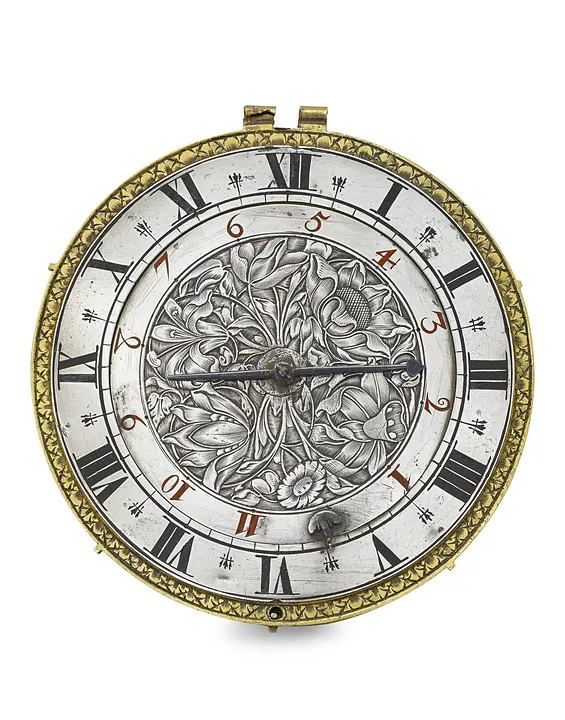
Movements & Components · 1640–1660
Watch movement by Edward East, England, 1640–1660
Science Museum Group, London
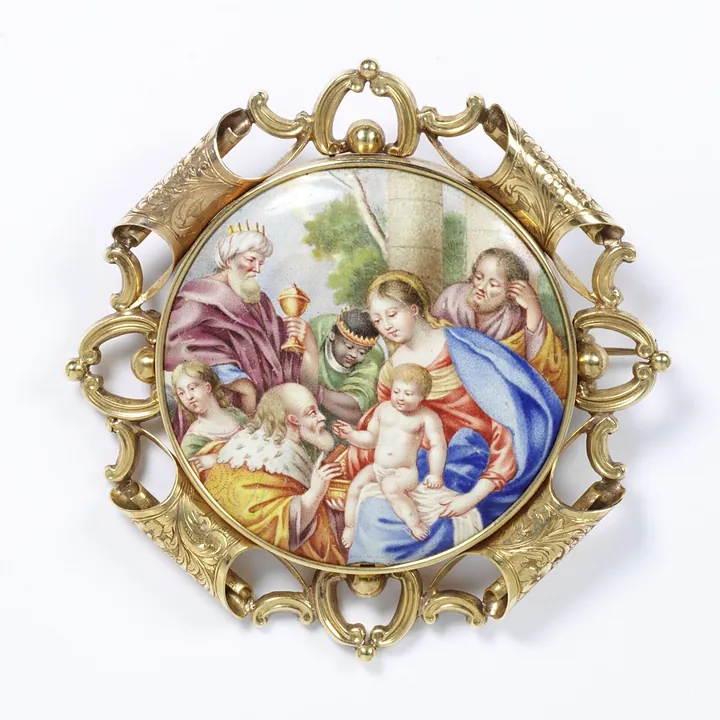
Movements & Components · 1650
Watch case, France, 1650
Victoria and Albert Museum, London
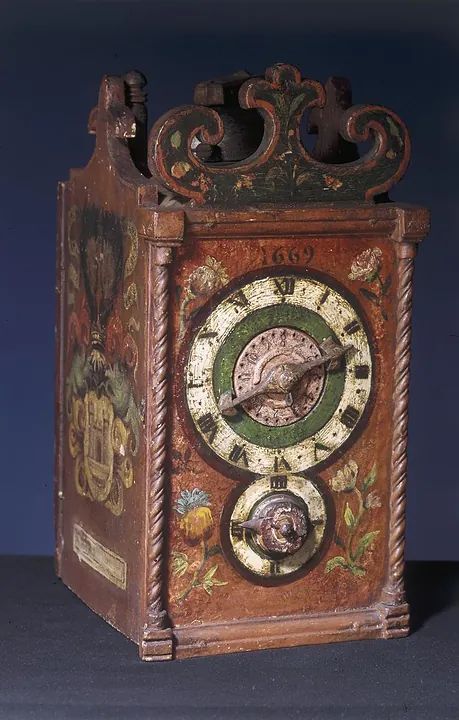
Movements & Components · 1669
Wooden clock, with foliot type escapement, Germany, 1669 (driving weights missing).
Science Museum Group, London
Movements & Components · 1670
Watch movement, England, 1670
Science Museum Group, London