
Wristwatches · Wristwatch
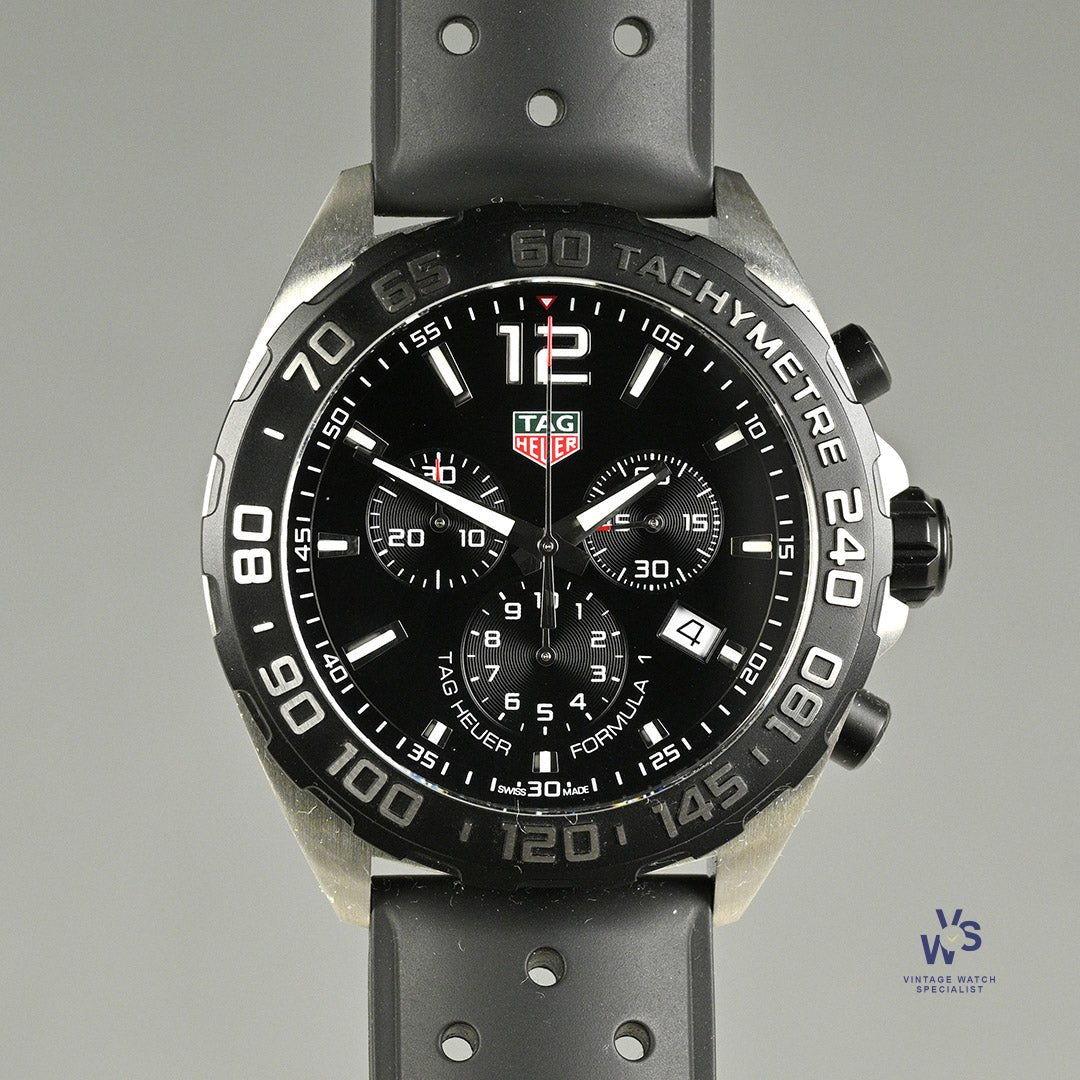
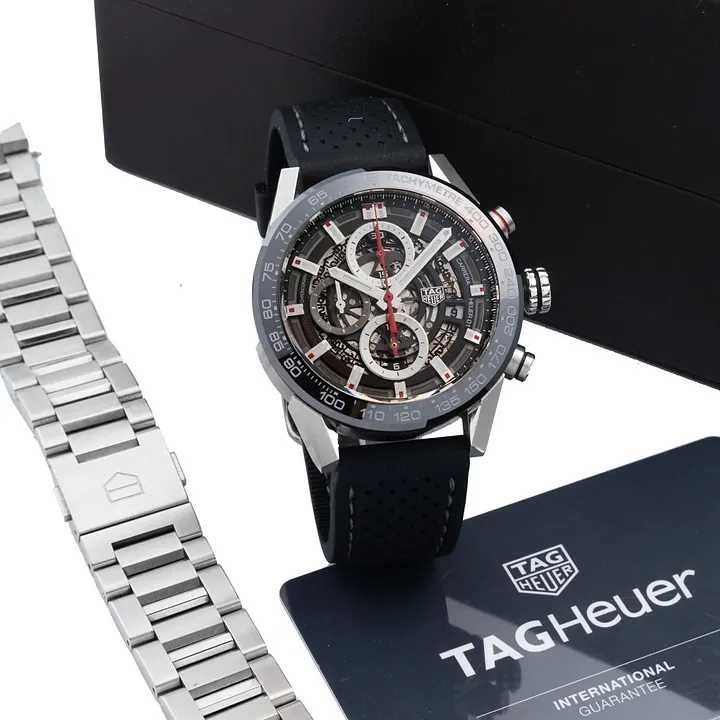
TAG Heuer Formula 1 Chronograph CAZ1010, circa 2015
- Maker / attribution
- TAG Heuer (maker)
- Date
- c. 2015
- Historical period
- Contemporary Horology (2010 – Present)
- Country of origin
- Switzerland
- Object type
- Wristwatch
- Dimensions
- Case 43 mm
- Stock no.
- vws4446cs
- Credit line
- Dealer listing, Vintage Watch Specialist (vws4446cs)
- Catalogue title (original)
- TAG Heuer Formula 1 Chronograph CAZ1010 – New & Unworn - c.2015 (English)
View the source record (dealer listing) ↗ (opens another website in a new tab)Suggest a correction
Record summary
Catalogued by Vintage Watch Specialist (dealer), United Kingdom (stock number vws4446cs), this is a wristwatch by TAG Heuer, made in Switzerland, dated c. 2015. The Atlas places it in the Contemporary Horology period (2010 – Present) of its Wristwatches collection. Recorded dimensions: Case 43 mm. The record is illustrated with 6 photographs.
Assembled from the source record's structured fields. Dates and attributions are given as the source states them; where a field is missing the Atlas leaves it blank rather than estimating.
Catalogue description
Dealer description — Vintage Watch Specialist
The Formula 1 name has been part of TAG Heuer’s story since 1986, when it became the first watch collection launched under the newly formed TAG Heuer name. From the outset, the range was intended to capture the brand’s close association with motorsport in a sporty, practical and more accessible watch. Over the following decades, the Formula 1 evolved considerably. The colourful early models gave way to increasingly substantial sports watches, while chronographs became an important part of the collection. Motorsport remained the common thread, expressed through features such as tachymetre bezels, highly legible dials, robust cases and designs influenced by racing instrumentation. By the 2010s, the Formula 1 had developed into the bold modern sports watch we recognise today. Reference CAZ1010 belongs firmly to this era, combining a large case, chronograph functionality and racing-inspired detailing with the accuracy and convenience of a quartz movement. What’s on Offer Here we have a TAG Heuer Formula 1 Chronograph, reference CAZ1010, dating to circa 2015 and, unusually, presented in new and unworn condition. The 43mm stainless-steel case is paired with a fixed black tachymetre bezel, black chronograph pushers and crown, giving the watch its purposeful motorsport appearance. Its black dial carries applied luminous hour markers, a prominent Arabic 12, three chronograph registers and a date aperture between four and five o’clock. Red accents provide a restrained flash of colour against the otherwise monochrome design. Protecting the dial is a sapphire crystal, while the watch is fitted to a black TAG Heuer strap with perforated detailing. At approximately 48mm lug-to-lug, it has the substantial proportions expected of a modern Formula 1. Inside is the Ronda 5040.D quartz chronograph movement, offering dependable timekeeping alongside the chronograph and date functions.
Historical context
Contemporary Horology (2010 – Present)
Silicon components, connected watches, optical-lattice research clocks and a thriving independent scene.
Smartwatches became the world's best-selling watches, while mechanical watchmaking focuses on craft, innovation (silicon components, new escapements) and independent makers.
Read the period in the timelineMore wristwatches from this periodEarlier: Mechanical Renaissance
Atlas type guide
Chronographs and split-seconds watches
A chronograph is a watch with an additional seconds hand that can be started, stopped and returned to zero independently of the timekeeping. Louis Moinet built an early example in 1816 and Nicolas Rieussec a recording 'chronographe' in 1821; Adolphe Nicole's heart-shaped reset cam (patented 1862) made the modern return-to-zero possible. Split-seconds (rattrapante) chronographs add a second hand that can be stopped for intermediate times; flyback chronographs restart instantly.
Chronographs were essential tools for doctors (pulsometer scales), artillery (telemeter), engineers and sport. In wristwatches, Valjoux, Venus, Lemania and later the automatic chronographs of 1969 (Zenith El Primero, the Chronomatic Calibre 11 group and Seiko 6139) are milestones.
What to look for
- Push-pieces on the case band or a single button in the crown (monopusher).
- Subsidiary registers for minutes and hours; tachymeter, telemeter or pulsometer scales.
- Column wheel versus cam control visible in the movement.
- Calibre markings of specialist makers (Valjoux, Lemania, Venus, Landeron).
Dating clues
- Pocket chronographs with heart cam reset: after 1862.
- Wrist chronographs: from c. 1910; two-button designs from the 1930s.
- Automatic chronographs: from 1969.
General guidance written by the Atlas editors about this kind of object. It is not a statement about this particular piece; for that, rely on the source record above and on physical examination.
Read next:Flyback chronographChronograph
Related records
Wristwatches · c. 2000
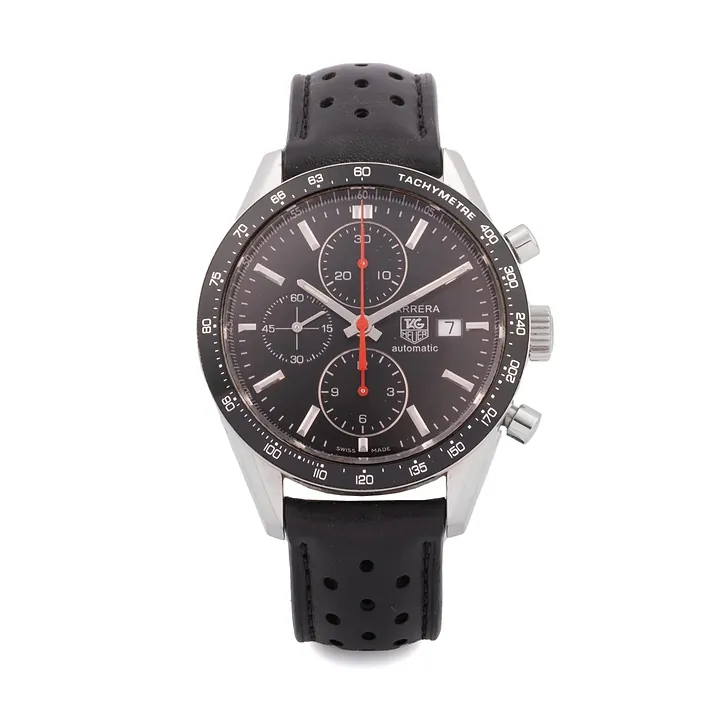
TAG Heuer wristwatch, ref. cv2014-2, c. 2000
Antiquorum auction archive, Geneva
Wristwatches · c. 2010s
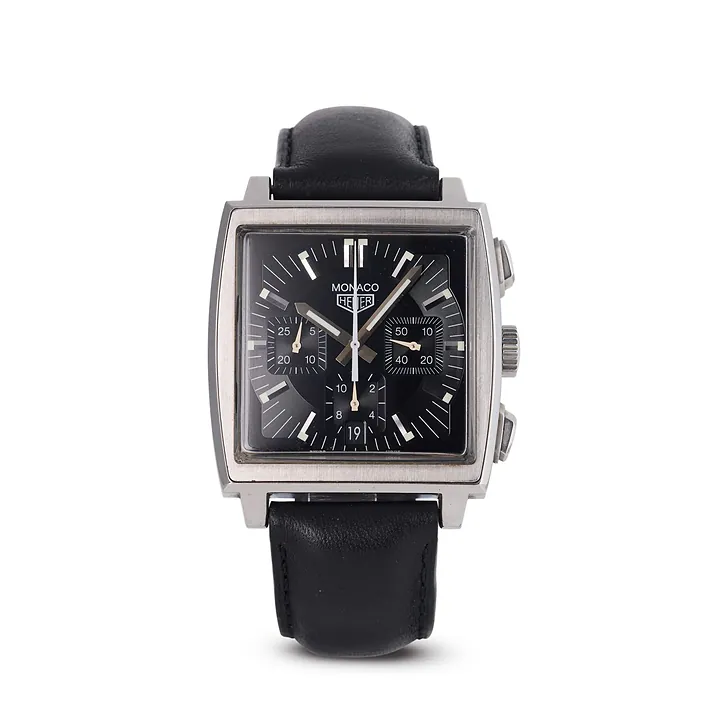
TAG Heuer Monaco, ref. CS2111, c. 2010s
Antiquorum auction archive, Geneva
Wristwatches · c. 2014
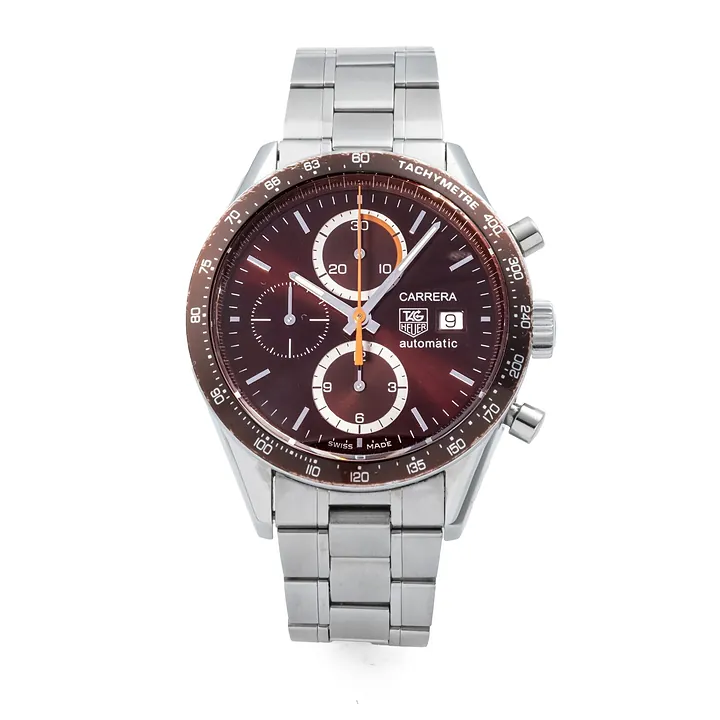
TAG Heuer Carrera 1860, ref. CV2013.BA0794, c. 2014
Antiquorum auction archive, Geneva
Wristwatches · Sold in March 2018
TAG Heuer Carrera, ref. CAR201V, Sold in March 2018
Antiquorum auction archive, Geneva

Wristwatches · c. 2010s
Breguet Type XXI, ref. 3810, c. 2010s (Antiquorum Lot 381-24)
Antiquorum auction archive, Geneva

Wristwatches · c. 2010s
Breguet Type XXI, ref. 3810, c. 2010s (Antiquorum Lot 386-229)
Antiquorum auction archive, Geneva

Wristwatches · Sold in September 2010
Breitling Cosmonaute, ref. A 22322, Sold in September 2010
Antiquorum auction archive, Geneva

Wristwatches · c. 2010
Corum Bubble Chrono, ref. 396.150.20, c. 2010
Antiquorum auction archive, Geneva