
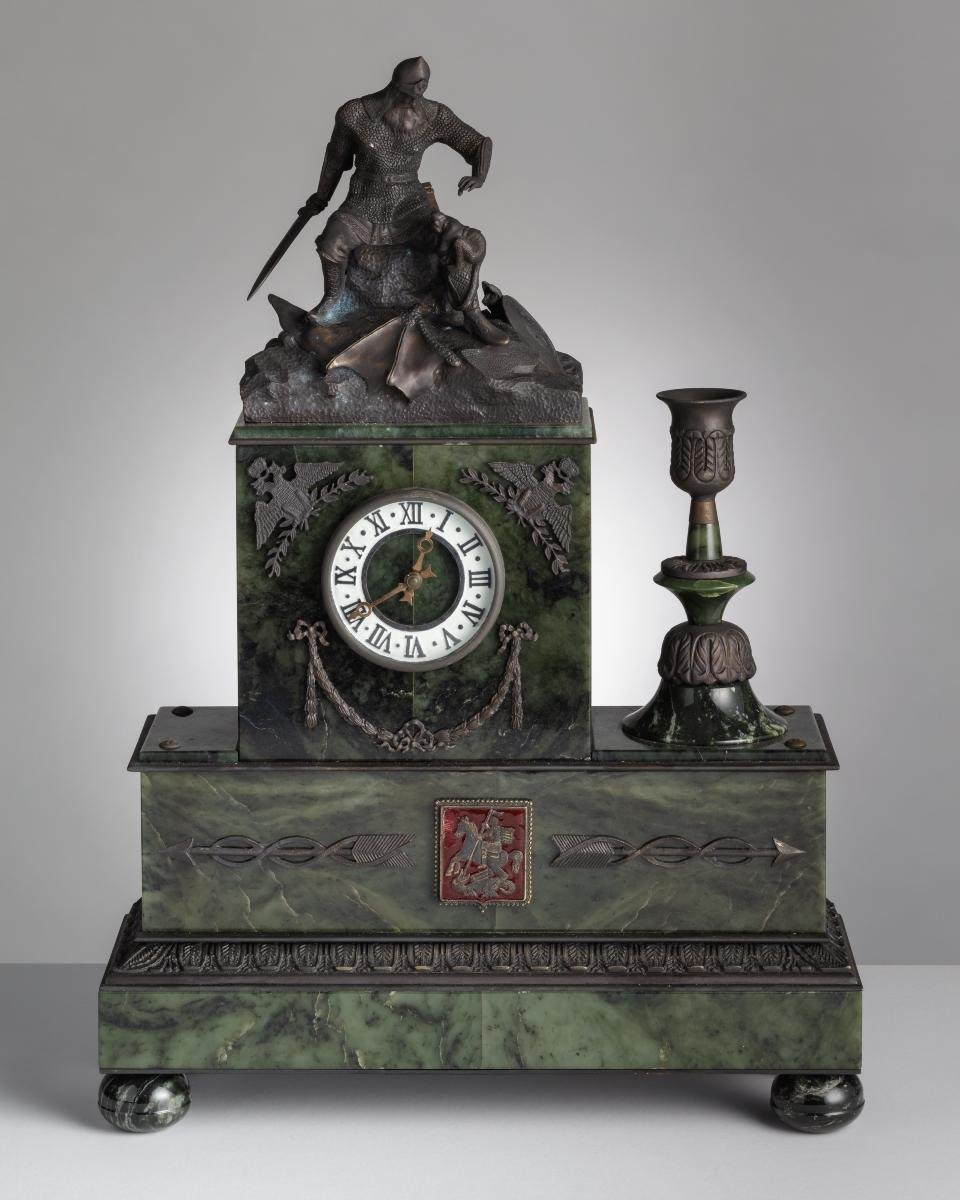
Clocks · Table clock
Table clock, Russia, first half of the 1980s
- Maker / attribution
- Unrecorded in source
- Date
- first half of the 1980s
- Historical period
- Quartz Revolution (1969 – 1990)
- Country of origin
- Russia
- Place
- Soviet Union
- Object type
- Table clock
- Materials / technique
- metal, stone
- Dimensions
- height, max., kello: 49.5 cm; width, max., kello: 35 cm; depth, max., kello: 14.5 cm; height, box: 63.5 cm; width, box: 43 cm; depth, box: 26 cm
- Holding institution
- Suomen kansallismuseo
- Accession / object no.
- IT20:7
- Credit line
- Suomen kansallismuseo (via Finna)
- Catalogue title (original)
- pöytäkello (Finnish)
View the source record ↗ (opens another website in a new tab)Suggest a correction
Record summary
Held and catalogued by Suomen kansallismuseo (object number IT20:7), this is a table clock, made in Soviet Union, Russia, dated first half of the 1980s. The Atlas places it in the Quartz Revolution period (1969 – 1990) of its Clocks collection. Materials and techniques recorded by the source: metal, stone. Recorded dimensions: height, max., kello: 49.5 cm; width, max., kello: 35 cm; depth, max., kello: 14.5 cm; height, box: 63.5 cm; width, box: 43 cm; depth, box: 26 cm. The record is illustrated with 3 photographs.
Assembled from the source record's structured fields. Dates and attributions are given as the source states them; where a field is missing the Atlas leaves it blank rather than estimating.
Catalogue description
Description — Suomen kansallismuseo
fyysinen kuvaus: Suorakaiteisella, neljällä matalalla pallomaisella jalalla varustetulla korkealla jalustalla oleva nelikulmainen kello, jonka vierellä on matala kynttilänjalka. Jalustan etuseinässä on Moskovan vaakuna (Pyhä Yrjö) ja vaakasuuntaiset nuoliaiheiset metallikoristeet. Kellotaulussa roomalaiset numero I-XII, kellotaulun kulmissa Venäjän kaksipäiset kotkat. Kellon päällä istuu plastinen, metallista valettu soturifiguuri (taru- tai satuhahmo, Ruslan?), jonka polvella istuu pieni apina. Näkyvillä olevat metalliosat on patinoitu mustaksi, muutoin jalusta ja kellon kotelo on päällystetty ohuella vihreällä kivilevyllä (vihreää kvartsia tai aventuriinia?). Puinen, tammiviilulla päällystetty laatikko, jossa on saranoitu kansi (ts. etusivu). Kotelon etusivulla metallisin kirjaimin C ROSNA. Pienet metallijalat ja kyljissä metalliset kantimet, ovessa metallisalvat. Kello on kiinnitetty kotelon sisäseiniin kahdella kangashihnalla. Avain.
Shown in the original language of the source catalogue. An editor-reviewed English translation has not yet been published; we do not publish machine translations as authoritative text.
Inscriptions & marks
leima: 555, soikio sisällä, takana; leima: 350, takana; leima: C ROSNA, R-kirjain C-kirjaimen sisällä, takana; leima, soikea leima, jossa kaksi pyöreämuotoista kirjainta?, takana; leima: SU, takana; leima: .IF. I, takana; leima: POPOV VI, takana
Historical context
Quartz Revolution (1969 – 1990)
Seiko's Astron begins mass quartz timekeeping; traditional industries contract sharply.
Quartz movements and digital displays made accurate clocks cheap and ubiquitous after the early 1970s. LED and LCD clocks, clock radios and radio-controlled clocks appeared, while traditional mechanical clockmaking contracted sharply in Germany, France and Britain.
Read the period in the timelineMore clocks from this periodEarlier: Modern Mechanical Horology
Atlas type guide
Bracket, table and spring-driven clocks
Spring-driven clocks freed timekeeping from the hanging weight. The coiled mainspring, documented from the fifteenth century, made portable table clocks possible; to even out its declining force, makers used the fusee, a conical pulley connected to the barrel by a gut line or chain. Renaissance table clocks from Augsburg and Nuremberg — drum-shaped, square or tower-shaped in gilt brass — were luxury scientific objects, often with astronomical dials and alarms.
After the pendulum, English makers developed the bracket clock: a wooden case with a carrying handle, a short pendulum with a verge escapement, and often repeating work to sound the hours on demand at night. Later examples use the anchor escapement. In the nineteenth century, 'table clock' became a broad term for spring clocks of every nationality.
What to look for
- A fusee in the movement (cone-shaped pulley) and the type of line — gut or chain.
- Verge escapement with a short bob pendulum, often with a decoratively engraved backplate.
- Repeat cords or buttons that make the clock strike again on demand.
- Gilt-brass engraved cases and horizontal dials on Renaissance pieces.
- Case shapes: inverted bell, bell top, break-arch, lancet or balloon.
Dating clues
- Drum and tower table clocks: c. 1520–1650.
- Ebony veneered English bracket clocks with verge escapements: c. 1670–1800.
- Engraved backplates were usual on English clocks until c. 1800, then generally plain.
General guidance written by the Atlas editors about this kind of object. It is not a statement about this particular piece; for that, rely on the source record above and on physical examination.
Related records
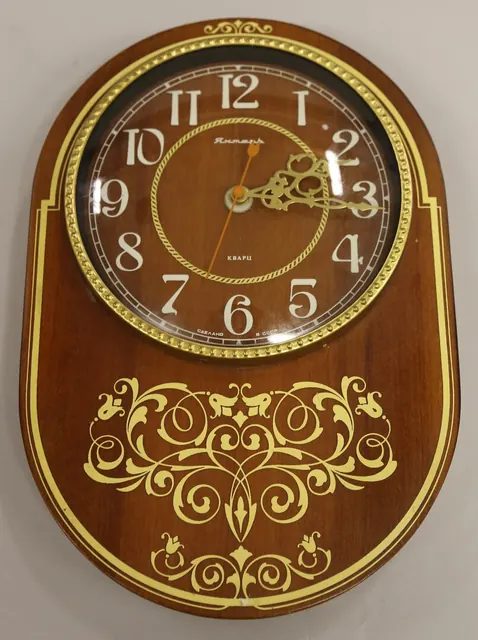
Clocks · 1970s
Wall clock by Orjolin kellotehdas "Jantar", Russia, 1970s
Työväenmuseo Werstas
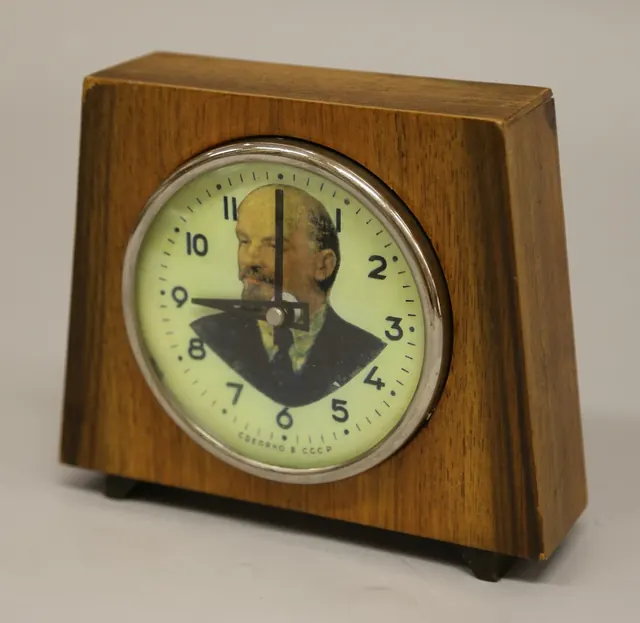
Clocks · 1960s–1970s
Table clock, Russia, 1960s–1970s
Työväenmuseo Werstas
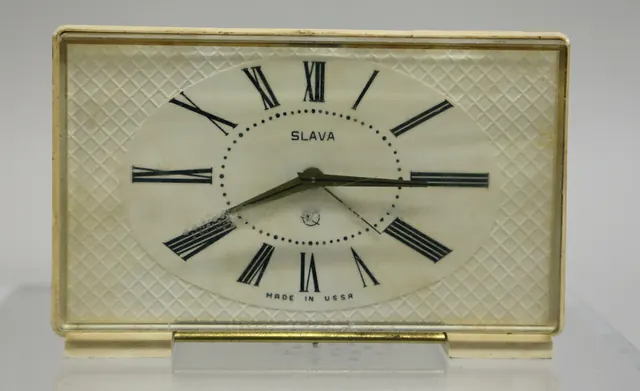
Clocks · 1980
Table clock by Slava, Russia, 1980
Työväenmuseo Werstas
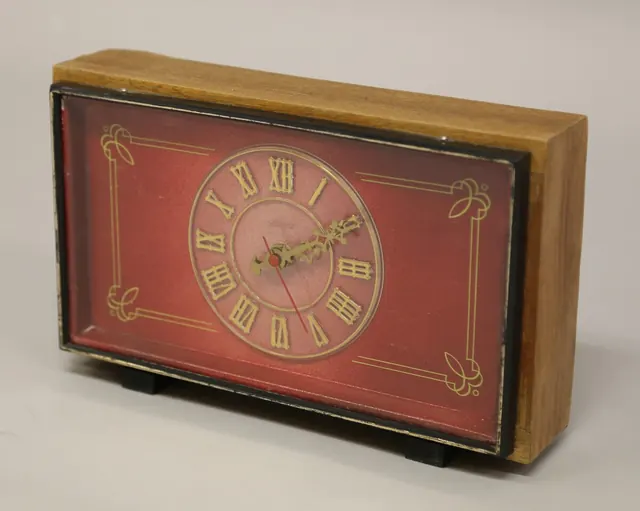
Clocks · 1970s
Table clock by Majak, Russia, 1970s
Työväenmuseo Werstas
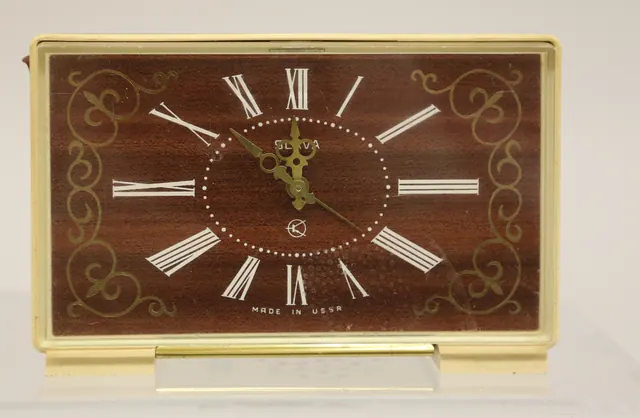
Clocks · 1980
Table clock by Slava, Russia, 1980
Työväenmuseo Werstas
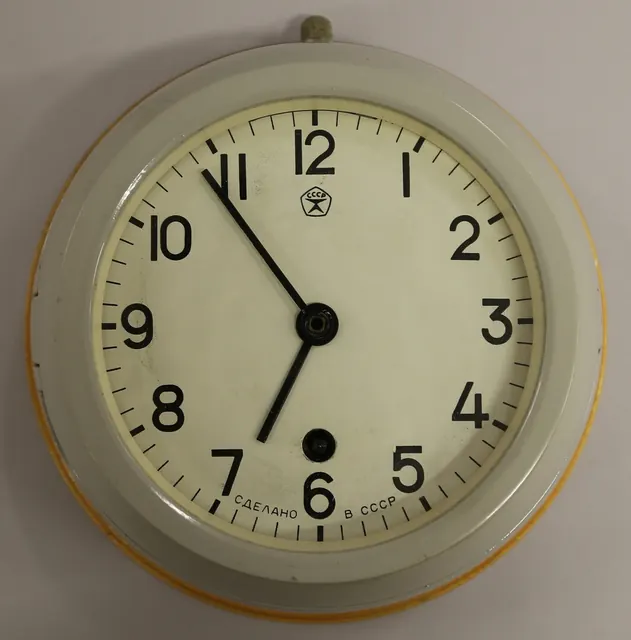
Clocks · 1960s–1970s
Wall clock, Russia, 1960s–1970s
Työväenmuseo Werstas
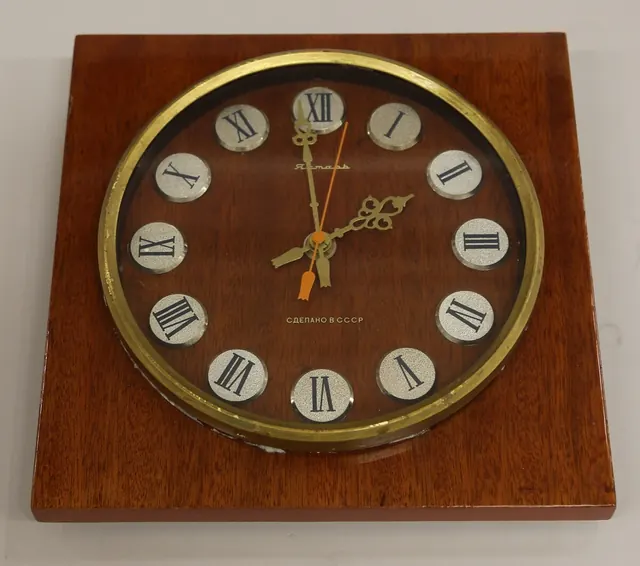
Clocks · 1970s
Wall clock by Orjolin kellotehdas "Jantar", Russia, 1970s
Työväenmuseo Werstas
Clocks · 1980
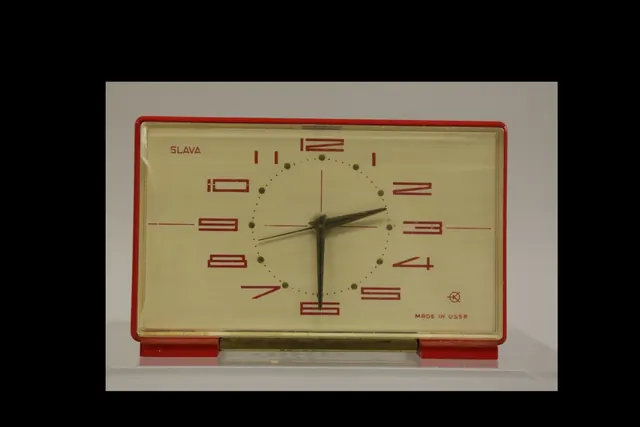
Table clock by Slava, Russia, 1980
Työväenmuseo Werstas