
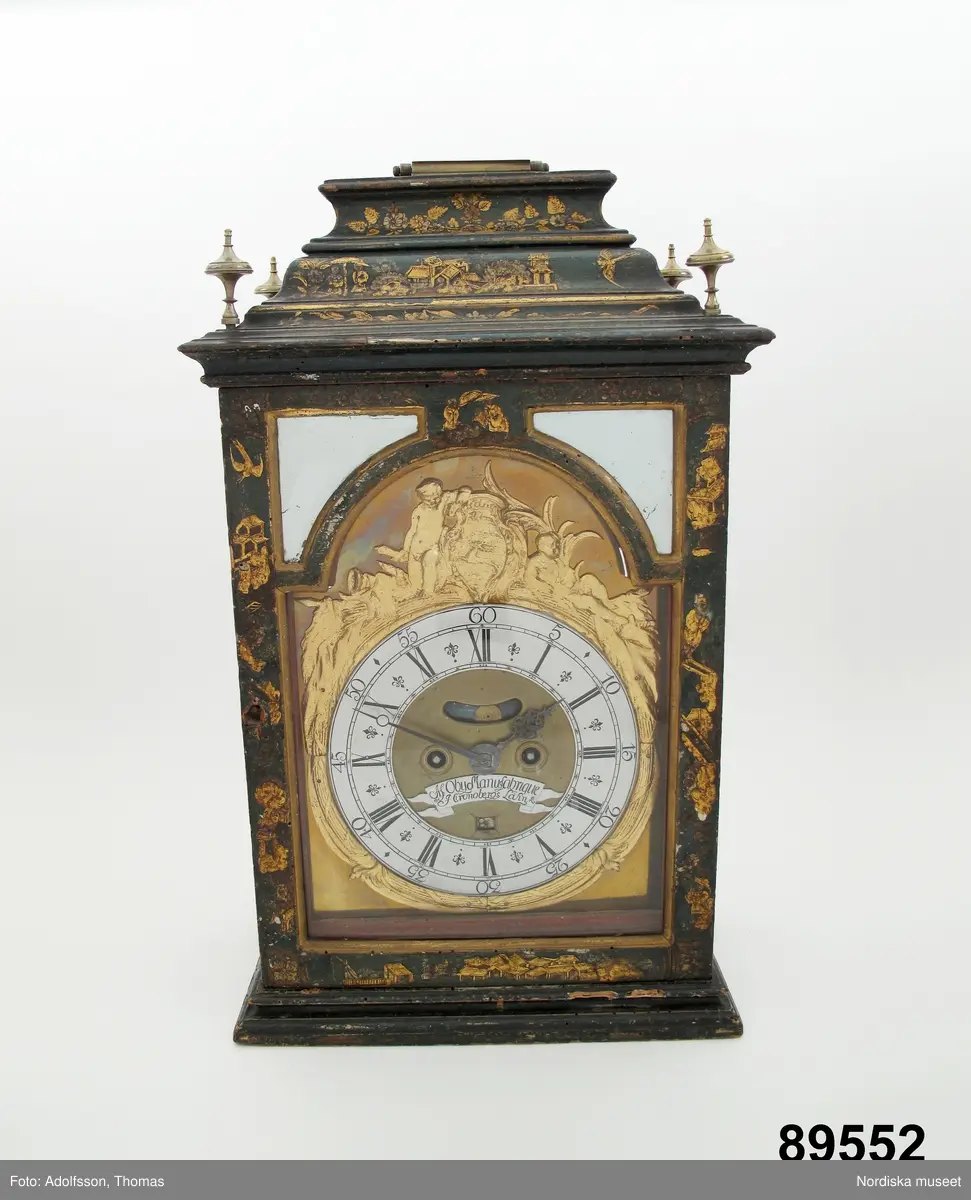
Clocks · Table clock
Table clock by Gustaf Cronhiort, Sweden, 1741–1745
- Maker / attribution
- Gustaf Cronhiort (Maker)
- Date
- 1741–1745
- Historical period
- Early Modern Horology (1600 – 1750)
- Country of origin
- Sweden
- Place
- Sverige Stockholm Stockholm Oby
- Object type
- Table clock
- Materials / technique
- Lackarbete Glas
- Dimensions
- Bredd 30.0 cm Djup 16.5 cm
- Holding institution
- Nordic Museum Foundation
- Accession / object no.
- NM.0089552
- Credit line
- Nordic Museum Foundation
- Catalogue title (original)
- Bordsur (Swedish)
View the source record ↗ (opens another website in a new tab)Suggest a correction
Record summary
Held and catalogued by Nordic Museum Foundation (object number NM.0089552), this is a table clock by Gustaf Cronhiort, made in Sverige Stockholm Stockholm Oby, Sweden, dated 1741–1745. The Atlas places it in the Early Modern Horology period (1600 – 1750) of its Clocks collection. Materials and techniques recorded by the source: Lackarbete Glas. Recorded dimensions: Bredd 30.0 cm Djup 16.5 cm. The record is illustrated with 1 photograph.
Assembled from the source record's structured fields. Dates and attributions are given as the source states them; where a field is missing the Atlas leaves it blank rather than estimating.
Catalogue description
Catalogue description from Nordic Museum Foundation
Tillverkat vid Oby Manufabrique, Kronobergs län, Småland. Fabriken grundades 1741 av friherre Carl Gustaf Cronhiort och drevs endast några år. /Anna Arfvidsson Womack 2021 Bordsur, 1740-tal, senbarock modell, lackmålat fodral av trä med kineserier i guld på blågrön botten. Infällda spegelglas. Signerat på urtavlan: "Af Oby Manufabrique i Cronobergs Lähn". /Anna Arfvidsson Womack 2021
Shown in the original language of the source catalogue. An editor-reviewed English translation has not yet been published; we do not publish machine translations as authoritative text.
Historical context
Early Modern Horology (1600 – 1750)
Huygens' pendulum and balance spring transform accuracy; English makers develop the anchor and deadbeat escapements.
Huygens's pendulum (1656–57) improved clock accuracy from about a quarter of an hour to under a minute a day. The anchor escapement (c. 1670) and the long seconds pendulum created the longcase clock; London makers such as Fromanteel, Knibb, Tompion and Quare led European clockmaking, and French makers created the Boulle pendule.
Read the period in the timelineMore clocks from this periodEarlier: Renaissance Horology
Atlas type guide
Bracket, table and spring-driven clocks
Spring-driven clocks freed timekeeping from the hanging weight. The coiled mainspring, documented from the fifteenth century, made portable table clocks possible; to even out its declining force, makers used the fusee, a conical pulley connected to the barrel by a gut line or chain. Renaissance table clocks from Augsburg and Nuremberg — drum-shaped, square or tower-shaped in gilt brass — were luxury scientific objects, often with astronomical dials and alarms.
After the pendulum, English makers developed the bracket clock: a wooden case with a carrying handle, a short pendulum with a verge escapement, and often repeating work to sound the hours on demand at night. Later examples use the anchor escapement. In the nineteenth century, 'table clock' became a broad term for spring clocks of every nationality.
What to look for
- A fusee in the movement (cone-shaped pulley) and the type of line — gut or chain.
- Verge escapement with a short bob pendulum, often with a decoratively engraved backplate.
- Repeat cords or buttons that make the clock strike again on demand.
- Gilt-brass engraved cases and horizontal dials on Renaissance pieces.
- Case shapes: inverted bell, bell top, break-arch, lancet or balloon.
Dating clues
- Drum and tower table clocks: c. 1520–1650.
- Ebony veneered English bracket clocks with verge escapements: c. 1670–1800.
- Engraved backplates were usual on English clocks until c. 1800, then generally plain.
General guidance written by the Atlas editors about this kind of object. It is not a statement about this particular piece; for that, rely on the source record above and on physical examination.
Related records
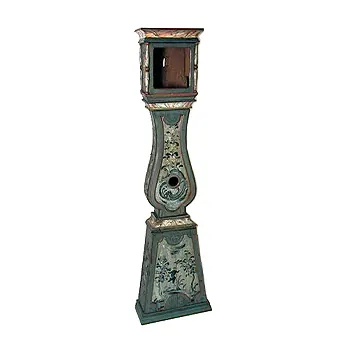
Clocks · 1700
Longcase clock, Sweden, 1700
Skelleftea museum
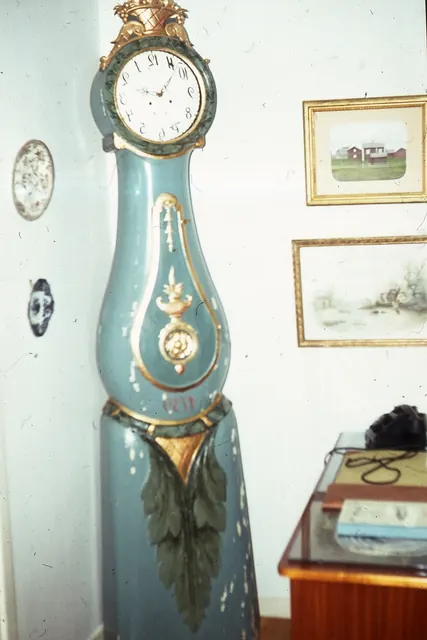
Clocks · 1739
Longcase clock, Sweden, 1739
National Association of Swedish Handicraft Societies
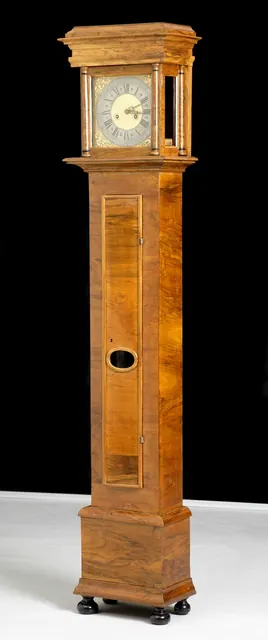
Clocks · 1700–1750
Longcase clock, Sweden, 1700–1750
Kulturparken Småland
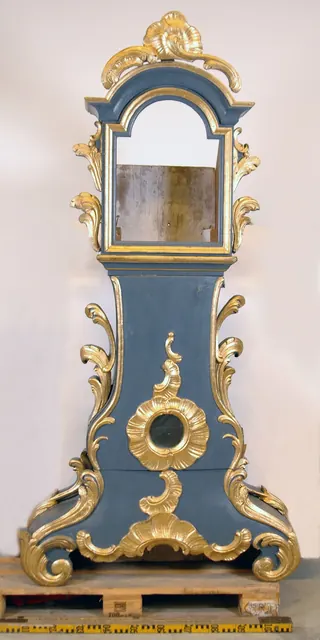
Clocks · 1700-tal (1700 AD - 1799 AD)
Longcase clock, Sweden, 1700-tal (1700 AD - 1799 AD)
Swedish History Museum
Clocks · 1700
Longcase clock by Anders Torsel, Sweden, 1700
Nordic Museum Foundation
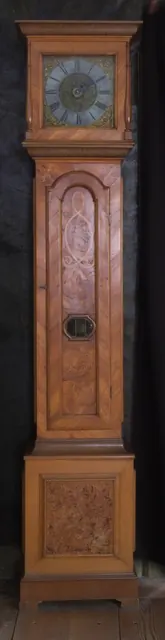
Clocks · 1735
Clock by Olof Nohrin, Sweden, 1735
Skansen
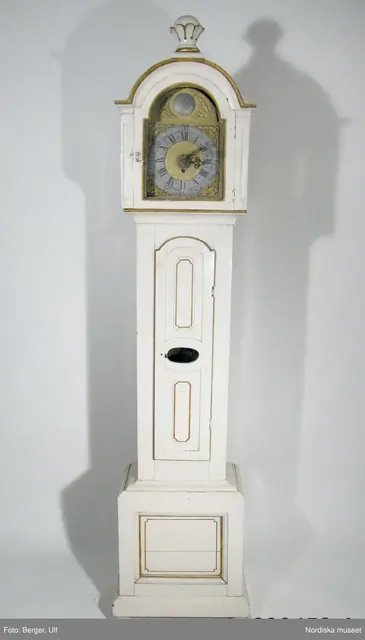
Clocks · 1735
Longcase clock by Petter Norsell, Sweden, 1735
Nordic Museum Foundation
Clocks · 1700s
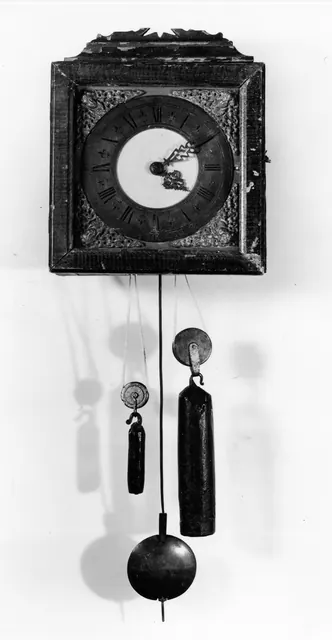
Wall clock by Petter Ernst, Sweden, 1700s
Suomen kansallismuseo