Clocks · Clock
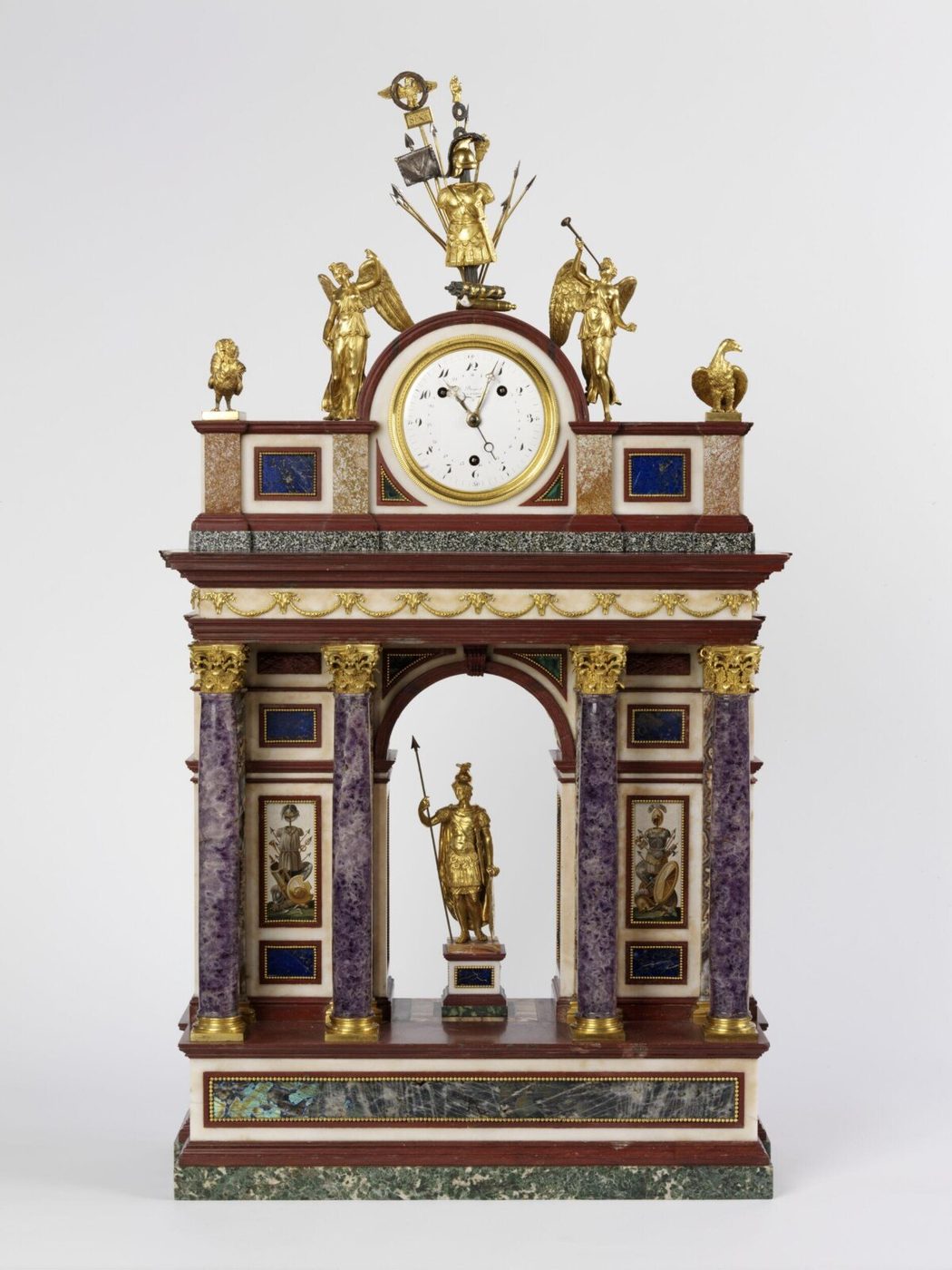
Stones and micromosaic clock in the form of a triumphal arch, 1804. Case: Rome, Giacomo Raffaelli; clock: Paris, Abraham-Louis Breguet.
- Maker / attribution
- Giacomo Raffaelli (maker)
- Date
- 1804
- Historical period
- Precision & Scientific Horology (1750 – 1850)
- Country of origin
- Italy
- Place
- Rome
- Object type
- Clock
- Materials / technique
- Hardstones, amethyst, lapis lazuli, malachite, labradorite, jasper, agate, marble, glass micromosaic, gilded bronze and clock movement.
- Dimensions
- Height: 89.6 cm; Width: 51.1 cm; Depth: 21 cm
- Holding institution
- Victoria and Albert Museum, London
- Accession / object no.
- LOAN:GILBERT.4:1 to 4-2008
- Credit line
- The Rosalinde and Arthur Gilbert Collection on loan to the Victoria and Albert Museum
Record summary
Held and catalogued by Victoria and Albert Museum, London (object number LOAN:GILBERT.4:1 to 4-2008), this is a clock by Giacomo Raffaelli, made in Rome, Italy, dated 1804. The Atlas places it in the Precision & Scientific Horology period (1750 – 1850) of its Clocks collection. Materials and techniques recorded by the source: Hardstones, amethyst, lapis lazuli, malachite, labradorite, jasper, agate, marble, glass micromosaic, gilded bronze and clock movement. Recorded dimensions: Height: 89.6 cm; Width: 51.1 cm; Depth: 21 cm. The record is illustrated with 3 photographs.
Assembled from the source record's structured fields. Dates and attributions are given as the source states them; where a field is missing the Atlas leaves it blank rather than estimating.
Catalogue description
V&A — Summary
Giacomo Raffaelli (1753–1836) invented the micromosaic technique. His intricate creations, often complemented by hardstone elements, were acquired by European and Russian sovereigns. This clock is one of four ever designed by Raffaelli. Produced between 1801 and 1814 the clock differ in the type of stone used for the four stone pillars. Here the columns are made from amethyst, for the other three he used: bloodstone (signed and dated 1801, now in the Hermitage Museum, inv. N. Epr-5601), labradorite (unrecorded) and malachite (signed and dated 1814, now in the Fersman Mineralogical Museum, inv. N. PDK1712). Newly discovered archives record that Eugene de Beauharnais, Viceroy of Italy, gave this clock to his mother Empress Josephine for her château of Malmaison, France. Sir Arthur Gilbert and his wife Rosalinde formed one of the world's great decorative art collections, including silver, mosaics, enamelled portrait miniatures and gold boxes. He donated his extraordinary collection to Britain in 1996.
V&A — Physical description
A clock mounted on top of a triumphal arch made of red and white antique marble. To the front of the arch are four amethyst columns topped by Corinthian capitals. Between these columns are visible two micromosaic panels depicting military trophies. The clock dial is surmounted by a military trophy that is flanked by the figures of Victory and Fame, with a cockerel and eagle standing on the corners. In the centre and beneath the arch is a gilt-bronze statuette of Mars, standing on a stone base.
V&A — Object history
Giacomo Raffaelli was a Roman mosaicist credited with the invention of a new technique which allowed the creation of mosaics with incredibly small pieces of glass in a seemingly infinite range of colours. He was a fantastic businessman and worked with his sons Vincenzo, Filippo, Giovanni, in designing, creating and developing his name through Europe. Based in Rome, he also had a shop in Milan and received commissions from European and Russian sovereigns, including Emperor Napoleon I, Empress Josephine, and King of Poland Stanislas August II Poniatowski (1732-1798). Raffaelli worked also in hardstones and bronze to create most fantastic pieces, from gold boxes to fireplace, jewellery to clocks, in the utmost neoclassical fashion. This clock is one of four clocks uniquely produced by Giacomo Raffaelli between 1801 and 1814. All after the same neoclassical model, they differ in the stone used for their columns: one was made of bloodstone (signed and dated 1801, now in the Hermitage museum, inv. N. Epr-5601), one of Labrador (yet unrecovered), one of malachite (signed and dated 1814, now in the Fersman Mineralogical Museum, inv. N. PDK1712), and one of amethyst which is the Gilbert example. When Sir Arthur Gilbert acquired this clock, it was thought to have been chosen by the Venetian sculptor Antonio Canova and presented by Pope Pius to Napoleon Bonaparte on the occasion of his coronation in Paris, December 1804. Anna Maria Massinelli recently published undiscovered archives (2018), bringing to light a further fascinating and complicated provenance. A correspondence between Vincenzo, son of Giacomo Raffaelli and head of the workshop in Milan, and his father, still in Rome, reveals that the clock was made from April to September 1804. Work began in the Milan workshop in April 1804 and was completed by Giacomo in Rome around September/October 1804. In another letter, dated 2 September 1850, Vincenzo explains that the clock was given by Eugene de Beauharnais, viceroy of Italy, to his mother the Empress Josephine, who kept it in her château de Malmaison. After the fall of Napoléon, the clock was sold to Russian collections but unfortunately Vincenzo was find it in St Petersburg palace during his visit in 1850. The clock then reappears on the art market in 1973, with the following provenance: ‘Napoleon is said to have been presented the clock to Marshal Bernadotte, later King of Sweden, one of whose descendants gave it to Sir Alexander Kleinworth in acknowledgement of financial advice. It passed to his son Mr Cyril Kleinworth, and thence to H. Burton-Jones and to the present owner.” Provenance Given to Empress Josephine, Malmaison, by her brother Eugene de Beauharnais. Somehow in St Petersburg Palace, circa 1815-before 1850. Said to have been given to Sir Alexander Kleinwort by descendants of Marshal Bernadotte, later King of Sweden. Thence by descent to Cyril Kleinwort. Thence by descent H. Burton Jones. Thence by descent A. Gifford-Scott. Sale, Sotheby's, London, lot 33, 15 June 1973. Sold by John Partridge, London, 1976 to Arthur Gilbert.
V&A gallery label
4. Triumphal-arch clock About 1804 Impressed by the work of Giacomo Raffaelli, who designed the case, Napoleon encouraged Raffaelli to set up a workshop near the Imperial Court in Milan. This clock is one of only four designed by Raffaelli. Eugene de Beauharnais, Viceroy of Italy, gave this clock to his mother Empress Josephine for her château of Malmaison, France. Case: Rome, Italy; Giacomo Raffaelli (1753-1836) Clock: Pairs, France; Abraham-Louis Breguet (1747-1823) Hardstones (Marble, granite, amethyst, lapis lazuli, malachite, labradorite, jaspers, agates). Soft stone (travertine), glass micromosaics, gilded brzone, clock movement Museum no. Loan:Gilbert.4:1, 2-2008
Inscriptions & marks
Signed and dated on back of marble 'Giacomo Raffaelli fece anno 1804' and on upper clock face 'Breguet, Paris'.
Historical context
Precision & Scientific Horology (1750 – 1850)
Harrison solves longitude; Mudge invents the lever; Breguet's Paris workshop defines the modern watch.
The age of the deadbeat escapement, compensated pendulums and observatory regulators. Domestic clocks spread through the middle classes: English longcase and bracket clocks, French gilt-bronze mantel clocks, Viennese Biedermeier wall clocks, Black Forest painted-shield clocks, and the first American shelf clocks.
Read the period in the timelineMore clocks from this periodEarlier: Early Modern Horology
Atlas type guide
Domestic clocks
A clock combines four systems: a source of power (falling weight, coiled spring, or later electricity), a gear train that divides time, an escapement and oscillator that regulate it (foliot, pendulum or balance), and an indicating system of dial and hands or a bell. Its history runs from the large iron weight-driven clocks of the late thirteenth century to Renaissance spring-driven table clocks, the pendulum revolution of 1656, the factory clocks of the nineteenth century and electric and quartz clocks of the twentieth.
Domestic clocks also reflect regional furniture and decorative traditions — English longcase and bracket clocks, French pendules, Viennese regulators, Black Forest and American shelf clocks — and therefore record changing tastes as much as technical progress.
What to look for
- How the clock is powered: weights, spring barrel, fusee, electric coil.
- The oscillator: foliot, short pendulum, long seconds pendulum or balance.
- Whether it strikes: hour only (count wheel) or hours and quarters (rack striking).
- The maker or retailer's name on dial and movement, and any factory trademarks.
- Signs of alteration — replaced dials, converted escapements, 'married' cases.
Dating clues
- Before 1656 clocks used foliots or balances; after, most domestic clocks have pendulums.
- Anchor escapements spread after c. 1670; minute hands became common at the same time.
- Factory production in America and Germany transformed prices after c. 1840.
General guidance written by the Atlas editors about this kind of object. It is not a statement about this particular piece; for that, rely on the source record above and on physical examination.
Related records
Clocks · 1766
Longcase clock by Mario Gambelli, Italy, 1766
The Metropolitan Museum of Art, New York
Clocks · 1701-1799
Alarm clock, Austria, 1701-1799
Science Museum Group, London
Clocks · 1711–1827
Longcase clock by David Roentgen ( - ), England, 1711–1827
Badisches Landesmuseum Karlsruhe
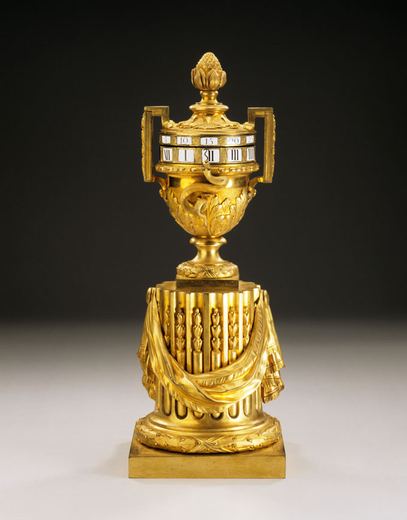
Clocks · 1723–1811
Table clock by Louis Montjoye, France, 1723–1811
Badisches Landesmuseum Karlsruhe
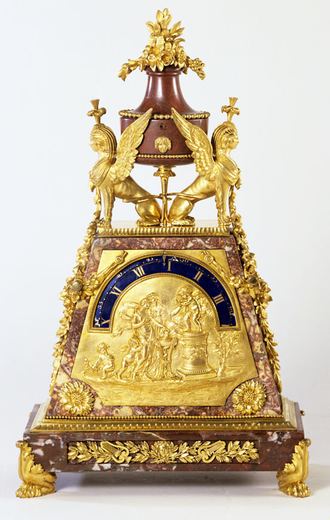
Clocks · 1738–1814
Table clock by Jean Simon Bourdier, France, 1738–1814
Badisches Landesmuseum Karlsruhe
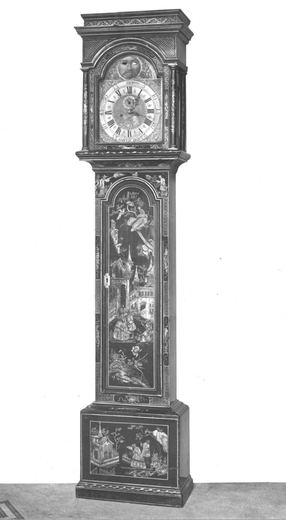
Clocks · 1740-1760
Longcase clock, English, 1740-1760, japanned wood, John Ellicott
Victoria and Albert Museum, London
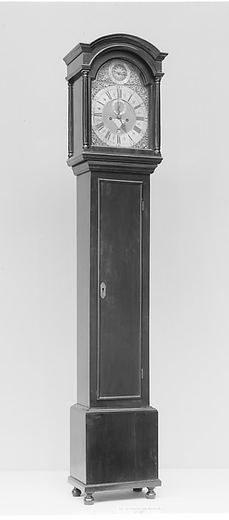
Clocks · 1740–60
Tall clock by Samuel Bagnall, United States, 1740–60
The Metropolitan Museum of Art, New York
Clocks · 1750-1800
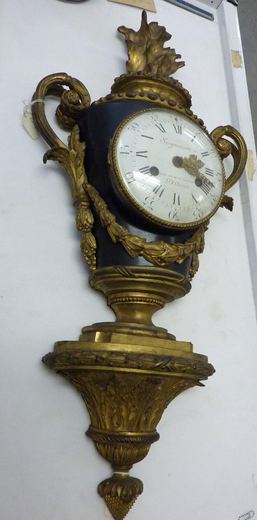
Bracket clock in metal case with scroll handles and flamed-shaped top signed by Pierre Seignoret, Clockmaket to the the Comte d'Artois
Victoria and Albert Museum, London