
Wristwatches · Wristwatch
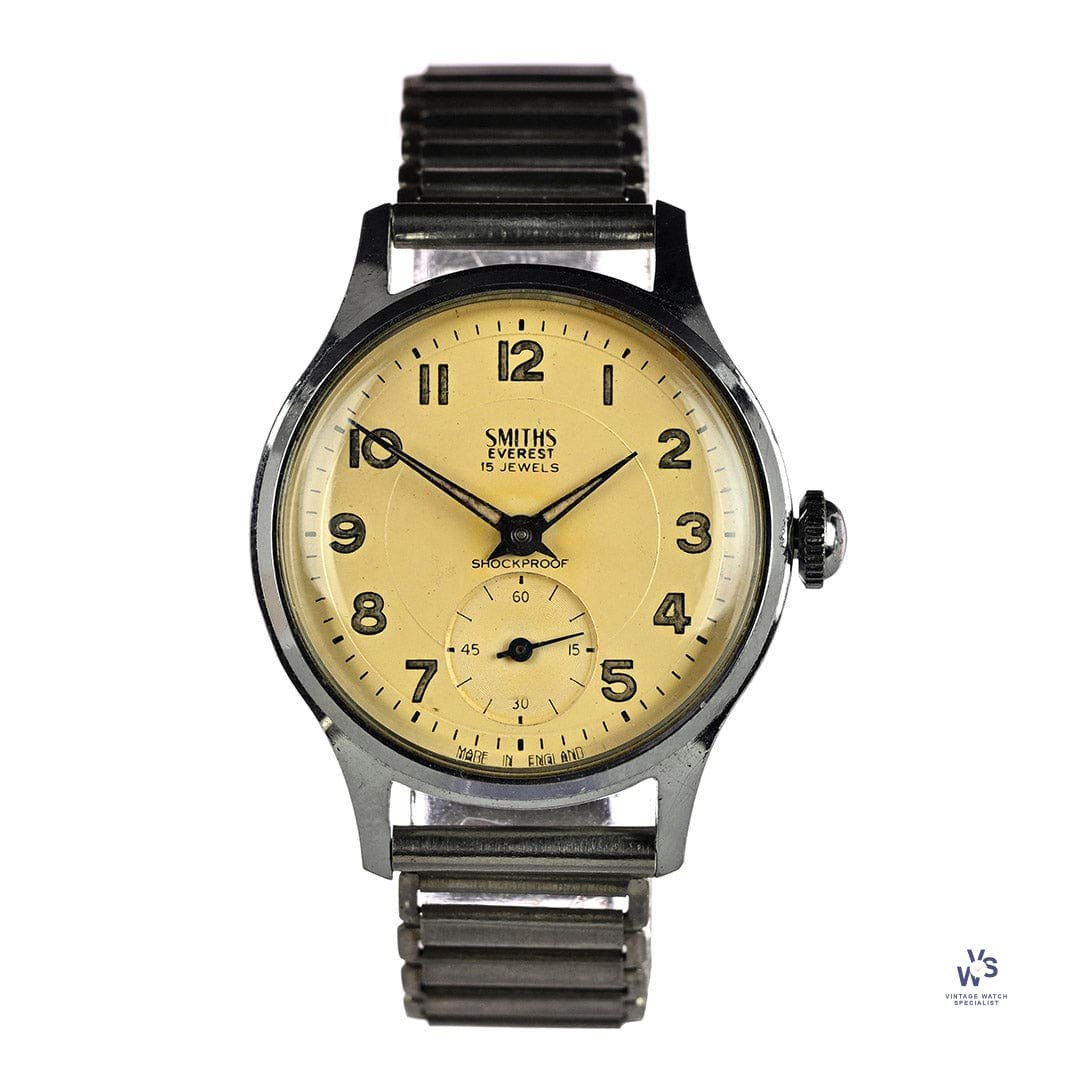
Smiths Everest Watch, Tropical Dial, circa 1950s
- Maker / attribution
- Smiths (maker)
- Date
- c. 1950s
- Historical period
- Modern Mechanical Horology (1945 – 1969)
- Country of origin
- England
- Object type
- Wristwatch
- Stock no.
- vws3697cs
- Credit line
- Dealer listing, Vintage Watch Specialist (vws3697cs)
- Catalogue title (original)
- Vintage Smiths Everest Watch - Tropical Dial - c.1950s (English)
View the source record (dealer listing) ↗ (opens another website in a new tab)Suggest a correction
Record summary
Catalogued by Vintage Watch Specialist (dealer), United Kingdom (stock number vws3697cs), this is a wristwatch by Smiths, made in England, dated c. 1950s. The Atlas places it in the Modern Mechanical Horology period (1945 – 1969) of its Wristwatches collection. The record is illustrated with 6 photographs.
Assembled from the source record's structured fields. Dates and attributions are given as the source states them; where a field is missing the Atlas leaves it blank rather than estimating.
Catalogue description
Dealer description — Vintage Watch Specialist
A Fantastic Vintage Smiths Everest Watch with a Warm 'Tropical' Dial, Bold Arabic Numerals and Stylish Dauphine Hands, c.1950s The Smiths Everest watch is a timepiece steeped in history and adventure. The story begins in the 1950s when Smiths, a British company known for manufacturing precision instruments, sought to make their mark in the world of horology. In 1953, their efforts culminated in the Smiths DeLuxe wristwatch being worn during the successful British expedition to Mount Everest, led by Sir John Hunt. Sir Edmund Hillary and Tenzing Norgay, the first climbers to reach Everest's summit, symbolically linked the Smiths watch to this monumental achievement. Primarily designed for endurance and reliability in harsh conditions, the Smiths Everest watch soon gained acclaim. Its robust build and elegant design appealed to adventurers and watch enthusiasts alike. Over the decades, it has evolved in style while retaining its heritage, becoming a symbol of British craftsmanship and exploration synonymous with conquering one of Earth's greatest challenges. Today, collectors and enthusiasts regard it as a classic, celebrating its legacy in the annals of horological history. What's on Offer We are delighted to offer this vintage Smiths Everest wristwatch for sale in such wonderful preowned condition. A classic example of British watchmaking from the mid-20th century, the watch features a warm 'tropical' ecru dial with bold black Arabic numerals, offering excellent legibility. The beautiful Dauphine hands and recessed sub-seconds dial at 6 o’clock offer timeless design and functional appeal. The "Smiths Everest" branding, along with the "15 Jewels" and "Shockproof" inscriptions, highlights its robust construction and reliable manual-wind movement. The watch is powered by an in-house Smiths 15-jewel movement, designed for durability and precision. The dial is complete by the synonymous 'Made in England' stamp Smiths are so well known for. Encased in a plated case, the watch is fitted with a vintage-style expandable metal bracelet, adding to its utilitarian charm. As part of the Everest series, this model is associated with Smiths’ legacy in adventure and exploration, making it a sought-after timepiece for collectors of British horology. This watch is in fantastic shape and would make a fantastic addition to any collection.
Historical context
Modern Mechanical Horology (1945 – 1969)
Tool watches for divers, pilots and astronauts; electric watches anticipate the electronic age.
The classic era of the mechanical wristwatch: dive watches, chronographs for motor racing and space flight, GMT watches for jet travel, slim dress watches, automatic calendars, and the rise of Japanese manufacturers alongside Swiss, American, German and Soviet industries.
Read the period in the timelineMore wristwatches from this periodEarlier: Golden Age of Mechanical Watchmaking
Atlas type guide
Wristwatches
Bracelet watches were worn by women from the early nineteenth century — Breguet made one for Caroline Murat, Queen of Naples, in 1810–12 — but the wristwatch only became a man's instrument with military use and aviation in the early twentieth century. Between the World Wars it overtook the pocket watch; the 1920s and 1930s brought rectangular Art Deco cases, water-resistant cases and the first automatic winding systems.
After 1945 the wristwatch became a carrier of identity — dress watches, sports and dive watches, chronographs, calendars — produced by Swiss, American, Japanese, German, Soviet and Chinese industries. The quartz revolution after 1969 and the mechanical renaissance since the 1990s, including the rise of independent watchmakers, complete the story.
What to look for
- The reference number (between the lugs or inside the case back) and serial number, the starting point for dating.
- The calibre: its maker and number are often stamped under the dial or on the bridge.
- Originality of dial, hands and crown — refinished ('redial') dials are common.
- Case material marks: 18K/750, 14K/585, stainless steel, gold-filled, plated.
Dating clues
- Wire-lug cases: before c. 1925.
- Water-resistant screw-down cases: from 1926.
- Quartz movements: from 1969; sapphire crystals widespread after c. 1980.
General guidance written by the Atlas editors about this kind of object. It is not a statement about this particular piece; for that, rely on the source record above and on physical examination.
Related records
Clocks · 1971–1979
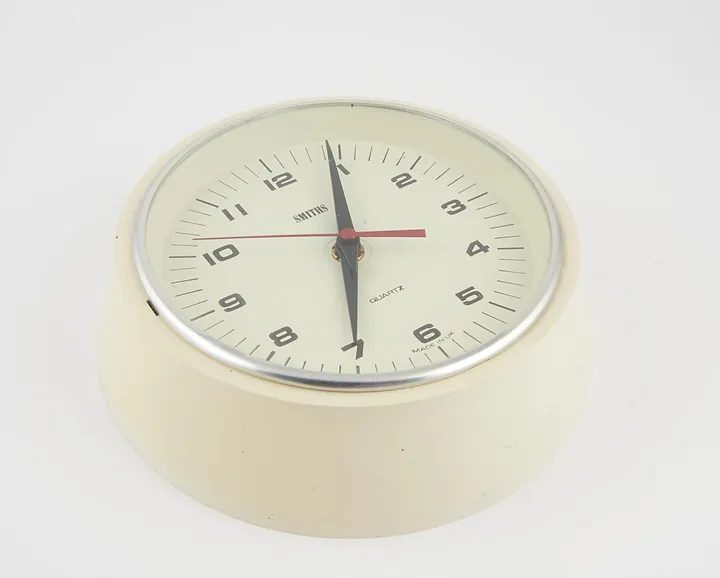
Electric clock by Smiths, England, 1971–1979
Science Museum Group, London
Wristwatches · c. 1950s
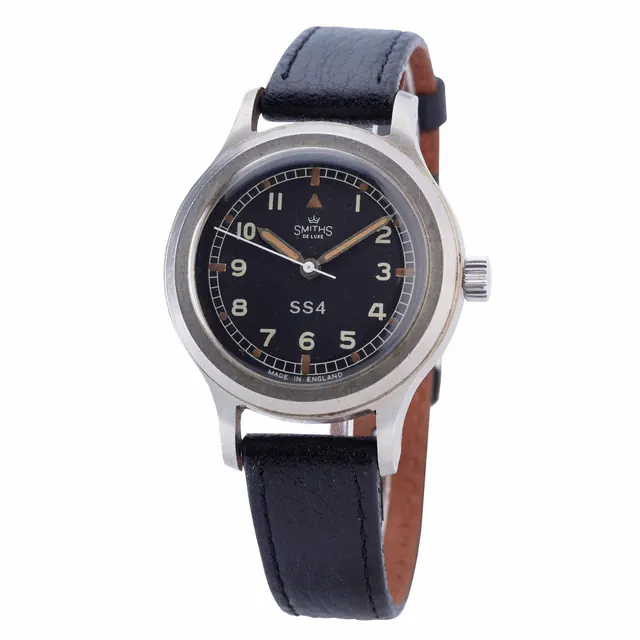
Smiths wristwatch, ref. SS4, Military, circa 1950s
Antiquorum auction archive, Geneva
Wristwatches · 1955
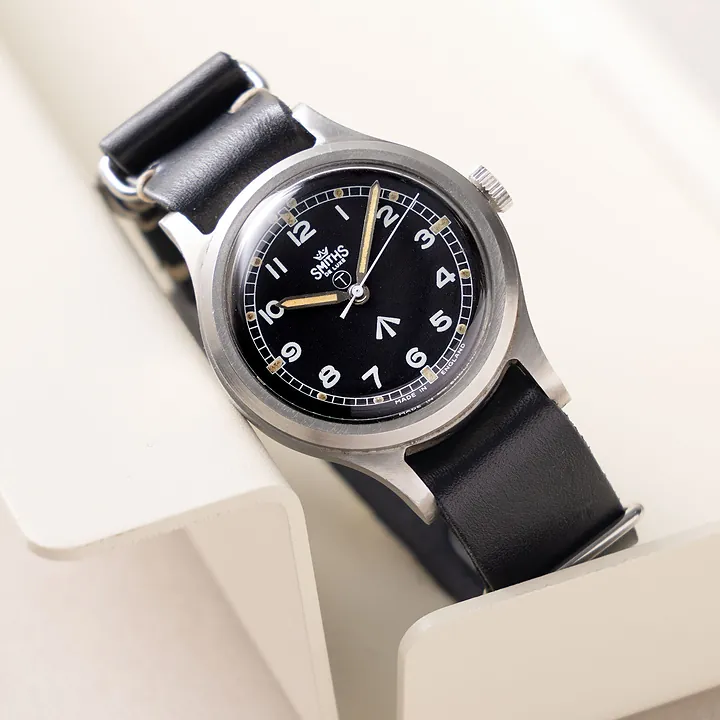
Smiths "Deluxe" ref 6B/542 Military Watch for the British RAF, 1955
Bulang & Sons (dealer), Copenhagen
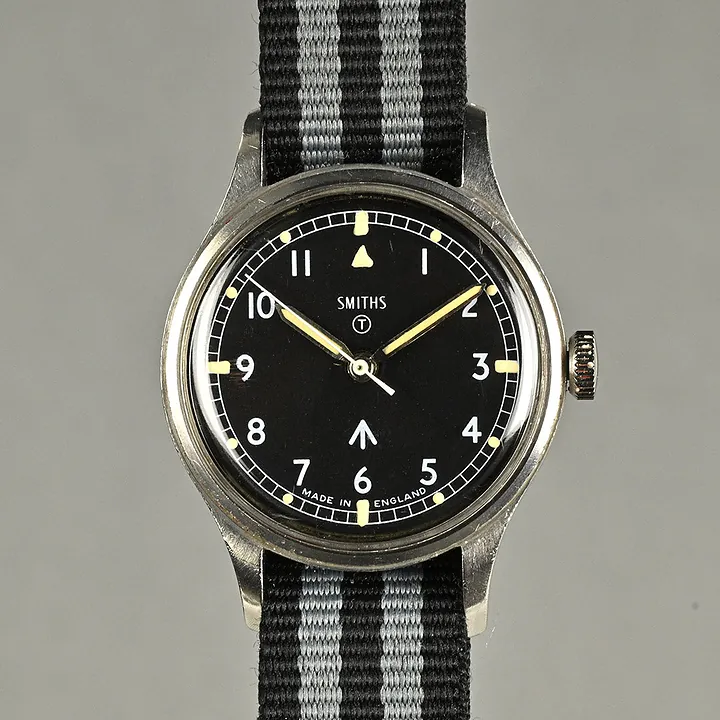
Wristwatches · 1968
Smiths W10 British Army Military Watch, ref. W10/6645-99-961-4045, 1968
Vintage Watch Specialist (dealer), United Kingdom
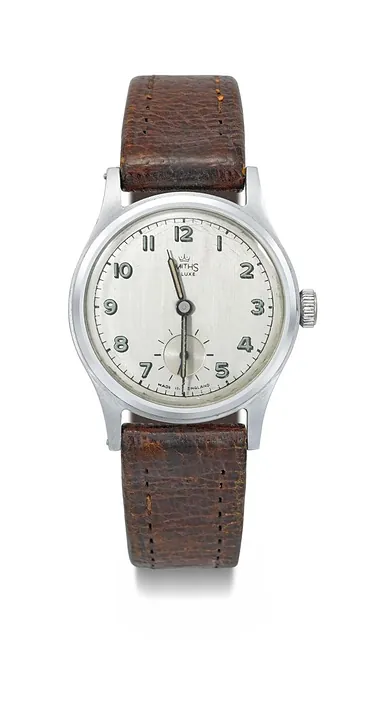
Wristwatches · 1953
Wristwatch by Smiths English Clocks Limited, England, 1953
Science Museum Group, London
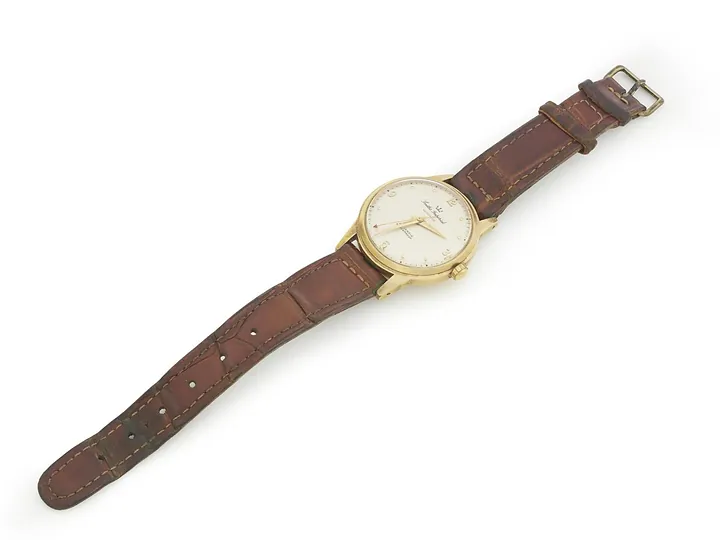
Wristwatches · 1959
Wristwatch by Smiths Clocks & Watches Ltd, England, 1959
Science Museum Group, London
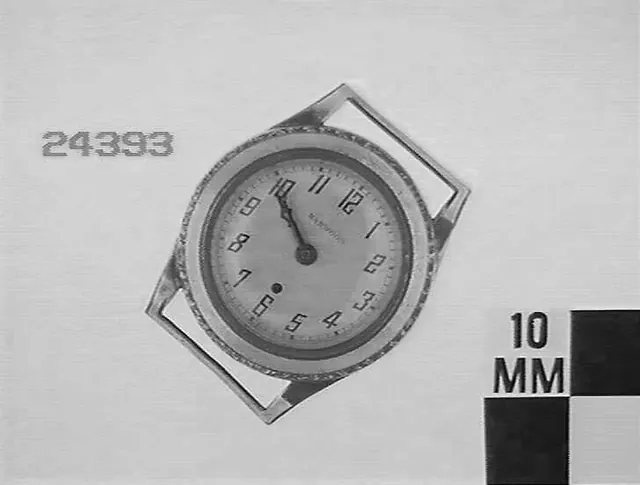
Wristwatches · 1958
Wrist Watch - Harwood, England, 1958
Museums Victoria, Melbourne
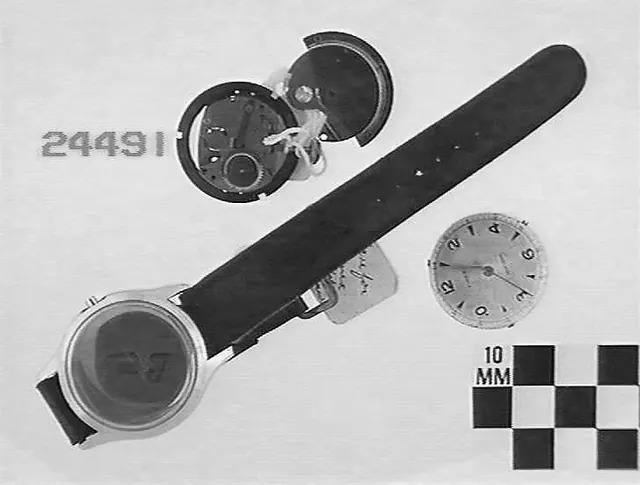
Wristwatches · c. 1957
Wrist Watch - Timex, Great Britain, c. 1957
Museums Victoria, Melbourne