
Wristwatches · Wristwatch
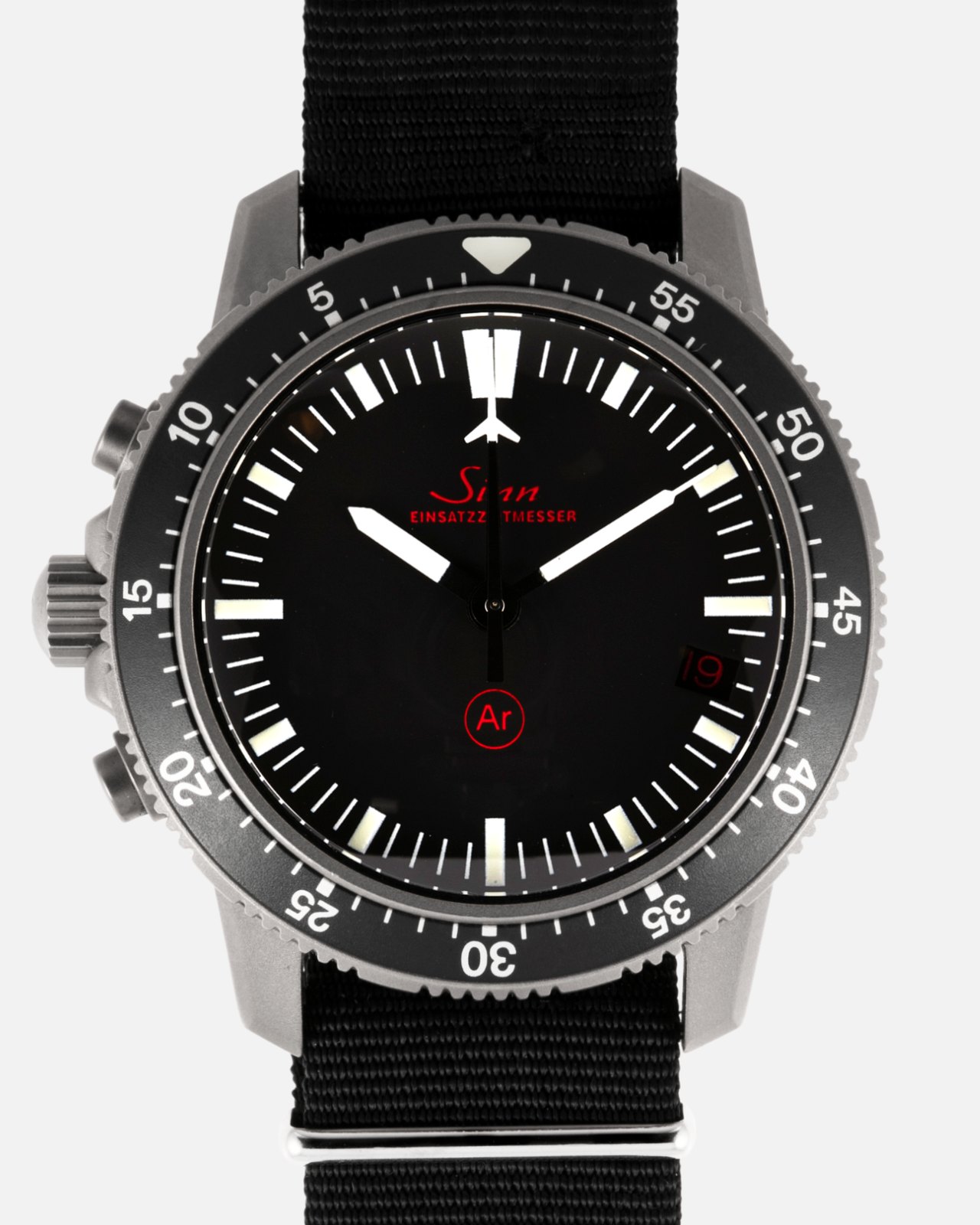
Sinn EZM1, 1990s
- Maker / attribution
- Sinn (maker)
- Date
- 1990s
- Historical period
- Mechanical Renaissance (1990 – 2010)
- Country of origin
- Unrecorded in source
- Object type
- Wristwatch
- Dimensions
- Case 40 mm
- Stock no.
- Product 6743747854423
- Credit line
- Dealer listing, S.Song Watches (product 6743747854423)
- Catalogue title (original)
- Sinn EZM1 (English)
View the source record (dealer listing) ↗ (opens another website in a new tab)Suggest a correction
Record summary
Catalogued by S.Song Watches (dealer), Seattle (stock number Product 6743747854423), this is a wristwatch by Sinn, dated 1990s. The Atlas places it in the Mechanical Renaissance period (1990 – 2010) of its Wristwatches collection. Recorded dimensions: Case 40 mm. The record is illustrated with 6 photographs.
Assembled from the source record's structured fields. Dates and attributions are given as the source states them; where a field is missing the Atlas leaves it blank rather than estimating.
Catalogue description
Dealer description — S.Song Watches
Across the watchmaking industry lies several brands that maintain a cult-like following thanks to their particular aesthetic, heritage, or level of craftsmanship. Perhaps arising from their blend of all three, German watchmaker Sinn has developed a devout following of enthusiasts that appreciate both their modern and vintage watches alike. Perhaps one of their best-known vintage watches is what I have here, the original EZM 1 launched in 1997. While recently reissued as a modern watch (the EZM 1.1), the EZM 1 ref. 503.010 is famed amongst collectors for its unique heritage. Designed as an economical no-nonsense straight-shooting timepiece, it earned its stripes as a watch worn by the Zentrale Unterstützungsgruppe Zoll (ZUZ), also known as the SWAT team of Germany's federal customs authority. As a result of its military use-case, its distinctive chronograph pushers were placed at 9 o'clock to ensure its wearer could comfortably wield a gun without the pushers digging into their hand. Featuring a no-frills dial that championed legibility, the EZM 1 uses an abundance of SuperLuminova on its indices and hour and minute hands. With a centrally-located chronograph seconds and minutes hand, the EZM 1's military-style dial is clear of anything that might slow down its wearer from reading the time, even going as far to place the date at 4:30 to maintain a full-sized 3 o'clock hour marker. With its black left-handed bi-directional ratcheting timing bezel matching its dial, the EZM 1 is a stylish watch that benefits from a monochromatic design. Serving as a pop of color, the EZM 1 also features the unit's logo at 6 o'clock, or '3H', or 'Ar,' in red to indicate the luminous used on the dial. On top of its legible dial and ergonomically laid-out design, the EZM 1 also sports a wonderful sandblasted titanium case. Measuring 40mm x 16mm, the EZM 1 is significantly smaller than its 43mm x 16.4mm reissue and so wears rather favorably in comparison. Furthermore, with its tidy bracelet and consistent surface finish, the EZM 1 is a vintage watch that could easily slot itself into a collector's sphere of daily wearing timepieces. Limited to a production output of just a few hundred watches between the German SWAT team that it was originally for, the subsequent Japanese (ZUZ), and public-release models, the EZM 1 is a watch that deserves its cult status and revered position within Sinn's rich heritage.
Historical context
Mechanical Renaissance (1990 – 2010)
Mechanical watches return as cultural objects; independent watchmaking flourishes.
Mechanical watches returned as cultural and luxury objects. Complications, tourbillons and new materials proliferated; independent watchmakers such as George Daniels, F.P. Journe and Philippe Dufour revived artisanal watchmaking; collecting vintage watches became a major field.
Read the period in the timelineMore wristwatches from this periodEarlier: Quartz Revolution
Atlas type guide
Wristwatches
Bracelet watches were worn by women from the early nineteenth century — Breguet made one for Caroline Murat, Queen of Naples, in 1810–12 — but the wristwatch only became a man's instrument with military use and aviation in the early twentieth century. Between the World Wars it overtook the pocket watch; the 1920s and 1930s brought rectangular Art Deco cases, water-resistant cases and the first automatic winding systems.
After 1945 the wristwatch became a carrier of identity — dress watches, sports and dive watches, chronographs, calendars — produced by Swiss, American, Japanese, German, Soviet and Chinese industries. The quartz revolution after 1969 and the mechanical renaissance since the 1990s, including the rise of independent watchmakers, complete the story.
What to look for
- The reference number (between the lugs or inside the case back) and serial number, the starting point for dating.
- The calibre: its maker and number are often stamped under the dial or on the bridge.
- Originality of dial, hands and crown — refinished ('redial') dials are common.
- Case material marks: 18K/750, 14K/585, stainless steel, gold-filled, plated.
Dating clues
- Wire-lug cases: before c. 1925.
- Water-resistant screw-down cases: from 1926.
- Quartz movements: from 1969; sapphire crystals widespread after c. 1980.
General guidance written by the Atlas editors about this kind of object. It is not a statement about this particular piece; for that, rely on the source record above and on physical examination.
Related records
Wristwatches · 1980s
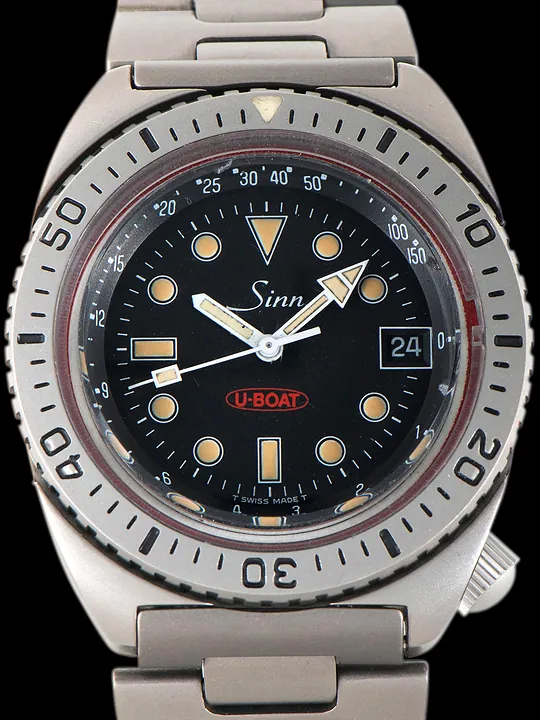
Sinn U-Boat Titanium (Ref. 8820T), 1980s
Craft & Tailored (dealer), Los Angeles
Wristwatches · 1998
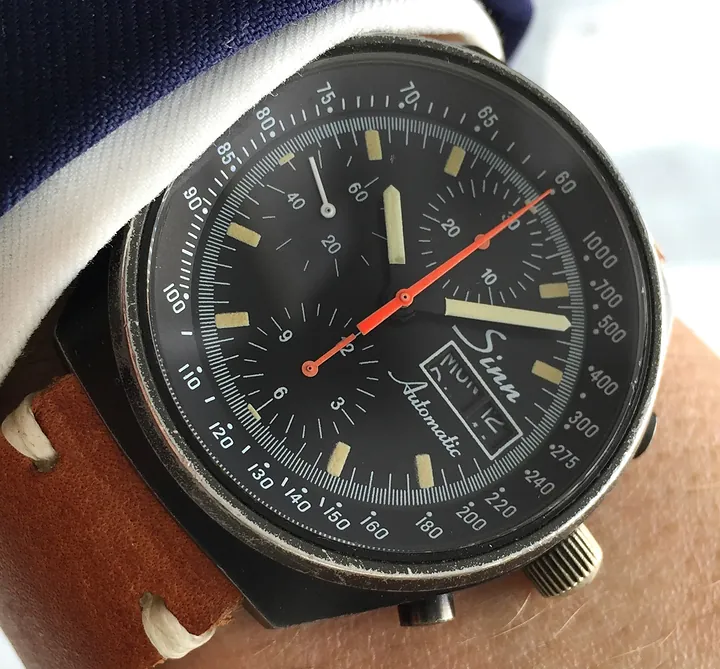
Sinn Chronograph PVD Day Date, 1998
Vintage Portfolio (dealer), Vienna
Wristwatches · 2016
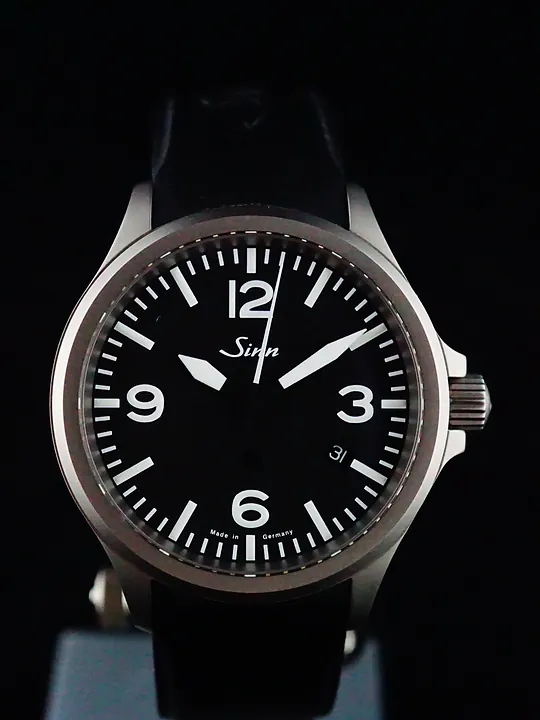
Sinn Ref. 856 Pilot Watch (Box and Papers), 2016
Craft & Tailored (dealer), Los Angeles
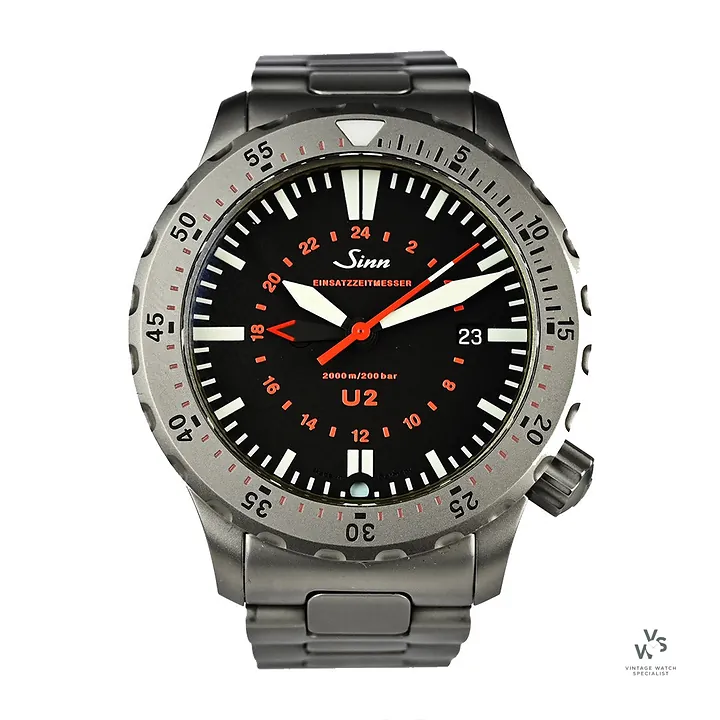
Wristwatches · 2005
Sinn Diving Watch U2 (EZM 5), 2005
Vintage Watch Specialist (dealer), United Kingdom
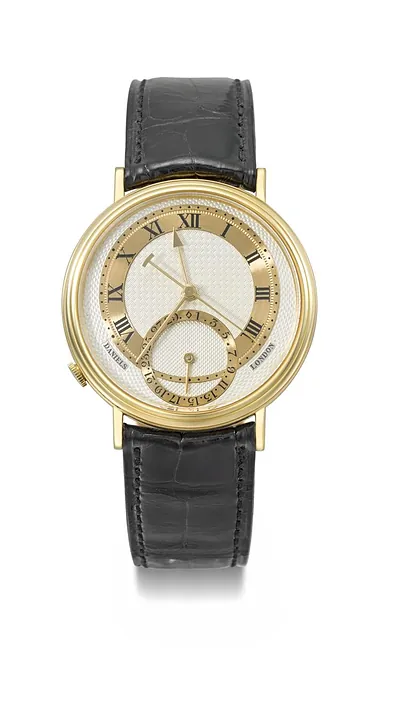
Wristwatches · 1999
'Millennium' co-axial wristwatch by George Daniels and Omega, England, 1999
Science Museum Group, London

Wristwatches · 2008
Wristwatch by Breitling?, 2008
Museum Rotterdam
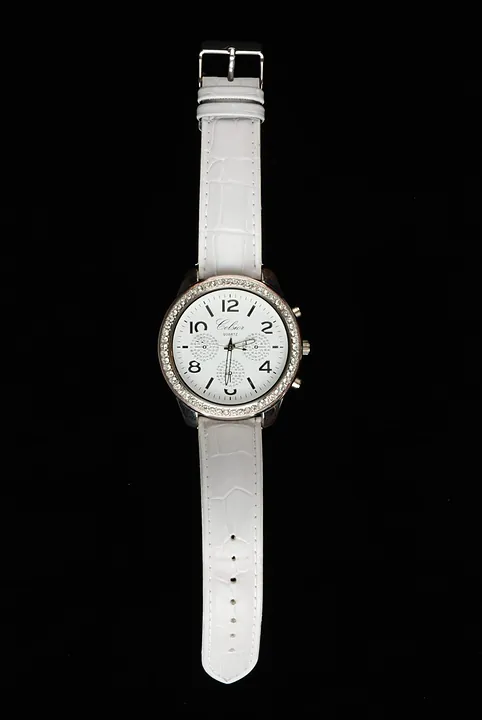
Wristwatches · 2008
Wristwatch by Celsior Quartz, 2008
Museum Rotterdam
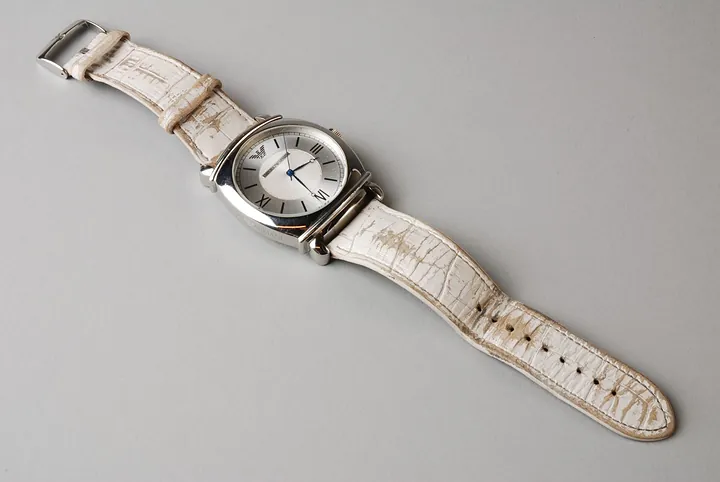
Wristwatches · 2008
Wristwatch possibly by Emporio Armani, 2008
Museum Rotterdam