
Pocket Watches · Calendar watch
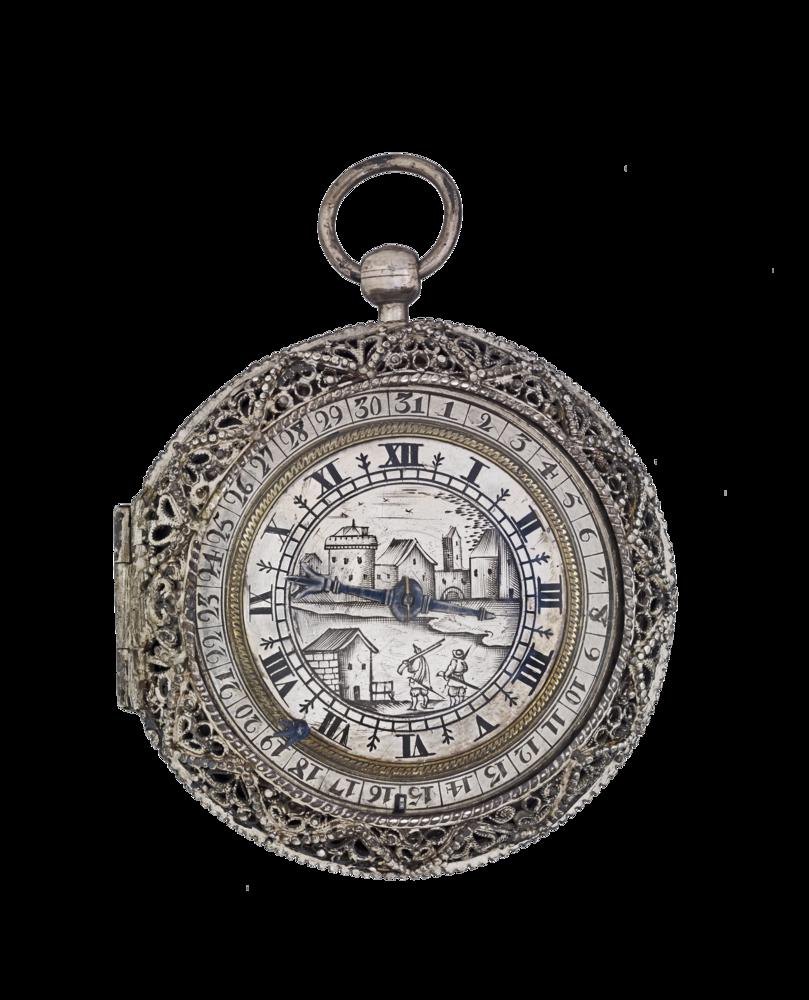
Silver filigree pair-cased verge watch with date indicator
- Maker / attribution
- Samuel Betts (Made by)
- Date
- 1665–1670
- Historical period
- Early Modern Horology (1600 – 1750)
- Country of origin
- England
- Place
- London (England) (Lombard Street)
- Object type
- Calendar watch
- Materials / technique
- silver
- Dimensions
- Diameter: 51.30 millimetres (outer case) Thickness: 23.70 millimetres (including domed glass)
- Holding institution
- British Museum
- Accession / object no.
- 1958,1201.2318
- Credit line
- British Museum, London
- Catalogue title (original)
- Silver filigree pair-cased verge watch with date indicator (English)
View the source record ↗ (opens another website in a new tab)Suggest a correction
Record summary
Held and catalogued by British Museum (object number 1958,1201.2318), this is a calendar watch by Samuel Betts, made in London (England) (Lombard Street), dated 1665–1670. The Atlas places it in the Early Modern Horology period (1600 – 1750) of its Pocket Watches collection. Materials and techniques recorded by the source: silver. Recorded dimensions: Diameter: 51.30 millimetres (outer case) Thickness: 23.70 millimetres (including domed glass). The record is illustrated with 4 photographs.
Assembled from the source record's structured fields. Dates and attributions are given as the source states them; where a field is missing the Atlas leaves it blank rather than estimating.
Catalogue description
Description — British Museum
Movement frame: Circular gilt-brass plates with four pierced tulip pillars. Riveted potence and riveted counter-potence. Engraved decoration around the verge aperture. Four lugs in the edge of the pillar-plate engage in recesses in the case band. There is a potence-hole in the pillar-plate but the short potence does not pass into it because the deep set second wheel is in the way. Mainspring & set-up: Gilt-brass barrel with snap-in cap and riveted steel hook. Tangent-screw set-up on the potence-plate, the worm gear held by two cut-steel brackets. Fusee & stop-work: Gilt-brass fusee with chain and English stop-work. Train: Four wheel train of brass wheels, the second and third wheel with three crossings, the contrate with four. The second wheel is planted almost in the centre of the plate. Escapement & balance: Verge escapement, the crown-wheel ungilded, the verge and balance replaced. Screwed-on balance cock, pierced and engraved with scrolling foliage. Dial & hand: Around the outside a separate pinned-on ring is engraved 1-31 for the date. Within this a rotating ring carries a pointer to indicate the date. In the centre the pinned-on dial has Roman hours I-XII and foliate half-hour marks surrounding a quarter-circle. In the middle of the dial is an engraved landscape with a castle in the background and two standing figures in the foreground. Pinned-on single blued-steel hand. Cases: Plain silver inner case with a rotating winding-hole cover. Plain silver hinged bezel, split and glazed. Silver pendant with loose ring. Silver filigree outer case.
Inscriptions & marks
signature; Samuel Betts Londini [potence-plate]
Provenance
Previous owner/ex-collection:, Courtenay Adrian Ilbert; Purchased through:, Christie's; Acquired 1958
Historical context
Early Modern Horology (1600 – 1750)
Huygens' pendulum and balance spring transform accuracy; English makers develop the anchor and deadbeat escapements.
The balance spring (c. 1675) improved watches dramatically and introduced the minute hand. English pair-cased verge watches with pierced balance cocks and French oignons were typical; enamel painting at Blois and Geneva, and the repeating watch (1680s), made watches objects of great refinement.
Read the period in the timelineMore pocket watches from this periodEarlier: Renaissance Horology
Atlas type guide
Calendar, moon-phase and perpetual calendar watches
Calendar complications range from a simple date to the perpetual calendar, which automatically allows for months of different lengths and leap years until 2100. Pocket watches with perpetual calendars were made in the eighteenth and nineteenth centuries; Patek Philippe made the first perpetual calendar wristwatch in 1925, and series production followed in 1941. The annual calendar (Patek Philippe, 1996) needs correction only once a year.
Moon-phase displays use a disc with two moons and 59 teeth advanced daily, approximating the 29.5-day lunation; more precise trains reduce the error to one day in over a century.
What to look for
- Apertures or subsidiary dials for day, date, month and leap year.
- Moon disc under a 'bosom' shaped aperture.
- Recessed correctors on the case band for setting the calendar.
Dating clues
- Triple-date wristwatches: popular c. 1940–1955.
- Perpetual calendar wristwatches: from 1925 (unique) and 1941 (series).
General guidance written by the Atlas editors about this kind of object. It is not a statement about this particular piece; for that, rely on the source record above and on physical examination.
Related records
Pocket Watches · 17th century
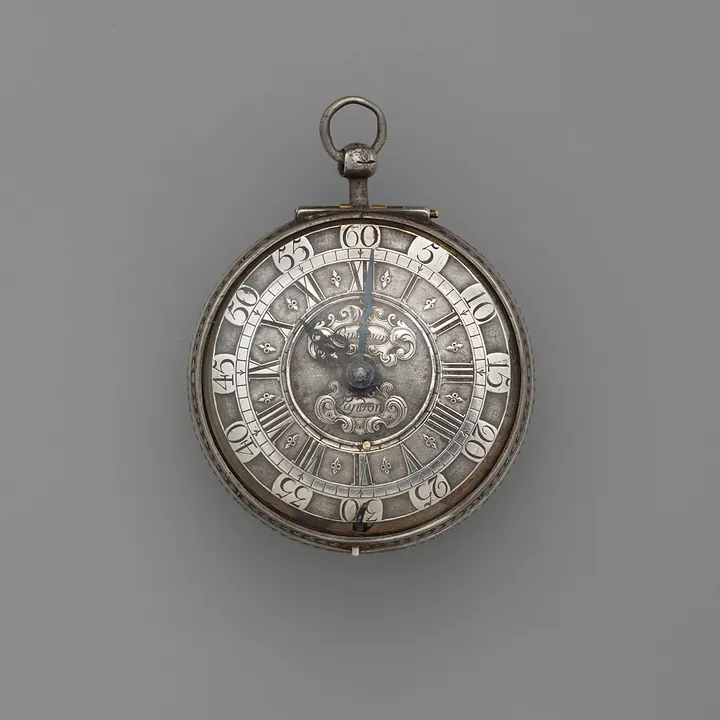
Watch by John Bushman, England, 17th century
The Metropolitan Museum of Art, New York
Pocket Watches · c. 1610-1620
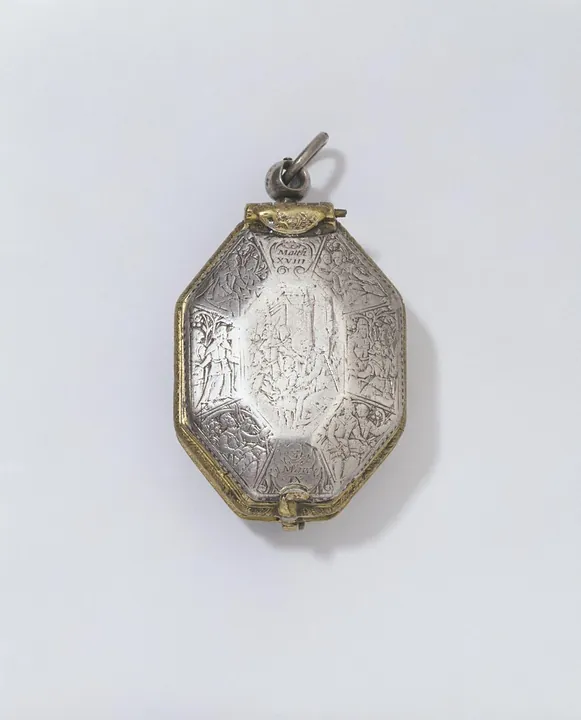
Case and dial of engraved silver and gilt brass. English, about 1640.
Victoria and Albert Museum, London
Pocket Watches · c. 1610
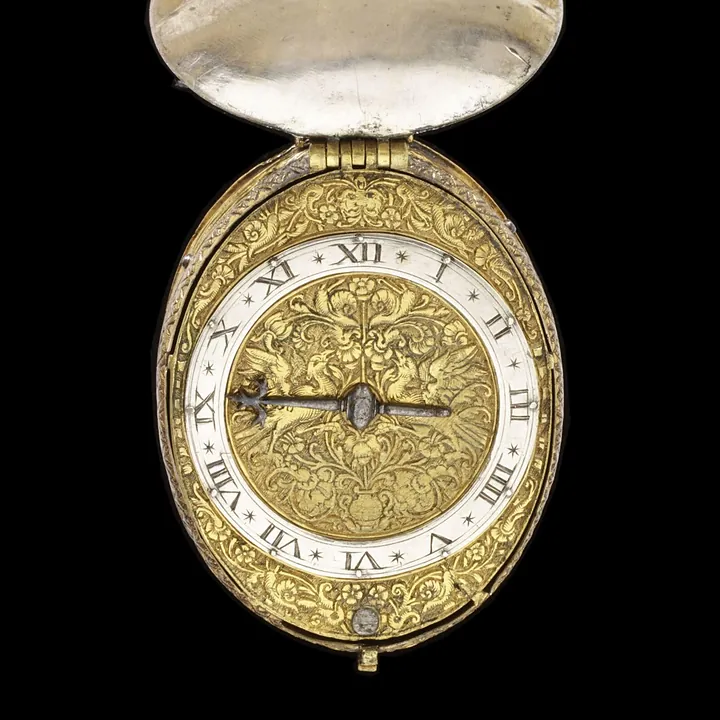
Watch by N. Ridgdale, England, c. 1610
Victoria and Albert Museum, London
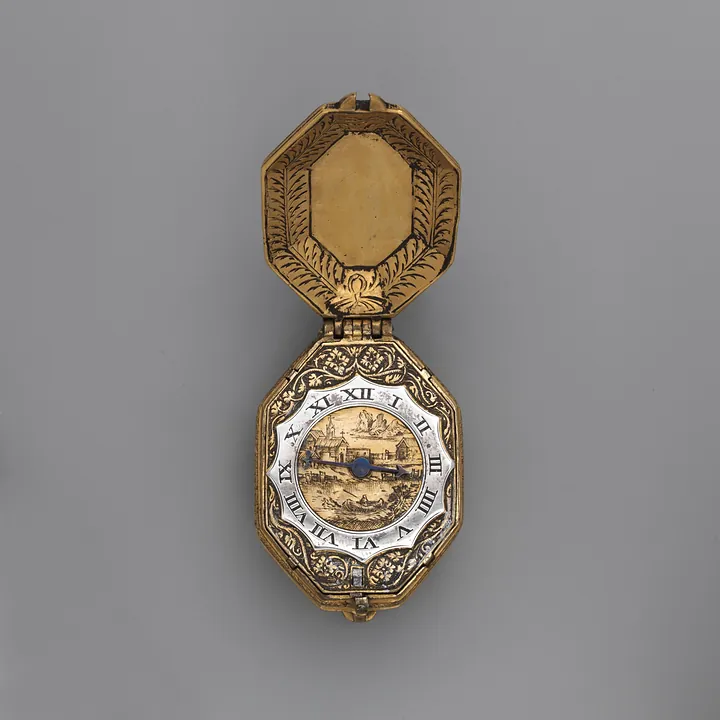
Pocket Watches · c. 1620–25
Watch by Isaac Symms, England, c. 1620–25
The Metropolitan Museum of Art, New York
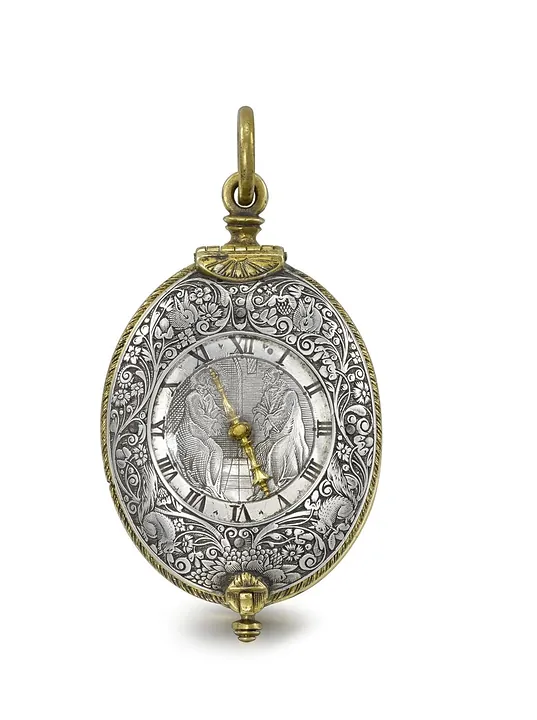
Pocket Watches · 1622–1628
Pocket watch by James Vautrollier, England, 1622–1628
Science Museum Group, London
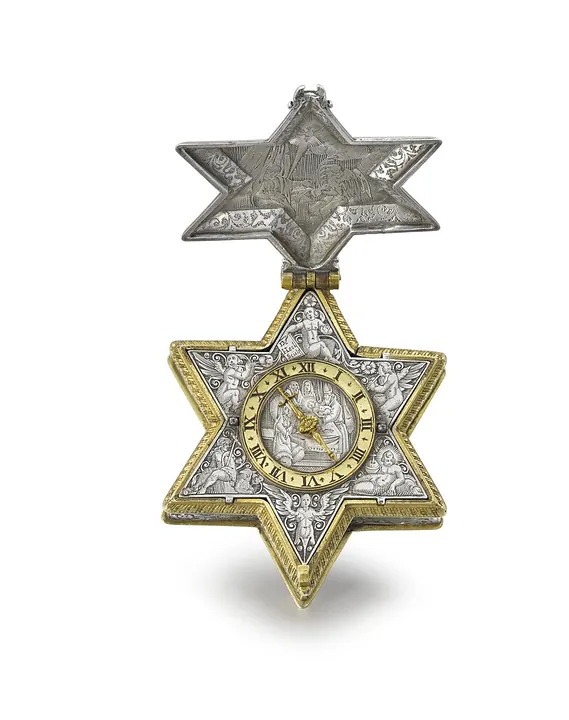
Pocket Watches · 1625
Pocket watch by David Ramsay, England, 1625
Science Museum Group, London
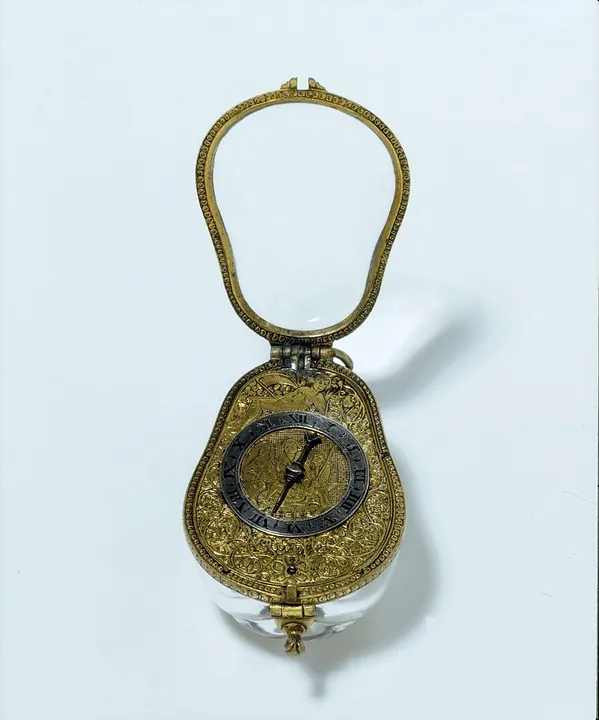
Pocket Watches · c. 1635
Jewellery, England
Victoria and Albert Museum, London
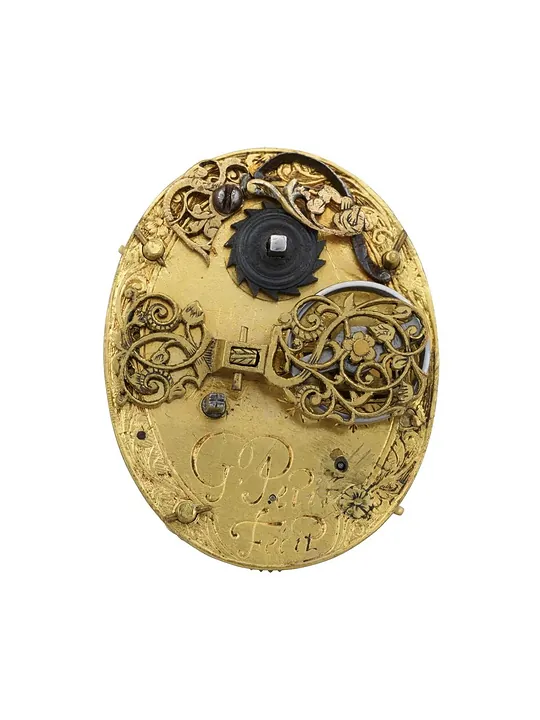
Pocket Watches · 1630
Pocket watch by G Petit, England, 1630
Science Museum Group, London