
Wristwatches · Wristwatch
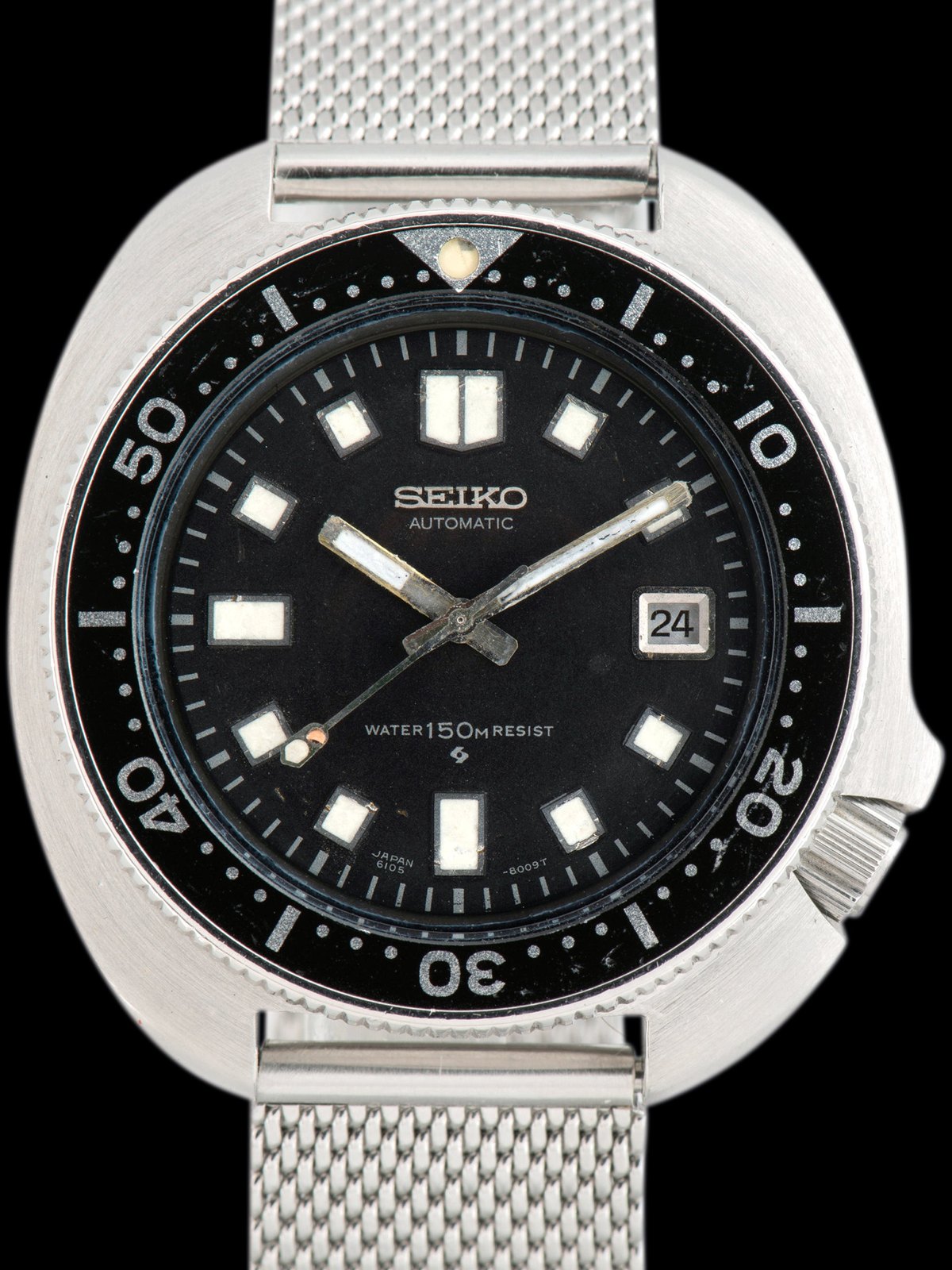
Seiko Diver (Ref. 6105-8119) "Captain Willard", 1971
- Maker / attribution
- Seiko (maker)
- Date
- 1971
- Historical period
- Quartz Revolution (1969 – 1990)
- Country of origin
- Japan
- Object type
- Wristwatch
- Dimensions
- Case 44 mm
- Stock no.
- SKO61058119-71
- Credit line
- Dealer listing, Craft & Tailored (SKO61058119-71)
- Catalogue title (original)
- 1971 Seiko Diver (Ref. 6105-8119) "Captain Willard" (English)
View the source record (dealer listing) ↗ (opens another website in a new tab)Suggest a correction
Record summary
Catalogued by Craft & Tailored (dealer), Los Angeles (stock number SKO61058119-71), this is a wristwatch by Seiko, made in Japan, dated 1971. The Atlas places it in the Quartz Revolution period (1969 – 1990) of its Wristwatches collection. Recorded dimensions: Case 44 mm. The record is illustrated with 6 photographs.
Assembled from the source record's structured fields. Dates and attributions are given as the source states them; where a field is missing the Atlas leaves it blank rather than estimating.
Catalogue description
Dealer description — Craft & Tailored
Although they may not be the most luxurious or difficult watch to obtain, Seiko watches are loved by collectors both at the entry-level and by the most decerning collector with a cult-like following. There is a specific sense of satisfaction that comes from wearing a Seiko that you are a part of a long lineage of excellent watchmaking and extreme attention to detail in a resilient fashion across the range of Seiko timepieces. The Seiko 6105-8119 series replaced Seiko’s original professional diver, the 62MAS, in 1968 and was produced until the year 1977. The 6105-8110 was the first Seiko diver to use an asymmetrical case and integrated crown guards which can still be seen in the modern Seiko Professional divers today which makes the 6105 an icon. If you have ever owned a vintage Seiko Diver then you will know that the build quality and finishing of the Seiko 6105-8110 is exceptional, and without a doubt definitely on par with dive watches of the same period, like the Omega Seamaster 300 and the Rolex Submariner. The Seiko 6105 measures 44mm and came on a rubber dive strap, although robust and solidly built, the watch when on the wrist doesn't wear bulky or oversized. The 6105 is powered by the Seiko caliber 6105B, a 17 jewel self-winding movement that is hackable but does not support hand winding, much like the variants that would follow it in the future. The dial of the 6105 is no-nonsense and simple. The large applied indices are filled with lume surrounded by a white and visible minute track that pairs perfectly with a handset that allows for an easy read of the time at a glance even in low light conditions adding to the tool like build and feel. The Seiko 6105 is famous for its presence in the 1979 Francis Coppola film Apocalypse Now as Martin Sheen’s character, Captain Willard can be seen wearing one throughout the film. Being true to detail the Seiko 6105 was a watch that was commonly seen on the wrist of soldiers during the Vietnam War as it was sold in military PX’s and while not the most inexpensive watch it was certainly less expensive than a Rolex Submariner and possessed the same tool like quality and dependability of an automatic movement. Stock # SKO61058119-71 Brand Seiko Style Diver Model 6105-8119 Serial 14XXXX Size Men's Material Stainless Steel Dial Black Millimeters 44 Bracelet 2pc Stainless Steel Mesh Bracelet CASE & BRACELET The impressive case remains unpolished, showing strong factory finishing and honest signs of use. The original bezel remains deep black, shows light wear, and retains its luminous pearl at the 12 o'clock with minimal degradation. The case retains its original "Lock" crown which remains fully functional. The case back retains all of its original factory markings in exceptional condition. The watch comes supplied on a 2pc stainless steel mesh bracelet. DIAL & HANDS The matte black dial offers a rugged and handsome vintage aesthetic with how it has aged over time. The dial does show some minor wear and age throughout with some marks on the markers and dial itself. The luminous material on the dial remains white with some very light degradation present when inspected under U.V. light. The hour and minute hand appear to have been restored with luminova prior to our acquisition and exhibit some minor degradation, the seconds hand retains its original lume which matches the dial and shows light degradation in its orange lume. ACCESSORIES None. The watch is keeping time, previous service history is unknown.
Historical context
Quartz Revolution (1969 – 1990)
Seiko's Astron begins mass quartz timekeeping; traditional industries contract sharply.
Quartz and digital watches transformed the market after 1969. Swiss employment collapsed, Japanese and Hong Kong production soared, and the Swatch (1983) helped the Swiss industry recover; mechanical watches survived as luxury goods.
Read the period in the timelineMore wristwatches from this periodEarlier: Modern Mechanical Horology
Atlas type guide
Dive and water-resistant watches
Keeping water and dust out of a wristwatch was a long-standing challenge. Rolex's screw-down Oyster case (1926) and Omega's Marine (1932) were landmarks; in the early 1950s Blancpain's Fifty Fathoms and Rolex's Submariner defined the professional dive watch with rotating bezels for timing dives, luminous dials and high water resistance. The ISO 6425 standard (1982) later codified what a 'diver's watch' must do.
Dive watches became icons of post-war design and exploration, and their evolution — helium escape valves, ceramic bezels, saturation-diving depth ratings — records the history of underwater work.
What to look for
- Unidirectional or bidirectional rotating bezel with minute markings.
- Screw-down crown and case back; depth rating printed on the dial.
- Luminous hands and markers (radium before c. 1960, tritium c. 1960–1998, then Super-LumiNova).
- Reference numbers on the case between the lugs or inside the back.
Dating clues
- Screw-down Oyster cases: from 1926.
- Professional dive watches: from 1953.
- Tritium 'T' marks on dials: c. 1960–1998.
General guidance written by the Atlas editors about this kind of object. It is not a statement about this particular piece; for that, rely on the source record above and on physical examination.
Related records
Wristwatches · 1967
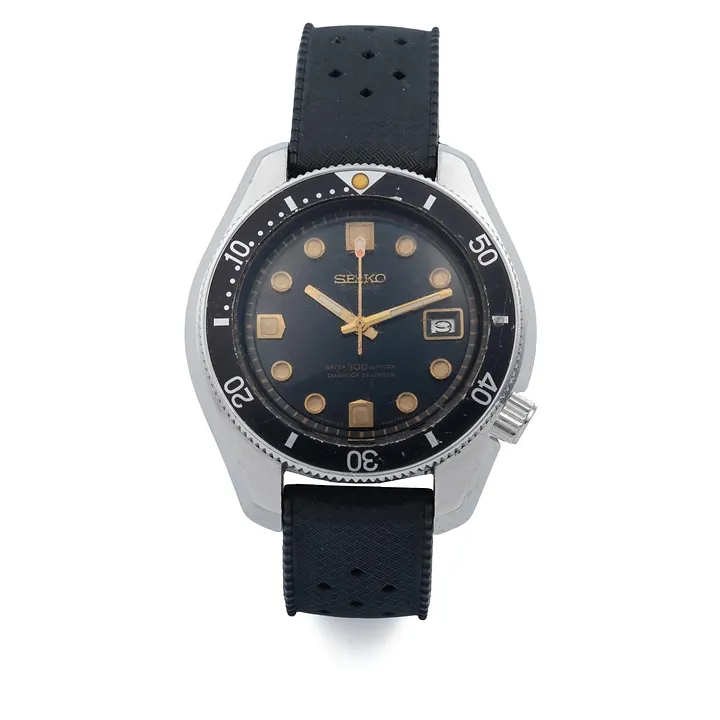
Seiko 300 M, ref. 6215-7000, 1967
Antiquorum auction archive, Geneva
Wristwatches · 1967
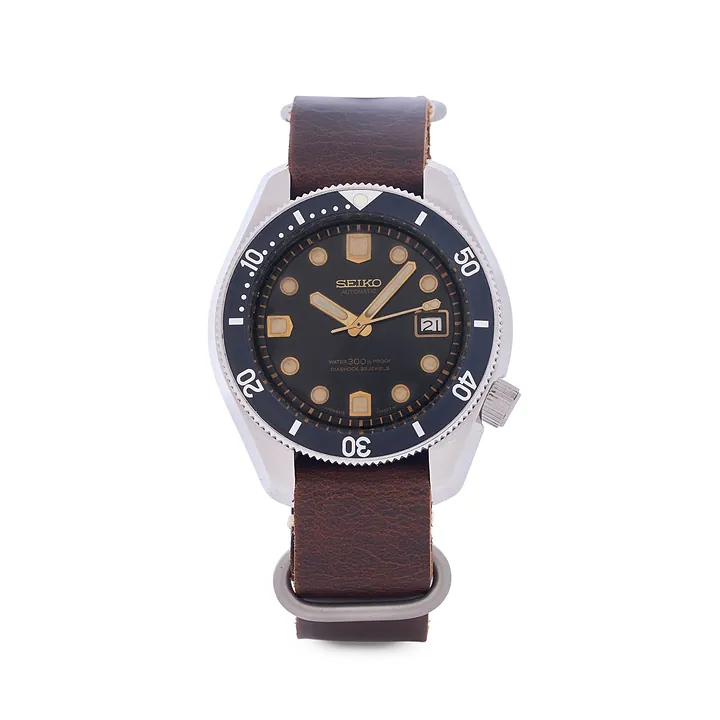
Seiko 300 Meter Diver, ref. 6215-7000, 1967
Antiquorum auction archive, Geneva
Wristwatches · c. 1968
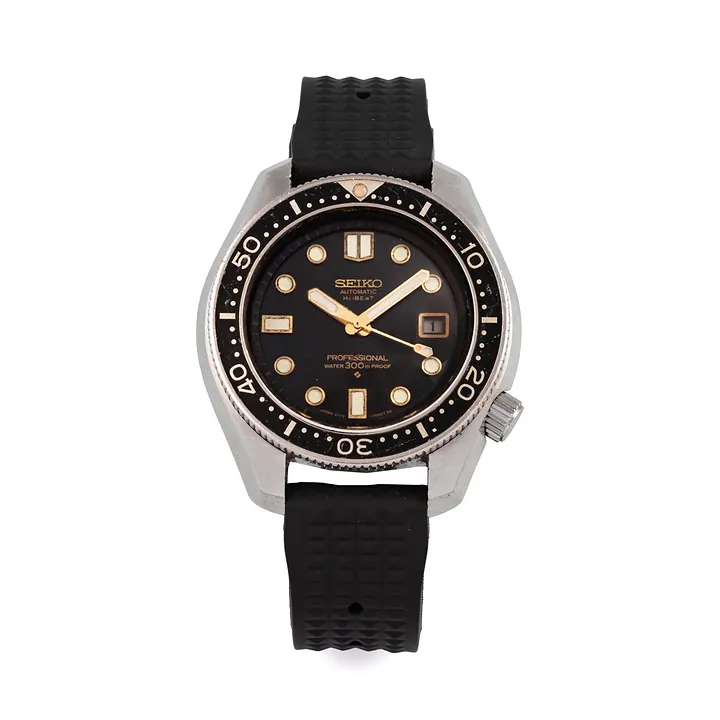
Seiko Hi-Beat, ref. 6159-7000, c. 1968
Antiquorum auction archive, Geneva
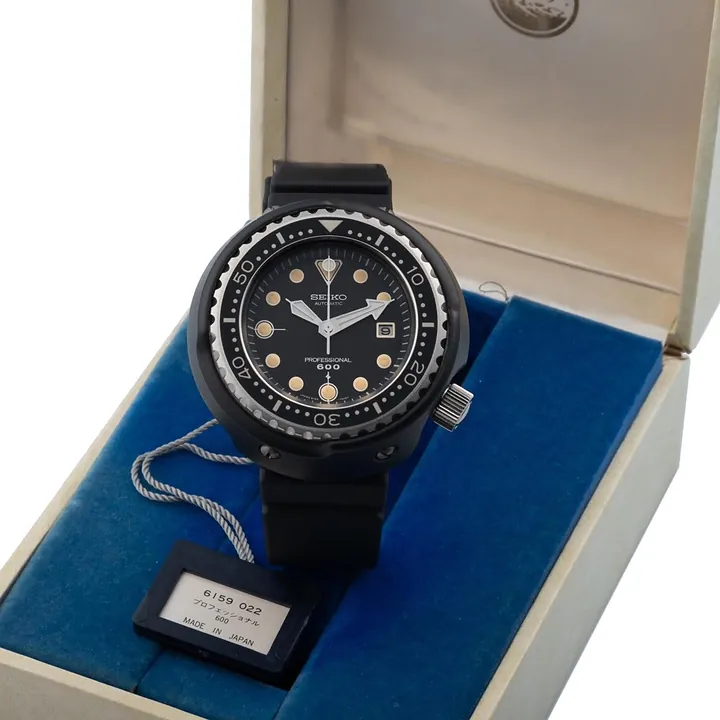
Wristwatches · 1975
Seiko Tuna Professional 600, ref. 6159-7010, 1975
Antiquorum auction archive, Geneva
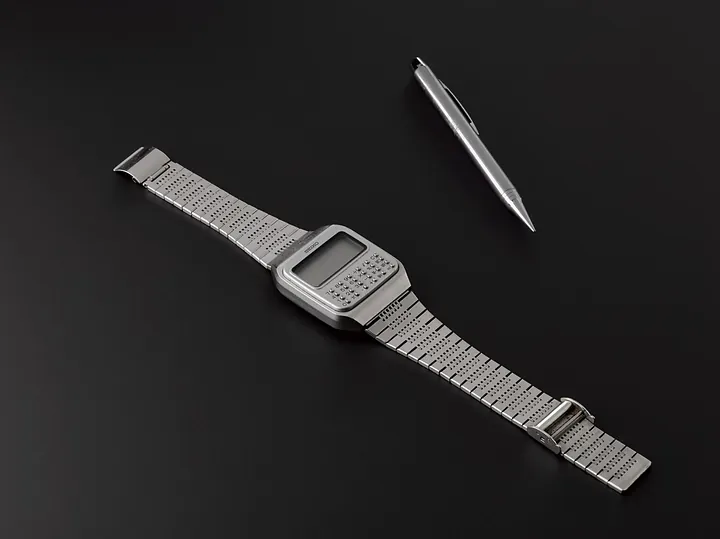
Wristwatches · 1978
Calculator wristwatch by Suwa Seikosha Co. Limited, Japan, 1978
Science Museum Group, London
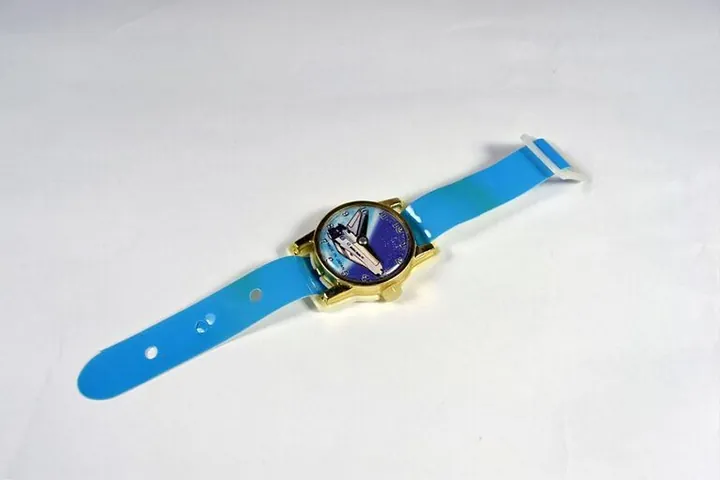
Wristwatches · 1980–1982
Wristwatch, Space Shuttle; plastic, Japan, 1970-1979?
Victoria and Albert Museum, London
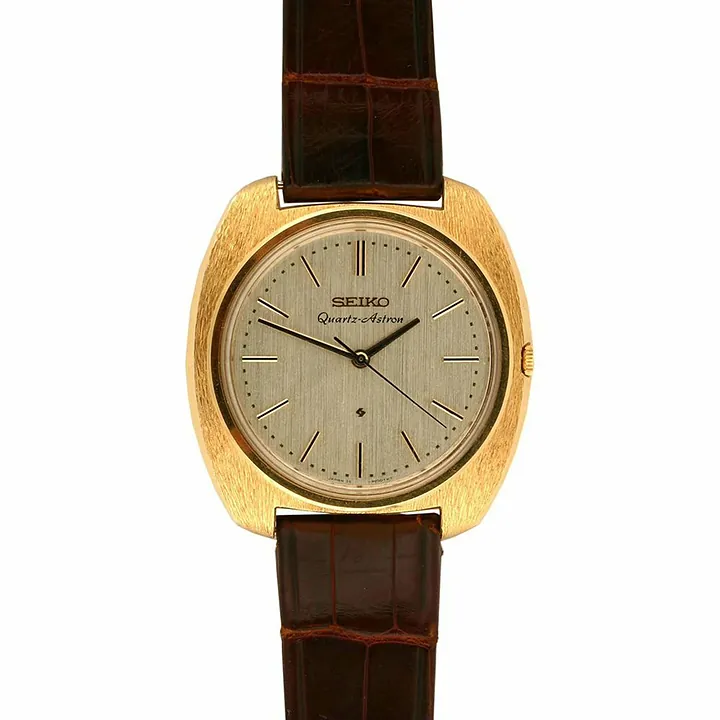
Wristwatches · 1969
Wristwatch, Japan, 1969 (no. 29912)
German Clock Museum
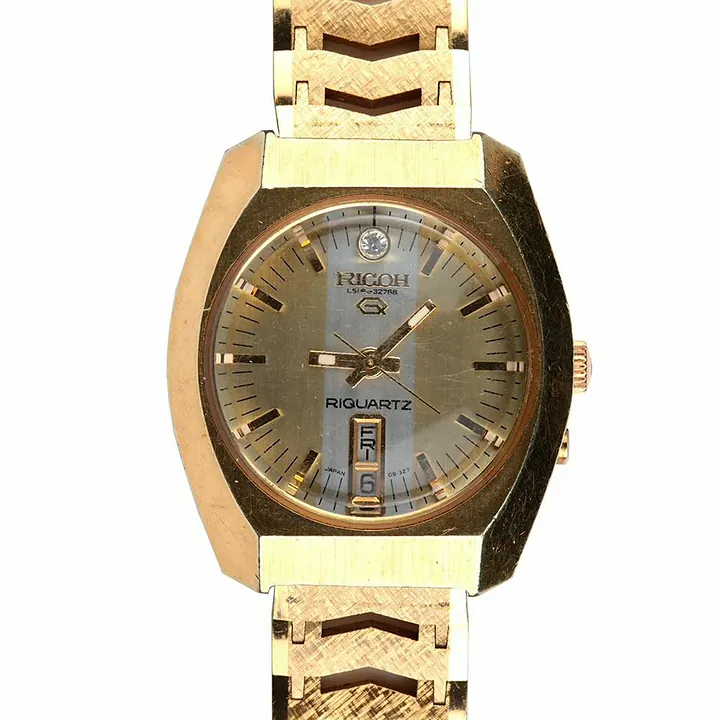
Wristwatches · c. 1972
Wristwatch, Japan, c. 1972
German Clock Museum