
Wristwatches · Wristwatch
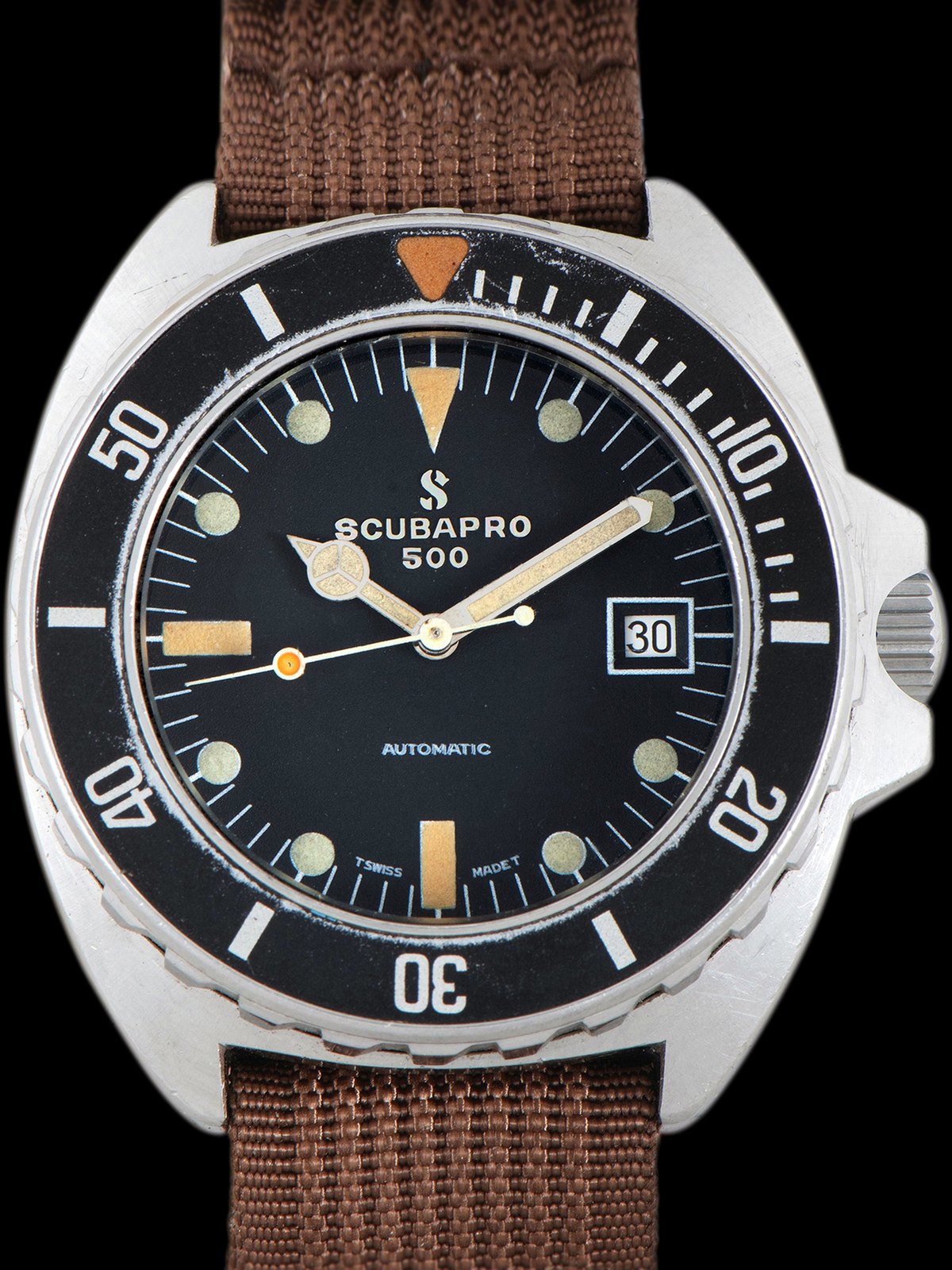
Scubapro 500 (Ref. 67155) "Error Dial", 1980s
- Maker / attribution
- Unrecorded in source
- Date
- 1980s
- Historical period
- Quartz Revolution (1969 – 1990)
- Country of origin
- Unrecorded in source
- Object type
- Wristwatch
- Dimensions
- Case 40 mm
- Stock no.
- SCBPR500-2
- Credit line
- Dealer listing, Craft & Tailored (SCBPR500-2)
- Catalogue title (original)
- 1980s Scubapro 500 (Ref. 67155) "Error Dial" (English)
View the source record (dealer listing) ↗ (opens another website in a new tab)Suggest a correction
Record summary
Catalogued by Craft & Tailored (dealer), Los Angeles (stock number SCBPR500-2), this is a wristwatch, dated 1980s. The Atlas places it in the Quartz Revolution period (1969 – 1990) of its Wristwatches collection. Recorded dimensions: Case 40 mm. The record is illustrated with 6 photographs.
Assembled from the source record's structured fields. Dates and attributions are given as the source states them; where a field is missing the Atlas leaves it blank rather than estimating.
Catalogue description
Dealer description — Craft & Tailored
Founded in the U.S. in 1963, Scubapro quickly earned a reputation for producing rugged, reliable, and technically advanced diving equipment. By the mid-1970s through the 1980s, the brand extended its expertise into timepieces, offering a range of watches that carried the Scubapro seal of approval—built to meet the demanding standards of professional and military divers. Among collectors, Scubapro dive watches from this era are celebrated for their uncompromising design and robust construction. Their rarity on the market today only fuels their cult-like following, as most remain tightly held within the enthusiast community. (Norwegian JaegerMarine Wearing Scubapro 500 Automatic) This example features a 40mm case with a bold unidirectional bezel, epitomizing the no-nonsense tool-watch ethos that earned it a place in Scubapro’s professional equipment lineup. The dial is the rare “high-visibility” variant, distinguished by orange tritium lume plots at the 12, 6, and 9 o’clock markers, paired with matching orange-filled hands for enhanced legibility in low-light conditions. Favored by special operations teams and combat divers, the Scubapro 500 automatic remains one of the most coveted references of its kind. SPECS Stock # SCBPR500-2 Brand Scubapro Style 500 Model 67155 Serial 3097 Size Men's Material Stainless Steel Dial Matte Black Millimeters 42 Strap Brown NATO Strap CASE & BRACELET The robust case retains strong factory dimensions with the original chamfers still present along the case edges. The case does exhibit honest wear from use, with nominal evidence of being previously polished present. The thick saw-tooth bezel is original, as is the insert, which shows some minor wear and retains its orange lume triangle. The mineral glass crystal does show some minor scratches and wear. The case retains its original, unsigned screw-down crown. The case back retains all of its factory markings in deep and crisp condition, with some tool marks present from being previously opened. The watch comes supplied on a brown NATO strap. DIAL & HANDS The original and very well-preserved matte black dial features a unique quirk or "error" in the printing from the factory. The "Automatic" text was accidentally double-printed, resulting in a 3D-like effect. While known, this is extremely uncommon within Scubapros, and while niche, it is sought after among collectors. The dial itself exhibits no damage or notable are. The tritium lume plots are comprised of orange lume at the 12, 6, and 9 o'clock markers that match the lume triangle in the bezel, with the rest of the plots featuring a subtle green coloration. The original hands continue this bi-color trend as the center seconds hand features a bright orange paint, while the lume in the hour and minute hands coordinates closely with the dial patina. Under UV light inspection, the dial exhibits no degradation, and the lume in the hands also remains fully intact, though the orange paint in the seconds hand does feature some minor cracking. ACCESSORIES None. The watch is keeping time, but the service history is unknown. A movement service can be provided upon request.
Historical context
Quartz Revolution (1969 – 1990)
Seiko's Astron begins mass quartz timekeeping; traditional industries contract sharply.
Quartz and digital watches transformed the market after 1969. Swiss employment collapsed, Japanese and Hong Kong production soared, and the Swatch (1983) helped the Swiss industry recover; mechanical watches survived as luxury goods.
Read the period in the timelineMore wristwatches from this periodEarlier: Modern Mechanical Horology
Atlas type guide
Wristwatches
Bracelet watches were worn by women from the early nineteenth century — Breguet made one for Caroline Murat, Queen of Naples, in 1810–12 — but the wristwatch only became a man's instrument with military use and aviation in the early twentieth century. Between the World Wars it overtook the pocket watch; the 1920s and 1930s brought rectangular Art Deco cases, water-resistant cases and the first automatic winding systems.
After 1945 the wristwatch became a carrier of identity — dress watches, sports and dive watches, chronographs, calendars — produced by Swiss, American, Japanese, German, Soviet and Chinese industries. The quartz revolution after 1969 and the mechanical renaissance since the 1990s, including the rise of independent watchmakers, complete the story.
What to look for
- The reference number (between the lugs or inside the case back) and serial number, the starting point for dating.
- The calibre: its maker and number are often stamped under the dial or on the bridge.
- Originality of dial, hands and crown — refinished ('redial') dials are common.
- Case material marks: 18K/750, 14K/585, stainless steel, gold-filled, plated.
Dating clues
- Wire-lug cases: before c. 1925.
- Water-resistant screw-down cases: from 1926.
- Quartz movements: from 1969; sapphire crystals widespread after c. 1980.
General guidance written by the Atlas editors about this kind of object. It is not a statement about this particular piece; for that, rely on the source record above and on physical examination.
Related records

Wristwatches · 1970
Wristwatch by Heno, Switzerland, 1970
Museum Rotterdam
Wristwatches · 1970s
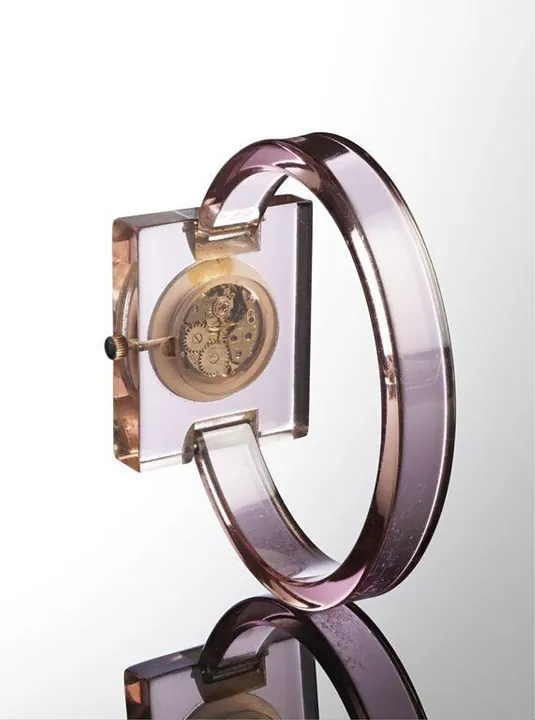
Wristwatch, plastic, by Gucci; Italy, 1970s.
Victoria and Albert Museum, London
Wristwatches · 1978
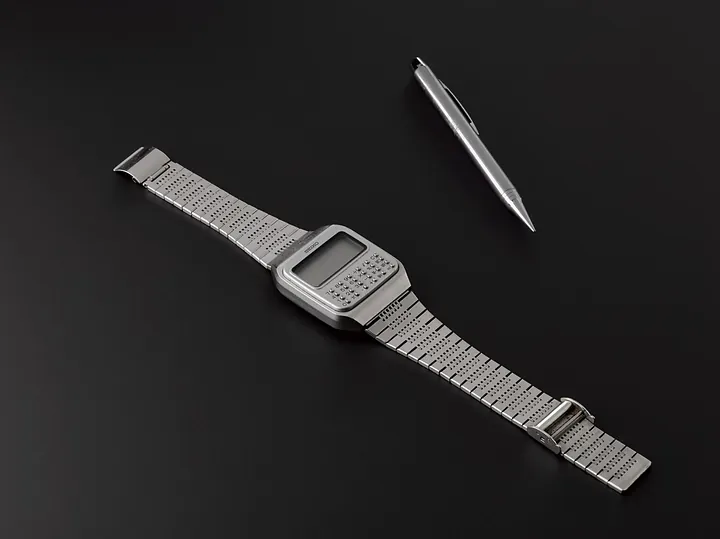
Calculator wristwatch by Suwa Seikosha Co. Limited, Japan, 1978
Science Museum Group, London
Wristwatches · 1980
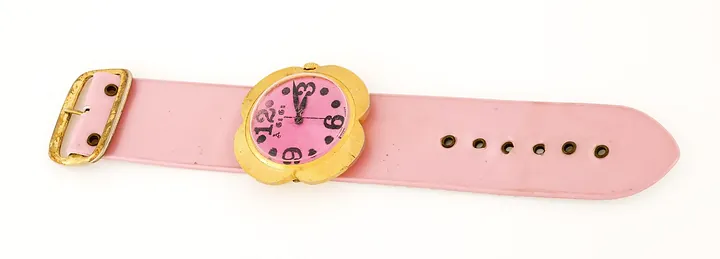
Wristwatch, 1980 (no. 71413)
Museum Rotterdam
Wristwatches · 1980
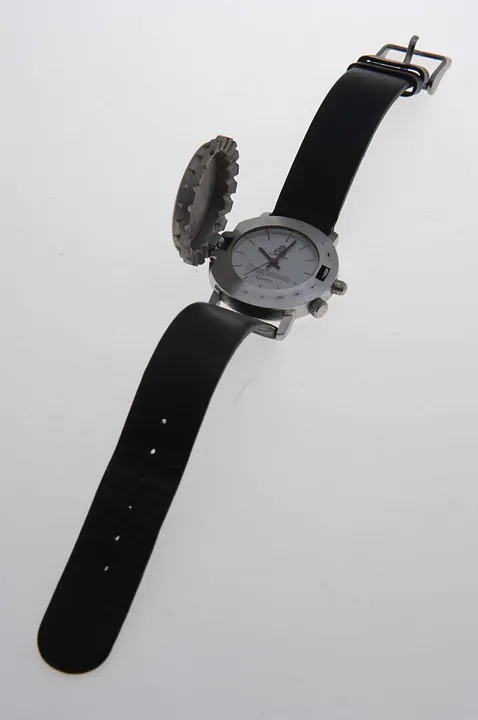
Wristwatch, 1980 (no. 91477)
Museum Rotterdam
Wristwatches · 1980–1982
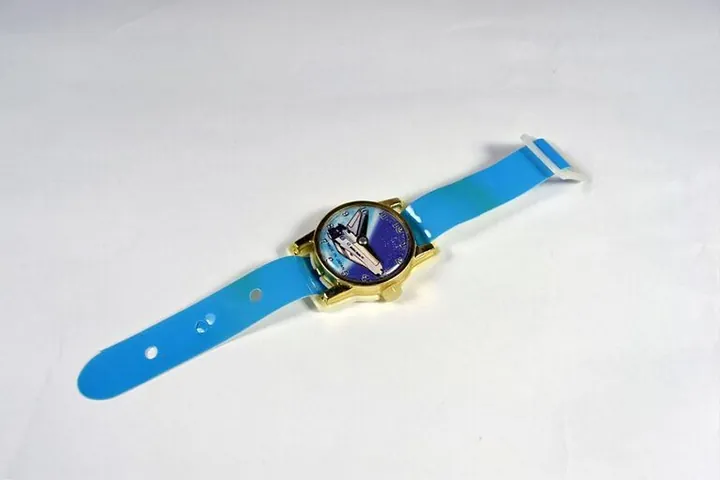
Wristwatch, Space Shuttle; plastic, Japan, 1970-1979?
Victoria and Albert Museum, London
Wristwatches · 1949–1992
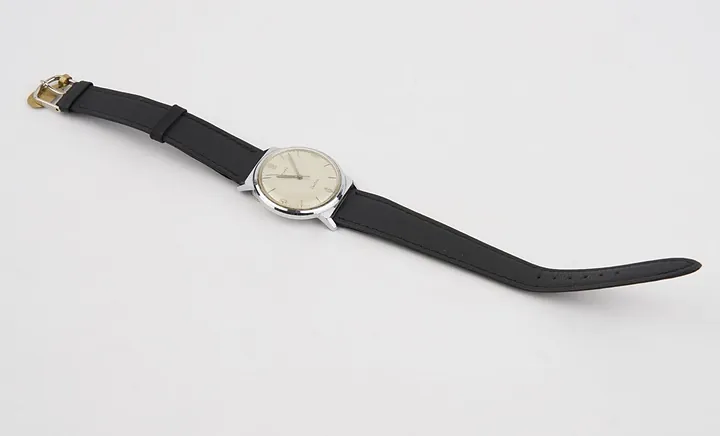
Timex `Electric' wristwatch, with electrically operated balance wheel mechanism, United States, 1949–1992
Science Museum Group, London

Wristwatches · 1960–1986
'Tri-Compax' calendar chronograph wristwatch in gold case, by Universal, Geneva, Switzerland, 1960–1986.
Science Museum Group, London