
Clocks · Clock
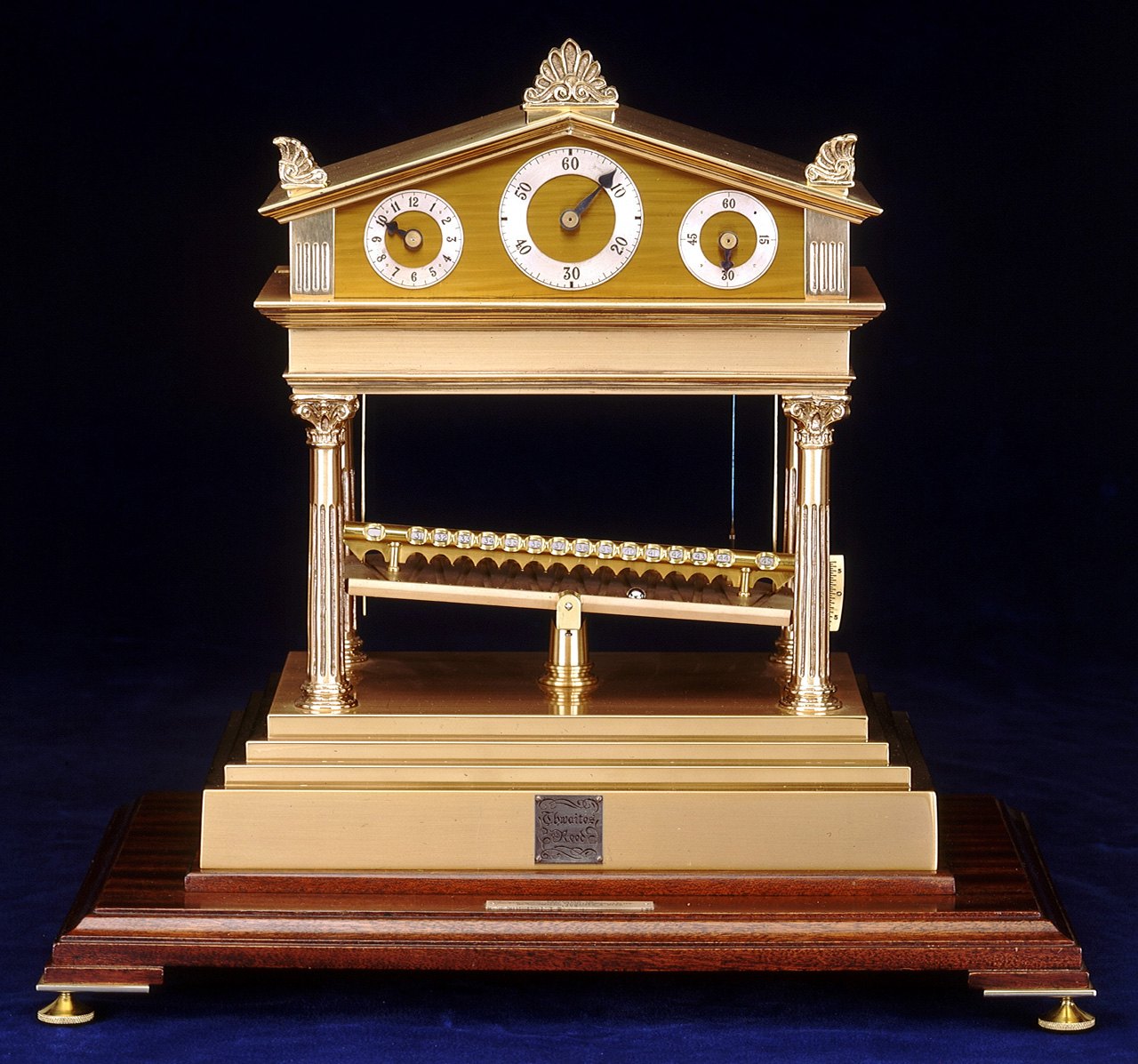
Rolling ball clock by Thwaites & Reed
- Maker / attribution
- Thwaites & Reed (maker)
- Date
- c.1972
- Historical period
- Quartz Revolution (1969 – 1990)
- Country of origin
- England
- Object type
- Clock
- Materials / technique
- metal
- Dimensions
- Overall: 445 x 478 x 320 mm
- Holding institution
- Royal Museums Greenwich
- Accession / object no.
- ZAA0176
- Credit line
- National Maritime Museum, Greenwich, London
- Catalogue title (original)
- Rolling ball clock (English)
View the source record ↗ (opens another website in a new tab)Suggest a correction
Record summary
Held and catalogued by Royal Museums Greenwich (object number ZAA0176), this is a clock by Thwaites & Reed, made in England, dated c.1972. The Atlas places it in the Quartz Revolution period (1969 – 1990) of its Clocks collection. Materials and techniques recorded by the source: metal. Recorded dimensions: Overall: 445 x 478 x 320 mm. The record is illustrated with 1 photograph.
Assembled from the source record's structured fields. Dates and attributions are given as the source states them; where a field is missing the Atlas leaves it blank rather than estimating.
Catalogue description
Catalogue description — Royal Museums Greenwich
A reproduction of Sir William Congreve’s rolling ball clock by Thwaites & Reed, London, made circa 1972 The lacquered brass case is modelled in the architectural style and the dials for hours, minutes and fifteen-second units are placed within the tympanum below a moulded cornice which is decorated with Anthemion finials. The single fusee movement is enclosed behind the dials and is supported by four reeded Corinthian columns. Within the colonnade is the pivoted table upon which is a zigzag runway. A steel ball travels down the runway until it activates a lever, which releases the train and tilts the table to allow the ball to return. The ball passes through a series of fifteen arches, above which the seconds are numerically indicated. The ball takes approximately fifteen seconds to run from top to the bottom of the table and as the table is tilted the seconds indication changes. The clock has a stepped gilt brass plinth with applied manufacturer’s signature plate over a moulded mahogany base with adjustable brass feet and presentation plaque that reads: ‘Presented to the National Maritime Museum by the Makers, Thwaites & Reed, 1972’ The early 1970s saw a revival of interest in novel horological inventions and companies such as Thwaites & Reed and Dent produced limited editions of various designs. William Congreve (1772-1828) is better known for developing solid fuel rockets that were used effectively against the Americans in the War of 1812.
Historical context
Quartz Revolution (1969 – 1990)
Seiko's Astron begins mass quartz timekeeping; traditional industries contract sharply.
Quartz movements and digital displays made accurate clocks cheap and ubiquitous after the early 1970s. LED and LCD clocks, clock radios and radio-controlled clocks appeared, while traditional mechanical clockmaking contracted sharply in Germany, France and Britain.
Read the period in the timelineMore clocks from this periodEarlier: Modern Mechanical Horology
Atlas type guide
Domestic clocks
A clock combines four systems: a source of power (falling weight, coiled spring, or later electricity), a gear train that divides time, an escapement and oscillator that regulate it (foliot, pendulum or balance), and an indicating system of dial and hands or a bell. Its history runs from the large iron weight-driven clocks of the late thirteenth century to Renaissance spring-driven table clocks, the pendulum revolution of 1656, the factory clocks of the nineteenth century and electric and quartz clocks of the twentieth.
Domestic clocks also reflect regional furniture and decorative traditions — English longcase and bracket clocks, French pendules, Viennese regulators, Black Forest and American shelf clocks — and therefore record changing tastes as much as technical progress.
What to look for
- How the clock is powered: weights, spring barrel, fusee, electric coil.
- The oscillator: foliot, short pendulum, long seconds pendulum or balance.
- Whether it strikes: hour only (count wheel) or hours and quarters (rack striking).
- The maker or retailer's name on dial and movement, and any factory trademarks.
- Signs of alteration — replaced dials, converted escapements, 'married' cases.
Dating clues
- Before 1656 clocks used foliots or balances; after, most domestic clocks have pendulums.
- Anchor escapements spread after c. 1670; minute hands became common at the same time.
- Factory production in America and Germany transformed prices after c. 1840.
General guidance written by the Atlas editors about this kind of object. It is not a statement about this particular piece; for that, rely on the source record above and on physical examination.
Related records
Clocks · c. 1852
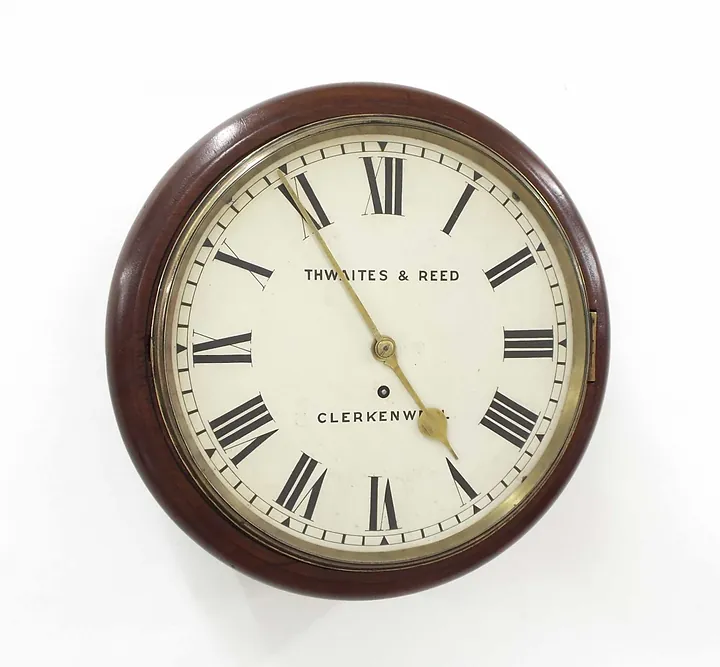
Mahogany single fusee 12-inch wall dial clock signed Thwaites & Reed, circa 1852
Gardiner Houlgate (auction house), Corsham
Clocks · c. 1825
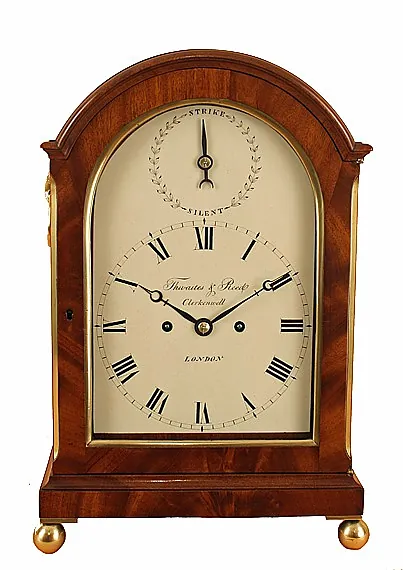
Bracket clock by Thwaites & Reed, London, c. 1825
P A Oxley (dealer), Wiltshire
Clocks · c. 1806
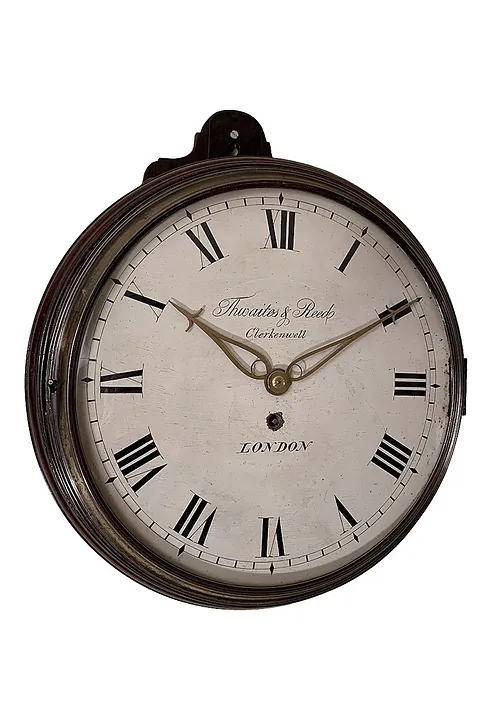
Georgian wall clock by Thwaites & Reed, Clerkenwell, London, c. 1806
P A Oxley (dealer), Wiltshire
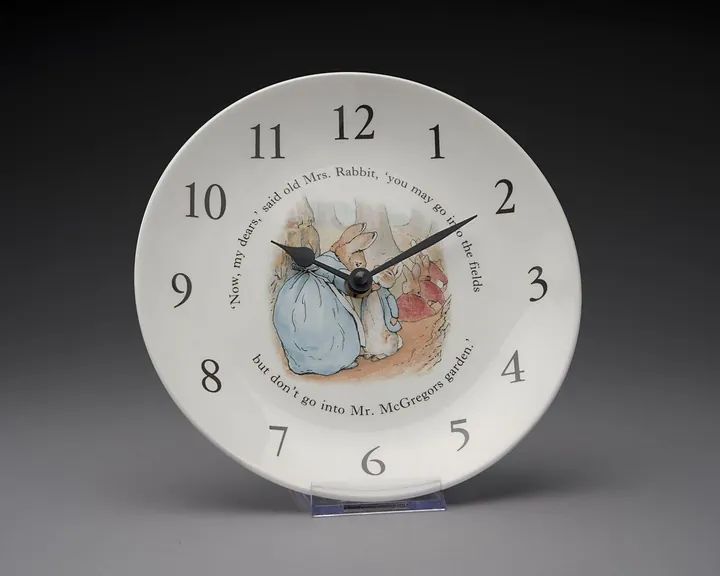
Clocks · late 20th century
Clock, 'Peter Rabbit', Queen's ware, transfer printing, Josiah Wedgwood and Sons, Barlaston, late 20th century (V&A WE.17466-2014)
Victoria and Albert Museum, London
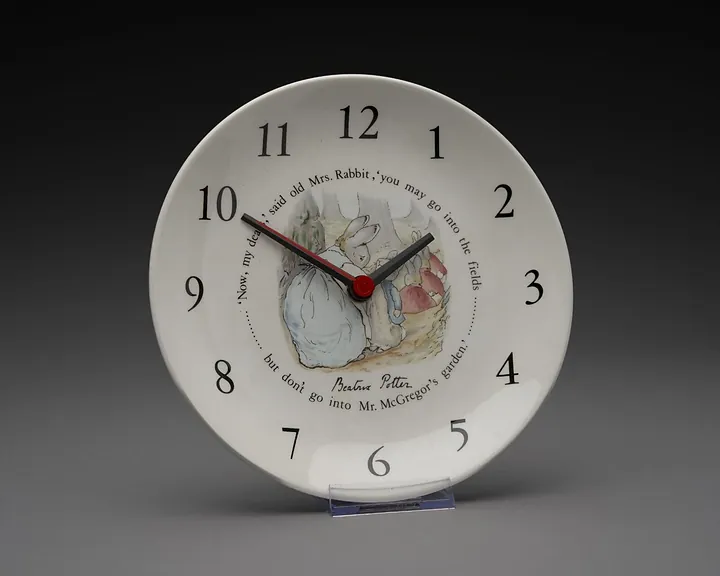
Clocks · late 20th century
Clock, 'Peter Rabbit', Queen's ware, transfer printing, Josiah Wedgwood and Sons, Barlaston, late 20th century (V&A WE.18029-2014)
Victoria and Albert Museum, London
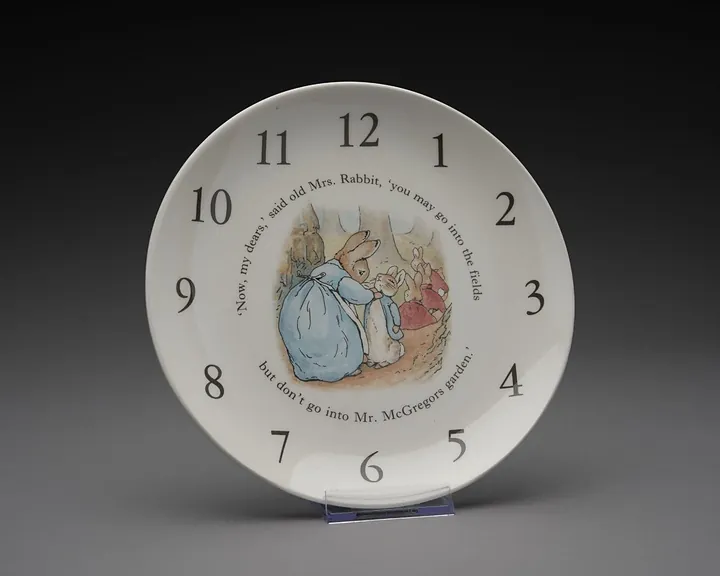
Clocks · late 20th century
Clock, 'Peter Rabbit', glazed earthenware, transfer printing, Josiah Wedgwood and Sons, Barlaston, late 20th century
Victoria and Albert Museum, London
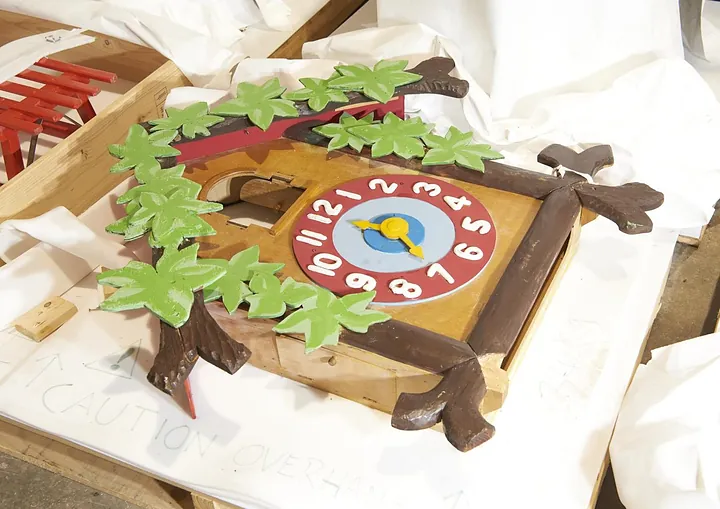
Clocks · 1964–1988
The clock from BBC children's television series 'Playschool', c 1977
Science Museum Group, London
Clocks · 1964–1988
The clock housing from BBC children's television series 'Playschool', c 1977
Science Museum Group, London