
Wristwatches · Wristwatch
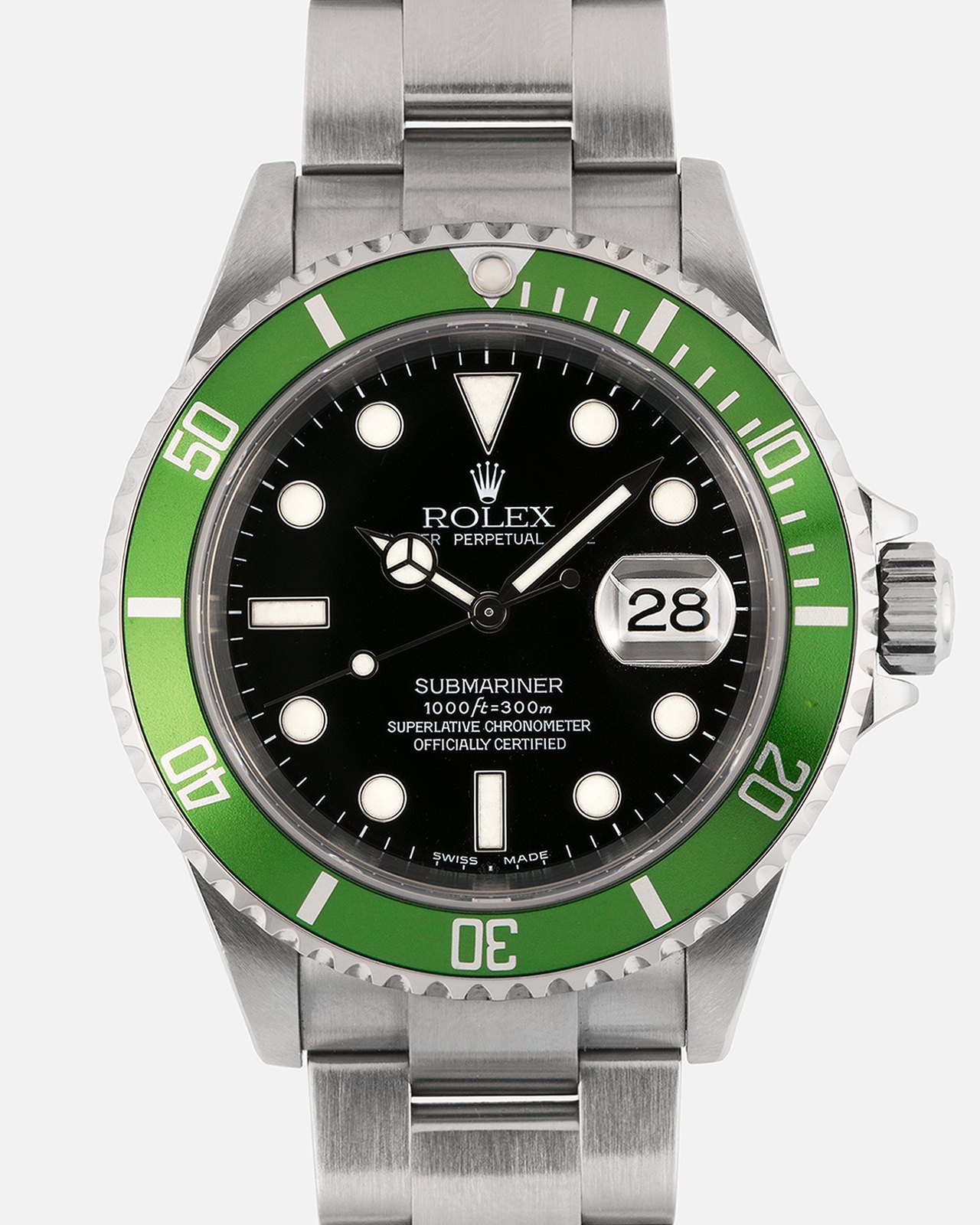
Rolex Submariner 16610LV Kermit 'Flat 4' F Serial, 2003
- Maker / attribution
- Rolex (maker)
- Date
- 2003
- Historical period
- Mechanical Renaissance (1990 – 2010)
- Country of origin
- Switzerland
- Object type
- Wristwatch
- Dimensions
- Case 40 mm
- Stock no.
- Product 7791974744151
- Credit line
- Dealer listing, S.Song Watches (product 7791974744151)
- Catalogue title (original)
- Rolex Submariner 16610LV Kermit 'Flat 4' F Serial (English)
View the source record (dealer listing) ↗ (opens another website in a new tab)Suggest a correction
Record summary
Catalogued by S.Song Watches (dealer), Seattle (stock number Product 7791974744151), this is a wristwatch by Rolex, made in Switzerland, dated 2003. The Atlas places it in the Mechanical Renaissance period (1990 – 2010) of its Wristwatches collection. Recorded dimensions: Case 40 mm. The record is illustrated with 6 photographs.
Assembled from the source record's structured fields. Dates and attributions are given as the source states them; where a field is missing the Atlas leaves it blank rather than estimating.
Catalogue description
Dealer description — S.Song Watches
Few watches are as closely associated with Rolex as the Submariner. Introduced in 1953 as a purpose-built diving watch, its basic formula would remain remarkably consistent over the following decades, gradually evolving through improvements in movements, materials and construction while retaining essentially the same design. In 2003, Rolex celebrated the 50th anniversary of the Submariner with the introduction of the Ref. 16610LV. Based on the existing 16610, the anniversary model represented a surprisingly significant departure for what had historically been one of Rolex's most conservative sports watches. For the first time on a stainless steel Submariner, the traditional black bezel was replaced by one in green, Rolex's corporate colour, with the letters "LV" standing for "Lunette Verte", or green bezel. The unusual colour combination would eventually earn it the nickname "Kermit". The changes went beyond simply swapping the bezel. The 16610LV also introduced what collectors now refer to as the "Maxi" dial, with substantially larger luminous hour markers and a broader minute hand. The result is a watch that remains immediately recognisable as a five-digit Submariner, but with a noticeably more graphic appearance than the standard 16610 produced alongside it. The present example is an early F-series watch featuring the particularly desirable "Flat Four" bezel insert. Found on the earliest examples of the 16610LV, the name refers to the typography of the numeral 4 within the "40" on the green aluminium bezel, where the internal opening has a distinctly flat rather than pointed top. More importantly, the Flat Four belongs to the earliest and considerably rarer period of Kermit production. These inserts are principally associated with the first Y and F serial examples before Rolex transitioned to the later pointed four typography. What was originally an almost insignificant production detail has subsequently become one of the key distinctions collectors use to separate the earliest 16610LVs from the much larger number of watches that followed. Otherwise, the 16610LV retains everything that made the five-digit Submariner such an effective everyday watch. Its stainless steel Oyster case measures 40mm across and is water resistant to 300 metres, paired with a sapphire crystal, Triplock crown and Oyster bracelet. Inside is the automatic Calibre 3135, the same robust movement that powered the standard Submariner Date throughout much of this period. The 16610LV would remain in production until 2010, and over those seven years a surprising number of subtle variations appeared. Changes to bezel typography and colour-ageing, dial printing and other small details have resulted in collectors identifying multiple different versions of the Kermit today. As with vintage Rolex, these differences were never intended to create separate models, but were simply the result of Rolex continually changing components throughout production. In many ways, this is what makes the Kermit particularly interesting today. It is arguably one of the last truly collectable modern Rolex sports references in the traditional sense, produced during a transitional period when small variations could still appear throughout a reference's production run. As Rolex manufacturing became increasingly streamlined and consistent with the six-digit generation, these sorts of variations became considerably less common. The early Flat Four sits at the very beginning of that story. It combines the slimmer case, aluminium bezel and proportions of the classic five-digit Submariner with the Maxi dial and use of colour that would become increasingly important to modern Rolex. Being both earlier and rarer than the later Kermit variants, the Flat Four has understandably become the version collectors pay the most attention to, and one of the clearest examples of why the 16610LV remains such an interesting reference to collect.
Historical context
Mechanical Renaissance (1990 – 2010)
Mechanical watches return as cultural objects; independent watchmaking flourishes.
Mechanical watches returned as cultural and luxury objects. Complications, tourbillons and new materials proliferated; independent watchmakers such as George Daniels, F.P. Journe and Philippe Dufour revived artisanal watchmaking; collecting vintage watches became a major field.
Read the period in the timelineMore wristwatches from this periodEarlier: Quartz Revolution
Atlas type guide
Dive and water-resistant watches
Keeping water and dust out of a wristwatch was a long-standing challenge. Rolex's screw-down Oyster case (1926) and Omega's Marine (1932) were landmarks; in the early 1950s Blancpain's Fifty Fathoms and Rolex's Submariner defined the professional dive watch with rotating bezels for timing dives, luminous dials and high water resistance. The ISO 6425 standard (1982) later codified what a 'diver's watch' must do.
Dive watches became icons of post-war design and exploration, and their evolution — helium escape valves, ceramic bezels, saturation-diving depth ratings — records the history of underwater work.
What to look for
- Unidirectional or bidirectional rotating bezel with minute markings.
- Screw-down crown and case back; depth rating printed on the dial.
- Luminous hands and markers (radium before c. 1960, tritium c. 1960–1998, then Super-LumiNova).
- Reference numbers on the case between the lugs or inside the back.
Dating clues
- Screw-down Oyster cases: from 1926.
- Professional dive watches: from 1953.
- Tritium 'T' marks on dials: c. 1960–1998.
General guidance written by the Atlas editors about this kind of object. It is not a statement about this particular piece; for that, rely on the source record above and on physical examination.
Related records

Movements & Components · c. 1970s
Rolex watch movement, c. 1970s
Antiquorum auction archive, Geneva

Pocket Watches · 1982
Fake Rolex watch, gold coloured metal, possibly made in Taiwan, 1982; part of a casual outfit, UK, 1982-84.
Victoria and Albert Museum, London

Wristwatches · c. 1920s
Rolex wristwatch, c. 1920s
Antiquorum auction archive, Geneva

Wristwatches · c. 1920s
Rolex wristwatch, ref. 6194, c. 1920s
Antiquorum auction archive, Geneva

Wristwatches · 2008
Wristwatch by Breitling?, 2008
Museum Rotterdam

Wristwatches · c. 1990s
Audemars Piguet Bamboo, c. 1990s
Antiquorum auction archive, Geneva

Wristwatches · c. 1990
Audemars Piguet Huitieme Perpetual Calendar, ref. 25696PT, c. 1990
Antiquorum auction archive, Geneva

Wristwatches · c. 1990
Breitling Chronomat, ref. b13050.1, c. 1990
Antiquorum auction archive, Geneva