
Wristwatches · Wristwatch
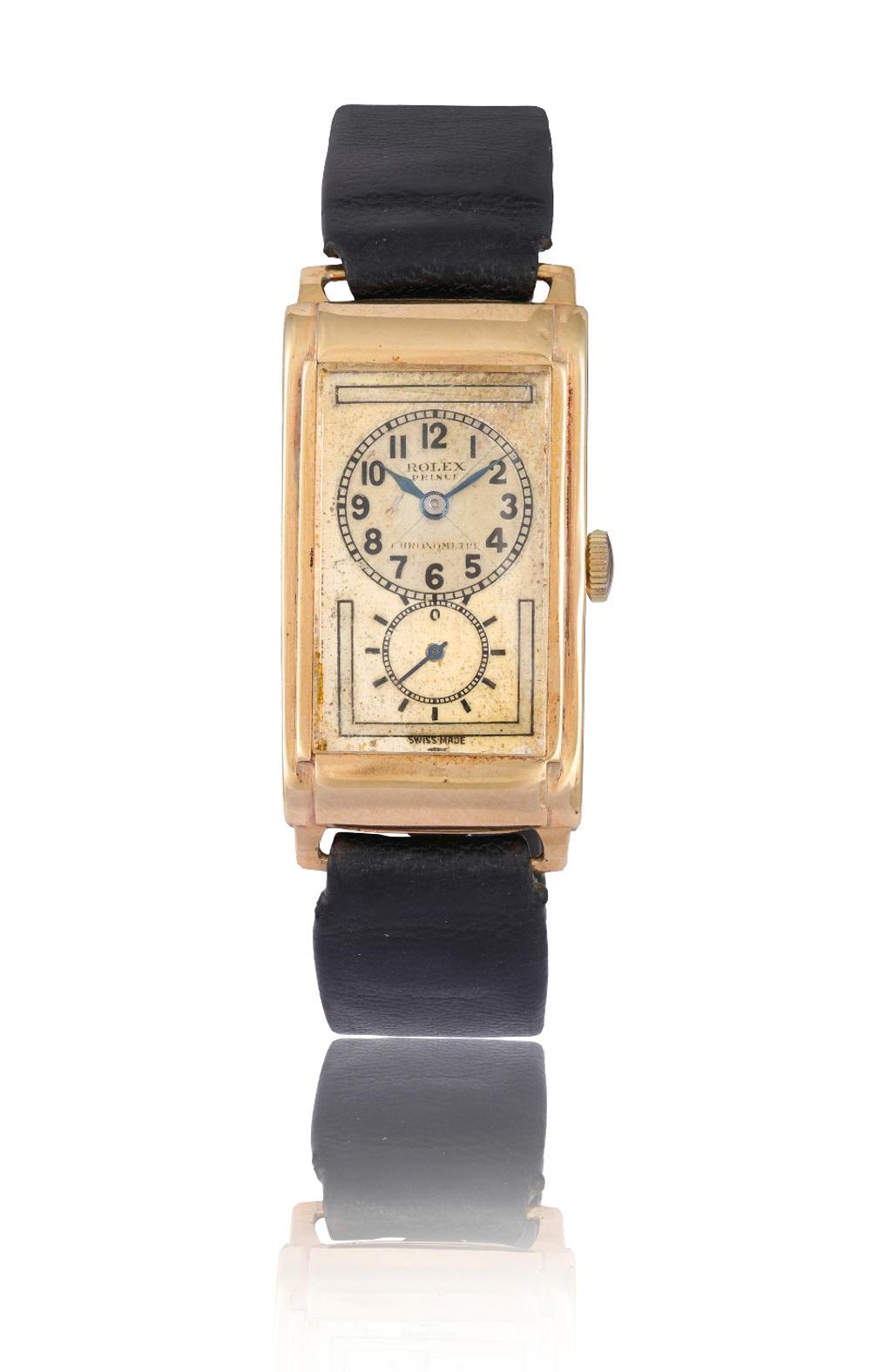
Rolex Prince 'Doctor's watch', ref. 1862, 9K yellow gold
- Maker / attribution
- ROLEX (maker)
- Date
- c. 1937
- Historical period
- Golden Age of Mechanical Watchmaking (1900 – 1945)
- Country of origin
- Unrecorded in source
- Object type
- Wristwatch
- Materials / technique
- gilt, gold, steel
- Auction house
- Invaluable auction listings
- Lot
- Lot C1F3A6725A
- Credit line
- Auction lot record: lot 47, Fine Watches, Adam's (2026), via Invaluable
- Catalogue title (original)
- ROLEX REF. 1862, PRINCE “DOCTOR’S WATCH”, 9K YELLOW GOLD A rare 9K yellow gold manual-winding rectangular wristwatch with two-part “doctor’s” dial, subsidiary seconds and presentation inscription. Yea (English)
Editor's note
Title rewritten in English from the auction house's own lot title (Dutch, German or run into the description); facts unchanged.View the source record (auction lot) ↗ (opens another website in a new tab)Suggest a correction
Record summary
Catalogued by Invaluable auction listings (lot Lot C1F3A6725A), this is a wristwatch by ROLEX, dated c. 1937. The Atlas places it in the Golden Age of Mechanical Watchmaking period (1900 – 1945) of its Wristwatches collection. Materials and techniques recorded by the source: gilt, gold, steel. The record is illustrated with 3 photographs.
Assembled from the source record's structured fields. Dates and attributions are given as the source states them; where a field is missing the Atlas leaves it blank rather than estimating.
Catalogue description
Lot description — Adam's
r: Circa 1937–1942 Dial: Two-tone silvered dial with black Arabic numerals, blued steel hands, upper hours-and-minutes display, subsidiary seconds register occupying the lower portion of the dial and outer minute track, signed Rolex Prince. Calibre: Rolex/Aegler manual-winding rectangular movement, 18 jewels, adjusted, signed Rolex. Case: 9K yellow gold rectangular case with stepped Art Deco bezel, fixed lugs and snap-on case back, ref. 1862, serial numbered 39,962. Case back engraved “1942 – Irish Grand National – ‘Prince Regent’ – To Tom Dreaper from J.V. Rank.” Dimensions: Approx. 21 x 36 mm, excluding lugs Gross Weight: Approx. 26.4 g Bracelet: Black leather strap with gilt pin buckle. Signature: Dial, movement and case. Presented after Prince Regent's victory in the 1942 Irish Grand National, an engraved Rolex offered at Adam's recalls the beginning of one of Irish racing's most remarkable careers. On the reverse of a gold Rolex Prince offered in Adam's forthcoming Fine Watches auction, a short inscription records a remarkable moment in Irish racing history: '1942 Irish Grand National – Prince Regent – To Tom Dreaper – From J.V. Rank'. The watch was a presentation from racehorse owner James Voase Rank to his trainer, Tom Dreaper, following Prince Regent's victory at Fairyhouse on Easter Monday, 6 April 1942. It marked the first of what would become a record ten Irish Grand National wins for Dreaper. Prince Regent was seven years old when he lined up at Fairyhouse, carrying the formidable top weight of 12 stone 7 pounds. The 5/2 favourite in a field of ten, he faced exceptionally heavy ground and a determined challenge from Golden Jack. Ridden by Tim Hyde, Prince Regent asserted his superiority over the fences before holding off his rival in the closing stages, securing a celebrated victory under testing conditions. The horse's achievements did not end there. Despite restrictions on racing in Britain during the Second World War, Prince Regent became one of Ireland's outstanding steeplechasers. In March 1946, by then eleven years old, he won the Cheltenham Gold Cup, again ridden by Hyde, giving Dreaper his first victory in the race. Rank, the man whose name appears on the watch, was a prominent British flour-milling industrialist and the elder brother of J. Arthur Rank, founder of the British film empire. He had entrusted his horses to Dreaper in 1938, bringing Prince Regent to the trainer's Greenogue stables in County Dublin and establishing a partnership that would deliver some of Dreaper's earliest major successes. Dreaper would go on to become one of the greatest trainers in National Hunt history. His ten Irish Grand National victories included seven in succession between 1960 and 1966, while his five Cheltenham Gold Cup wins remain a record. Most famously, he trained Arkle, winner of three consecutive Gold Cups, as well as Flyingbolt, another of the highest-rated steeplechasers of all time. That history continues through the Dreaper family. In 2024, Tom Dreaper's grandson, also named Tom, took over the training licence at Greenogue from his father Jim, carrying the family name into a third generation. More than eighty years after Prince Regent's victory, the engraving on this Rolex preserves a personal exchange between owner and trainer at the very beginning of an extraordinary career. It is a rare meeting of watchmaking and Irish sporting history, made all the more compelling by the names it records
Historical context
Golden Age of Mechanical Watchmaking (1900 – 1945)
The wristwatch displaces the pocket watch; waterproof cases, self-winding and grand complications.
The wristwatch overtook the pocket watch. Military use in the First World War, aviation, water-resistant cases (1926), automatic winding (1923–31), rectangular Art Deco designs and early chronographs and calendars defined the period.
Read the period in the timelineMore wristwatches from this periodEarlier: Industrial Revolution
Atlas type guide
Wristwatches
Bracelet watches were worn by women from the early nineteenth century — Breguet made one for Caroline Murat, Queen of Naples, in 1810–12 — but the wristwatch only became a man's instrument with military use and aviation in the early twentieth century. Between the World Wars it overtook the pocket watch; the 1920s and 1930s brought rectangular Art Deco cases, water-resistant cases and the first automatic winding systems.
After 1945 the wristwatch became a carrier of identity — dress watches, sports and dive watches, chronographs, calendars — produced by Swiss, American, Japanese, German, Soviet and Chinese industries. The quartz revolution after 1969 and the mechanical renaissance since the 1990s, including the rise of independent watchmakers, complete the story.
What to look for
- The reference number (between the lugs or inside the case back) and serial number, the starting point for dating.
- The calibre: its maker and number are often stamped under the dial or on the bridge.
- Originality of dial, hands and crown — refinished ('redial') dials are common.
- Case material marks: 18K/750, 14K/585, stainless steel, gold-filled, plated.
Dating clues
- Wire-lug cases: before c. 1925.
- Water-resistant screw-down cases: from 1926.
- Quartz movements: from 1969; sapphire crystals widespread after c. 1980.
General guidance written by the Atlas editors about this kind of object. It is not a statement about this particular piece; for that, rely on the source record above and on physical examination.
Related records
Wristwatches · c. 1949
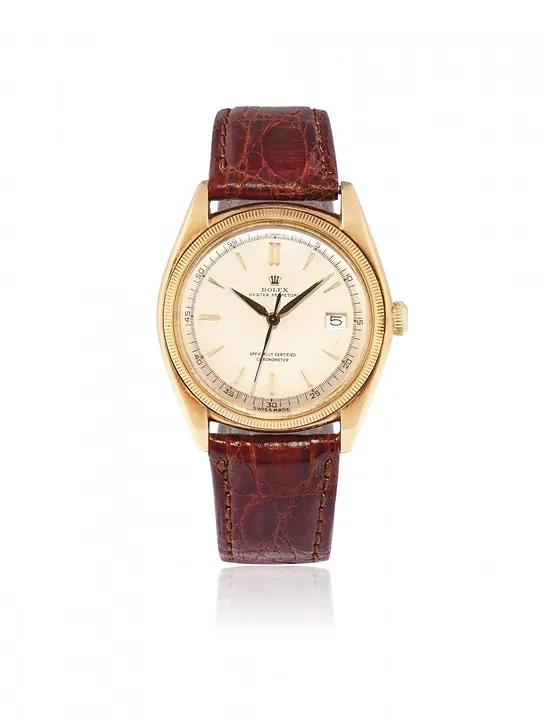
Gold Rolex Datejust 'Big Bubbleback', ref. 4467, c. 1949
LiveAuctioneers auction archive
Wristwatches · 1970s
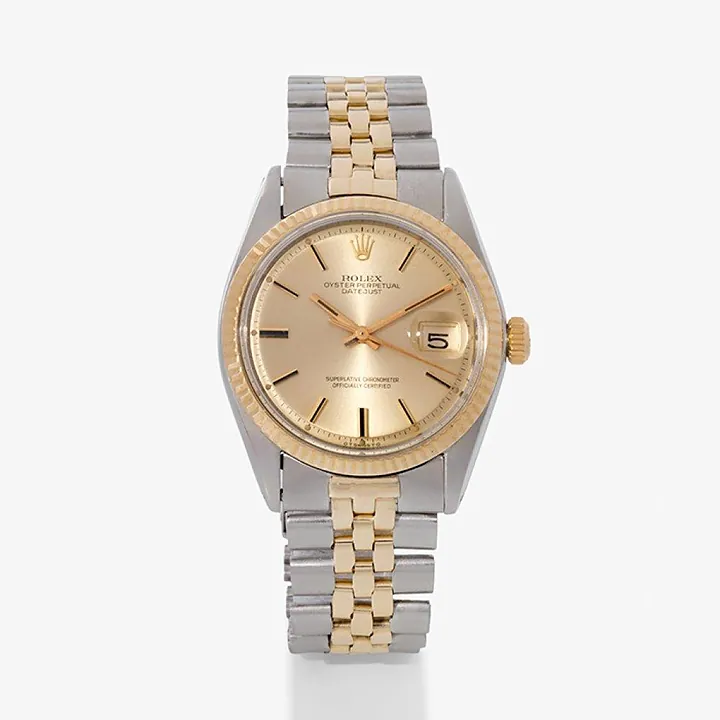
Rolex Oyster Perpetual Datejust watch, ref. 1601, serial no. 36133XX, 1970s
Invaluable auction listings
Wristwatches · 1900–1999
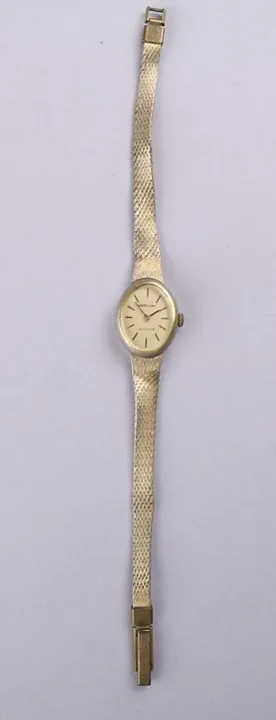
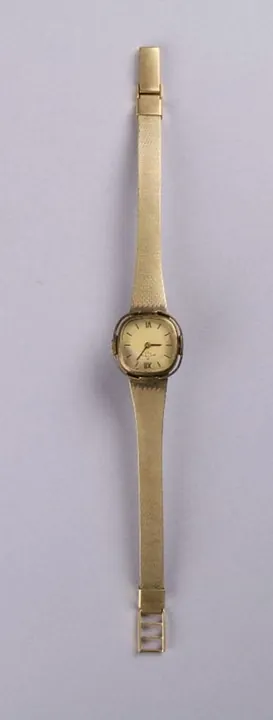
Wristwatch by Mercury, 1900–1999
Modemuseum Hasselt
Wristwatches · 1900–1999
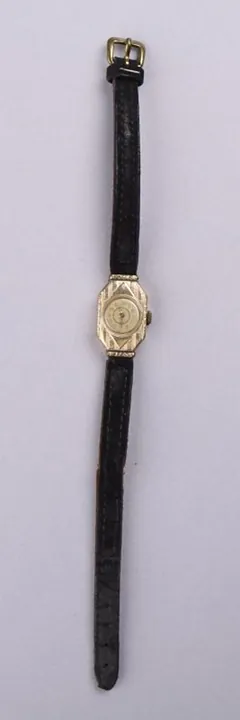
Wristwatch by Nutrix, 1900–1999
Modemuseum Hasselt
Wristwatches · 1920
Wristwatch, 1920
Modemuseum Hasselt

Wristwatches · 1931
Rolex 'Oyster Perpetual' rotor self-winding wrist-watch, lever escapement, in steel case with glass in back, Montres Rolex SA, Geneva, Switzerland, 1931
Science Museum Group, London
Wristwatches · c. 1936
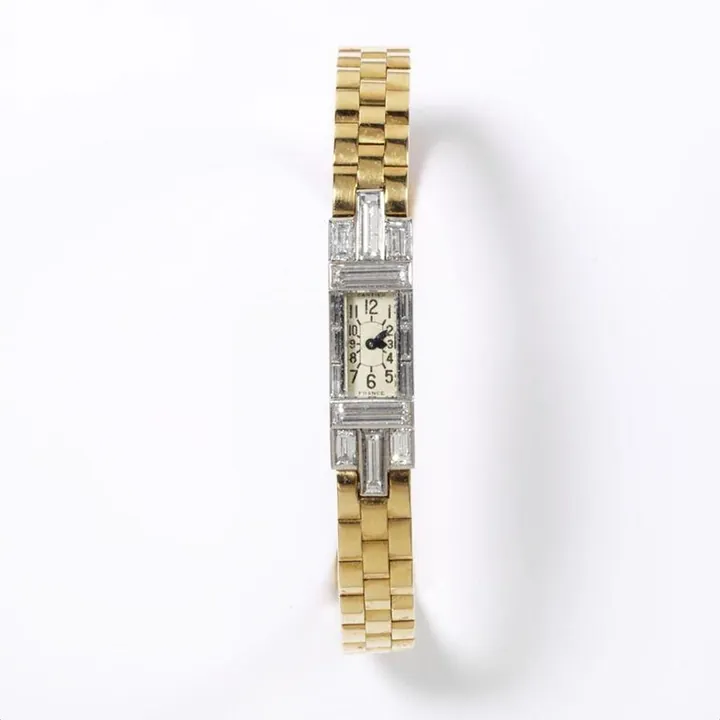
Watch with diamond-set platinum case and gold link bracelet, Cartier, Paris, c. 1936.
Victoria and Albert Museum, London
Wristwatches · early to mid 20th century
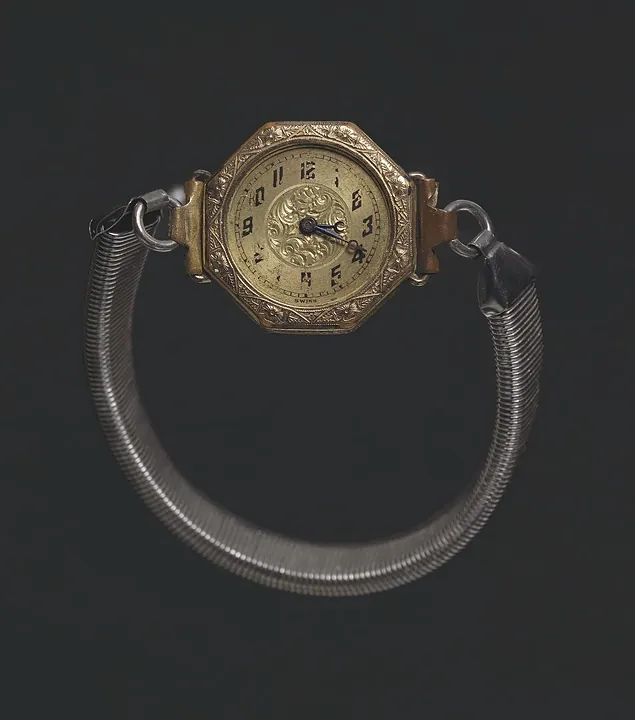
Woman's wristwatch worn by Harriette Vyda Simms Moore, early to mid 20th century
National Museum of African American History and Culture, Smithsonian Institution, Washington DC