
Wristwatches · Wristwatch
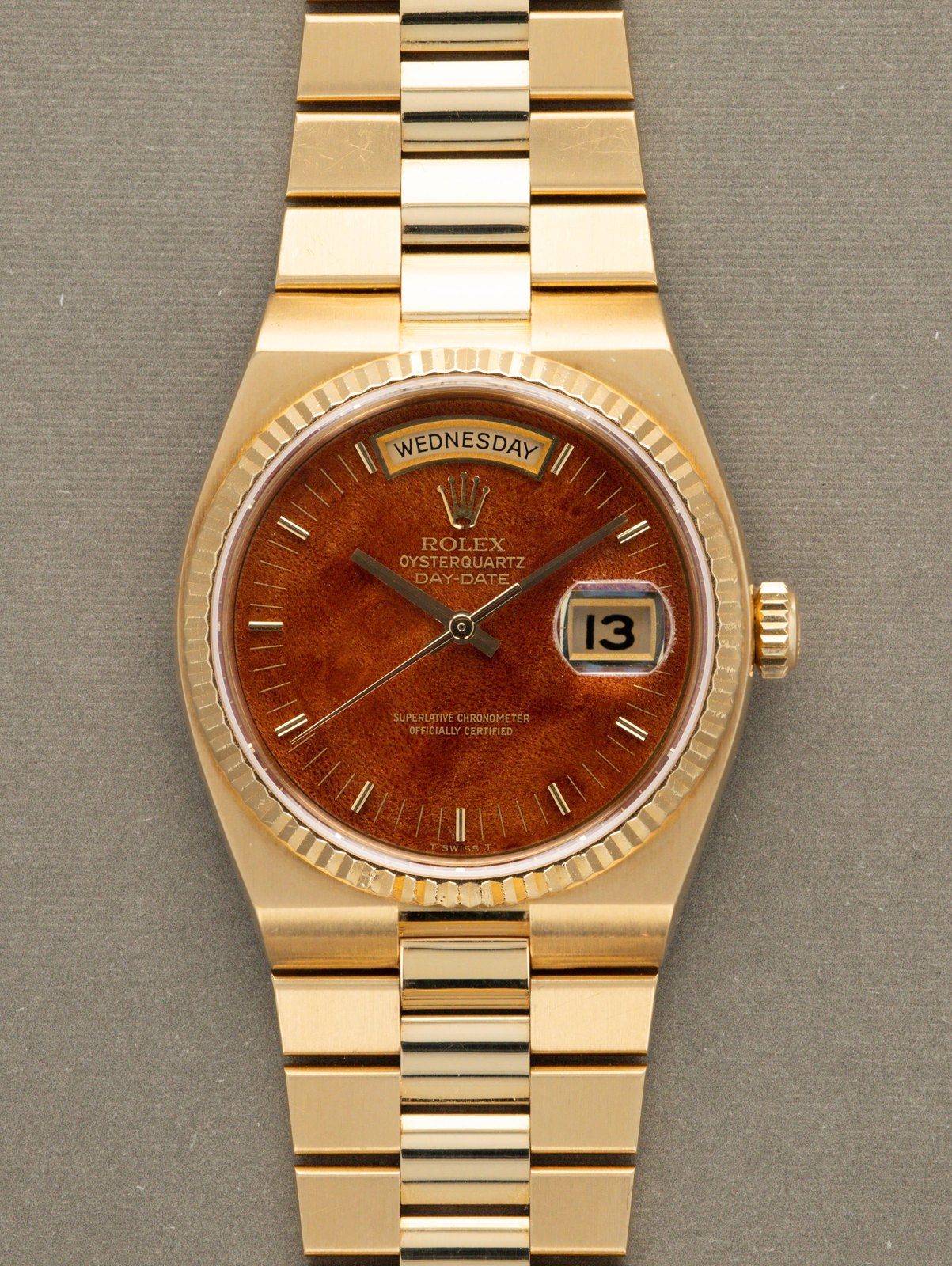
Rolex Oysterquartz Day-Date ref. 19018N, 'Burlwood' Dial
- Maker / attribution
- Rolex (maker)
- Date
- c. 1988
- Historical period
- Quartz Revolution (1969 – 1990)
- Country of origin
- Switzerland
- Object type
- Wristwatch
- Stock no.
- OC2029
- Credit line
- Dealer listing, Oliver & Clarke (OC2029)
- Catalogue title (original)
- Rolex Oysterquartz Day-Date Ref. 19018N - 'Burlwood' Dial (English)
View the source record (dealer listing) ↗ (opens another website in a new tab)Suggest a correction
Record summary
Catalogued by Oliver & Clarke (dealer), United Kingdom (stock number OC2029), this is a wristwatch by Rolex, made in Switzerland, dated c. 1988. The Atlas places it in the Quartz Revolution period (1969 – 1990) of its Wristwatches collection. The record is illustrated with 6 photographs.
Assembled from the source record's structured fields. Dates and attributions are given as the source states them; where a field is missing the Atlas leaves it blank rather than estimating.
Catalogue description
Dealer description — Oliver & Clarke
When the Day-Date was released in 1956, Rolex had made numerous attempts to capture the market with more complicated timepieces such as the Ref. 6036, the Ref. 8171, and the Ref. 6062, but it seemed like buyers were not particularly fond of complicated Rolexes. All of that changed when President Dwight D. Eisenhower was spotted wearing one Rolex in particular: a Day-Date. The model has since become known worldwide as ‘The President’ and as a symbol of success and prestige. Simply put, this one stuck. The 1970s were an interesting time for the watch industry. The Great Quartz Crisis from Japan offered the world better quality watches, that were more accurate, more reliable, and generally much more affordable. A kiss of death for mechanical watchmaking at the time. Even the very best of Switzerland will still lose accuracy over time — an issue that a quartz watch virtually solved (though not perfect). Great, beloved Swiss brands like Universal Genève, Gallet, Zodiac, and Blancpain would disappear — some of which were acquired by holding companies, other brands, etc. and eventually resurface, but hundreds of smaller brands were completely wiped away. Rolex responded by producing their own version of the quartz watch called it the Oysterquartz, which introduced a more style-forward and angular design that was becoming popular in the 1970s, and of course, a quartz movement inside. On top of this new model line name, these pieces utilized existing cornerstone model names to denote specific models with the Oysterquartz range, such as the Datejust and Day-Date. The piece that we have here is a Day-Date variant dating to circa 1988, and as with all other pieces in Rolex's flagship line, it is constructed out of solid gold. In this case, yellow gold with a very of-its-time, lacquered 'burlwood' dial within — further adding to this pieces scarcity. The case and integrated bracelet are in excellent overall condition, having seen a light previous polishing and showing only light signs of wear throughout and only one small impression on the upper left lug. The 'fluted' yellow gold bezel retains crisp finishing and also shows only light signs of wear. Inside, the non-luminous lacquered burlwood dial with its printed minute markers, applied hour markers, and framed day & date apertures remains in outstanding, seemingly-flawless condition and is complimented by a matching non-luminous handset. The flat-link bracelet wears beautifully and features a signed 'hidden' deployant clasp. This then, is a strange yet important piece from the pages of Rolex's history, and is a must if you are looking to add a Day-Date to a collection of many, or simply snag a lesser-known piece thats a bit out of the ordinary.
Historical context
Quartz Revolution (1969 – 1990)
Seiko's Astron begins mass quartz timekeeping; traditional industries contract sharply.
Quartz and digital watches transformed the market after 1969. Swiss employment collapsed, Japanese and Hong Kong production soared, and the Swatch (1983) helped the Swiss industry recover; mechanical watches survived as luxury goods.
Read the period in the timelineMore wristwatches from this periodEarlier: Modern Mechanical Horology
Atlas type guide
Dive and water-resistant watches
Keeping water and dust out of a wristwatch was a long-standing challenge. Rolex's screw-down Oyster case (1926) and Omega's Marine (1932) were landmarks; in the early 1950s Blancpain's Fifty Fathoms and Rolex's Submariner defined the professional dive watch with rotating bezels for timing dives, luminous dials and high water resistance. The ISO 6425 standard (1982) later codified what a 'diver's watch' must do.
Dive watches became icons of post-war design and exploration, and their evolution — helium escape valves, ceramic bezels, saturation-diving depth ratings — records the history of underwater work.
What to look for
- Unidirectional or bidirectional rotating bezel with minute markings.
- Screw-down crown and case back; depth rating printed on the dial.
- Luminous hands and markers (radium before c. 1960, tritium c. 1960–1998, then Super-LumiNova).
- Reference numbers on the case between the lugs or inside the back.
Dating clues
- Screw-down Oyster cases: from 1926.
- Professional dive watches: from 1953.
- Tritium 'T' marks on dials: c. 1960–1998.
General guidance written by the Atlas editors about this kind of object. It is not a statement about this particular piece; for that, rely on the source record above and on physical examination.
Related records

Movements & Components · c. 1970s
Rolex watch movement, c. 1970s
Antiquorum auction archive, Geneva

Pocket Watches · 1982
Fake Rolex watch, gold coloured metal, possibly made in Taiwan, 1982; part of a casual outfit, UK, 1982-84.
Victoria and Albert Museum, London

Wristwatches · c. 1920s
Rolex wristwatch, c. 1920s
Antiquorum auction archive, Geneva

Wristwatches · c. 1920s
Rolex wristwatch, ref. 6194, c. 1920s
Antiquorum auction archive, Geneva

Wristwatches · 1970
Wristwatch by Heno, Switzerland, 1970
Museum Rotterdam

Wristwatches · 1960–1986
'Tri-Compax' calendar chronograph wristwatch in gold case, by Universal, Geneva, Switzerland, 1960–1986.
Science Museum Group, London

Wristwatches · 1969–1970
Beta 21 Quartz wristwatch movement, made in Switzerland, 1970.
Science Museum Group, London

Wristwatches · c. 1969
Omega Speedmaster Moonwatch, ref. 145022-69st, c. 1969
Antiquorum auction archive, Geneva