
Wristwatches · Wristwatch
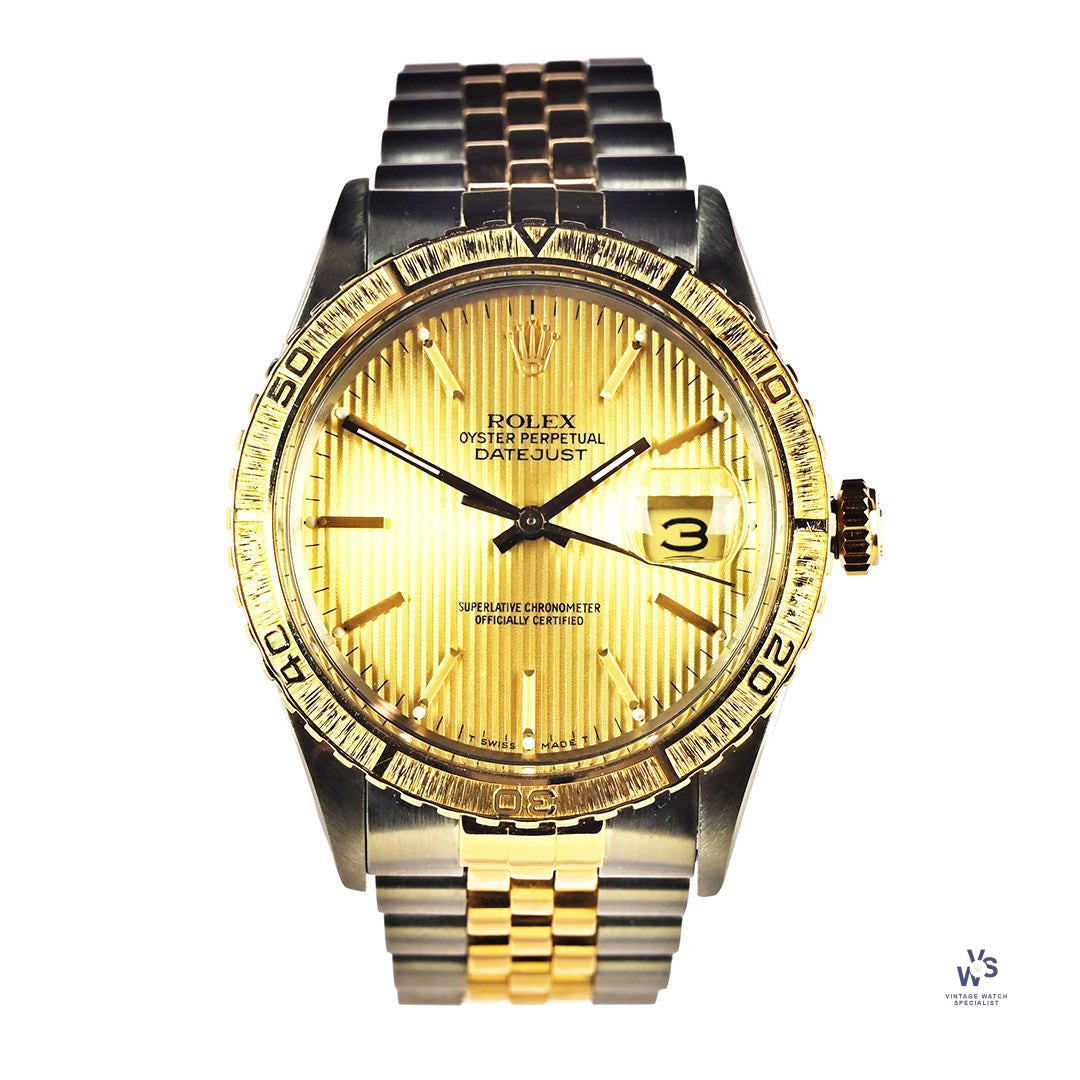
Rolex Oyster Perpetual Datejust Turn-O-Graph 'Thunder Bird', ref. 16253, circa 1985
- Maker / attribution
- Rolex (maker)
- Date
- c. 1985
- Historical period
- Quartz Revolution (1969 – 1990)
- Country of origin
- Switzerland
- Object type
- Wristwatch
- Stock no.
- vws3236cs
- Credit line
- Dealer listing, Vintage Watch Specialist (vws3236cs)
- Catalogue title (original)
- Rolex Oyster Perpetual Datejust Turn-O-Graph 'Thunder Bird' - Model Reference 16253 c.1985 (English)
View the source record (dealer listing) ↗ (opens another website in a new tab)Suggest a correction
Record summary
Catalogued by Vintage Watch Specialist (dealer), United Kingdom (stock number vws3236cs), this is a wristwatch by Rolex, made in Switzerland, dated c. 1985. The Atlas places it in the Quartz Revolution period (1969 – 1990) of its Wristwatches collection. The record is illustrated with 6 photographs.
Assembled from the source record's structured fields. Dates and attributions are given as the source states them; where a field is missing the Atlas leaves it blank rather than estimating.
Catalogue description
Dealer description — Vintage Watch Specialist
A Superb Gold and Steel Rolex Datejust Turn-O-Graph 'ThunderBird' Model Ref: 16253, in Beautiful Preowned Condition on a Gold and Steel Jubilee Bracelet, c.1985 The original turn-o-graph was launched in the 1950s, the R ef. 6202 could have been considered the brand's first tool watch as it featured a rotating bezel, marked with a 60-minute scale to give the ability to quickly measure elapsed time. The watch's original similarities to the Submariner disappeared by the second generation of the watch and whilst it retained its rotating bezel it changed from being a black aluminium insert into embossed metal, finished off with an engine-turned design, and the watch also gained a date function. By the end of the decade, the Turn-O-Graph had captured the attention of an elite group of aviators, the USAF aerobatics squadron, ‘The Thunderbirds’, and it became, at their request, the official timepiece of the unit. The watch was renamed the Rolex Thunderbird for the North American market. What's on Offer The Datejust comes in many guises and this particular reference is a rather opulent take on the popular classic. The perfect watch for the high-rolling yuppies of the 1980s, this Thunderbird has now become a rather collectable piece and this example is in superb condition. The gold textured Tuxedo dial is incredibly sharp and features applied baton hour indexes with luminous pips, stick hands with luminous inserts and a date wheel underneath a magnifying cyclops at 3 o'clock. The dial is encapsulated underneath an acrylic crystal and framed by a solid 18k gold Rolex diver bezel on a stainless steel case. The watch is powered by the 27-jewelled Rolex calibre 3035 COSC automatic movement. A sports luxe 18k gold and stainless steel Rolex Turn-O-Graph reference 16253 Thunderbird, a great addition to any collection, we are pleased to offer this beautiful watch for sale in such wonderful condition.
Historical context
Quartz Revolution (1969 – 1990)
Seiko's Astron begins mass quartz timekeeping; traditional industries contract sharply.
Quartz and digital watches transformed the market after 1969. Swiss employment collapsed, Japanese and Hong Kong production soared, and the Swatch (1983) helped the Swiss industry recover; mechanical watches survived as luxury goods.
Read the period in the timelineMore wristwatches from this periodEarlier: Modern Mechanical Horology
Atlas type guide
Dive and water-resistant watches
Keeping water and dust out of a wristwatch was a long-standing challenge. Rolex's screw-down Oyster case (1926) and Omega's Marine (1932) were landmarks; in the early 1950s Blancpain's Fifty Fathoms and Rolex's Submariner defined the professional dive watch with rotating bezels for timing dives, luminous dials and high water resistance. The ISO 6425 standard (1982) later codified what a 'diver's watch' must do.
Dive watches became icons of post-war design and exploration, and their evolution — helium escape valves, ceramic bezels, saturation-diving depth ratings — records the history of underwater work.
What to look for
- Unidirectional or bidirectional rotating bezel with minute markings.
- Screw-down crown and case back; depth rating printed on the dial.
- Luminous hands and markers (radium before c. 1960, tritium c. 1960–1998, then Super-LumiNova).
- Reference numbers on the case between the lugs or inside the back.
Dating clues
- Screw-down Oyster cases: from 1926.
- Professional dive watches: from 1953.
- Tritium 'T' marks on dials: c. 1960–1998.
General guidance written by the Atlas editors about this kind of object. It is not a statement about this particular piece; for that, rely on the source record above and on physical examination.
Related records

Movements & Components · c. 1970s
Rolex watch movement, c. 1970s
Antiquorum auction archive, Geneva

Pocket Watches · 1982
Fake Rolex watch, gold coloured metal, possibly made in Taiwan, 1982; part of a casual outfit, UK, 1982-84.
Victoria and Albert Museum, London

Wristwatches · c. 1920s
Rolex wristwatch, c. 1920s
Antiquorum auction archive, Geneva

Wristwatches · c. 1920s
Rolex wristwatch, ref. 6194, c. 1920s
Antiquorum auction archive, Geneva

Wristwatches · 1970
Wristwatch by Heno, Switzerland, 1970
Museum Rotterdam

Wristwatches · 1960–1986
'Tri-Compax' calendar chronograph wristwatch in gold case, by Universal, Geneva, Switzerland, 1960–1986.
Science Museum Group, London

Wristwatches · 1969–1970
Beta 21 Quartz wristwatch movement, made in Switzerland, 1970.
Science Museum Group, London

Wristwatches · c. 1969
Omega Speedmaster Moonwatch, ref. 145022-69st, c. 1969
Antiquorum auction archive, Geneva