
Wristwatches · Wristwatch
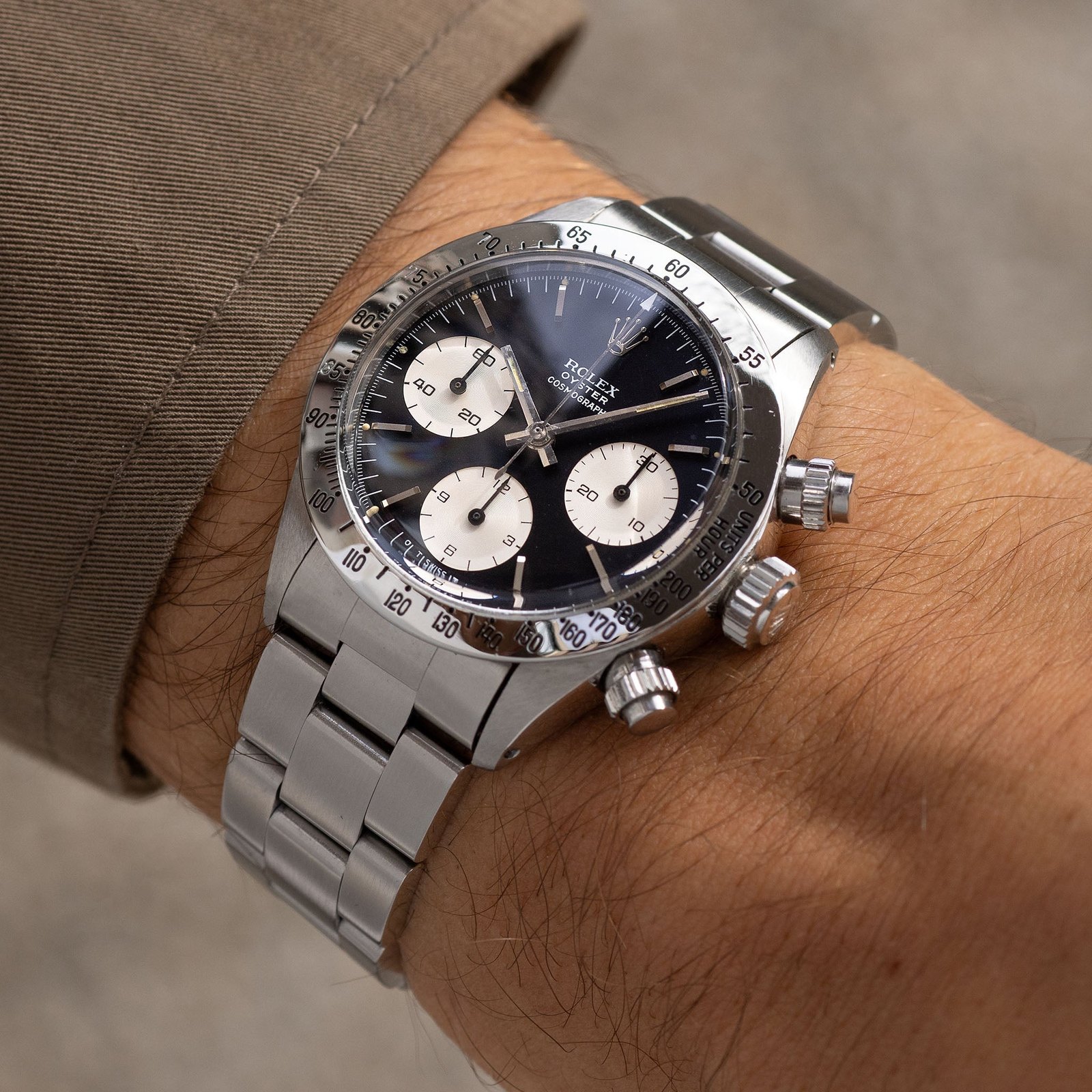
Rolex Oyster Cosmograph Daytona Ref 6265 MK2 Black Sigma Dial, 1975
- Maker / attribution
- Rolex (maker)
- Date
- 1975
- Historical period
- Quartz Revolution (1969 – 1990)
- Country of origin
- Switzerland
- Object type
- Wristwatch
- Dimensions
- Case 37 mm
- Stock no.
- W-3952
- Credit line
- Dealer listing, Bulang & Sons (W-3952)
- Catalogue title (original)
- Rolex Oyster Cosmograph Daytona Ref 6265 MK2 Black Sigma Dial (English)
View the source record (dealer listing) ↗ (opens another website in a new tab)Suggest a correction
Record summary
Catalogued by Bulang & Sons (dealer), Copenhagen (stock number W-3952), this is a wristwatch by Rolex, made in Switzerland, dated 1975. The Atlas places it in the Quartz Revolution period (1969 – 1990) of its Wristwatches collection. Recorded dimensions: Case 37 mm. The record is illustrated with 6 photographs.
Assembled from the source record's structured fields. Dates and attributions are given as the source states them; where a field is missing the Atlas leaves it blank rather than estimating.
Catalogue description
Dealer description — Bulang & Sons
There is something incredibly appealing about the early hand-wound Rolex Daytonas, especially when they come with a beautifully contrasting black dial. This reference 6265 has everything we love about the original Cosmograph: balanced proportions, purposeful details and a character that has only become more attractive with age. And then there is that wonderful Black Sigma dial, a subtle detail that makes this particular example especially interesting. Dating to 1975, this stainless steel Daytona features the distinctive MK2 Black Sigma dial with contrasting white registers and crisp white printing. At six o'clock, the small Greek sigma symbols flank the T SWISS T signature, indicating the use of precious-metal hour markers and hands, in this case white gold. It is one of those understated details that collectors have come to appreciate in these early Oyster Cosmographs. The dial presents beautifully, with finely textured subsidiary registers and warm, gently aged tritium hour plots. The familiar three-register layout is framed by the engraved stainless steel tachymeter bezel, giving the watch its unmistakable early Daytona appearance. The 37 mm Oyster case retains well-defined proportions, with light signs of wear consistent with its age. The steel bezel remains attractive, with clearly legible engravings and some small marks from use. Early MK1 screw-down chronograph pushers complete the classic appearance. The watch is fitted with a Rolex Oyster bracelet reference 78350 with 571 end links, a natural match for the sporty character of the Cosmograph. Inside beats the celebrated manually wound Rolex calibre 727, based on the Valjoux 72 chronograph movement and fully serviced by an experienced professional watchmaker. For us, the beauty of this Daytona lies in its restraint. No colourful accents or unnecessary details, just a wonderfully balanced black-and-white dial, a steel bezel and one of the great hand-wound chronograph designs. Specifications: Rolex Oyster Cosmograph Daytona, Ref. 6265 Serial 396xxxx, 1975 Stainless steel Oyster case, approximately 37 mm, acrylic crystal MK2 Black Sigma dial with white text, white-gold markers and contrasting white registers Engraved steel tachymeter bezel and Early MK1 screw-down pushers Rolex Oyster bracelet Ref. 78350 with 571 end links Manual-winding Rolex calibre 727 Fully serviced by an experienced professional watchmaker Historical Context Introduced in the early 1960s, the Rolex Cosmograph evolved into one of the most recognisable chronographs in watchmaking. References 6263 and 6265 represented the final generation of manually wound Oyster Daytonas, remaining in production until the arrival of the automatic Daytona in 1988. While the 6263 featured a black acrylic bezel insert, the 6265 retained the engraved metal tachymeter bezel, giving it a particularly clean and understated appearance. The Sigma dials belong to a fascinating chapter of 1970s Swiss watchmaking. Their discreet markings highlighted the use of gold components at a time when the traditional mechanical watch industry was increasingly challenged by new technologies. Today, they remain a small but meaningful detail for collectors who appreciate the many variations of the early Cosmograph.
Historical context
Quartz Revolution (1969 – 1990)
Seiko's Astron begins mass quartz timekeeping; traditional industries contract sharply.
Quartz and digital watches transformed the market after 1969. Swiss employment collapsed, Japanese and Hong Kong production soared, and the Swatch (1983) helped the Swiss industry recover; mechanical watches survived as luxury goods.
Read the period in the timelineMore wristwatches from this periodEarlier: Modern Mechanical Horology
Atlas type guide
Dive and water-resistant watches
Keeping water and dust out of a wristwatch was a long-standing challenge. Rolex's screw-down Oyster case (1926) and Omega's Marine (1932) were landmarks; in the early 1950s Blancpain's Fifty Fathoms and Rolex's Submariner defined the professional dive watch with rotating bezels for timing dives, luminous dials and high water resistance. The ISO 6425 standard (1982) later codified what a 'diver's watch' must do.
Dive watches became icons of post-war design and exploration, and their evolution — helium escape valves, ceramic bezels, saturation-diving depth ratings — records the history of underwater work.
What to look for
- Unidirectional or bidirectional rotating bezel with minute markings.
- Screw-down crown and case back; depth rating printed on the dial.
- Luminous hands and markers (radium before c. 1960, tritium c. 1960–1998, then Super-LumiNova).
- Reference numbers on the case between the lugs or inside the back.
Dating clues
- Screw-down Oyster cases: from 1926.
- Professional dive watches: from 1953.
- Tritium 'T' marks on dials: c. 1960–1998.
General guidance written by the Atlas editors about this kind of object. It is not a statement about this particular piece; for that, rely on the source record above and on physical examination.
Related records

Movements & Components · c. 1970s
Rolex watch movement, c. 1970s
Antiquorum auction archive, Geneva

Pocket Watches · 1982
Fake Rolex watch, gold coloured metal, possibly made in Taiwan, 1982; part of a casual outfit, UK, 1982-84.
Victoria and Albert Museum, London

Wristwatches · c. 1920s
Rolex wristwatch, c. 1920s
Antiquorum auction archive, Geneva

Wristwatches · c. 1920s
Rolex wristwatch, ref. 6194, c. 1920s
Antiquorum auction archive, Geneva

Wristwatches · 1970
Wristwatch by Heno, Switzerland, 1970
Museum Rotterdam

Wristwatches · 1960–1986
'Tri-Compax' calendar chronograph wristwatch in gold case, by Universal, Geneva, Switzerland, 1960–1986.
Science Museum Group, London

Wristwatches · 1969–1970
Beta 21 Quartz wristwatch movement, made in Switzerland, 1970.
Science Museum Group, London

Wristwatches · c. 1969
Omega Speedmaster Moonwatch, ref. 145022-69st, c. 1969
Antiquorum auction archive, Geneva