
Wristwatches · Wristwatch
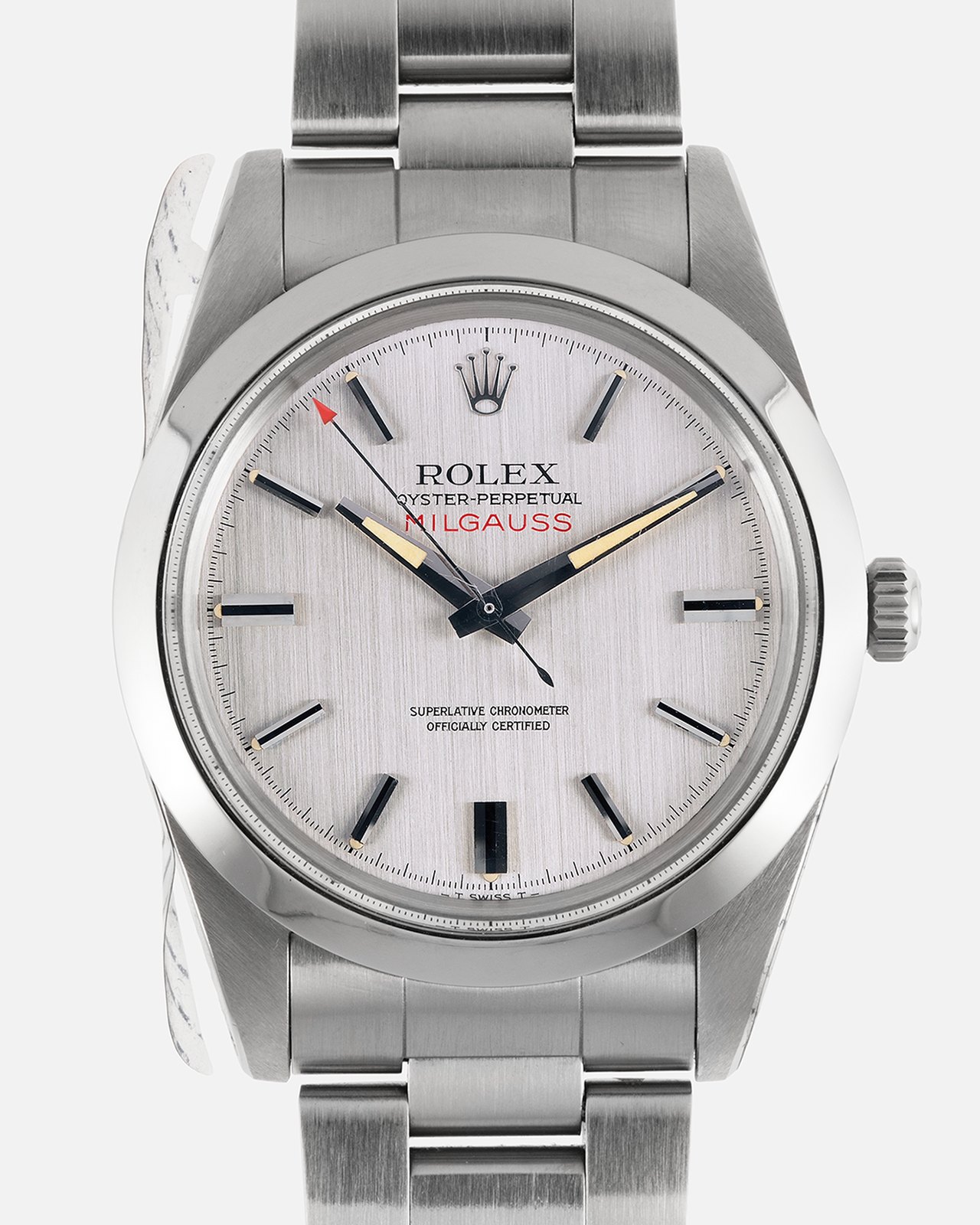
Rolex Milgauss 1019 'LNOS' Full Set, 1988
- Maker / attribution
- Rolex (maker)
- Date
- 1988
- Historical period
- Quartz Revolution (1969 – 1990)
- Country of origin
- Switzerland
- Object type
- Wristwatch
- Dimensions
- Case 38 mm
- Stock no.
- Product 7773328179287
- Credit line
- Dealer listing, S.Song Watches (product 7773328179287)
- Catalogue title (original)
- Rolex Milgauss 1019 'LNOS' Full Set (English)
View the source record (dealer listing) ↗ (opens another website in a new tab)Suggest a correction
Record summary
Catalogued by S.Song Watches (dealer), Seattle (stock number Product 7773328179287), this is a wristwatch by Rolex, made in Switzerland, dated 1988. The Atlas places it in the Quartz Revolution period (1969 – 1990) of its Wristwatches collection. Recorded dimensions: Case 38 mm. The record is illustrated with 6 photographs.
Assembled from the source record's structured fields. Dates and attributions are given as the source states them; where a field is missing the Atlas leaves it blank rather than estimating.
Catalogue description
Dealer description — S.Song Watches
The Rolex Milgauss has always occupied a slightly unusual position within the brand's history. Introduced in 1956, it was conceived not for divers, pilots or racing drivers, but for scientists, engineers and technicians working in environments where strong magnetic fields could interfere with the accuracy of a conventional mechanical watch. Its name quite literally described its purpose. "Mille" refers to one thousand in French, while gauss is a unit used to measure magnetism. Through the use of a soft iron inner cage surrounding the movement, the Milgauss was capable of resisting magnetic fields of up to 1,000 gauss, a remarkable figure at the time and one that would become particularly associated with scientists working at CERN outside Geneva. The Ref. 1019 arrived in 1960 as the successor to the earlier 6541 and represented a considerable departure from the original Milgauss. Gone were the rotating bezel, honeycomb dial and famous lightning-shaped seconds hand. In their place was a considerably more restrained 38mm stainless-steel case with a smooth bezel and a choice of black or silver dials. The only obvious clues to its unusual purpose were the red "MILGAUSS" signature and the distinctive straight seconds hand terminating in a small red arrow. This relative simplicity is perhaps what makes the 1019 so appealing today. The vertically brushed silver dial has an almost industrial quality, complemented by applied baton markers with black centres and tritium accents. The red Milgauss signature and arrow-tipped seconds hand provide just enough colour to distinguish the watch, while the broad 38mm case gives it considerably more presence than many other Rolex references from the same period. Inside is the automatic Calibre 1580, a movement used exclusively for the Ref. 1019 and protected by the watch's soft iron anti-magnetic enclosure. The reference would remain in production for almost three decades, making it a long-running model in the catalogue. Despite this unusually long lifespan, the model was never produced or sold in anything approaching the numbers of Rolex's more conventional professional watches, and was eventually discontinued towards the end of the 1980s. What makes the present example exceptional, however, is not simply the rarity of the reference but its condition. The case remains unpolished and remarkably close to new old stock, retaining its strongly bevelled edges and original surface finishes that are so often lost on vintage Rolex watches. The broad brushed lugs remain clearly defined against the polished bezel and case sides, while the Oyster bracelet is similarly preserved. Even more importantly, the silver dial, hands and tritium remain exceptionally clean, giving a remarkably clear impression of how a Ref. 1019 would have appeared when new. On top of this, its original owner seems to have been a meticulous person, never wearing the watch yet still sending it back to Rolex for service. It also comes with Rolex service papers from 2000 and 2019. There is something particularly interesting about that late 1988 sale. The Milgauss was never a particularly strong seller during its original production, and the present watch provides an unusually tangible illustration of this. Its inner caseback is stamped "II.70", dating that component to the second quarter of 1970, while its 6.1 million case serial places the case itself around 1980. The original invoice, meanwhile, records that the watch was not ultimately sold until 1988. While Rolex's use of existing components means these dates should not be interpreted as a conventional production chronology, the remarkable spread between them speaks to the slow-moving nature of the 1019 and the gradual use of parts across its long production run. Even once completed, this example appears to have remained with the retailer for years before finally finding an owner. Importantly, the considerably earlier caseback should not be mistaken for evidence that the watch has been assembled from unrelated parts. This phenomenon is well documented on the Ref. 1019, with numerous later examples known to carry casebacks stamped "II.70". Other watches with 6.1 million serial numbers extremely close to the present example have appeared with precisely the same caseback stamp, while similarly early casebacks have been documented on 1019s dating from as late as the early 1980s. Rather than raising questions over originality, it appears to be one of the peculiarities of the Milgauss' relatively low production and slow sales, with Rolex continuing to use a stock of components manufactured considerably earlier. Ironically, it is precisely this lack of popularity that makes the 1019 so compelling today. Watches produced for a niche purpose and overlooked when new often become some of the most collectable references decades later. Far fewer were sold, fewer exceptional examples survive, and the very qualities that once made them oddballs within the catalogue are often what collectors now find most interesting. For me, this is what makes the present watch so compelling. A Ref. 1019 in good condition is already increasingly difficult to find, but an unpolished silver-dial example preserved almost as new and accompanied by virtually everything supplied when it was purchased is something altogether different. Its condition allows the details of the case, dial and bracelet to be appreciated much as they would have been more than 35 years ago, while the extraordinary accompanying documentation tells the story of a Milgauss that spent years waiting to be sold. If there is ever a time to use the term 'collector-grade', this is it.
Historical context
Quartz Revolution (1969 – 1990)
Seiko's Astron begins mass quartz timekeeping; traditional industries contract sharply.
Quartz and digital watches transformed the market after 1969. Swiss employment collapsed, Japanese and Hong Kong production soared, and the Swatch (1983) helped the Swiss industry recover; mechanical watches survived as luxury goods.
Read the period in the timelineMore wristwatches from this periodEarlier: Modern Mechanical Horology
Atlas type guide
Wristwatches
Bracelet watches were worn by women from the early nineteenth century — Breguet made one for Caroline Murat, Queen of Naples, in 1810–12 — but the wristwatch only became a man's instrument with military use and aviation in the early twentieth century. Between the World Wars it overtook the pocket watch; the 1920s and 1930s brought rectangular Art Deco cases, water-resistant cases and the first automatic winding systems.
After 1945 the wristwatch became a carrier of identity — dress watches, sports and dive watches, chronographs, calendars — produced by Swiss, American, Japanese, German, Soviet and Chinese industries. The quartz revolution after 1969 and the mechanical renaissance since the 1990s, including the rise of independent watchmakers, complete the story.
What to look for
- The reference number (between the lugs or inside the case back) and serial number, the starting point for dating.
- The calibre: its maker and number are often stamped under the dial or on the bridge.
- Originality of dial, hands and crown — refinished ('redial') dials are common.
- Case material marks: 18K/750, 14K/585, stainless steel, gold-filled, plated.
Dating clues
- Wire-lug cases: before c. 1925.
- Water-resistant screw-down cases: from 1926.
- Quartz movements: from 1969; sapphire crystals widespread after c. 1980.
General guidance written by the Atlas editors about this kind of object. It is not a statement about this particular piece; for that, rely on the source record above and on physical examination.
Related records

Movements & Components · c. 1970s
Rolex watch movement, c. 1970s
Antiquorum auction archive, Geneva

Pocket Watches · 1982
Fake Rolex watch, gold coloured metal, possibly made in Taiwan, 1982; part of a casual outfit, UK, 1982-84.
Victoria and Albert Museum, London

Wristwatches · c. 1920s
Rolex wristwatch, c. 1920s
Antiquorum auction archive, Geneva

Wristwatches · c. 1920s
Rolex wristwatch, ref. 6194, c. 1920s
Antiquorum auction archive, Geneva

Wristwatches · 1970
Wristwatch by Heno, Switzerland, 1970
Museum Rotterdam

Wristwatches · 1960–1986
'Tri-Compax' calendar chronograph wristwatch in gold case, by Universal, Geneva, Switzerland, 1960–1986.
Science Museum Group, London

Wristwatches · 1969–1970
Beta 21 Quartz wristwatch movement, made in Switzerland, 1970.
Science Museum Group, London

Wristwatches · c. 1969
Omega Speedmaster Moonwatch, ref. 145022-69st, c. 1969
Antiquorum auction archive, Geneva