
Wristwatches · Wristwatch
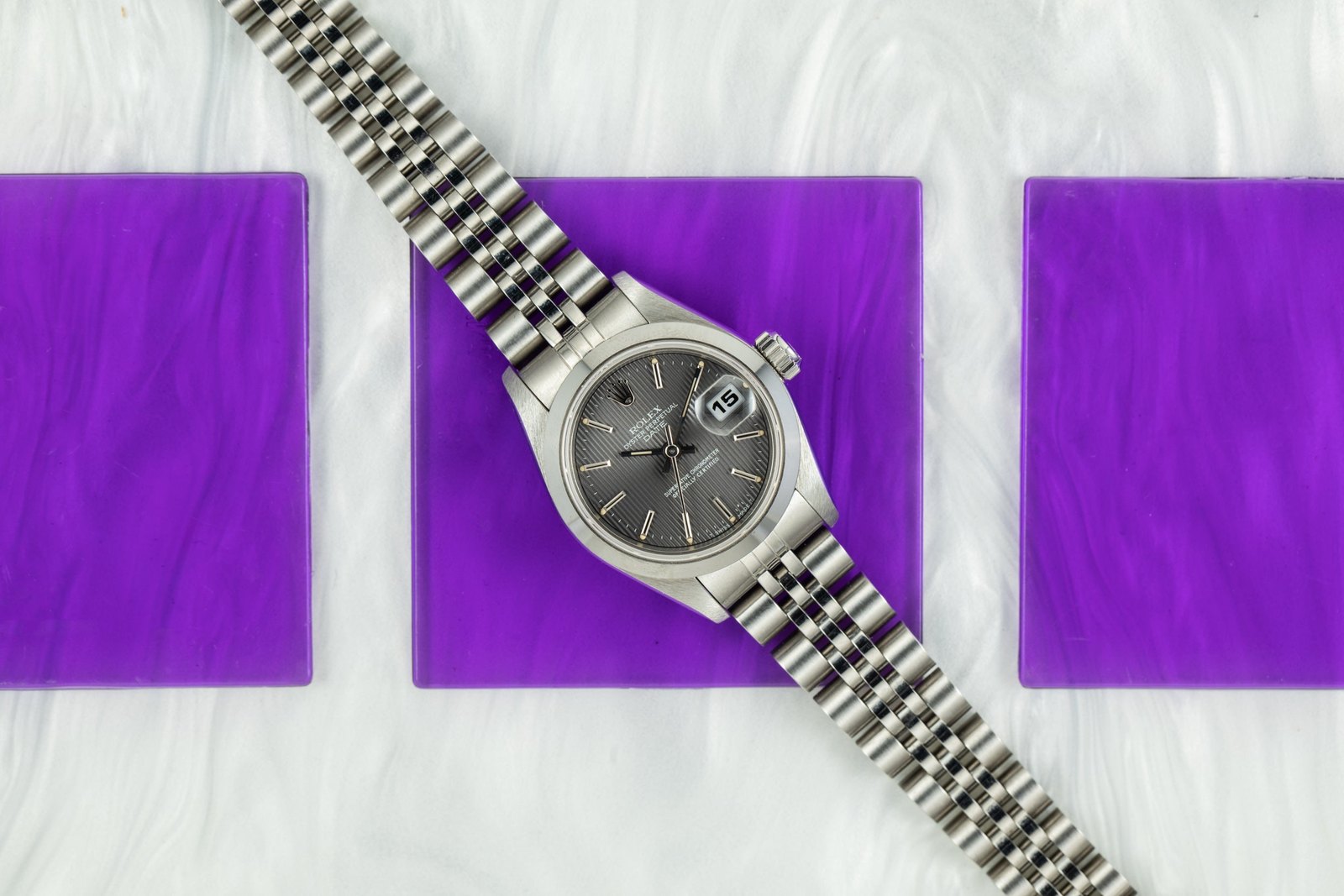
Rolex Lady Oyster Perpetual Date, c. 1997
- Maker / attribution
- Rolex (maker)
- Date
- c. 1997
- Historical period
- Mechanical Renaissance (1990 – 2010)
- Country of origin
- Switzerland
- Object type
- Wristwatch
- Stock no.
- 40920174
- Credit line
- Dealer listing, Analog/Shift (40920174)
- Catalogue title (original)
- Rolex Lady Oyster Perpetual Date (English)
View the source record (dealer listing) ↗ (opens another website in a new tab)Suggest a correction
Record summary
Catalogued by Analog/Shift (dealer), New York (stock number 40920174), this is a wristwatch by Rolex, made in Switzerland, dated c. 1997. The Atlas places it in the Mechanical Renaissance period (1990 – 2010) of its Wristwatches collection. The record is illustrated with 6 photographs.
Assembled from the source record's structured fields. Dates and attributions are given as the source states them; where a field is missing the Atlas leaves it blank rather than estimating.
Catalogue description
Dealer description — Analog/Shift
Why We Love It It is perhaps one of the greatest injustices in horology that women's wristwatches have not historically received the same respect as their larger cased counterparts, resulting in far fewer executions worth collecting. This is truly a shame, and probably one of the reasons why horologically-minded ladies have taken to wearing men's watches during the past decade. It seems that just now brands are getting the memo, and a few manufactures (notably Vacheron Constantin and Parmigiani Fleurier) have begun producing proper ladies watches again - you know, those ones that eschew faux-gold, not-so-precious stones and batteries for the real thing: mechanical, wearable art. Long overdue. Still, when it comes to vintage options for ladies, the pickings can be slim, quite the opposite from men's. Fortunately there are things like this to soften the blow: A Rolex Lady Oyster Perpetual Date. This particular example dates to circa 1997 and remains entirely unworn with a flawless stainless case, smooth bezel, and an outstanding grey 'tuxedo' dial with warmly aged Tritium indices and handset. It comes fitted on a solid link Jubilee bracelet and comes complete with a fully intact factory green case back sticker and punched papers from Little Switzerland in Aruba. Checking all of the boxes as its larger brothers, this lovely piece can easily be w orn as a dress watch or a demure daily driver for the lady who knows what proper watches are all about . The Oyster Perpetual Story In Rolex's impressive history, the brand has released a veritable arsenal of models that have become classics. Many of these bear the moniker "Oyster Perpetual." While this name is used on a particular model line, it also finds itself used widely across Rolex’s varied collections. This signifies two things: first, that the watch will have the trademark waterproof Rolex Oyster case. And secondly, that the movement beating inside that Oyster case will be one of Rolex's famed Perpetual (automatic winding) movements. Rolex first patented the Oyster case in 1925, but the quest for a waterproof and dust-proof case began shortly before the First World War. The cases of the Great War and the early 1920s came in two or three pieces with an inner case that shielded the movement (then a manual-wind movement) from the wet, dusty conditions on the battlefield. The Oyster case of 1925 represented the culmination of ten years of development. As with the Oyster case, the Perpetual movement saw many iterations before finally being perfected in the 1930s. Rolex's first automatic movement quietly debuted in 1931, and was met with some consternation from purists who decried the "extreme novelty" of a self-winding watch. Nevertheless, Rolex could see that the future lay in the Perpetual movement. They continued to develop and improve it over the years, establishing a line of dressier watches bearing the “Oyster Perpetual” nomenclature that would stand as an alternative to Rolex's sportier models. These models run the gamut of size, casing material and dial design, and offer a tremendous value for buyers. Meant to be worn every day, the Oyster Perpetual combines elegant looks with rugged dependability, and are very much the backbone of the Rolex brand.
Historical context
Mechanical Renaissance (1990 – 2010)
Mechanical watches return as cultural objects; independent watchmaking flourishes.
Mechanical watches returned as cultural and luxury objects. Complications, tourbillons and new materials proliferated; independent watchmakers such as George Daniels, F.P. Journe and Philippe Dufour revived artisanal watchmaking; collecting vintage watches became a major field.
Read the period in the timelineMore wristwatches from this periodEarlier: Quartz Revolution
Atlas type guide
Dive and water-resistant watches
Keeping water and dust out of a wristwatch was a long-standing challenge. Rolex's screw-down Oyster case (1926) and Omega's Marine (1932) were landmarks; in the early 1950s Blancpain's Fifty Fathoms and Rolex's Submariner defined the professional dive watch with rotating bezels for timing dives, luminous dials and high water resistance. The ISO 6425 standard (1982) later codified what a 'diver's watch' must do.
Dive watches became icons of post-war design and exploration, and their evolution — helium escape valves, ceramic bezels, saturation-diving depth ratings — records the history of underwater work.
What to look for
- Unidirectional or bidirectional rotating bezel with minute markings.
- Screw-down crown and case back; depth rating printed on the dial.
- Luminous hands and markers (radium before c. 1960, tritium c. 1960–1998, then Super-LumiNova).
- Reference numbers on the case between the lugs or inside the back.
Dating clues
- Screw-down Oyster cases: from 1926.
- Professional dive watches: from 1953.
- Tritium 'T' marks on dials: c. 1960–1998.
General guidance written by the Atlas editors about this kind of object. It is not a statement about this particular piece; for that, rely on the source record above and on physical examination.
Related records

Movements & Components · c. 1970s
Rolex watch movement, c. 1970s
Antiquorum auction archive, Geneva

Pocket Watches · 1982
Fake Rolex watch, gold coloured metal, possibly made in Taiwan, 1982; part of a casual outfit, UK, 1982-84.
Victoria and Albert Museum, London

Wristwatches · c. 1920s
Rolex wristwatch, c. 1920s
Antiquorum auction archive, Geneva

Wristwatches · c. 1920s
Rolex wristwatch, ref. 6194, c. 1920s
Antiquorum auction archive, Geneva

Wristwatches · 2008
Wristwatch by Breitling?, 2008
Museum Rotterdam

Wristwatches · c. 1990s
Audemars Piguet Bamboo, c. 1990s
Antiquorum auction archive, Geneva

Wristwatches · c. 1990
Audemars Piguet Huitieme Perpetual Calendar, ref. 25696PT, c. 1990
Antiquorum auction archive, Geneva

Wristwatches · c. 1990
Breitling Chronomat, ref. b13050.1, c. 1990
Antiquorum auction archive, Geneva