
Wristwatches · Wristwatch
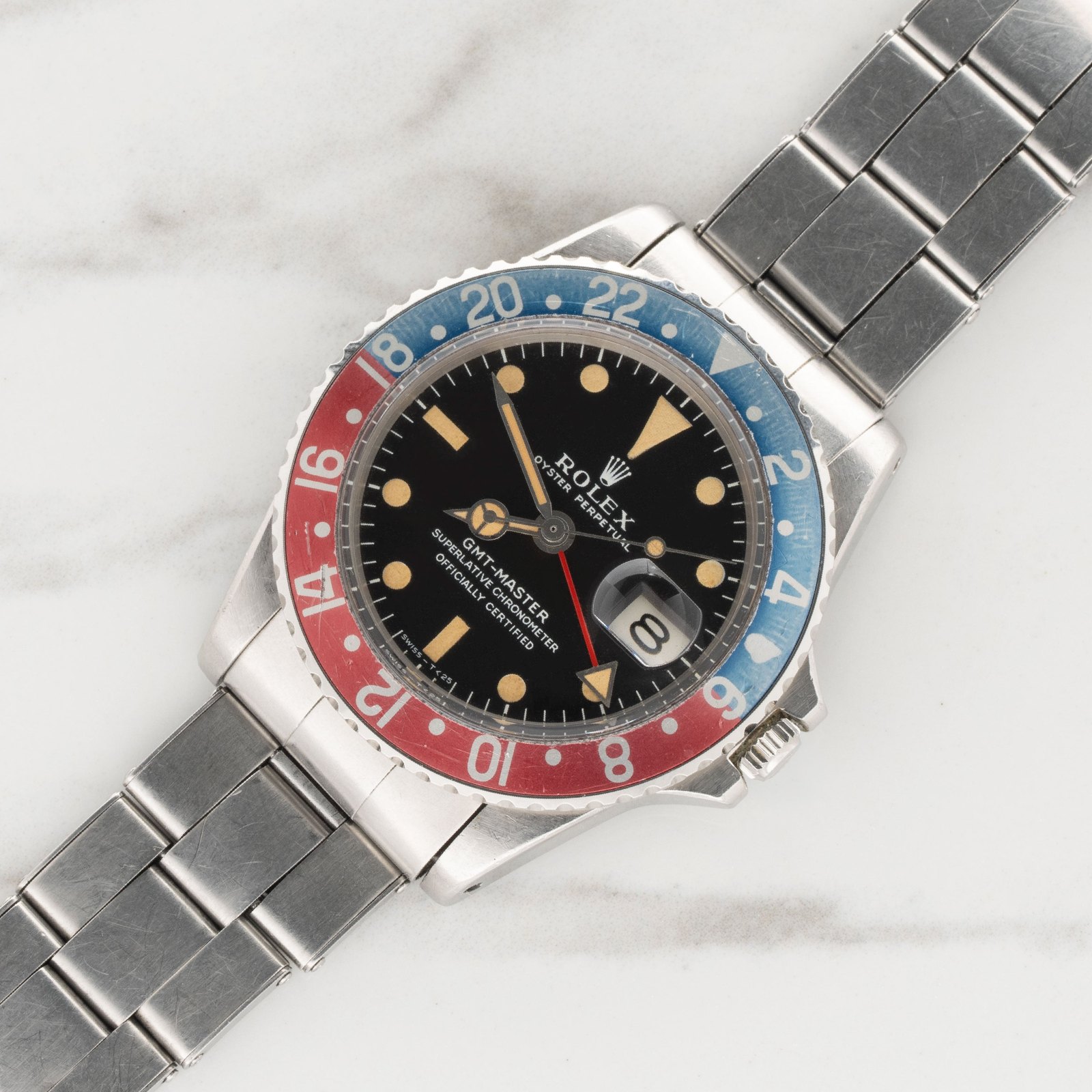
Rolex GMT-Master, ref. 1675 "Pepsi"
- Maker / attribution
- Rolex (maker)
- Date
- c. 1969
- Historical period
- Quartz Revolution (1969 – 1990)
- Country of origin
- Switzerland
- Object type
- Wristwatch
- Stock no.
- Product 10352733651220
- Credit line
- Dealer listing, Collectors Corner NY (product 10352733651220)
- Catalogue title (original)
- Rolex GMT-Master II - 1675 "Pepsi" - *Unpolished* (English)
Editor's note
The dealer's listing title calls this a GMT-Master II; reference 1675 is the original GMT-Master (made c. 1959–1980). The GMT-Master II began with reference 16760 in 1983.View the source record (dealer listing) ↗ (opens another website in a new tab)Suggest a correction
Record summary
Catalogued by Collectors Corner NY (dealer), New York (stock number Product 10352733651220), this is a wristwatch by Rolex, made in Switzerland, dated c. 1969. The Atlas places it in the Quartz Revolution period (1969 – 1990) of its Wristwatches collection. The record is illustrated with 6 photographs.
Assembled from the source record's structured fields. Dates and attributions are given as the source states them; where a field is missing the Atlas leaves it blank rather than estimating.
Catalogue description
Dealer description — Collectors Corner NY
Introduced in 1954, the now cult classic Rolex GMT was initially designed as a pilots and travelers watch with its roots tied to Pan Am. The first examples featured a "Pepsi" bezel insert which provided ease of use for deciphering day/night in an alternate time-zone and remains in production to this day. Over the decades, various iterations of the GMT have been released from the "Root Beer" to the blue "Batman." Today, the GMT is as practical as it is popular with collectors, offering great beauty in it's vintage and neo-vintage Rolex watches which have taken on their own unique character over the decades. This particular 159X serial example, circa 1969 has remained in stunning vintage condition. It houses a "Mk1 matte dial" that remains mint with no notable wear under magnification. All of the tritium plots are full, have aged cleanly and have taken a gorgeous and warm patina that sets this example a cut above the vast majority we come across. The minute hand was professionally color matched but all the hands match well to the dial as a result. The insert is a correct "red back" that shows normal signs of use. There are some scuffs, particularly at 14 but it shows beautiful color that pairs well with the dial patina. Most notably, the case/bracelet are completely unpolished which is very difficult to come by today in this reference. This piece is paired to a stretch rivet C&I with matching date code of '69. It remains very tight and retains 11 links fitting an approximate 7.25 inch wrist. For anyone looking for a true collector grade 1675, we could not be more thrilled to offer this outstanding timepiece in the shop.
Historical context
Quartz Revolution (1969 – 1990)
Seiko's Astron begins mass quartz timekeeping; traditional industries contract sharply.
Quartz and digital watches transformed the market after 1969. Swiss employment collapsed, Japanese and Hong Kong production soared, and the Swatch (1983) helped the Swiss industry recover; mechanical watches survived as luxury goods.
Read the period in the timelineMore wristwatches from this periodEarlier: Modern Mechanical Horology
Atlas type guide
Military, pilot and travel watches
The wristwatch owes much of its adoption by men to warfare and aviation. Wristlets — small pocket watches soldered with lugs and worn on a strap — were used in colonial campaigns and became standard equipment in the First World War, with protective grilles over the crystal ('shrapnel guards'). Louis Cartier's Santos (1904), designed for the aviator Alberto Santos-Dumont, is often cited as an early purpose-made pilot's watch.
In the Second World War governments specified watches in detail: the German B-Uhr observation watches, the American A-11, and the British 'W.W.W.' (the 'Dirty Dozen' set of 1945). After the war, jet travel brought GMT and world-time watches, which show two or more time zones at once — Louis Cottier's world-time mechanism and the Rolex GMT-Master (1955) are examples.
What to look for
- Military markings on the case back: broad arrow, issue numbers, 'W.W.W.', 'A.T.P.'
- High-legibility black dials with luminous Arabic numerals; oversized crowns for gloved hands.
- 24-hour hands and rotating 24-hour bezels or city rings on GMT/world-time watches.
- Wire lugs on early wristlets converted from pocket watches.
Dating clues
- Wire-lug wristlets: c. 1900–1925.
- Military specifications of the Second World War: 1939–1945.
- GMT and world-time wristwatches: mainly after 1950.
General guidance written by the Atlas editors about this kind of object. It is not a statement about this particular piece; for that, rely on the source record above and on physical examination.
Related records

Movements & Components · c. 1970s
Rolex watch movement, c. 1970s
Antiquorum auction archive, Geneva

Pocket Watches · 1982
Fake Rolex watch, gold coloured metal, possibly made in Taiwan, 1982; part of a casual outfit, UK, 1982-84.
Victoria and Albert Museum, London

Wristwatches · c. 1920s
Rolex wristwatch, c. 1920s
Antiquorum auction archive, Geneva

Wristwatches · c. 1920s
Rolex wristwatch, ref. 6194, c. 1920s
Antiquorum auction archive, Geneva

Wristwatches · 1970
Wristwatch by Heno, Switzerland, 1970
Museum Rotterdam

Wristwatches · 1960–1986
'Tri-Compax' calendar chronograph wristwatch in gold case, by Universal, Geneva, Switzerland, 1960–1986.
Science Museum Group, London

Wristwatches · 1969–1970
Beta 21 Quartz wristwatch movement, made in Switzerland, 1970.
Science Museum Group, London

Wristwatches · c. 1969
Omega Speedmaster Moonwatch, ref. 145022-69st, c. 1969
Antiquorum auction archive, Geneva