
Wristwatches · Wristwatch
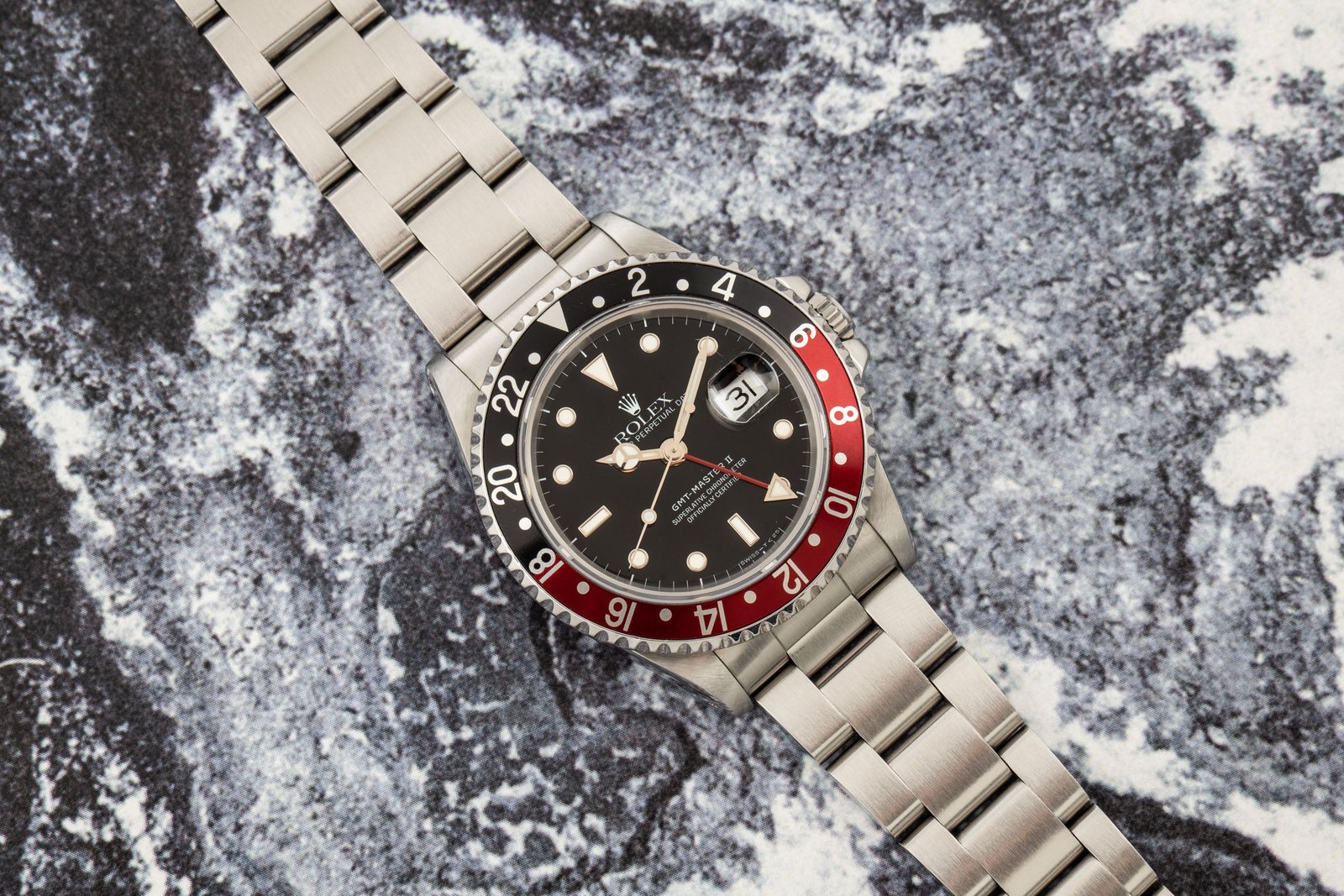
Rolex GMT-Master II 'Coke', c. 1991
- Maker / attribution
- Rolex (maker)
- Date
- c. 1991
- Historical period
- Mechanical Renaissance (1990 – 2010)
- Country of origin
- Switzerland
- Object type
- Wristwatch
- Dimensions
- Case 39 mm
- Stock no.
- 40920347
- Credit line
- Dealer listing, Analog/Shift (40920347)
- Catalogue title (original)
- Rolex GMT-Master II 'Coke' (English)
View the source record (dealer listing) ↗ (opens another website in a new tab)Suggest a correction
Record summary
Catalogued by Analog/Shift (dealer), New York (stock number 40920347), this is a wristwatch by Rolex, made in Switzerland, dated c. 1991. The Atlas places it in the Mechanical Renaissance period (1990 – 2010) of its Wristwatches collection. Recorded dimensions: Case 39 mm. The record is illustrated with 6 photographs.
Assembled from the source record's structured fields. Dates and attributions are given as the source states them; where a field is missing the Atlas leaves it blank rather than estimating.
Catalogue description
Dealer description — Analog/Shift
Why We Love It In 1989, Rolex rolled out the first model of its now famous GMT-Master II - the Reference 16710. They are a seamless blend of old and new, with vintage looks and modern technology—all that we could ask for in a Rolex. Whereas the current crop of GMT-Master IIs have gotten larger and heftier, the Reference 16710 is still a svelte 39mm, having the proportions of a GMT of yesteryear, with thin lugs and a bracelet with brushed—not polished—center links. The only obvious concessions to modernity are the glossy dial and and a sapphire crystal. Early versions used Tritium luminous on the dial, before transitioning to Super Luminova for enhanced visibility in low-light conditions. This particular example dates to circa 1991 and features a strong case with a flawless glossy black dial, patinated Tritium indices with a matching handset, and a 'Coke' bezel insert. Additionally, this piece includes punched papers as well as an RSC service card dated 8/19/2019. If you appreciate the functionality of a GMT-Master over a Submariner and are looking for a strong example of a Pre-Maxi case model with a subtle black and steel configuration, your search is complete! The GMT-Master Story The years following the end of The Second World War saw the world become a much, much smaller place. Advances in aviation technology led to the world’s first nonstop Transatlantic passenger flights between Europe and North America, and the era of the jetsetter began. Along with this new age of travel arose a need for travelers, and more importantly pilots, to have a wristwatch that could display two time zones at once. As a pioneer of transatlantic and transcontinental flight, Pan American Airlines approached Rolex in 1953 looking for a watch specially designed for their pilots, and Rolex agreed to take on the project. The newly designed Submariner became the base for this new watch, and several important complications were added. A date function with a cyclops lens magnifier, GMT complication, and two-colored bezel to provide long-haul pilots with the info they needed as they circumnavigated the globe. The GMT-Master’s 24-hour hand works in conjunction with a rotating bezel to make tracking a second time zone incredibly simple. When the wearer rotates the bezel so that the numbers around the bezel correspond to a second time zone (such as Greenwich Mean Time, the inspiration for the model’s nomenclature), it allows the watch to track any two time zones in the world at once. Not long after the debut of the GMT-Master at the Basel World Fair in 1954, Pan-Am adopted the GMT Master as its official wristwatch. Decades later, the GMT-Master and its “Pepsi” bezel has become a true icon of the watch world. It is instantly recognizable and eternally stylish – the very best of what Rolex has to offer.
Historical context
Mechanical Renaissance (1990 – 2010)
Mechanical watches return as cultural objects; independent watchmaking flourishes.
Mechanical watches returned as cultural and luxury objects. Complications, tourbillons and new materials proliferated; independent watchmakers such as George Daniels, F.P. Journe and Philippe Dufour revived artisanal watchmaking; collecting vintage watches became a major field.
Read the period in the timelineMore wristwatches from this periodEarlier: Quartz Revolution
Atlas type guide
Military, pilot and travel watches
The wristwatch owes much of its adoption by men to warfare and aviation. Wristlets — small pocket watches soldered with lugs and worn on a strap — were used in colonial campaigns and became standard equipment in the First World War, with protective grilles over the crystal ('shrapnel guards'). Louis Cartier's Santos (1904), designed for the aviator Alberto Santos-Dumont, is often cited as an early purpose-made pilot's watch.
In the Second World War governments specified watches in detail: the German B-Uhr observation watches, the American A-11, and the British 'W.W.W.' (the 'Dirty Dozen' set of 1945). After the war, jet travel brought GMT and world-time watches, which show two or more time zones at once — Louis Cottier's world-time mechanism and the Rolex GMT-Master (1955) are examples.
What to look for
- Military markings on the case back: broad arrow, issue numbers, 'W.W.W.', 'A.T.P.'
- High-legibility black dials with luminous Arabic numerals; oversized crowns for gloved hands.
- 24-hour hands and rotating 24-hour bezels or city rings on GMT/world-time watches.
- Wire lugs on early wristlets converted from pocket watches.
Dating clues
- Wire-lug wristlets: c. 1900–1925.
- Military specifications of the Second World War: 1939–1945.
- GMT and world-time wristwatches: mainly after 1950.
General guidance written by the Atlas editors about this kind of object. It is not a statement about this particular piece; for that, rely on the source record above and on physical examination.
Related records

Movements & Components · c. 1970s
Rolex watch movement, c. 1970s
Antiquorum auction archive, Geneva

Pocket Watches · 1982
Fake Rolex watch, gold coloured metal, possibly made in Taiwan, 1982; part of a casual outfit, UK, 1982-84.
Victoria and Albert Museum, London

Wristwatches · c. 1920s
Rolex wristwatch, c. 1920s
Antiquorum auction archive, Geneva

Wristwatches · c. 1920s
Rolex wristwatch, ref. 6194, c. 1920s
Antiquorum auction archive, Geneva

Wristwatches · 2008
Wristwatch by Breitling?, 2008
Museum Rotterdam

Wristwatches · c. 1990s
Audemars Piguet Bamboo, c. 1990s
Antiquorum auction archive, Geneva

Wristwatches · c. 1990
Audemars Piguet Huitieme Perpetual Calendar, ref. 25696PT, c. 1990
Antiquorum auction archive, Geneva

Wristwatches · c. 1990
Breitling Chronomat, ref. b13050.1, c. 1990
Antiquorum auction archive, Geneva