
Wristwatches · Wristwatch
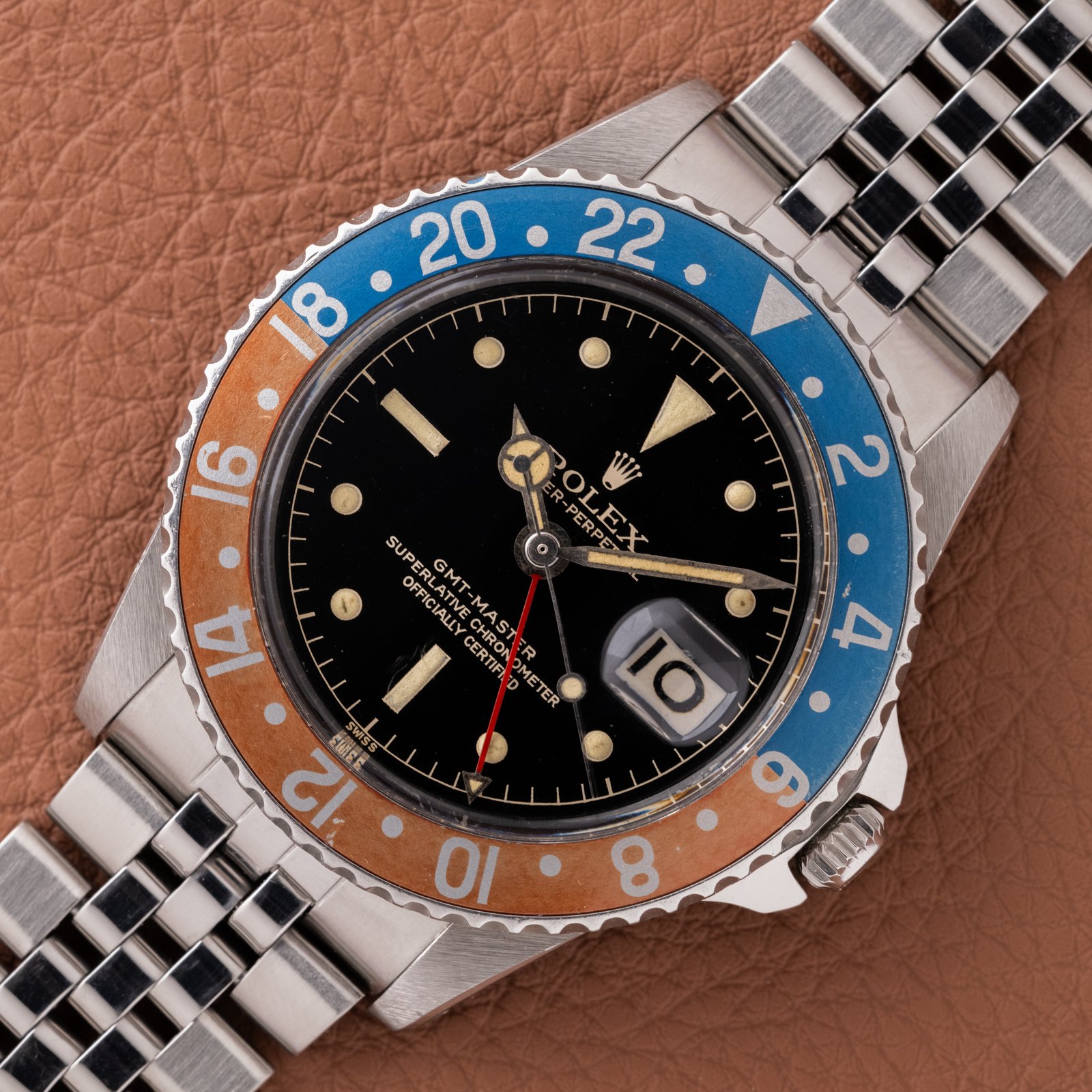
Rolex GMT Master Gilt Chapter Ring Dial - PCG Case (Ref. 1675), 1960
- Maker / attribution
- Rolex (maker)
- Date
- 1960
- Historical period
- Modern Mechanical Horology (1945 – 1969)
- Country of origin
- Switzerland
- Object type
- Wristwatch
- Dimensions
- Case 40 mm
- Stock no.
- Product 8675071754423
- Credit line
- Dealer listing, Huntington Company (product 8675071754423)
- Catalogue title (original)
- 1960 Rolex GMT Master Gilt Chapter Ring Dial - PCG Case (Ref. 1675) (English)
View the source record (dealer listing) ↗ (opens another website in a new tab)Suggest a correction
Record summary
Catalogued by Huntington Company (dealer) (stock number Product 8675071754423), this is a wristwatch by Rolex, made in Switzerland, dated 1960. The Atlas places it in the Modern Mechanical Horology period (1945 – 1969) of its Wristwatches collection. Recorded dimensions: Case 40 mm. The record is illustrated with 6 photographs.
Assembled from the source record's structured fields. Dates and attributions are given as the source states them; where a field is missing the Atlas leaves it blank rather than estimating.
Catalogue description
Dealer description — Huntington Company
History and Significance Few vintage Rolex references offer the same depth of collecting as the GMT Master 1675. Produced for over two decades, the reference evolved constantly through subtle changes to the dial, bezel, case, crown guards, bracelets, and movement. To the casual observer they may all look similar, but experienced collectors know that no two early 1675s are exactly alike. This 1960 example brings together an incredible collection of desirable traits. It features a gloss gilt dial with a closed chapter ring, silver "Swiss" designation, the early small GMT hand, and the highly collectible pointed crown guard case. The original bezel insert has developed beautiful honest patina, while the matching bracelet dates correctly to 1961 and retains its proper 55 end links. What truly separates this watch is the dial. The glossy gilt surface remains remarkably well preserved with no deep scratches, peeling, or significant wear, while every original tritium lume plot remains fully intact. Watches like this are becoming increasingly difficult to source because collectors understand just how many correct details need to come together before a 1675 becomes truly exceptional. Writer’s Thoughts One of the best parts about collecting early Rolex sports models is that every watch tells a different story. This one has everything you immediately look for. The pointed crown guards, the gorgeous gloss gilt dial, the original insert, the correct bracelet, and perhaps most importantly, an honest dial that has survived beautifully over the last sixty five years. It is exactly the kind of GMT Master that reminds you why early four digit Rolex references have become so beloved by collectors. Our Promise Every watch is thoroughly vetted, carefully described with complete transparency, and guaranteed authentic. Each piece is offered in honest condition, ensuring collectors receive a timepiece that reflects both originality and integrity. Specifications Brand: Rolex Model: GMT Master Reference: 1675 Year: 1960 Case Material: Stainless Steel Case Size: 40mm Dial: Original Gloss Gilt Closed Chapter Ring Dial Movement: Automatic Strap/Bracelet: Original Rolex Oyster Bracelet Buckle/Clasp: Original Rolex Folding Clasp Contents: Watch only Condition Case: The case has been professionally polished, retaining excellent overall proportions, strong pointed crown guards, and crisp definition throughout. The lugs remain thick and well-balanced. Dial: The original gloss gilt dial is exceptionally preserved with rich lacquer, crisp gilt printing, and all original tritium lume plots fully intact. There are no deep scratches, peeling, or significant signs of deterioration. Hands: The original handset remains in excellent condition with matching lume and the desirable early small GMT hand. Crystal: The crystal remains clean overall with light signs of wear consistent with careful use. Strap/Bracelet: The original Rolex Oyster bracelet is the correct bracelet for the watch, dating to 1961 with the proper 55 end links. It remains in excellent overall condition with honest stretch consistent with age. Buckle/Clasp: The original Rolex clasp remains in excellent condition and functions exactly as intended.
Historical context
Modern Mechanical Horology (1945 – 1969)
Tool watches for divers, pilots and astronauts; electric watches anticipate the electronic age.
The classic era of the mechanical wristwatch: dive watches, chronographs for motor racing and space flight, GMT watches for jet travel, slim dress watches, automatic calendars, and the rise of Japanese manufacturers alongside Swiss, American, German and Soviet industries.
Read the period in the timelineMore wristwatches from this periodEarlier: Golden Age of Mechanical Watchmaking
Atlas type guide
Military, pilot and travel watches
The wristwatch owes much of its adoption by men to warfare and aviation. Wristlets — small pocket watches soldered with lugs and worn on a strap — were used in colonial campaigns and became standard equipment in the First World War, with protective grilles over the crystal ('shrapnel guards'). Louis Cartier's Santos (1904), designed for the aviator Alberto Santos-Dumont, is often cited as an early purpose-made pilot's watch.
In the Second World War governments specified watches in detail: the German B-Uhr observation watches, the American A-11, and the British 'W.W.W.' (the 'Dirty Dozen' set of 1945). After the war, jet travel brought GMT and world-time watches, which show two or more time zones at once — Louis Cottier's world-time mechanism and the Rolex GMT-Master (1955) are examples.
What to look for
- Military markings on the case back: broad arrow, issue numbers, 'W.W.W.', 'A.T.P.'
- High-legibility black dials with luminous Arabic numerals; oversized crowns for gloved hands.
- 24-hour hands and rotating 24-hour bezels or city rings on GMT/world-time watches.
- Wire lugs on early wristlets converted from pocket watches.
Dating clues
- Wire-lug wristlets: c. 1900–1925.
- Military specifications of the Second World War: 1939–1945.
- GMT and world-time wristwatches: mainly after 1950.
General guidance written by the Atlas editors about this kind of object. It is not a statement about this particular piece; for that, rely on the source record above and on physical examination.
Related records

Movements & Components · c. 1970s
Rolex watch movement, c. 1970s
Antiquorum auction archive, Geneva

Pocket Watches · 1982
Fake Rolex watch, gold coloured metal, possibly made in Taiwan, 1982; part of a casual outfit, UK, 1982-84.
Victoria and Albert Museum, London

Wristwatches · c. 1920s
Rolex wristwatch, c. 1920s
Antiquorum auction archive, Geneva

Wristwatches · c. 1920s
Rolex wristwatch, ref. 6194, c. 1920s
Antiquorum auction archive, Geneva

Wristwatches · 1945
Wristwatch by Eterna, 1945
Museum Rotterdam

Wristwatches · c. 1945
Breitling Premier, ref. 790, c. 1945
Antiquorum auction archive, Geneva

Wristwatches · c. 1945
Universal Genève Uni-Compax, ref. 22492, c. 1945
Antiquorum auction archive, Geneva

Wristwatches · c. 1950s
Baume & Mercier wristwatch, c. 1950s
Antiquorum auction archive, Geneva