
Wristwatches · Wristwatch
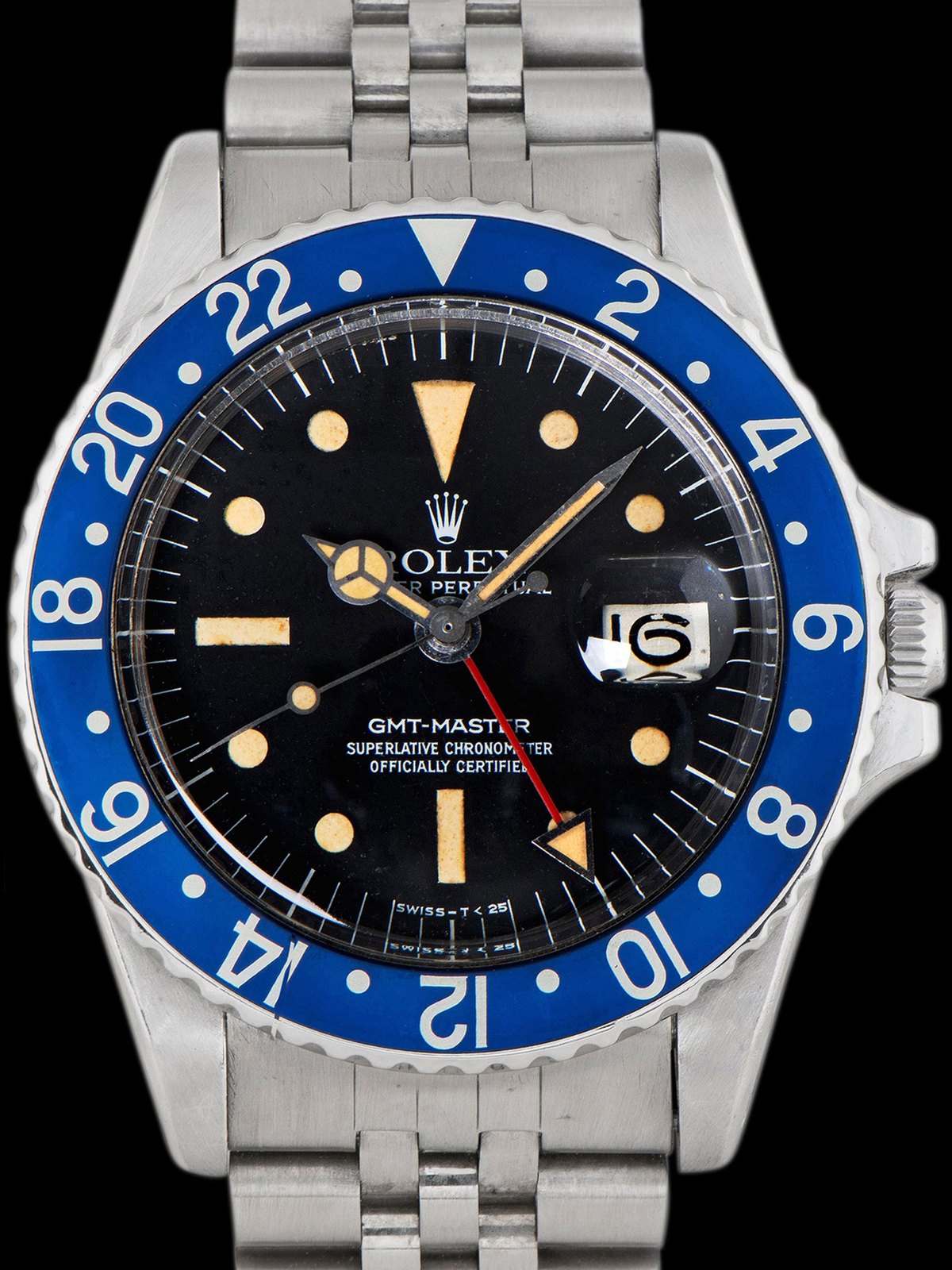
Rolex GMT-Master "Blueberry" (Ref. 1675) Mk. III "Radial" Dial, 1977
- Maker / attribution
- Rolex (maker)
- Date
- 1977
- Historical period
- Quartz Revolution (1969 – 1990)
- Country of origin
- Switzerland
- Object type
- Wristwatch
- Stock no.
- RLXGMT1675BB
- Credit line
- Dealer listing, Craft & Tailored (RLXGMT1675BB)
- Catalogue title (original)
- 1977 Rolex GMT-Master "Blueberry" (Ref. 1675) Mk. III "Radial" Dial (English)
View the source record (dealer listing) ↗ (opens another website in a new tab)Suggest a correction
Record summary
Catalogued by Craft & Tailored (dealer), Los Angeles (stock number RLXGMT1675BB), this is a wristwatch by Rolex, made in Switzerland, dated 1977. The Atlas places it in the Quartz Revolution period (1969 – 1990) of its Wristwatches collection. The record is illustrated with 6 photographs.
Assembled from the source record's structured fields. Dates and attributions are given as the source states them; where a field is missing the Atlas leaves it blank rather than estimating.
Catalogue description
Dealer description — Craft & Tailored
Within the vintage Rolex collecting community, the all-blue “Blueberry” bezel insert has become a well-known variation associated with the GMT-Master reference 1675. While period Rolex catalogs and advertising materials do not document a factory configuration pairing the reference with an all-blue bezel, many collectors believe these inserts originated through Rolex service channels rather than standard production. Examples began appearing within the collecting market in the early 2000s, reportedly sourced from an official Rolex service center. Because of this, many seasoned collectors view the Blueberry insert as a period Rolex service component produced during the lifespan of the GMT-Master rather than a bezel fitted to watches when originally delivered from the factory. The deep blue tone of the insert offers a distinctive alternative to the more commonly seen red and blue “Pepsi” or all-black bezel configurations and has become a recognizable aesthetic within the broader GMT-Master collecting landscape. Interestingly, the "Blueberry" inserts do possess key font and manufacturing characteristics seen in other period inserts, such as serrifs on the font Today, the Blueberry insert represents one of the many fascinating variations that emerged during the decades-long production of the GMT-Master. For collectors who appreciate the nuances of vintage Rolex components and the subtle evolution of the model over time, it remains a compelling and visually striking configuration. The Mk. III matte dial for the Rolex ref. 1675 GMT-Master, also known as the "Radial Dial" or "Mini Dial", is revered as being the rarest and most unique variant among the matte dial range for the ref. 1675. The Radial dial is not only special among Rolex's GMT-Master models, either. The Mk. III dial features design characteristics more similar to the Gilt-era of dial manufacturing, but not seen in any other dial produced by Rolex in the entirety of the matte dial sports models. The "Radial" or "Mini" dial nicknames come from the noticeably more centered and smaller lume plots represented as opposed to the more traditional Rolex matte dial format. The Mk. III ref. 1675 is loved by collectors not only for its rarity, but because its characteristics offer a truly unique experience among one of the most historically significant references from Rolex. SPECS Stock # RLXGMT1675BB Brand Rolex Style GMT-Master Model 1675 Serial 53XXXXX Size Men's Material Stainless Steel Dial Matte Black Mk. III "Radial Millimeters 40 Bracelet Rolex 62510H Jubilee Bracelet W/ 555 End Pieces CASE & BRACELET The impressive case boasts broad chamfers along the thick, symmetrical lugs, while exhibiting honest signs of use and evidence of light polishing in the past. The exceptional "blueberry" insert, correct with "ghost triangle", is in near-perfect condition, showing nominal fading or signs of wear. The Rolex 62510H Jubilee bracelet with 555 end pieces is a later service unit that retains 20 links that show moderate stretch and will fit up to a 7.5-inch wrist. DIAL & HANDS The original and rare matte black Mk. III "Radial" dial is in exceptional vintage condition, exhibiting no damage of note, though the dial does feature a subtle spotted patina throughout that is characteristic of the Mk. III dial variation. The tritium lume plots have achieved a vibrant golden-yellow patina with no degradation exhibited when inspected under UV light. The original tritium hands match the dial almost perfectly, featuring a slightly more saturated patina, and exhibit no degradation when inspected under UV light. T he metallic date wheel is original with "open" 6 and 9 numerals. ACCESSORIES None. The watch is keeping time, but the service history is unknown. A movement service can be purchased upon request.
Historical context
Quartz Revolution (1969 – 1990)
Seiko's Astron begins mass quartz timekeeping; traditional industries contract sharply.
Quartz and digital watches transformed the market after 1969. Swiss employment collapsed, Japanese and Hong Kong production soared, and the Swatch (1983) helped the Swiss industry recover; mechanical watches survived as luxury goods.
Read the period in the timelineMore wristwatches from this periodEarlier: Modern Mechanical Horology
Atlas type guide
Military, pilot and travel watches
The wristwatch owes much of its adoption by men to warfare and aviation. Wristlets — small pocket watches soldered with lugs and worn on a strap — were used in colonial campaigns and became standard equipment in the First World War, with protective grilles over the crystal ('shrapnel guards'). Louis Cartier's Santos (1904), designed for the aviator Alberto Santos-Dumont, is often cited as an early purpose-made pilot's watch.
In the Second World War governments specified watches in detail: the German B-Uhr observation watches, the American A-11, and the British 'W.W.W.' (the 'Dirty Dozen' set of 1945). After the war, jet travel brought GMT and world-time watches, which show two or more time zones at once — Louis Cottier's world-time mechanism and the Rolex GMT-Master (1955) are examples.
What to look for
- Military markings on the case back: broad arrow, issue numbers, 'W.W.W.', 'A.T.P.'
- High-legibility black dials with luminous Arabic numerals; oversized crowns for gloved hands.
- 24-hour hands and rotating 24-hour bezels or city rings on GMT/world-time watches.
- Wire lugs on early wristlets converted from pocket watches.
Dating clues
- Wire-lug wristlets: c. 1900–1925.
- Military specifications of the Second World War: 1939–1945.
- GMT and world-time wristwatches: mainly after 1950.
General guidance written by the Atlas editors about this kind of object. It is not a statement about this particular piece; for that, rely on the source record above and on physical examination.
Related records

Movements & Components · c. 1970s
Rolex watch movement, c. 1970s
Antiquorum auction archive, Geneva

Pocket Watches · 1982
Fake Rolex watch, gold coloured metal, possibly made in Taiwan, 1982; part of a casual outfit, UK, 1982-84.
Victoria and Albert Museum, London

Wristwatches · c. 1920s
Rolex wristwatch, c. 1920s
Antiquorum auction archive, Geneva

Wristwatches · c. 1920s
Rolex wristwatch, ref. 6194, c. 1920s
Antiquorum auction archive, Geneva

Wristwatches · 1970
Wristwatch by Heno, Switzerland, 1970
Museum Rotterdam

Wristwatches · 1960–1986
'Tri-Compax' calendar chronograph wristwatch in gold case, by Universal, Geneva, Switzerland, 1960–1986.
Science Museum Group, London

Wristwatches · 1969–1970
Beta 21 Quartz wristwatch movement, made in Switzerland, 1970.
Science Museum Group, London

Wristwatches · c. 1969
Omega Speedmaster Moonwatch, ref. 145022-69st, c. 1969
Antiquorum auction archive, Geneva