
Wristwatches · Wristwatch
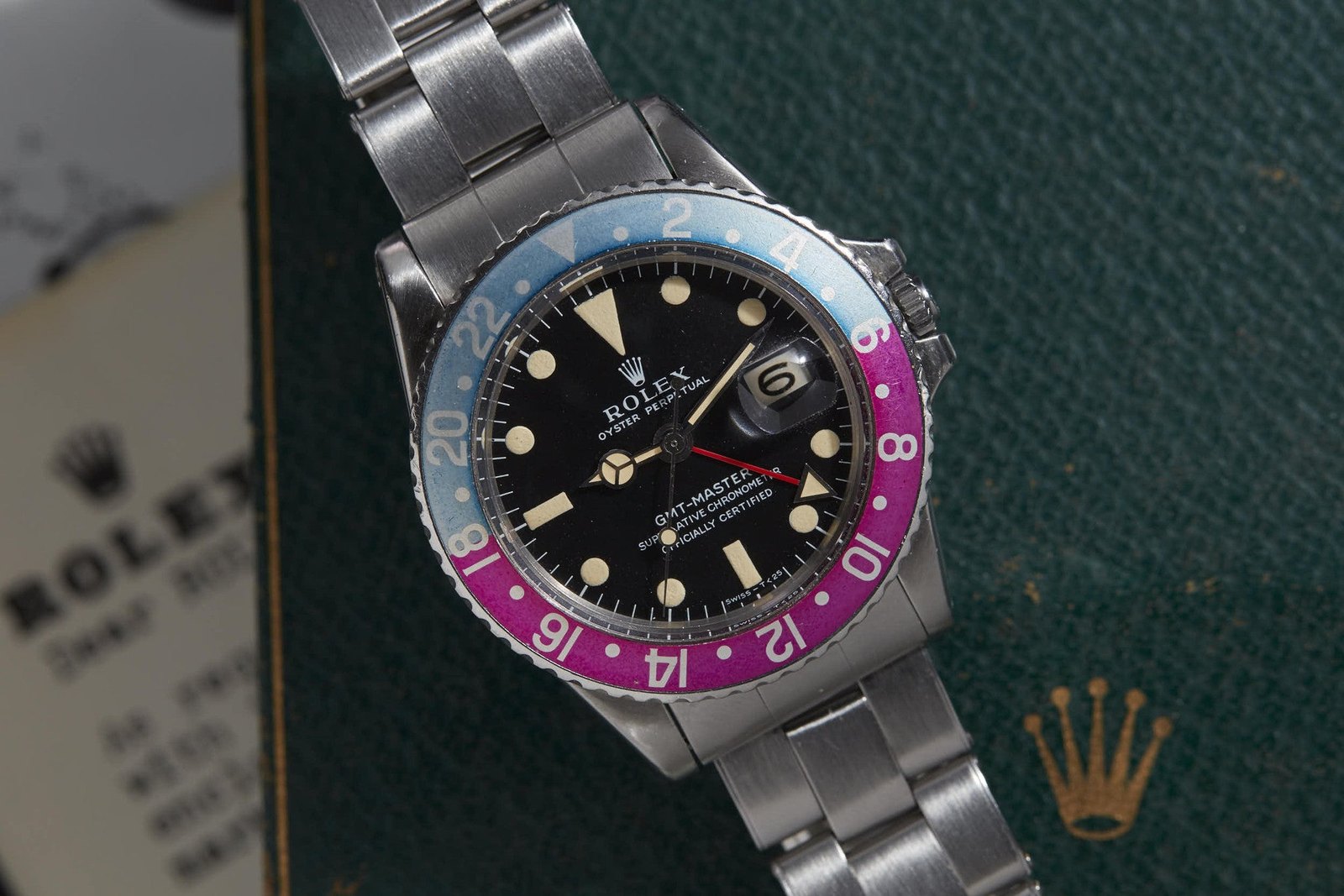
Rolex GMT Master, 1971
- Maker / attribution
- Rolex (maker)
- Date
- 1971
- Historical period
- Quartz Revolution (1969 – 1990)
- Country of origin
- Switzerland
- Object type
- Wristwatch
- Stock no.
- Product 8486885185
- Credit line
- Dealer listing, Analog/Shift (product 8486885185)
- Catalogue title (original)
- Rolex GMT Master (English)
View the source record (dealer listing) ↗ (opens another website in a new tab)Suggest a correction
Record summary
Catalogued by Analog/Shift (dealer), New York (stock number Product 8486885185), this is a wristwatch by Rolex, made in Switzerland, dated 1971. The Atlas places it in the Quartz Revolution period (1969 – 1990) of its Wristwatches collection. The record is illustrated with 6 photographs.
Assembled from the source record's structured fields. Dates and attributions are given as the source states them; where a field is missing the Atlas leaves it blank rather than estimating.
Catalogue description
Dealer description — Analog/Shift
The desire to collect and cherish precious objects is almost as old as humanity itself. Even the ancients collected artifacts that they themselves deemed old, as an archaeologist discovered in 1925 when he excavated the palace of a Babylonian princess and uncovered her private (curated and neatly organized) collection of antiquities. In the Modern Era, today's great museums and art galleries started as nobles' private collections and then were gradually opened to the public. So it's certainly an innate component of our human psychology, perhaps even hard-wired in our DNA. We could get into the psychology of collecting, but in it there's an indelible desire to connect, through objects, both to the past and the present. In other words, those who seek out vintage objects act as custodians of the past for future generations, not just for themselves. Watch collectors especially understand the deep significance of collecting and preserving these horological artifacts in an age when humanity has entered a Digital Age. In today's vintage watch market, collectors strive to feel as though they own a piece of their watch's past. There's a shift in today's vintage marketplace toward watches where the provenance--the complete history of the watch's ownership--is known. These watches, highly desirable, are veritable time capsules. As collectors ourselves, we understand that need more than anything, and how rare it is to come across one of these time capsules. Quite simply, watches change hands so many times over the years, are sold and get serviced, and associated documentation generally disappears. So when we find a watch that comes complete with a box and all its attendant paperwork, it's a special occasion indeed. In talking about this particular watch, a Rolex GMT Master Reference 1675, we don't use the term "time capsule" lightly; nor are we exaggerating when we say that it comes with perhaps the most complete set of paperwork we've ever seen. 1968. That's the year this watch was sold at Bucherer to a customer who lived in Brooklyn, New York. He obviously cherished and cared for this watch, because included are service receipts and associated paperwork from Rolex dating from 1971, 1974, and 1979. For an example of an already-desirable Reference , this watch goes above and beyond the requirements for what makes a watch collectible. Not only has it been exceedingly documented and loved, but it comes fitted with an early "long E" Mark I dial and a bezel that's aged to a beautiful fuchsia that makes previous examples we've seen (as lovely and desirable as they are) seem almost like shrinking violets in comparison. Those elements--and a lovely bracelet (dated 1967) with extra links--alone make it worthy of consideration, but when you add all the accoutrements, it transcends mere collectibility. To paraphrase Patek Philippe--you don't just own this watch, you merely safeguard it for the next generation. Never more has that been as important as it is now, when digital timekeepers take precedence over their mechanical counterparts. If you ever wanted to see an example of an artifact in the metal, something that has been and deserved to be preserved, then this is it.
Historical context
Quartz Revolution (1969 – 1990)
Seiko's Astron begins mass quartz timekeeping; traditional industries contract sharply.
Quartz and digital watches transformed the market after 1969. Swiss employment collapsed, Japanese and Hong Kong production soared, and the Swatch (1983) helped the Swiss industry recover; mechanical watches survived as luxury goods.
Read the period in the timelineMore wristwatches from this periodEarlier: Modern Mechanical Horology
Atlas type guide
Military, pilot and travel watches
The wristwatch owes much of its adoption by men to warfare and aviation. Wristlets — small pocket watches soldered with lugs and worn on a strap — were used in colonial campaigns and became standard equipment in the First World War, with protective grilles over the crystal ('shrapnel guards'). Louis Cartier's Santos (1904), designed for the aviator Alberto Santos-Dumont, is often cited as an early purpose-made pilot's watch.
In the Second World War governments specified watches in detail: the German B-Uhr observation watches, the American A-11, and the British 'W.W.W.' (the 'Dirty Dozen' set of 1945). After the war, jet travel brought GMT and world-time watches, which show two or more time zones at once — Louis Cottier's world-time mechanism and the Rolex GMT-Master (1955) are examples.
What to look for
- Military markings on the case back: broad arrow, issue numbers, 'W.W.W.', 'A.T.P.'
- High-legibility black dials with luminous Arabic numerals; oversized crowns for gloved hands.
- 24-hour hands and rotating 24-hour bezels or city rings on GMT/world-time watches.
- Wire lugs on early wristlets converted from pocket watches.
Dating clues
- Wire-lug wristlets: c. 1900–1925.
- Military specifications of the Second World War: 1939–1945.
- GMT and world-time wristwatches: mainly after 1950.
General guidance written by the Atlas editors about this kind of object. It is not a statement about this particular piece; for that, rely on the source record above and on physical examination.
Related records

Movements & Components · c. 1970s
Rolex watch movement, c. 1970s
Antiquorum auction archive, Geneva

Pocket Watches · 1982
Fake Rolex watch, gold coloured metal, possibly made in Taiwan, 1982; part of a casual outfit, UK, 1982-84.
Victoria and Albert Museum, London

Wristwatches · c. 1920s
Rolex wristwatch, c. 1920s
Antiquorum auction archive, Geneva

Wristwatches · c. 1920s
Rolex wristwatch, ref. 6194, c. 1920s
Antiquorum auction archive, Geneva

Wristwatches · 1970
Wristwatch by Heno, Switzerland, 1970
Museum Rotterdam

Wristwatches · 1960–1986
'Tri-Compax' calendar chronograph wristwatch in gold case, by Universal, Geneva, Switzerland, 1960–1986.
Science Museum Group, London

Wristwatches · 1969–1970
Beta 21 Quartz wristwatch movement, made in Switzerland, 1970.
Science Museum Group, London

Wristwatches · c. 1969
Omega Speedmaster Moonwatch, ref. 145022-69st, c. 1969
Antiquorum auction archive, Geneva