
Wristwatches · Wristwatch
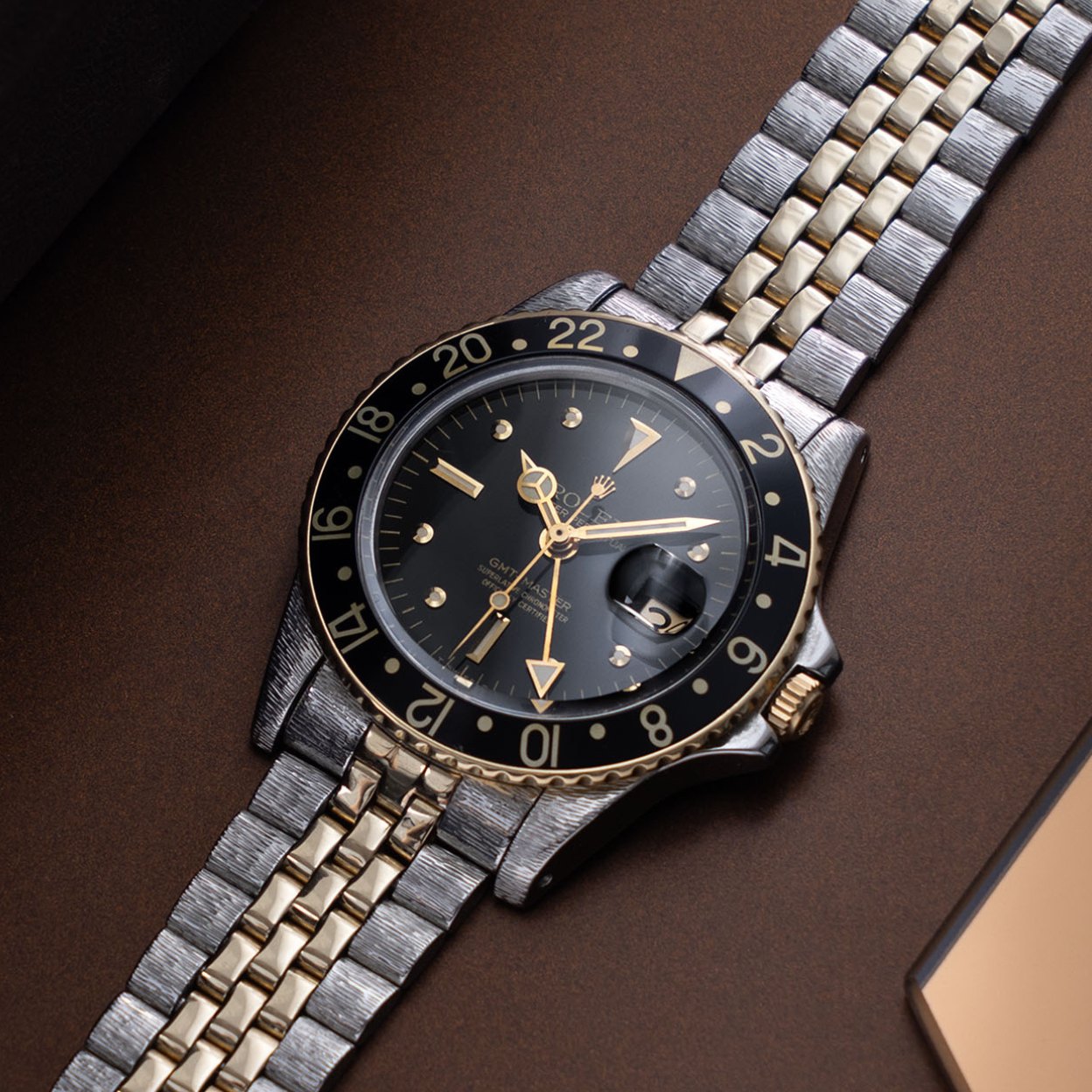
Rolex GMT-master 1675/3 Black Nipple Dial Steel and Gold "John Bull" Finish, 1975
- Maker / attribution
- Rolex (maker)
- Date
- 1975
- Historical period
- Quartz Revolution (1969 – 1990)
- Country of origin
- Switzerland
- Object type
- Wristwatch
- Materials / technique
- gold
- Dimensions
- Case 40 mm
- Stock no.
- W-3736
- Credit line
- Dealer listing, Bulang & Sons (W-3736)
- Catalogue title (original)
- Rolex GMT-master 1675/3 Black Nipple Dial Steel and Gold "John Bull" Finish (English)
View the source record (dealer listing) ↗ (opens another website in a new tab)Suggest a correction
Record summary
Catalogued by Bulang & Sons (dealer), Copenhagen (stock number W-3736), this is a wristwatch by Rolex, made in Switzerland, dated 1975. The Atlas places it in the Quartz Revolution period (1969 – 1990) of its Wristwatches collection. Materials and techniques recorded by the source: gold. Recorded dimensions: Case 40 mm. The record is illustrated with 6 photographs.
Assembled from the source record's structured fields. Dates and attributions are given as the source states them; where a field is missing the Atlas leaves it blank rather than estimating.
Catalogue description
Dealer description — Bulang & Sons
The Rolex GMT-Master was launched in 1955 as an essential tool for pilots during the dawn of the jet age. Developed in collaboration with Pan American World Airways (Pan Am), it allowed pilots to track two time zones simultaneously using an extra 24-hour hand and a rotating bezel! At hand we have a reference 1675, one of the longest-running Rolex references. It replaced Bakelite with aluminum and introduced crown guards. This particular example boasts some rare and unusual features. The steel and gold case (or “Rolesor” in Rolex terminology) was hand-finished and engraved by the Bahamian official Rolex retailer John Bull, by their master watchmaker Günter Miethe. This customization was a popular request from the Bahamian retailer throughout the 1970s and 1980s. It is understood that Rolex gave their blessing to John Bull to carry out these modifications for the local market, resulting in this distinctive “bark” texture. The Jubilee bracelet is also engraved with this texture and represents the typical US-market variant, featuring oval links with 14k gold trim and a gold crown on the clasp. The black dial is in excellent condition and features the desirable nipple-style hour markers, an applied coronet, gold printed text, and a beautifully even lume patina across both the hands and hour plots. The watch has been fully serviced by our watchmaker. At first glance, the combination of steel and gold with the bark finish can be somewhat challenging. However, over time, we have come to truly appreciate its unique character—not to mention the remarkable level of craftsmanship required to execute such a finish. Not long ago, these pieces tended to trade at a discount compared to standard examples of the same reference, but that narrative has gradually shifted. As the “John Bull Special” secures its place within the Rolex collecting world—and as more collectors recognize it as something far beyond a typical aftermarket customization—values have steadily continued to rise. If you are looking for something far removed from the standard Rolex sports catalog, this true conversation piece could be a perfect contender! Specifications: Rolex GMT-Master 1675/3 40mm steel and gold case “bark" texture Serial 401xxxx dating to 1975 Black nipple dial with applied coronet Faded black bezel insert Two-tone Jubilee bracelet, US market variant with oval links Fully serviced by our watchmaker
Historical context
Quartz Revolution (1969 – 1990)
Seiko's Astron begins mass quartz timekeeping; traditional industries contract sharply.
Quartz and digital watches transformed the market after 1969. Swiss employment collapsed, Japanese and Hong Kong production soared, and the Swatch (1983) helped the Swiss industry recover; mechanical watches survived as luxury goods.
Read the period in the timelineMore wristwatches from this periodEarlier: Modern Mechanical Horology
Atlas type guide
Military, pilot and travel watches
The wristwatch owes much of its adoption by men to warfare and aviation. Wristlets — small pocket watches soldered with lugs and worn on a strap — were used in colonial campaigns and became standard equipment in the First World War, with protective grilles over the crystal ('shrapnel guards'). Louis Cartier's Santos (1904), designed for the aviator Alberto Santos-Dumont, is often cited as an early purpose-made pilot's watch.
In the Second World War governments specified watches in detail: the German B-Uhr observation watches, the American A-11, and the British 'W.W.W.' (the 'Dirty Dozen' set of 1945). After the war, jet travel brought GMT and world-time watches, which show two or more time zones at once — Louis Cottier's world-time mechanism and the Rolex GMT-Master (1955) are examples.
What to look for
- Military markings on the case back: broad arrow, issue numbers, 'W.W.W.', 'A.T.P.'
- High-legibility black dials with luminous Arabic numerals; oversized crowns for gloved hands.
- 24-hour hands and rotating 24-hour bezels or city rings on GMT/world-time watches.
- Wire lugs on early wristlets converted from pocket watches.
Dating clues
- Wire-lug wristlets: c. 1900–1925.
- Military specifications of the Second World War: 1939–1945.
- GMT and world-time wristwatches: mainly after 1950.
General guidance written by the Atlas editors about this kind of object. It is not a statement about this particular piece; for that, rely on the source record above and on physical examination.
Related records

Movements & Components · c. 1970s
Rolex watch movement, c. 1970s
Antiquorum auction archive, Geneva

Pocket Watches · 1982
Fake Rolex watch, gold coloured metal, possibly made in Taiwan, 1982; part of a casual outfit, UK, 1982-84.
Victoria and Albert Museum, London

Wristwatches · c. 1920s
Rolex wristwatch, c. 1920s
Antiquorum auction archive, Geneva

Wristwatches · c. 1920s
Rolex wristwatch, ref. 6194, c. 1920s
Antiquorum auction archive, Geneva

Wristwatches · 1970
Wristwatch by Heno, Switzerland, 1970
Museum Rotterdam

Wristwatches · 1960–1986
'Tri-Compax' calendar chronograph wristwatch in gold case, by Universal, Geneva, Switzerland, 1960–1986.
Science Museum Group, London

Wristwatches · 1969–1970
Beta 21 Quartz wristwatch movement, made in Switzerland, 1970.
Science Museum Group, London

Wristwatches · c. 1969
Omega Speedmaster Moonwatch, ref. 145022-69st, c. 1969
Antiquorum auction archive, Geneva