
Wristwatches · Wristwatch
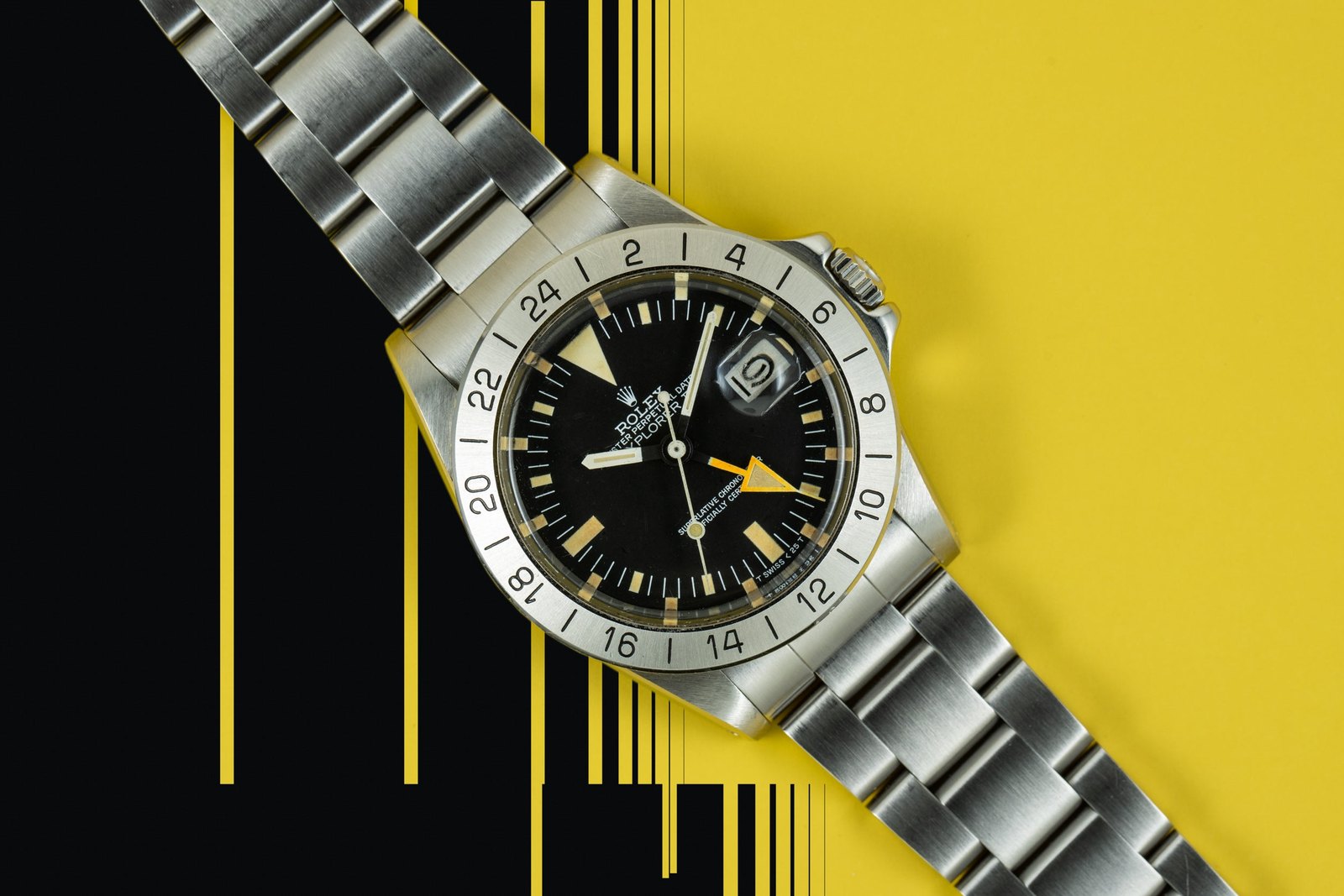
Rolex Explorer II 'Steve McQueen', c. 1973
- Maker / attribution
- Rolex (maker)
- Date
- c. 1973
- Historical period
- Quartz Revolution (1969 – 1990)
- Country of origin
- Switzerland
- Object type
- Wristwatch
- Stock no.
- 40920109
- Credit line
- Dealer listing, Analog/Shift (40920109)
- Catalogue title (original)
- Rolex Explorer II 'Steve McQueen' (English)
View the source record (dealer listing) ↗ (opens another website in a new tab)Suggest a correction
Record summary
Catalogued by Analog/Shift (dealer), New York (stock number 40920109), this is a wristwatch by Rolex, made in Switzerland, dated c. 1973. The Atlas places it in the Quartz Revolution period (1969 – 1990) of its Wristwatches collection. The record is illustrated with 6 photographs.
Assembled from the source record's structured fields. Dates and attributions are given as the source states them; where a field is missing the Atlas leaves it blank rather than estimating.
Catalogue description
Dealer description — Analog/Shift
Why We Love It Let's clear one thing up right from the start: To the best of anyone's knowledge, Steve McQueen neither owned or publicly wore this model Rolex Explorer! Due to an identification snafu in the early days of the internet, the Rolex Explorer Reference 1655 has been incorrectly associated with the actor, racer, and all-around legend for nearly two decades. We know he wore a Submariner, and we also know of his fondness for Heuer (not just the Monaco) and Hanhart. But there is no evidence to suggest the King Of Cool ever had anything to do with the 1655. Which is a shame really, because the 1655 is one of the absolute coolest - and least understood - model in Rolex's vintage catalog. Taking its movement architecture from a Reference 1675 GMT-Master, the 1655 features a fixed 24-hour bezel and an entirely unique dial and handset configuration with its iconic 'Orange Hand' second timezone indicator. So it wears like a Submariner, works like a GMT-Master, and has a look all its own! This particular example dates to circa 1973 and features a stunningly crisp dial devoid of the all-too-common edge wear or lume loss, a color matched handset, minty service bezel assembly, and a professionally recut case. It also comes complete with its inner and outer ('Green Stripe') box set, COSC papers and hangtag, booklets, 1974/1975 calendar card, and blank punched guarantee papers! The King Of Cool abides! The Explorer II Story The Rolex Explorer II has never been accused of being staid, wimpy or dainty. Worn by scientists and (you guessed it!) explorers into some of the more inhospitable regions on the planet, the Rolex Explorer II was from its birth designed to buck the presumptions of what a wristwatch could bear. Rolex has long been the watch of exploration and early on, Rolex technicians subjected their timepieces to the worst Mother Nature could conjure; whether traversing the English Channel, breaking land-speed records or climbing Mount Everest, there's a good chance Rolex was involved. The Explorer line traces its origins to the famous mountain and Sir Edmund Hillary's successful ascension of it in 1953, but numerous historic moments were marked by the presence of the Explorer and its descendent, the Explorer II. Ed Viesturs, the only American to climb all 14 of the globe's eight-thousander peaks (and the fifth person to ever do so without supplemental oxygen); Jean Troillet, the Swiss/Canadian who set the speed record for climbing the Matterhorn (at 21-years-old nonetheless) and was the first person to snowboard down Everest; and Alain Hubert, world-renowned Polar explorer who achieved a world-record cross of the Antarctic continent, all proudly wore the Rolex Explorer II on their expeditions. The Explorer II is definitely a timepiece for the man who craves something a little different from his sport model Rolex. Released in 1971 as a follow up to the original Explorer made famous by mountaineers in the 1950s, the Explorer II utilized a larger Oyster case design more in line with the sports models already offered (the Submariner and GMT-Master). Featuring a four-hand display with a large and distinctive 24-hour pointer hand, the Explorer II was essentially a GMT-Master with one notable difference: a fixed steel bezel was installed in place of the characteristic two-tone from the aviator's model. The reason for this fixed bezel was the target demographic: speleologists, or subterranean explorers. This hearty breed of mankind spends days on end underneath the surface of the earth and without seeing the sky, and are prone to losing track of daytime hours. The 24-hour hand would point to the appropriate place on the fixed 24-Hour bezel indicating whether it was AM or PM. While the original Explorer was designed to go into the clouds, the Explorer II was designed to descend into darkness.
Historical context
Quartz Revolution (1969 – 1990)
Seiko's Astron begins mass quartz timekeeping; traditional industries contract sharply.
Quartz and digital watches transformed the market after 1969. Swiss employment collapsed, Japanese and Hong Kong production soared, and the Swatch (1983) helped the Swiss industry recover; mechanical watches survived as luxury goods.
Read the period in the timelineMore wristwatches from this periodEarlier: Modern Mechanical Horology
Atlas type guide
Wristwatches
Bracelet watches were worn by women from the early nineteenth century — Breguet made one for Caroline Murat, Queen of Naples, in 1810–12 — but the wristwatch only became a man's instrument with military use and aviation in the early twentieth century. Between the World Wars it overtook the pocket watch; the 1920s and 1930s brought rectangular Art Deco cases, water-resistant cases and the first automatic winding systems.
After 1945 the wristwatch became a carrier of identity — dress watches, sports and dive watches, chronographs, calendars — produced by Swiss, American, Japanese, German, Soviet and Chinese industries. The quartz revolution after 1969 and the mechanical renaissance since the 1990s, including the rise of independent watchmakers, complete the story.
What to look for
- The reference number (between the lugs or inside the case back) and serial number, the starting point for dating.
- The calibre: its maker and number are often stamped under the dial or on the bridge.
- Originality of dial, hands and crown — refinished ('redial') dials are common.
- Case material marks: 18K/750, 14K/585, stainless steel, gold-filled, plated.
Dating clues
- Wire-lug cases: before c. 1925.
- Water-resistant screw-down cases: from 1926.
- Quartz movements: from 1969; sapphire crystals widespread after c. 1980.
General guidance written by the Atlas editors about this kind of object. It is not a statement about this particular piece; for that, rely on the source record above and on physical examination.
Related records

Movements & Components · c. 1970s
Rolex watch movement, c. 1970s
Antiquorum auction archive, Geneva

Pocket Watches · 1982
Fake Rolex watch, gold coloured metal, possibly made in Taiwan, 1982; part of a casual outfit, UK, 1982-84.
Victoria and Albert Museum, London

Wristwatches · c. 1920s
Rolex wristwatch, c. 1920s
Antiquorum auction archive, Geneva

Wristwatches · c. 1920s
Rolex wristwatch, ref. 6194, c. 1920s
Antiquorum auction archive, Geneva

Wristwatches · 1970
Wristwatch by Heno, Switzerland, 1970
Museum Rotterdam

Wristwatches · 1960–1986
'Tri-Compax' calendar chronograph wristwatch in gold case, by Universal, Geneva, Switzerland, 1960–1986.
Science Museum Group, London

Wristwatches · 1969–1970
Beta 21 Quartz wristwatch movement, made in Switzerland, 1970.
Science Museum Group, London

Wristwatches · c. 1969
Omega Speedmaster Moonwatch, ref. 145022-69st, c. 1969
Antiquorum auction archive, Geneva