
Wristwatches · Wristwatch
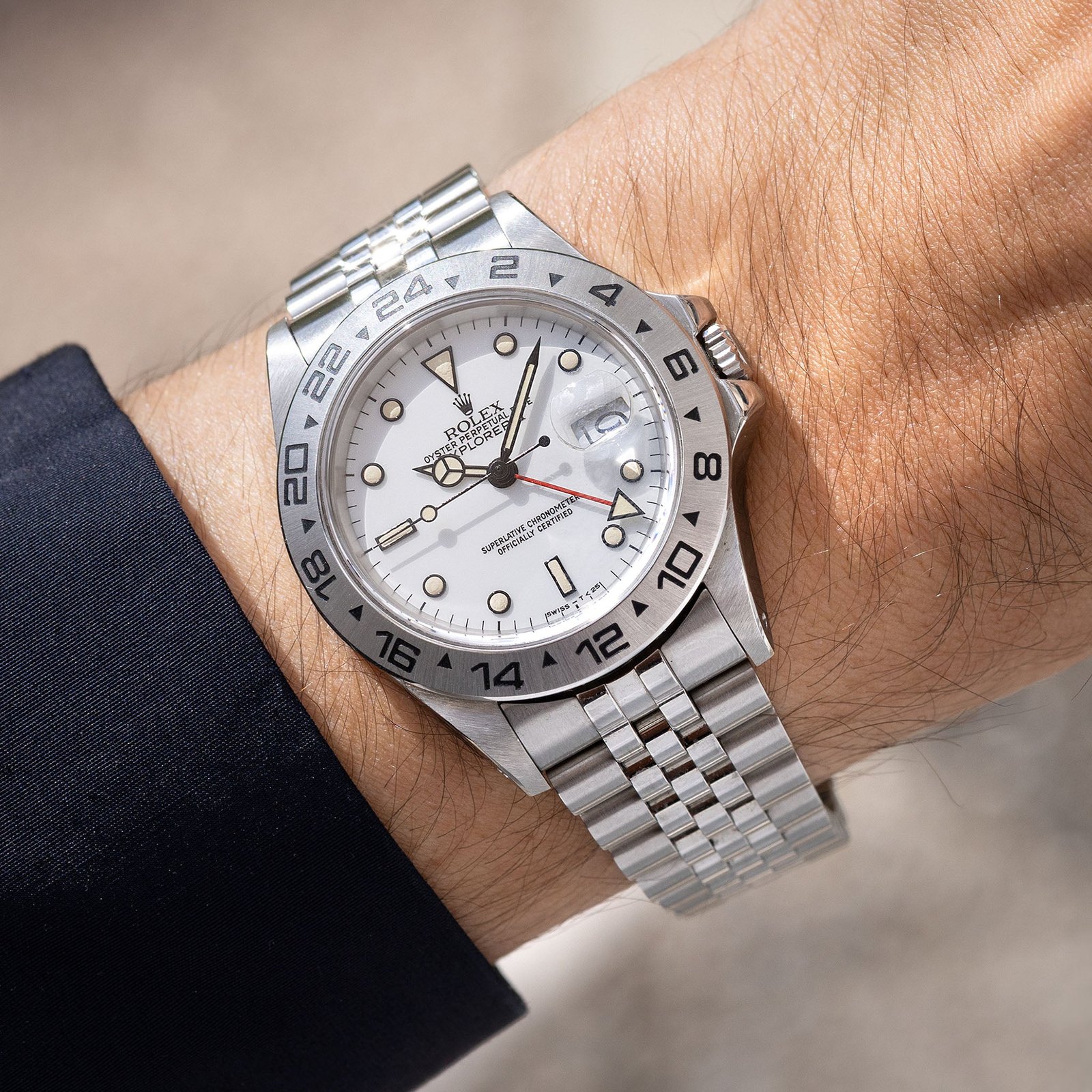
Rolex Explorer II 16550 "Warm Patina dial" with super Jubilee, 1987
- Maker / attribution
- Rolex (maker)
- Date
- 1987
- Historical period
- Quartz Revolution (1969 – 1990)
- Country of origin
- Switzerland
- Object type
- Wristwatch
- Stock no.
- W-3383
- Credit line
- Dealer listing, Bulang & Sons (W-3383)
- Catalogue title (original)
- Rolex Explorer II 16550 "Warm Patina dial" with super Jubilee (English)
View the source record (dealer listing) ↗ (opens another website in a new tab)Suggest a correction
Record summary
Catalogued by Bulang & Sons (dealer), Copenhagen (stock number W-3383), this is a wristwatch by Rolex, made in Switzerland, dated 1987. The Atlas places it in the Quartz Revolution period (1969 – 1990) of its Wristwatches collection. The record is illustrated with 6 photographs.
Assembled from the source record's structured fields. Dates and attributions are given as the source states them; where a field is missing the Atlas leaves it blank rather than estimating.
Catalogue description
Dealer description — Bulang & Sons
The original Rolex Oyster Perpetual Explorer II ref. 1655 was introduced in 1971. In hindsight, it’s fair to say the model struggled to gain traction at launch. Rolex positioned the Explorer II as a tool watch specifically designed for spelunking—an activity that, while adventurous, remained niche. The spirit of exploration was certainly present: navigating dark, damp, and potentially dangerous caves. However, despite a broader cultural fascination with adventure during the 1960s and 1970s, caving didn’t capture the public imagination quite like mountaineering or diving. As a result, the Explorer II failed to resonate with a wider audience in its early years. Following reference 1655 came reference 16550—the exact model we have on offer here. Slightly larger by just 1mm, the updated Explorer II introduced a sapphire crystal and the new caliber 3085 movement. But the real game-changer was the independently adjustable local hour hand, allowing wearers to track local time while the 24-hour hand displayed home time. Sound familiar? That slender, elongated 24-hour hand recalls the one seen on the GMT-Master. With this upgrade, the Explorer II was no longer confined to caves—it was ready to travel the world. This reference also introduced a second dial color (white, in addition to the previously exclusive black) and glossy dials with white gold surrounds on the hour markers—on both black dials and early white ones. The specific example we’re offering is a later R-series model featuring black surrounds on the hour plots. These plots have aged to a beautiful warm yellow hue, echoed in the black hands that also carry a golden patina. Both the case and bezel are in fantastic condition. One of the coolest and most surprising features of this watch is its pairing with the so-called “Super Jubilee” bracelet. It gives this sporty tool watch a very “summer and sun” ☀️ aesthetic that we love! While not period-correct (these bracelets were introduced by Rolex around 2005 and are now out of production), the Super Jubilee is prized for its hidden clasp, elegant design, and exceptional comfort. This sets it apart from the standard Jubilee bracelet, which typically features an exposed clasp. The Super Jubilee bracelet on this watch is reference 63600, featuring solid end links and a clasp stamped 7YK. If the buyer prefers a reference 78360 Oyster bracelet—as originally delivered with these watches—we can source and fit one on request. But we must say, we love the look and feel of this combo just as it is! This warm patinated Explorer has been fully serviced by our watchmaker and is ready for new Exploration for the years to come. Tool watch meets summer vibes ☀️—this Explorer II is ready for your wrist. Email us or reach out to secure it today. Specifications Rolex Reference 16550 Explorer II White dial with black surroundings , black hands and warm yellow patina Serial r27xxxx dating to 1987 Rolex “super jubilee “ ref 63600 bracelet with solid end links Fully serviced by our watchmaker
Historical context
Quartz Revolution (1969 – 1990)
Seiko's Astron begins mass quartz timekeeping; traditional industries contract sharply.
Quartz and digital watches transformed the market after 1969. Swiss employment collapsed, Japanese and Hong Kong production soared, and the Swatch (1983) helped the Swiss industry recover; mechanical watches survived as luxury goods.
Read the period in the timelineMore wristwatches from this periodEarlier: Modern Mechanical Horology
Atlas type guide
Wristwatches
Bracelet watches were worn by women from the early nineteenth century — Breguet made one for Caroline Murat, Queen of Naples, in 1810–12 — but the wristwatch only became a man's instrument with military use and aviation in the early twentieth century. Between the World Wars it overtook the pocket watch; the 1920s and 1930s brought rectangular Art Deco cases, water-resistant cases and the first automatic winding systems.
After 1945 the wristwatch became a carrier of identity — dress watches, sports and dive watches, chronographs, calendars — produced by Swiss, American, Japanese, German, Soviet and Chinese industries. The quartz revolution after 1969 and the mechanical renaissance since the 1990s, including the rise of independent watchmakers, complete the story.
What to look for
- The reference number (between the lugs or inside the case back) and serial number, the starting point for dating.
- The calibre: its maker and number are often stamped under the dial or on the bridge.
- Originality of dial, hands and crown — refinished ('redial') dials are common.
- Case material marks: 18K/750, 14K/585, stainless steel, gold-filled, plated.
Dating clues
- Wire-lug cases: before c. 1925.
- Water-resistant screw-down cases: from 1926.
- Quartz movements: from 1969; sapphire crystals widespread after c. 1980.
General guidance written by the Atlas editors about this kind of object. It is not a statement about this particular piece; for that, rely on the source record above and on physical examination.
Related records

Movements & Components · c. 1970s
Rolex watch movement, c. 1970s
Antiquorum auction archive, Geneva

Pocket Watches · 1982
Fake Rolex watch, gold coloured metal, possibly made in Taiwan, 1982; part of a casual outfit, UK, 1982-84.
Victoria and Albert Museum, London

Wristwatches · c. 1920s
Rolex wristwatch, c. 1920s
Antiquorum auction archive, Geneva

Wristwatches · c. 1920s
Rolex wristwatch, ref. 6194, c. 1920s
Antiquorum auction archive, Geneva

Wristwatches · 1970
Wristwatch by Heno, Switzerland, 1970
Museum Rotterdam

Wristwatches · 1960–1986
'Tri-Compax' calendar chronograph wristwatch in gold case, by Universal, Geneva, Switzerland, 1960–1986.
Science Museum Group, London

Wristwatches · 1969–1970
Beta 21 Quartz wristwatch movement, made in Switzerland, 1970.
Science Museum Group, London

Wristwatches · c. 1969
Omega Speedmaster Moonwatch, ref. 145022-69st, c. 1969
Antiquorum auction archive, Geneva