
Wristwatches · Wristwatch
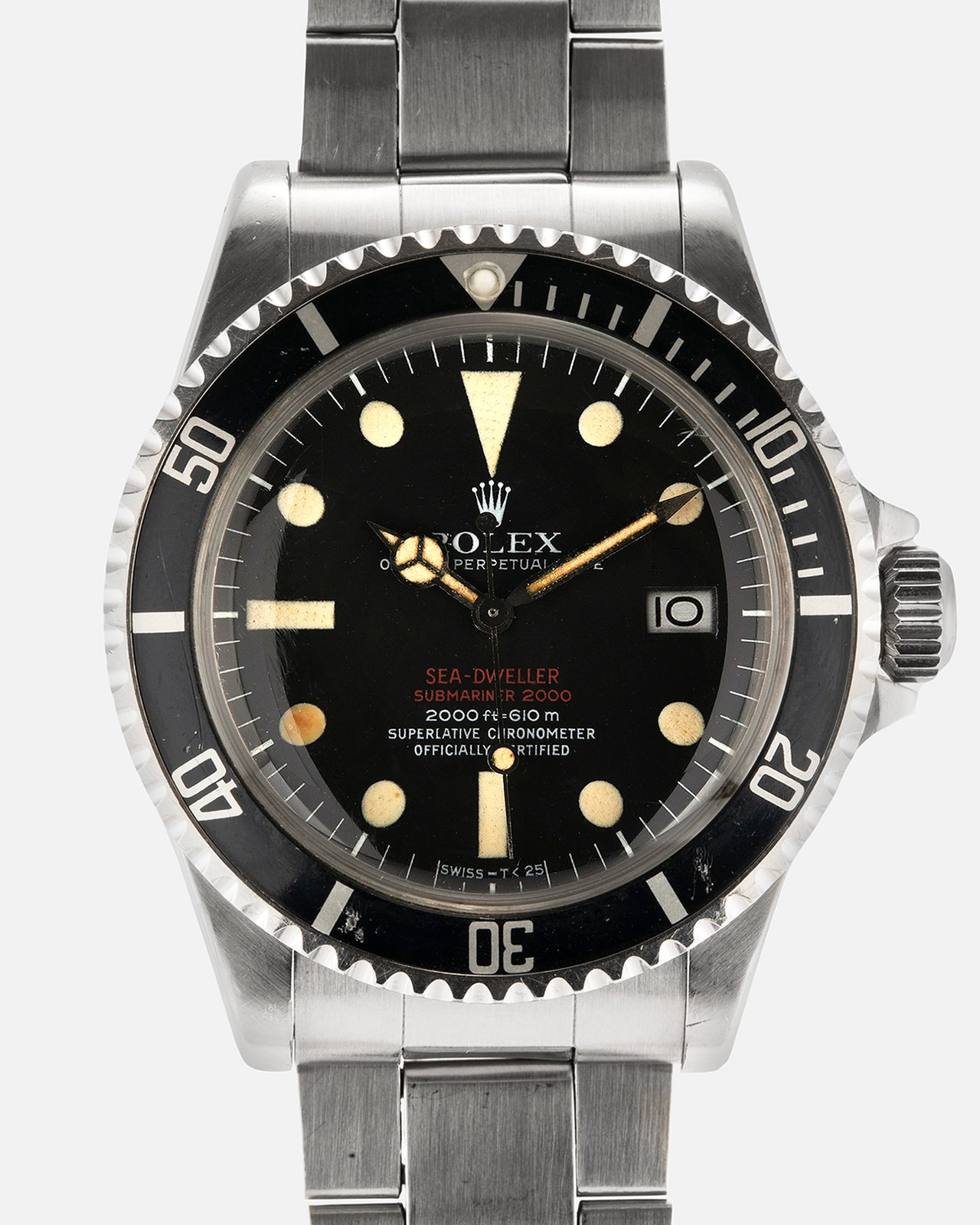
Rolex Double Red Sea Dweller Mk 3 Military Provenance, 1973
- Maker / attribution
- Rolex (maker)
- Date
- 1973
- Historical period
- Quartz Revolution (1969 – 1990)
- Country of origin
- Switzerland
- Object type
- Wristwatch
- Stock no.
- Product 7433092923479
- Credit line
- Dealer listing, S.Song Watches (product 7433092923479)
- Catalogue title (original)
- Rolex Double Red Sea Dweller Mk 3 Military Provenance (English)
View the source record (dealer listing) ↗ (opens another website in a new tab)Suggest a correction
Record summary
Catalogued by S.Song Watches (dealer), Seattle (stock number Product 7433092923479), this is a wristwatch by Rolex, made in Switzerland, dated 1973. The Atlas places it in the Quartz Revolution period (1969 – 1990) of its Wristwatches collection. The record is illustrated with 6 photographs.
Assembled from the source record's structured fields. Dates and attributions are given as the source states them; where a field is missing the Atlas leaves it blank rather than estimating.
Catalogue description
Dealer description — S.Song Watches
Rolex was never originally conceived as a luxury watch brand. While today the name is often associated with status and prestige, its roots lie firmly in the realm of professional tool watches—timepieces designed with specific utilitarian purposes in mind, such as diving, aviation, and motor racing. A significant part of the enduring appeal of the vintage Rolex market stems from this heritage. Collectors are drawn to the purity and integrity of these early designs, where functionality took precedence and aesthetic appeal naturally followed. While the Submariner and GMT-Master are the most famous, made for divers and pilots, respectively, the lesser-known, more hardcore side of Rolex collecting lies in the Sea-Dweller. To the uninformed, it looks nearly identical to the Submariner, but it has an interesting origin story. This is the point where Rolex truly ventured into highly specialized and niche markets, since the Submariner’s 200-meter depth rating was already more than sufficient for most divers. The Sea-Dweller was a watch that was developed out of necessity. During the late 1960s, many divers in SeaLab expeditions were experiencing issues with their Submariners, as the crystal would often pop out after a dive. Mind you, these were not your average Navy divers. SeaLab was an experimental arm of the U.S. Navy aiming to prove the viability of humans living underwater for extended periods. This was known as saturation diving, where helium was used in the breathing gas mixture. Rolex discovered that during decompression, helium particles that had seeped into the watch case needed a way to escape. Without a proper outlet, the internal pressure would build up and often cause the plexiglass crystal to eject outwards, effectively rendering the watch redundant. Their solution was the watch you see here: the Sea-Dweller 1665. While maintaining the same diameter as the Submariner, it featured a slightly thicker case profile to accommodate an internal helium escape valve mechanism, allowing the watch to safely release pressure as divers resurfaced. With a depth rating of 610 meters, more than double that of the Submariner, it quickly established itself as the ultimate tool watch for professional saturation divers. The example you see here is a first-generation 1665 Sea Dweller, famously known as the "Double Red" for the two lines of distinctly red text on the dial—a feature unique to this reference. Long considered one of the most desirable vintage Rolex models, it remains a true grail piece for many collectors. It comes fitted with a Mk 3 dial, identified by its grainy-textured print and the slightly larger "SEA DWELLER" text above the "SUBMARINER 2000" line when viewed under magnification. It's also paired with a Mk 3 “fat font” bezel insert, which shows some signs of wear that speak to its honest provenance and well-earned character. Additionally, the watch comes paired with a 9315 folded Oyster bracelet with ‘380B’ endlinks, complete with the sought-after "pateted" extension clasp typo—a small but highly sought-after detail among seasoned collectors. You see, there was a brief period during the early 1970s, estimated between 1971 and 1973, where some 9315 Oyster bracelets with either ‘280’ or ‘380’ endlinks were fitted with extension clasps mistakenly engraved "pateted" instead of "patented." While clearly a typographical error, it’s fascinating to consider that even Rolex, now synonymous with tight manufacturing tolerances and standardisation, once operated with a level of inconsistency that feels worlds apart from its highly controlled production environment today. What truly sets this particular Double Red Sea-Dweller apart, however, is its military pedigree. Along with the watch comes a signed letter of provenance from the previous owner, who served in the Australian Army Reserve. Allen Croft, the man who owned the watch for most of his life, acquired it around 1977 from a commercial diver who worked for Harry Baxter, a local marine salvage operator. What’s uniquely interesting about this diver and Baxter is that they were responsible for discovering the WWII Japanese submarine I-124 , which sank in 1942. Croft wore this watch during his years as a pearl diver in Broome, Western Australia, and later took it with him on deployments as a Combat Engineer and Officer in the Middle East. Just by looking at it, you get the sense that this 1665 has lived an extraordinary life. If only watches could talk, this one would surely have more than a few incredible stories to share. For many of us, it’s this kind of rich, personal history tied to watches that makes collecting so fascinating and deeply rewarding. The provenance of this 1665 adds a profound layer of meaning to both owning and wearing the watch, and I have no doubt the next owner will appreciate and cherish it just as deeply.
Historical context
Quartz Revolution (1969 – 1990)
Seiko's Astron begins mass quartz timekeeping; traditional industries contract sharply.
Quartz and digital watches transformed the market after 1969. Swiss employment collapsed, Japanese and Hong Kong production soared, and the Swatch (1983) helped the Swiss industry recover; mechanical watches survived as luxury goods.
Read the period in the timelineMore wristwatches from this periodEarlier: Modern Mechanical Horology
Atlas type guide
Military, pilot and travel watches
The wristwatch owes much of its adoption by men to warfare and aviation. Wristlets — small pocket watches soldered with lugs and worn on a strap — were used in colonial campaigns and became standard equipment in the First World War, with protective grilles over the crystal ('shrapnel guards'). Louis Cartier's Santos (1904), designed for the aviator Alberto Santos-Dumont, is often cited as an early purpose-made pilot's watch.
In the Second World War governments specified watches in detail: the German B-Uhr observation watches, the American A-11, and the British 'W.W.W.' (the 'Dirty Dozen' set of 1945). After the war, jet travel brought GMT and world-time watches, which show two or more time zones at once — Louis Cottier's world-time mechanism and the Rolex GMT-Master (1955) are examples.
What to look for
- Military markings on the case back: broad arrow, issue numbers, 'W.W.W.', 'A.T.P.'
- High-legibility black dials with luminous Arabic numerals; oversized crowns for gloved hands.
- 24-hour hands and rotating 24-hour bezels or city rings on GMT/world-time watches.
- Wire lugs on early wristlets converted from pocket watches.
Dating clues
- Wire-lug wristlets: c. 1900–1925.
- Military specifications of the Second World War: 1939–1945.
- GMT and world-time wristwatches: mainly after 1950.
General guidance written by the Atlas editors about this kind of object. It is not a statement about this particular piece; for that, rely on the source record above and on physical examination.
Related records

Movements & Components · c. 1970s
Rolex watch movement, c. 1970s
Antiquorum auction archive, Geneva

Pocket Watches · 1982
Fake Rolex watch, gold coloured metal, possibly made in Taiwan, 1982; part of a casual outfit, UK, 1982-84.
Victoria and Albert Museum, London

Wristwatches · c. 1920s
Rolex wristwatch, c. 1920s
Antiquorum auction archive, Geneva

Wristwatches · c. 1920s
Rolex wristwatch, ref. 6194, c. 1920s
Antiquorum auction archive, Geneva

Wristwatches · 1970
Wristwatch by Heno, Switzerland, 1970
Museum Rotterdam

Wristwatches · 1960–1986
'Tri-Compax' calendar chronograph wristwatch in gold case, by Universal, Geneva, Switzerland, 1960–1986.
Science Museum Group, London

Wristwatches · 1969–1970
Beta 21 Quartz wristwatch movement, made in Switzerland, 1970.
Science Museum Group, London

Wristwatches · c. 1969
Omega Speedmaster Moonwatch, ref. 145022-69st, c. 1969
Antiquorum auction archive, Geneva