
Wristwatches · Wristwatch
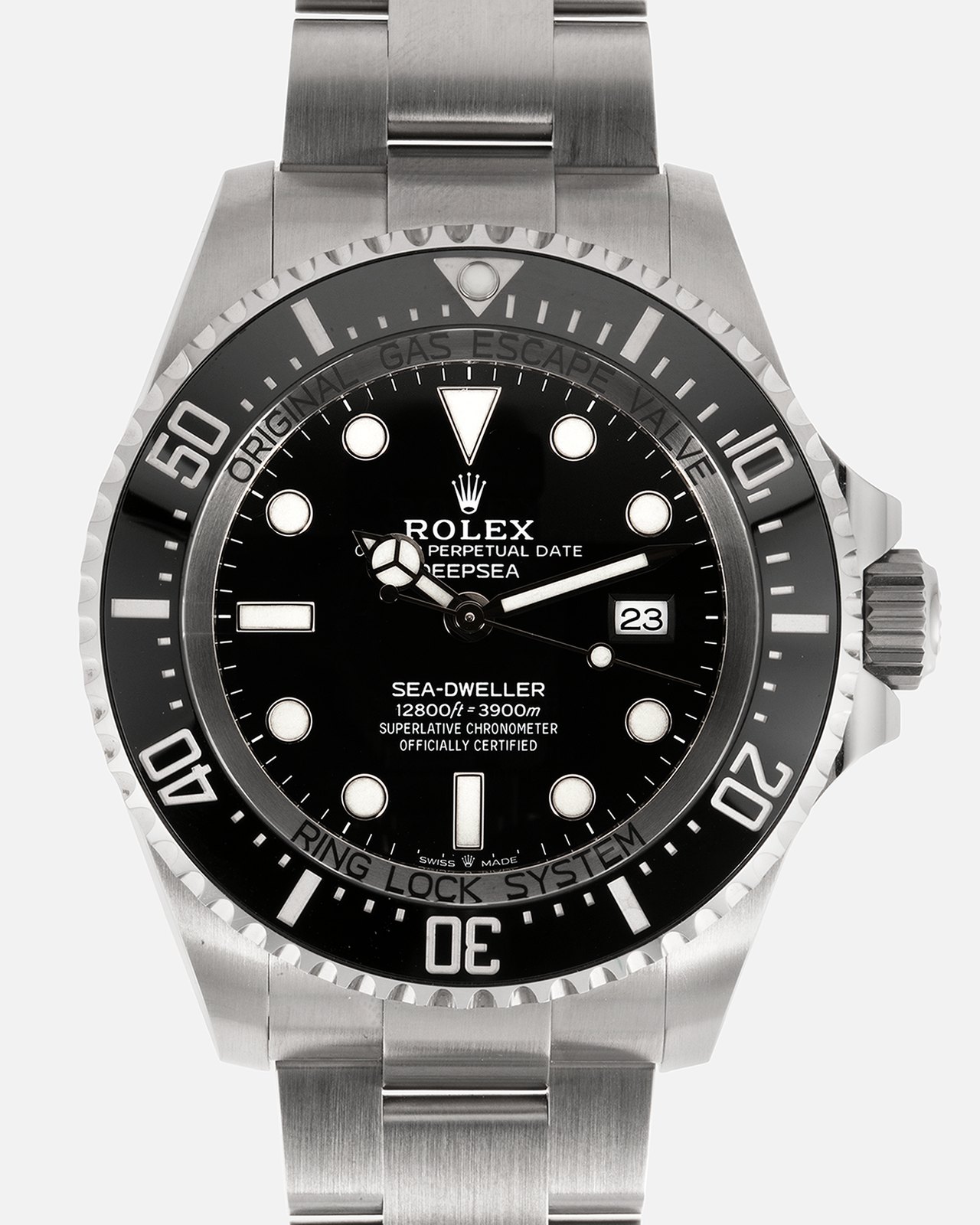
Rolex Deepsea Sea Dweller 126660, 2018
- Maker / attribution
- Rolex (maker)
- Date
- 2018
- Historical period
- Contemporary Horology (2010 – Present)
- Country of origin
- Switzerland
- Object type
- Wristwatch
- Dimensions
- Case 18 mm
- Stock no.
- Product 6871417585751
- Credit line
- Dealer listing, S.Song Watches (product 6871417585751)
- Catalogue title (original)
- Rolex Deepsea Sea Dweller 126660 (English)
View the source record (dealer listing) ↗ (opens another website in a new tab)Suggest a correction
Record summary
Catalogued by S.Song Watches (dealer), Seattle (stock number Product 6871417585751), this is a wristwatch by Rolex, made in Switzerland, dated 2018. The Atlas places it in the Contemporary Horology period (2010 – Present) of its Wristwatches collection. Recorded dimensions: Case 18 mm. The record is illustrated with 6 photographs.
Assembled from the source record's structured fields. Dates and attributions are given as the source states them; where a field is missing the Atlas leaves it blank rather than estimating.
Catalogue description
Dealer description — S.Song Watches
The Rolex Sea Dweller has a longstanding history that is deeply linked to deep-sea diving. It played an instrumental role in the research and development of the dive watch archetype that began sometime back in the 1950s. After the Second World War, leisure diving gradually grew in popularity, which in some ways, paved the way for such dive watches to be made commercially available for military, professional, as well as for civilian use. In the following decade, when experiments involving saturation diving for commercial deep sea divers were carried out extensively, there was suddenly a need for watches with much greater water resistance. At the time, the standard issue Rolex Submariner was able to withstand 200m of pressure and water resistance, but Rolex set out to triple those numbers. Eventually came the Sea-Dweller Ref. 1665 “Double Red” in 1967, which featured an impressive 610m of water resistance and cutting-edge technology that predominantly revolved around the helium escape valve (HEV). Fast forward half a century later, the Sea-Dweller has evolved into a model that sits at the top of the professional line of Rolex sports models, and what we have on offer here today is one such example – the Rolex Deepsea Sea-Dweller Ref. 126660. First introduced in 2018, the Ref. 126660 represented Rolex’s ongoing efforts in over-engineering their famed dive watch design, something the Crown has been known to do. In some ways, I’d say that the Ref. 126660 is somewhat like the G-Wagen of Rolex; it is big, built like a tank, and yet very seldom (as far I am aware) pushed to its limits by its respective owners. As far as its specifications go, the Ref. 126660 features a case size of 44m x 18mm and a whopping water resistance of 3,990 meters (12,800 feet), which is more than triple in water resistance over its non-Deepsea counterparts. How did they do it? Well, this came as a result of incorporating several engineering marvels onto the Ref. 126660, such as the 5mm-thick sapphire crystal supported by a Ring Lock system as seen on the dial, a unidirectional Cerachrom bezel, and a helium escape valve on the left flank of the case. On the dial, you will find a familiar configuration that is quintessentially Rolex; super-legible hands (and a Mercedes hour hand) and hour markers filled with blue Chromalight material for luminosity. There is also a subtle date window aperture at 3 o’clock which adds to the overall functionality of this beast. Powering the Ref. 126660 from within is the upgraded self-winding Rolex Cal. 3235, an incredibly reliable chronometer-grade movement featuring Rolex’s Chronergy escapement and an impressive 70-hour power reserve. The solid caseback is made out of titanium which helps with weight management and ensures water resistance. Additionally, Rolex also included another impressive technical feat that is the 904L steel Oyster bracelet with Glidelock (Rolex’s sliding in-clasp extension) and Fliplock (Rolex’s wetsuit extension) extension systems, which makes it effortless to adjust, so it can be easily worn over a wetsuit. Indeed, the Sea-Dweller may be considered by many as a niche model from Rolex, but I think it is important to remember that the Sea-Dweller belongs to Rolex’s top-of-the-line professional range; it was designed with an extremely pragmatic and technical purpose in mind. While it does not hold the universal appeal of a Daytona or a Submariner, the level of technical engineering that went into its design is still undeniably impressive, which makes it even more difficult to argue against it because it represents Rolex’s approach and philosophy when it comes to technical watch design.
Historical context
Contemporary Horology (2010 – Present)
Silicon components, connected watches, optical-lattice research clocks and a thriving independent scene.
Smartwatches became the world's best-selling watches, while mechanical watchmaking focuses on craft, innovation (silicon components, new escapements) and independent makers.
Read the period in the timelineMore wristwatches from this periodEarlier: Mechanical Renaissance
Atlas type guide
Wristwatches
Bracelet watches were worn by women from the early nineteenth century — Breguet made one for Caroline Murat, Queen of Naples, in 1810–12 — but the wristwatch only became a man's instrument with military use and aviation in the early twentieth century. Between the World Wars it overtook the pocket watch; the 1920s and 1930s brought rectangular Art Deco cases, water-resistant cases and the first automatic winding systems.
After 1945 the wristwatch became a carrier of identity — dress watches, sports and dive watches, chronographs, calendars — produced by Swiss, American, Japanese, German, Soviet and Chinese industries. The quartz revolution after 1969 and the mechanical renaissance since the 1990s, including the rise of independent watchmakers, complete the story.
What to look for
- The reference number (between the lugs or inside the case back) and serial number, the starting point for dating.
- The calibre: its maker and number are often stamped under the dial or on the bridge.
- Originality of dial, hands and crown — refinished ('redial') dials are common.
- Case material marks: 18K/750, 14K/585, stainless steel, gold-filled, plated.
Dating clues
- Wire-lug cases: before c. 1925.
- Water-resistant screw-down cases: from 1926.
- Quartz movements: from 1969; sapphire crystals widespread after c. 1980.
General guidance written by the Atlas editors about this kind of object. It is not a statement about this particular piece; for that, rely on the source record above and on physical examination.
Related records

Movements & Components · c. 1970s
Rolex watch movement, c. 1970s
Antiquorum auction archive, Geneva

Pocket Watches · 1982
Fake Rolex watch, gold coloured metal, possibly made in Taiwan, 1982; part of a casual outfit, UK, 1982-84.
Victoria and Albert Museum, London

Wristwatches · c. 1920s
Rolex wristwatch, c. 1920s
Antiquorum auction archive, Geneva

Wristwatches · c. 1920s
Rolex wristwatch, ref. 6194, c. 1920s
Antiquorum auction archive, Geneva

Wristwatches · c. 2010s
Breguet Type XXI, ref. 3810, c. 2010s (Antiquorum Lot 381-24)
Antiquorum auction archive, Geneva

Wristwatches · c. 2010s
Breguet Type XXI, ref. 3810, c. 2010s (Antiquorum Lot 386-229)
Antiquorum auction archive, Geneva

Wristwatches · Sold in September 2010
Breitling Cosmonaute, ref. A 22322, Sold in September 2010
Antiquorum auction archive, Geneva

Wristwatches · c. 2010
Corum Bubble Chrono, ref. 396.150.20, c. 2010
Antiquorum auction archive, Geneva