
Wristwatches · Wristwatch
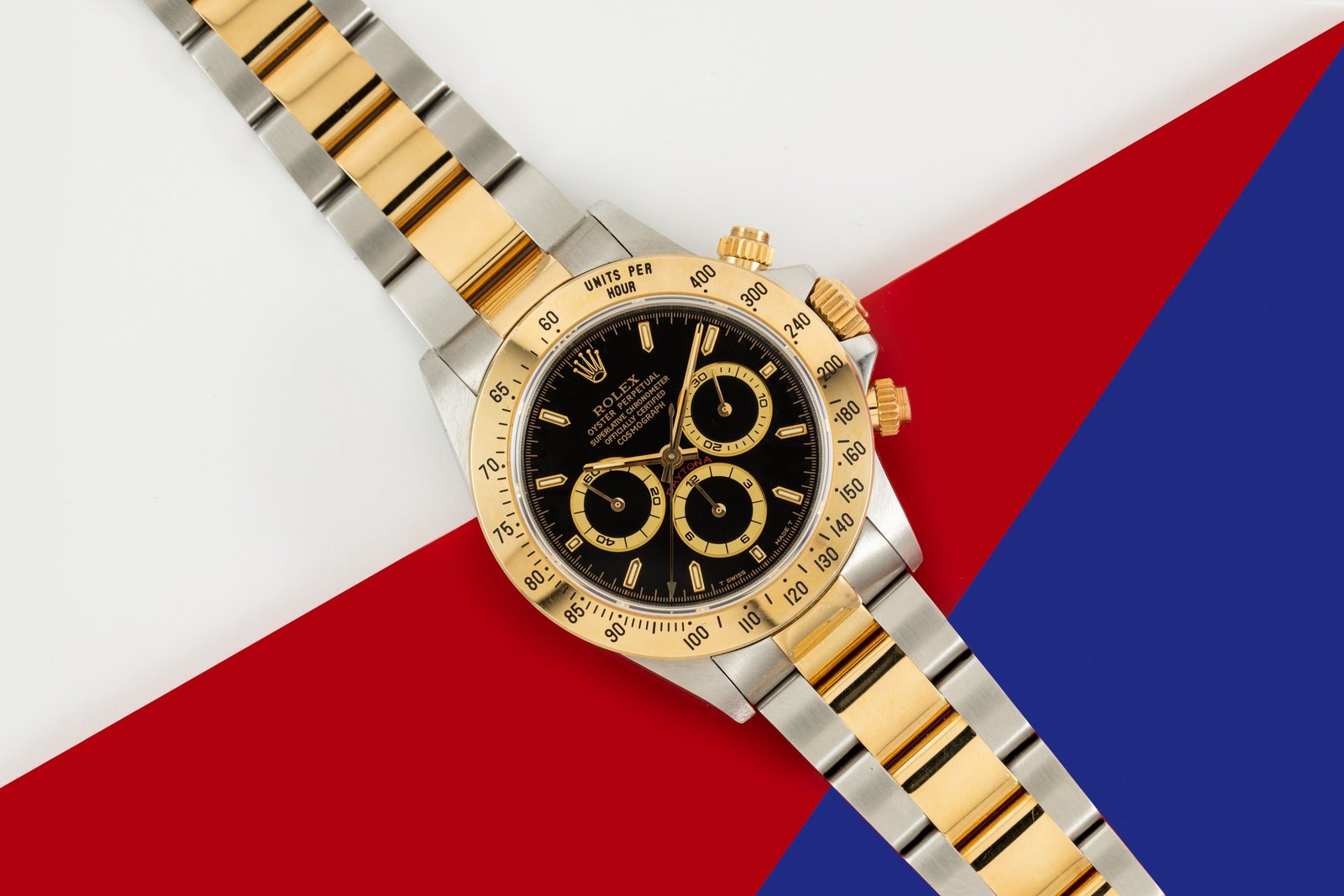
Rolex Daytona 'Zenith' Two-Tone, c. 1995
- Maker / attribution
- Rolex (maker)
- Date
- c. 1995
- Historical period
- Mechanical Renaissance (1990 – 2010)
- Country of origin
- Switzerland
- Object type
- Wristwatch
- Materials / technique
- two-tone
- Stock no.
- 40920129
- Credit line
- Dealer listing, Analog/Shift (40920129)
- Catalogue title (original)
- Rolex Daytona 'Zenith' Two-Tone (English)
View the source record (dealer listing) ↗ (opens another website in a new tab)Suggest a correction
Record summary
Catalogued by Analog/Shift (dealer), New York (stock number 40920129), this is a wristwatch by Rolex, made in Switzerland, dated c. 1995. The Atlas places it in the Mechanical Renaissance period (1990 – 2010) of its Wristwatches collection. Materials and techniques recorded by the source: two-tone. The record is illustrated with 6 photographs.
Assembled from the source record's structured fields. Dates and attributions are given as the source states them; where a field is missing the Atlas leaves it blank rather than estimating.
Catalogue description
Dealer description — Analog/Shift
Why We Love It For all of you who think owning a Rolex Daytona is out of reach, we’d recommend having a close look at the Reference 16523. Introduced in 1988, the Reference 16523 is a so-called “Zenith” Daytona, powered by the legendary El Primero Automatic Chronograph Movement, and features a full-size Rolesor (Two-Tone) case and bracelet. While Two-Tone can be a polarizing style, we would argue there are few watches that work better in bicolor than the Cosmograph Daytona. Offered with a variety of different dials, including slate grey, black, and white, these models are lagging far behind their all-steel counterparts - offering tremendous value for a high-style watch with a precious metal element! This particular 16523 dates to circa 1995 and features a black gloss dial with Tritium luminous plots and a matching handset that have developed a rich creamy patina throughout. The case, bezel and bracelet are in excellent, near mint condition showing only light handling wear. This stunner is a true time capsule and comes complete with its inner and outer boxes, books, and blank papers from Albriton's Jewelers in Mississippi. It even retains its factory green sticker on the case back and an inner bracelet protective sticker as well! This is a collector-quality example with great patina - don't miss it! The Daytona Story The Rolex Daytona. King of the chronographs! Rolex first started experimenting making chronographs in the 1930s – first known as Cosmographs – which set the mold for what would ultimately evolve into the single best-known chronograph in the world. These early watches, like many chronographs of the period, had monochromatic dials and a tachymeter ring printed on the outer edge of the dial. The design of the Cosmograph gradually changed its dial configuration (a shift from monochrome to the "panda" color schemes now closely associated with the model), and a relocation of the tachymetric scale to the bezel, which made it a clear sportsman's watch. In 1964 Rolex added the name Daytona to the model (taken from the 24 Hours of Daytona Race which Rolex started sponsoring in 1962), and its motorsports association was cemented. The earliest Daytonas relied on that well known manually-wound workhorse movement - the Valjoux 72. But in 1988 Rolex released a Daytona using Zenith's El Primero movement, making the Cosmograph Daytona now worthy of the appellation "Oyster Perpetual." These "Zenith" Daytonas have gained serious traction over the past decade on the vintage chronograph market, with potential to appreciate in value to lofty heights. Still, Rolex has never been the sort of brand to rely on off the shelf parts for long, so when the Reference 116520 debuted in 2000 at Basel World, it made headlines. This led to the eventual introduction of the current production model, Reference 116500LN, fitted with a black ceramic bezel that is arguably the most in-demand sports watch on the planet. Whether your taste runs to Pre-Daytona Cosmographs, hand-cranking Valjoux 72 powered models from the 1960s-1980s, or an Automatic Zenith or In-House model, a Rolex Daytona is quite simply a world-class chronograph with a righteous amount of pomp and circumstance justifiably included.
Historical context
Mechanical Renaissance (1990 – 2010)
Mechanical watches return as cultural objects; independent watchmaking flourishes.
Mechanical watches returned as cultural and luxury objects. Complications, tourbillons and new materials proliferated; independent watchmakers such as George Daniels, F.P. Journe and Philippe Dufour revived artisanal watchmaking; collecting vintage watches became a major field.
Read the period in the timelineMore wristwatches from this periodEarlier: Quartz Revolution
Atlas type guide
Wristwatches
Bracelet watches were worn by women from the early nineteenth century — Breguet made one for Caroline Murat, Queen of Naples, in 1810–12 — but the wristwatch only became a man's instrument with military use and aviation in the early twentieth century. Between the World Wars it overtook the pocket watch; the 1920s and 1930s brought rectangular Art Deco cases, water-resistant cases and the first automatic winding systems.
After 1945 the wristwatch became a carrier of identity — dress watches, sports and dive watches, chronographs, calendars — produced by Swiss, American, Japanese, German, Soviet and Chinese industries. The quartz revolution after 1969 and the mechanical renaissance since the 1990s, including the rise of independent watchmakers, complete the story.
What to look for
- The reference number (between the lugs or inside the case back) and serial number, the starting point for dating.
- The calibre: its maker and number are often stamped under the dial or on the bridge.
- Originality of dial, hands and crown — refinished ('redial') dials are common.
- Case material marks: 18K/750, 14K/585, stainless steel, gold-filled, plated.
Dating clues
- Wire-lug cases: before c. 1925.
- Water-resistant screw-down cases: from 1926.
- Quartz movements: from 1969; sapphire crystals widespread after c. 1980.
General guidance written by the Atlas editors about this kind of object. It is not a statement about this particular piece; for that, rely on the source record above and on physical examination.
Related records

Movements & Components · c. 1970s
Rolex watch movement, c. 1970s
Antiquorum auction archive, Geneva

Pocket Watches · 1982
Fake Rolex watch, gold coloured metal, possibly made in Taiwan, 1982; part of a casual outfit, UK, 1982-84.
Victoria and Albert Museum, London

Wristwatches · c. 1920s
Rolex wristwatch, c. 1920s
Antiquorum auction archive, Geneva

Wristwatches · c. 1920s
Rolex wristwatch, ref. 6194, c. 1920s
Antiquorum auction archive, Geneva

Wristwatches · 2008
Wristwatch by Breitling?, 2008
Museum Rotterdam

Wristwatches · c. 1990s
Audemars Piguet Bamboo, c. 1990s
Antiquorum auction archive, Geneva

Wristwatches · c. 1990
Audemars Piguet Huitieme Perpetual Calendar, ref. 25696PT, c. 1990
Antiquorum auction archive, Geneva

Wristwatches · c. 1990
Breitling Chronomat, ref. b13050.1, c. 1990
Antiquorum auction archive, Geneva