
Wristwatches · Wristwatch
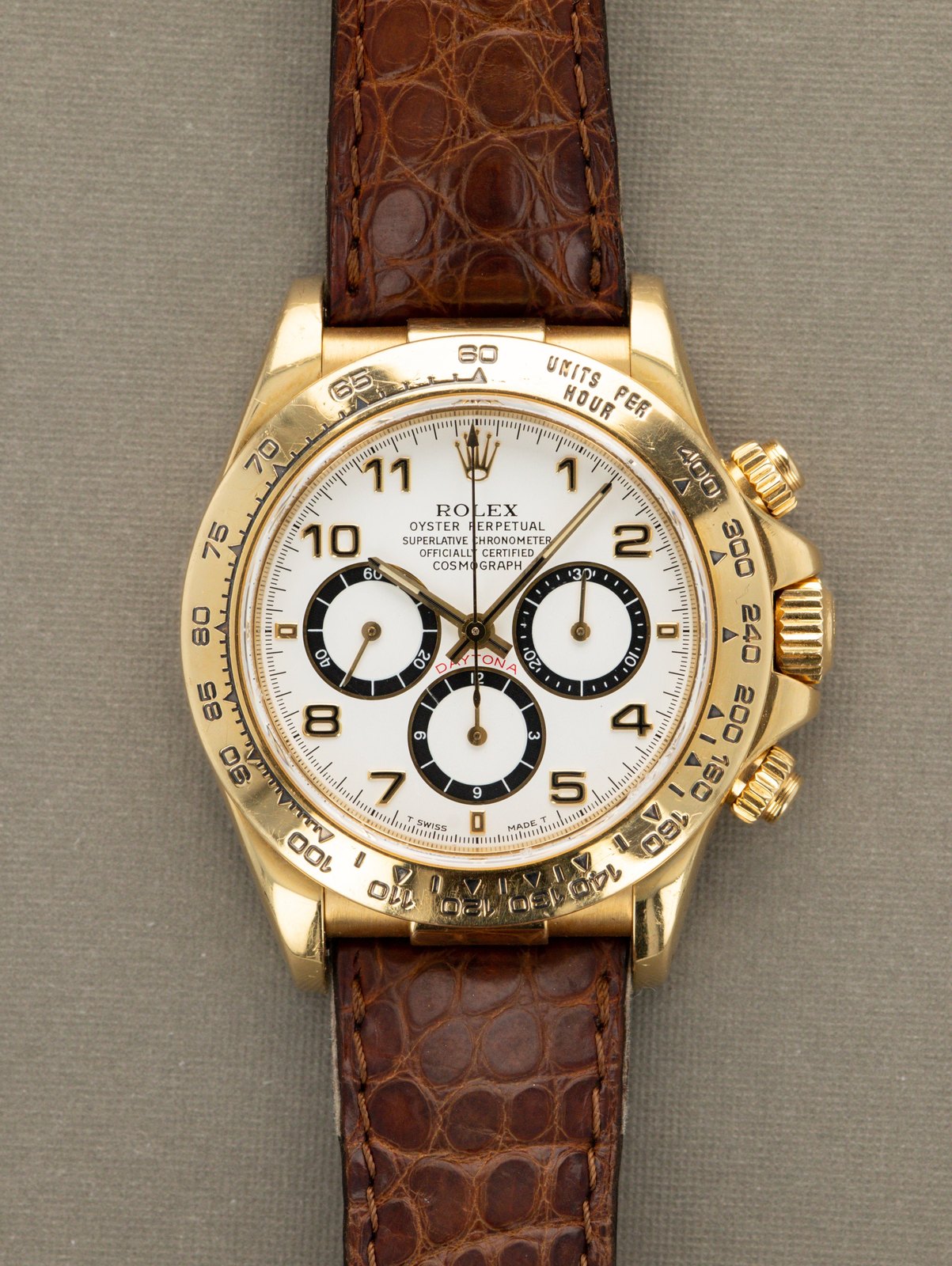
Rolex Daytona ref. 16518 'Zenith', White 'Inverted 6 Racing' Dial
- Maker / attribution
- Rolex (maker)
- Date
- c. 1997
- Historical period
- Mechanical Renaissance (1990 – 2010)
- Country of origin
- Switzerland
- Object type
- Wristwatch
- Stock no.
- OC2696
- Credit line
- Dealer listing, Oliver & Clarke (OC2696)
- Catalogue title (original)
- Rolex Daytona Ref. 16518 'Zenith' - White 'Inverted 6 Racing' Dial Box & Papers (English)
View the source record (dealer listing) ↗ (opens another website in a new tab)Suggest a correction
Record summary
Catalogued by Oliver & Clarke (dealer), United Kingdom (stock number OC2696), this is a wristwatch by Rolex, made in Switzerland, dated c. 1997. The Atlas places it in the Mechanical Renaissance period (1990 – 2010) of its Wristwatches collection. The record is illustrated with 6 photographs.
Assembled from the source record's structured fields. Dates and attributions are given as the source states them; where a field is missing the Atlas leaves it blank rather than estimating.
Catalogue description
Dealer description — Oliver & Clarke
The Rolex Daytona model, since its initial release, has been at the forefront of the market as the most desirable chronograph in production. Prior to the introduction of the automatic-winding Daytonas in 1988, all previous Rolex chronographs had been manually-wound. Rolex decided to outsource their movement for the Ref. 16xxx series of watches, looking for the best movement available. and settled on the best that was available at the time: the famous They used this movement as the basis and then fortified it, performing approximately 200 modifications to the base movement to meet the expectations prestigious of the Wilsdorf group. This created the workhorse Rolex 4030 movement that was put in production for an era of 12 years. In this Reference, Rolex also incorporated the more resilient sapphire crystals, a contributing factor to the increased depth rating guaranteed at 100m or 330ft. The piece that we have here, Reference 16518, stands out amongst its more popular sibling Reference 16528 with a somewhat unusual lug design. The 16518 features 'fillers' within the lugs to allow for a more seamless design when fitted to leather straps. Dating to circa 1997, this example comes to us in strong overall condition. The yellow gold Oyster case and matching yellow gold bezel shows normal wear from age with fully-intact black paint within the engraved markings and clear hallmarks on the underside of the lugs. Inside, the gloss white dial is exceptional. Rather than the more common baton-style indices, this example features applied 'Arabic' indices — which have taken on the colloquial name amongst the collecting community as a 'racing' dial. Combined with black subsidiary register rings, it absolutely has an attractive sporting look to it. Being from the mid-1990, it also has an 'Inverted 6' within the 6:00 subsidiary register ring, as well as applied Tritium-filled indices at the 3, 6, and 9 o'clock positions, and a perfectly matching handset. The brown leather strap shows just normal wear with plenty of life left and is fitted to a yellow gold fliplock clasp. Additionally, this piece is accompanied by its outer box, lacquered wood inner box, booklets, and papers confirming the white dial and dated 7/1/1999. These neo-vintage pieces still present exceptional value in todays market and are becoming a modern classic in a big way. These factory leather-strap pieces in particular, offer fantastic value next to modern offerings.
Historical context
Mechanical Renaissance (1990 – 2010)
Mechanical watches return as cultural objects; independent watchmaking flourishes.
Mechanical watches returned as cultural and luxury objects. Complications, tourbillons and new materials proliferated; independent watchmakers such as George Daniels, F.P. Journe and Philippe Dufour revived artisanal watchmaking; collecting vintage watches became a major field.
Read the period in the timelineMore wristwatches from this periodEarlier: Quartz Revolution
Atlas type guide
Wristwatches
Bracelet watches were worn by women from the early nineteenth century — Breguet made one for Caroline Murat, Queen of Naples, in 1810–12 — but the wristwatch only became a man's instrument with military use and aviation in the early twentieth century. Between the World Wars it overtook the pocket watch; the 1920s and 1930s brought rectangular Art Deco cases, water-resistant cases and the first automatic winding systems.
After 1945 the wristwatch became a carrier of identity — dress watches, sports and dive watches, chronographs, calendars — produced by Swiss, American, Japanese, German, Soviet and Chinese industries. The quartz revolution after 1969 and the mechanical renaissance since the 1990s, including the rise of independent watchmakers, complete the story.
What to look for
- The reference number (between the lugs or inside the case back) and serial number, the starting point for dating.
- The calibre: its maker and number are often stamped under the dial or on the bridge.
- Originality of dial, hands and crown — refinished ('redial') dials are common.
- Case material marks: 18K/750, 14K/585, stainless steel, gold-filled, plated.
Dating clues
- Wire-lug cases: before c. 1925.
- Water-resistant screw-down cases: from 1926.
- Quartz movements: from 1969; sapphire crystals widespread after c. 1980.
General guidance written by the Atlas editors about this kind of object. It is not a statement about this particular piece; for that, rely on the source record above and on physical examination.
Related records

Movements & Components · c. 1970s
Rolex watch movement, c. 1970s
Antiquorum auction archive, Geneva

Pocket Watches · 1982
Fake Rolex watch, gold coloured metal, possibly made in Taiwan, 1982; part of a casual outfit, UK, 1982-84.
Victoria and Albert Museum, London

Wristwatches · c. 1920s
Rolex wristwatch, c. 1920s
Antiquorum auction archive, Geneva

Wristwatches · c. 1920s
Rolex wristwatch, ref. 6194, c. 1920s
Antiquorum auction archive, Geneva

Wristwatches · 2008
Wristwatch by Breitling?, 2008
Museum Rotterdam

Wristwatches · c. 1990s
Audemars Piguet Bamboo, c. 1990s
Antiquorum auction archive, Geneva

Wristwatches · c. 1990
Audemars Piguet Huitieme Perpetual Calendar, ref. 25696PT, c. 1990
Antiquorum auction archive, Geneva

Wristwatches · c. 1990
Breitling Chronomat, ref. b13050.1, c. 1990
Antiquorum auction archive, Geneva