
Wristwatches · Wristwatch
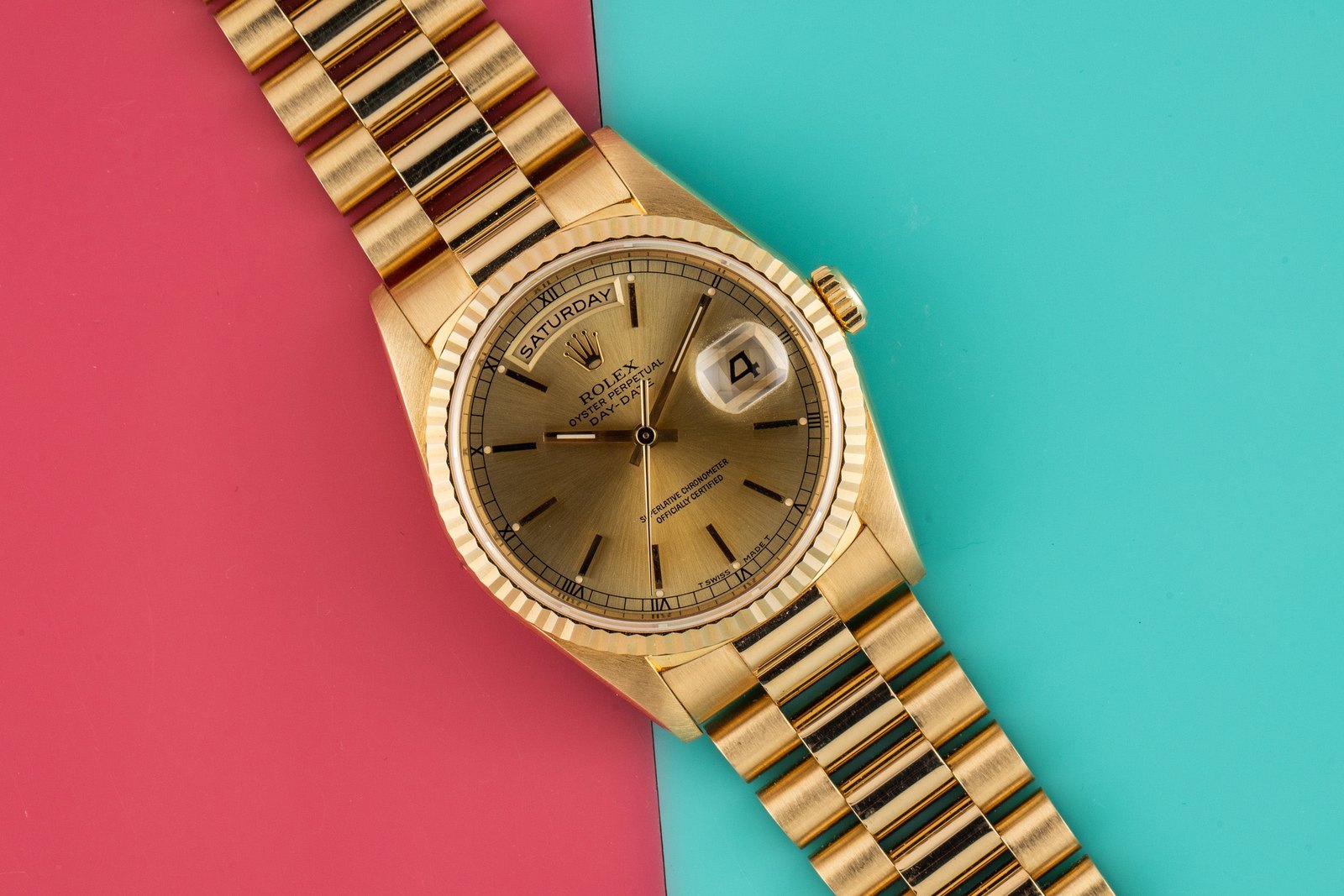
Rolex Day-Date 'Double Quickset', 1995
- Maker / attribution
- Rolex (maker)
- Date
- 1995
- Historical period
- Mechanical Renaissance (1990 – 2010)
- Country of origin
- Switzerland
- Object type
- Wristwatch
- Dimensions
- Case 36 mm
- Stock no.
- Product 4617956098135
- Credit line
- Dealer listing, Analog/Shift (product 4617956098135)
- Catalogue title (original)
- Rolex Day-Date 'Double Quickset' (English)
View the source record (dealer listing) ↗ (opens another website in a new tab)Suggest a correction
Record summary
Catalogued by Analog/Shift (dealer), New York (stock number Product 4617956098135), this is a wristwatch by Rolex, made in Switzerland, dated 1995. The Atlas places it in the Mechanical Renaissance period (1990 – 2010) of its Wristwatches collection. Recorded dimensions: Case 36 mm. The record is illustrated with 6 photographs.
Assembled from the source record's structured fields. Dates and attributions are given as the source states them; where a field is missing the Atlas leaves it blank rather than estimating.
Catalogue description
Dealer description — Analog/Shift
Why We Love it The Rolex Day-Date "President' is arguably the most important dress watch in history Worn as an accessory with a fine bespoke suit or with jeans and a t-shirt, a solid gold Rolex might just change the way you think about precious metal wristwatches. And going with a true icon, worn by everyone from President Eisenhower to Tony Soprano, makes the idea of adding a little extra shine to your wardrobe that much more compelling. This particular watch, a Reference 18238, dates to 1995 and is - in a word - mint. This model features a "double quickset" movement, meaning that minimal effort need be extended when setting either the day or date functions. Its champagne-toned dial features evenly aged intact luminous plots and its magnified sapphire crystal is framed by a fluted yellow gold bezel. Spared the fate of so many Day-Dates, this particular watch shows almost no signs of wear or use and NO signs of polishing, with thick, sharp lugs, deep hallmarks - and a factory case back sticker intact on its backside. Paired up on an equally mint hidden clasp bracelet, this is quite simply a lovely example of one of our favorite vintage Rolex references. When only a gold watch will do - meetings with heads of state or the heads of the Five Families - a Day-Date is always the right choice. The Day-Date Story When you’ve got a good thing going, sometimes you just know . Such is the case with the Rolex Day-Date. At the time of the Day-Date’s release in 1956, it was Rolex’s most complicated wristwatch: all previous attempts had failed to resonate with consumers. But as soon as Rolex secured the patent in July of 1955, production of the Day-Date was rushed for a debut at the Basel Fair the following spring. Although early Day-Dates were plagued by technical problems resulting from the complexity of the automatic movement with dual calendar function, those were soon resolved. After President Eisenhower sported one (a gift from the manufacture), its success was secured. The watch came to be known as the “President,” (due to the fact that several U.S. presidents since Eisenhower have worn one), and it certainly lives up to its dignified nickname. For a brand that has built its reputation on its sports watches, it's perhaps unsurprising that the Rolex Day-Date is amongst the brand's best-sellers. True, the brand has always produced dress watches, but while the brand's more overt dress watch, the Cellini, often seems out of place among the brand's Oyster-cased offerings, the Day-Date is sturdy, solid, and at home alongside the Submariners and GMTs that make up the Oyster Perpetual collection. Rolex has approached continual development of model as they do every other, making quiet improvements over the following decades, ensuring the Day-Date is worthy as the centerpiece of Rolex's Oyster line as horological technology evolves. Whether a simple 36mm yellow gold piece or a Day-Date II 41mm Day-Date in platinum with a gem set dial, the Day-Date is internationally recognized as time timepiece of success and leadership, and of great taste.
Historical context
Mechanical Renaissance (1990 – 2010)
Mechanical watches return as cultural objects; independent watchmaking flourishes.
Mechanical watches returned as cultural and luxury objects. Complications, tourbillons and new materials proliferated; independent watchmakers such as George Daniels, F.P. Journe and Philippe Dufour revived artisanal watchmaking; collecting vintage watches became a major field.
Read the period in the timelineMore wristwatches from this periodEarlier: Quartz Revolution
Atlas type guide
Calendar, moon-phase and perpetual calendar watches
Calendar complications range from a simple date to the perpetual calendar, which automatically allows for months of different lengths and leap years until 2100. Pocket watches with perpetual calendars were made in the eighteenth and nineteenth centuries; Patek Philippe made the first perpetual calendar wristwatch in 1925, and series production followed in 1941. The annual calendar (Patek Philippe, 1996) needs correction only once a year.
Moon-phase displays use a disc with two moons and 59 teeth advanced daily, approximating the 29.5-day lunation; more precise trains reduce the error to one day in over a century.
What to look for
- Apertures or subsidiary dials for day, date, month and leap year.
- Moon disc under a 'bosom' shaped aperture.
- Recessed correctors on the case band for setting the calendar.
Dating clues
- Triple-date wristwatches: popular c. 1940–1955.
- Perpetual calendar wristwatches: from 1925 (unique) and 1941 (series).
General guidance written by the Atlas editors about this kind of object. It is not a statement about this particular piece; for that, rely on the source record above and on physical examination.
Related records

Movements & Components · c. 1970s
Rolex watch movement, c. 1970s
Antiquorum auction archive, Geneva

Pocket Watches · 1982
Fake Rolex watch, gold coloured metal, possibly made in Taiwan, 1982; part of a casual outfit, UK, 1982-84.
Victoria and Albert Museum, London

Wristwatches · c. 1920s
Rolex wristwatch, c. 1920s
Antiquorum auction archive, Geneva

Wristwatches · c. 1920s
Rolex wristwatch, ref. 6194, c. 1920s
Antiquorum auction archive, Geneva

Wristwatches · 2008
Wristwatch by Breitling?, 2008
Museum Rotterdam

Wristwatches · c. 1990s
Audemars Piguet Bamboo, c. 1990s
Antiquorum auction archive, Geneva

Wristwatches · c. 1990
Audemars Piguet Huitieme Perpetual Calendar, ref. 25696PT, c. 1990
Antiquorum auction archive, Geneva

Wristwatches · c. 1990
Breitling Chronomat, ref. b13050.1, c. 1990
Antiquorum auction archive, Geneva