
Wristwatches · Wristwatch
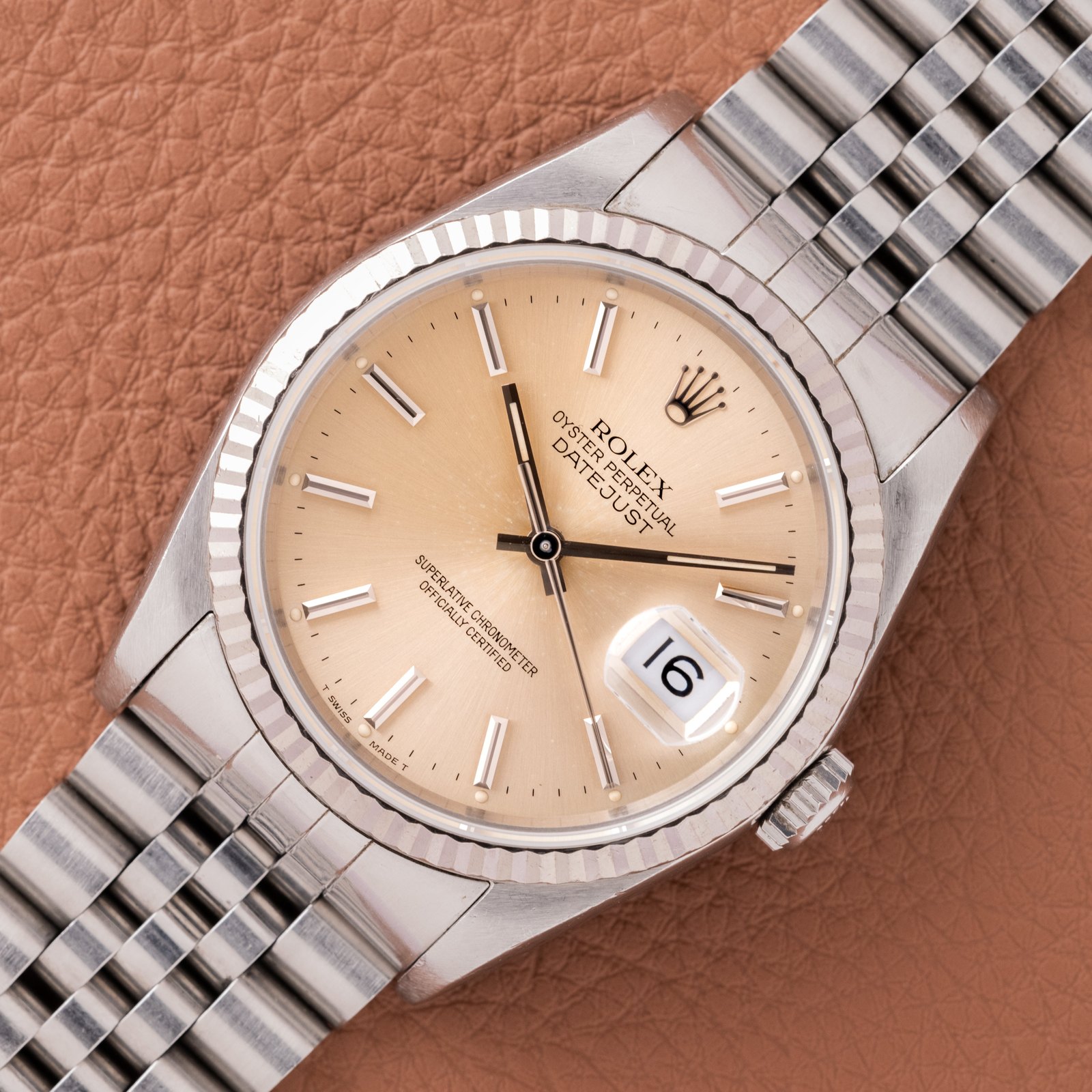
Rolex Datejust Tropical Dial (Ref. 16234), 1991
- Maker / attribution
- Rolex (maker)
- Date
- 1991
- Historical period
- Mechanical Renaissance (1990 – 2010)
- Country of origin
- Switzerland
- Object type
- Wristwatch
- Dimensions
- Case 36 mm
- Stock no.
- Product 8791973986487
- Credit line
- Dealer listing, Huntington Company (product 8791973986487)
- Catalogue title (original)
- 1991 Rolex Datejust Tropical Dial (Ref. 16234) (English)
View the source record (dealer listing) ↗ (opens another website in a new tab)Suggest a correction
Record summary
Catalogued by Huntington Company (dealer) (stock number Product 8791973986487), this is a wristwatch by Rolex, made in Switzerland, dated 1991. The Atlas places it in the Mechanical Renaissance period (1990 – 2010) of its Wristwatches collection. Recorded dimensions: Case 36 mm. The record is illustrated with 6 photographs.
Assembled from the source record's structured fields. Dates and attributions are given as the source states them; where a field is missing the Atlas leaves it blank rather than estimating.
Catalogue description
Dealer description — Huntington Company
History and Significance The Datejust has spent decades proving that a watch does not need to be complicated to become one of the most recognizable designs in watchmaking. The reference 16234 represents an especially appealing period of the model, pairing the familiar 36mm proportions with a fluted white gold bezel and automatic movement. It sits at the point where vintage character and modern everyday usability overlap particularly well. That balance has made the reference 16234 one of the most approachable ways into five-digit Rolex. What separates this example is the dial. Originally silver, decades of aging have transformed its surface toward a warm champagne tone that changes the personality of the watch completely. The creamy tritium plots complement that color beautifully and give the dial a warmth that a conventional silver example simply does not have. Tropical aging is never completely uniform, and that unpredictability is exactly what makes naturally changed dials so interesting. The Datejust format also works particularly well with this type of aging because everything surrounding the dial remains restrained. Applied baton markers, simple hands, a date aperture beneath the Cyclops, and the fluted bezel leave the unusual color as the focal point. At 36mm, the case retains the proportions that defined the Datejust for generations. Nothing about the design needs to be oversized or exaggerated for the watch to have presence. Another important part of this example is the condition of the case. The case remains unpolished, preserving the shape and surfaces that are so often softened on watches of this age. The later bracelet is also unpolished and shows normal wear throughout rather than having been refinished to appear artificially new. Combined with the naturally aged dial, the result is a reference 16234 that presents with the kind of honest character that makes an older Rolex compelling. Writer’s Thoughts A tropical Datejust can be far more interesting than its reputation as the safe Rolex choice suggests. The reference 16234 already has nearly ideal everyday proportions, but the champagne-like transformation of this dial makes the watch feel completely different from a standard silver example. The creamy tritium adds another layer of warmth without overwhelming the simplicity of the design. Most importantly, the aging gives this Rolex an identity that cannot simply be ordered from a catalog or recreated on another watch. Our Promise Every watch is thoroughly vetted, carefully described with complete transparency, and guaranteed authentic. Each piece is offered in honest condition, ensuring collectors receive a timepiece that reflects both originality and integrity. Specifications Brand: Rolex Model: Datejust Reference: 16234 Year: 1991 Case Material: Stainless steel with white gold fluted bezel Case Size: 36mm Dial: Silver dial aged to a warm champagne tone with creamy tritium lume Movement: Automatic Strap/Buckle: Later Rolex bracelet Buckle/Clasp: Rolex clasp Contents: Watch only Condition Case: Unpolished with normal signs of wear consistent with age. Dial: Originally silver and naturally aged to a warm champagne-like tone. Creamy tritium lume remains present throughout. Hands: Present well with age consistent with the watch and dial. Crystal: Shows normal signs of wear consistent with use. Strap/Buckle: Later Rolex bracelet remains unpolished with normal wear throughout. Buckle/Clasp: Rolex clasp with normal signs of wear.
Historical context
Mechanical Renaissance (1990 – 2010)
Mechanical watches return as cultural objects; independent watchmaking flourishes.
Mechanical watches returned as cultural and luxury objects. Complications, tourbillons and new materials proliferated; independent watchmakers such as George Daniels, F.P. Journe and Philippe Dufour revived artisanal watchmaking; collecting vintage watches became a major field.
Read the period in the timelineMore wristwatches from this periodEarlier: Quartz Revolution
Atlas type guide
Calendar, moon-phase and perpetual calendar watches
Calendar complications range from a simple date to the perpetual calendar, which automatically allows for months of different lengths and leap years until 2100. Pocket watches with perpetual calendars were made in the eighteenth and nineteenth centuries; Patek Philippe made the first perpetual calendar wristwatch in 1925, and series production followed in 1941. The annual calendar (Patek Philippe, 1996) needs correction only once a year.
Moon-phase displays use a disc with two moons and 59 teeth advanced daily, approximating the 29.5-day lunation; more precise trains reduce the error to one day in over a century.
What to look for
- Apertures or subsidiary dials for day, date, month and leap year.
- Moon disc under a 'bosom' shaped aperture.
- Recessed correctors on the case band for setting the calendar.
Dating clues
- Triple-date wristwatches: popular c. 1940–1955.
- Perpetual calendar wristwatches: from 1925 (unique) and 1941 (series).
General guidance written by the Atlas editors about this kind of object. It is not a statement about this particular piece; for that, rely on the source record above and on physical examination.
Related records

Movements & Components · c. 1970s
Rolex watch movement, c. 1970s
Antiquorum auction archive, Geneva

Pocket Watches · 1982
Fake Rolex watch, gold coloured metal, possibly made in Taiwan, 1982; part of a casual outfit, UK, 1982-84.
Victoria and Albert Museum, London

Wristwatches · c. 1920s
Rolex wristwatch, c. 1920s
Antiquorum auction archive, Geneva

Wristwatches · c. 1920s
Rolex wristwatch, ref. 6194, c. 1920s
Antiquorum auction archive, Geneva

Wristwatches · 2008
Wristwatch by Breitling?, 2008
Museum Rotterdam

Wristwatches · c. 1990s
Audemars Piguet Bamboo, c. 1990s
Antiquorum auction archive, Geneva

Wristwatches · c. 1990
Audemars Piguet Huitieme Perpetual Calendar, ref. 25696PT, c. 1990
Antiquorum auction archive, Geneva

Wristwatches · c. 1990
Breitling Chronomat, ref. b13050.1, c. 1990
Antiquorum auction archive, Geneva