
Wristwatches · Wristwatch
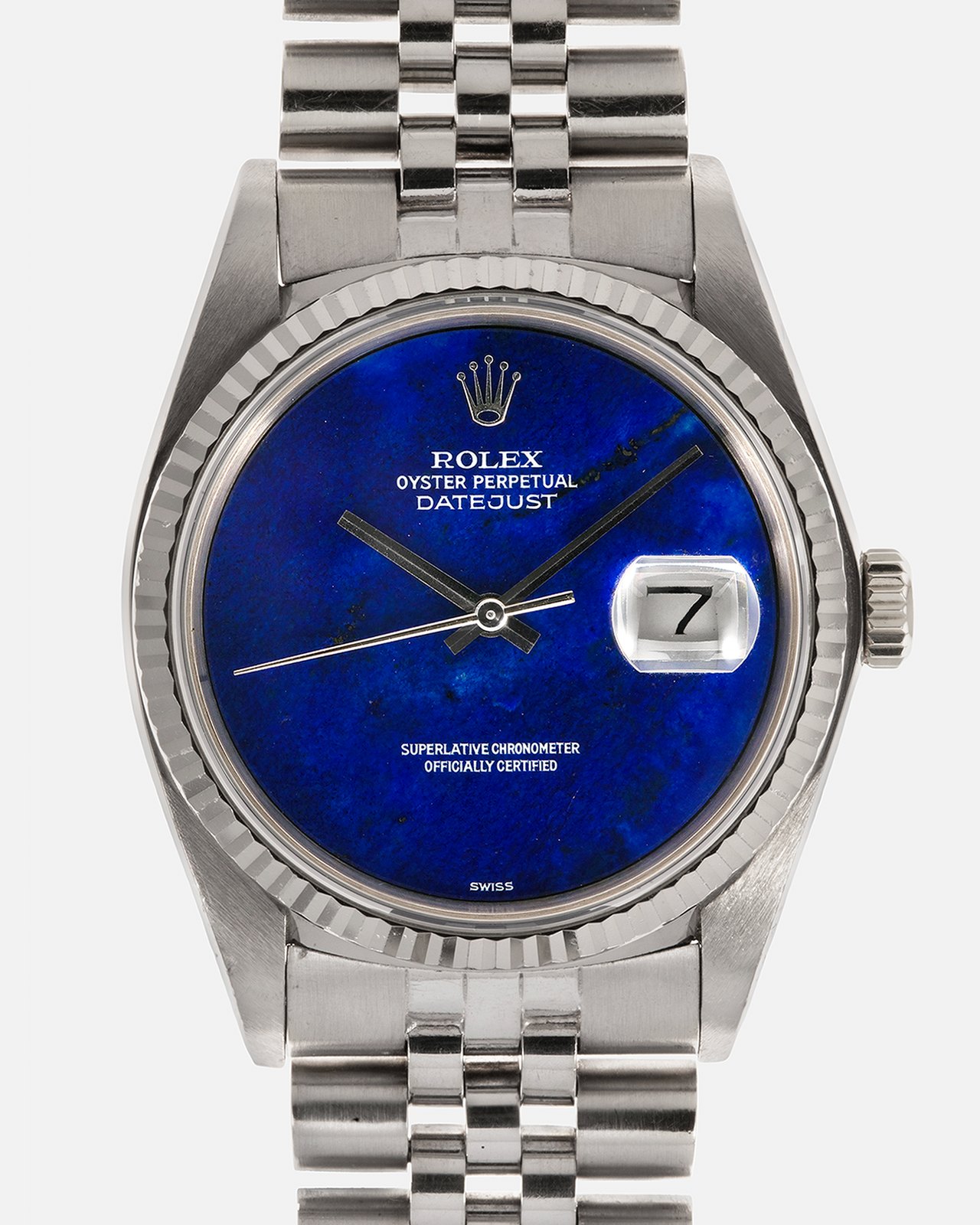
Rolex Datejust 16019 Lapis Lazuli White Gold, 1978
- Maker / attribution
- Rolex (maker)
- Date
- 1978
- Historical period
- Quartz Revolution (1969 – 1990)
- Country of origin
- Switzerland
- Object type
- Wristwatch
- Materials / technique
- white gold
- Dimensions
- Case 36 mm
- Stock no.
- Product 7425145503831
- Credit line
- Dealer listing, S.Song Watches (product 7425145503831)
- Catalogue title (original)
- Rolex Datejust 16019 Lapis Lazuli White Gold (English)
View the source record (dealer listing) ↗ (opens another website in a new tab)Suggest a correction
Record summary
Catalogued by S.Song Watches (dealer), Seattle (stock number Product 7425145503831), this is a wristwatch by Rolex, made in Switzerland, dated 1978. The Atlas places it in the Quartz Revolution period (1969 – 1990) of its Wristwatches collection. Materials and techniques recorded by the source: white gold. Recorded dimensions: Case 36 mm. The record is illustrated with 6 photographs.
Assembled from the source record's structured fields. Dates and attributions are given as the source states them; where a field is missing the Atlas leaves it blank rather than estimating.
Catalogue description
Dealer description — S.Song Watches
Over the years, Rolex has introduced a vast array of dial and case variations for the Datejust. While many of these are relatively accessible, some versions feature rare dials and case configurations, and even fewer qualify as the highly coveted "holy grails" among collectors. The Datejust 16019 in 18-carat white gold presented here firmly belongs to that category, distinguished not only by one of the most sought-after stone dials in the Rolex catalogue—lapis lazuli—but also by its elusive white gold case, which is hardly seen in the wild. Without further ado, let’s dive into what makes this Datejust truly unique. For those who may not be familiar with this material, lapis lazuli is a striking natural stone that has been cherished for thousands of years, dating back to ancient Egypt and Mesopotamia. Renowned for its deep, celestial blue colour and speckled with shimmering golden pyrite inclusions, lapis lazuli is a special stone that offers a unique and luxurious aesthetic that cannot be replicated by synthetic materials. When used as a watch dial—particularly in a timepiece as iconic as the Rolex Datejust—it transforms the watch into something far more than a functional accessory; it becomes a wearable piece of art. Each dial is inherently one-of-a-kind due to the natural variation in the stone, making every example subtly different. Today, it is a perennial favourite amongst watch collectors, and it is not hard to see why. Historically, the Day-Date serves as Rolex's creative canvas for exploring and experimenting with the use of precious stone dials. Encasing such dials in a precious metal Datejust, as seen in this example, is relatively uncommon. The design approach taken here is gracefully straightforward: customary hour markers typically found on a Datejust have been deliberately omitted, creating ample negative space that allows the brilliance of the deep blue lapis lazuli dial to take centre stage. To complete the set, the stone dial on this example here finds harmony with an 18-carat white gold case, fitted with a fluted bezel and a jubilee bracelet, a truly classy and impeccable combination, if I may say so myself. I believe it’s also important for us to emphasise just how rare it is to find a lapis dial Datejust 16019 in white gold. For those unfamiliar, the “9” at the end of its reference number indicates this metal. While we have offered several similar examples in yellow gold over the years, this is the first time we’re presenting one in this metal, as variants like this are significantly more uncommon, with only a handful known to exist. Additional distinguishing details include a matching white date wheel, date window frame, as well as white text on the dial, all of which are subtle yet telling features found exclusively on lapis dials made to be encased in white gold cases like these. As far as movement goes, housed within its conservative 36mm case is the famous self-winding, in-house Rolex Cal. 3035, which was also the first Datejust movement to feature a quick date change mechanism. I think it goes without saying that a watch like this is nothing short of exceptional and would make a standout addition to any discerning collector’s watch box. Having handled many remarkable stone dial Rolex models over the years, I’d go so far as to say that lapis lazuli dials rank among the most coveted and visually striking variants the brand has ever produced. The fact that this example comes fitted in an extremely rare white gold case makes it all the more compelling in its own right. That said, with a piece of this calibre, words often fall short in capturing the true depth and beauty of the dial, so instead, I am going to let the images speak for themselves.
Historical context
Quartz Revolution (1969 – 1990)
Seiko's Astron begins mass quartz timekeeping; traditional industries contract sharply.
Quartz and digital watches transformed the market after 1969. Swiss employment collapsed, Japanese and Hong Kong production soared, and the Swatch (1983) helped the Swiss industry recover; mechanical watches survived as luxury goods.
Read the period in the timelineMore wristwatches from this periodEarlier: Modern Mechanical Horology
Atlas type guide
Calendar, moon-phase and perpetual calendar watches
Calendar complications range from a simple date to the perpetual calendar, which automatically allows for months of different lengths and leap years until 2100. Pocket watches with perpetual calendars were made in the eighteenth and nineteenth centuries; Patek Philippe made the first perpetual calendar wristwatch in 1925, and series production followed in 1941. The annual calendar (Patek Philippe, 1996) needs correction only once a year.
Moon-phase displays use a disc with two moons and 59 teeth advanced daily, approximating the 29.5-day lunation; more precise trains reduce the error to one day in over a century.
What to look for
- Apertures or subsidiary dials for day, date, month and leap year.
- Moon disc under a 'bosom' shaped aperture.
- Recessed correctors on the case band for setting the calendar.
Dating clues
- Triple-date wristwatches: popular c. 1940–1955.
- Perpetual calendar wristwatches: from 1925 (unique) and 1941 (series).
General guidance written by the Atlas editors about this kind of object. It is not a statement about this particular piece; for that, rely on the source record above and on physical examination.
Related records

Movements & Components · c. 1970s
Rolex watch movement, c. 1970s
Antiquorum auction archive, Geneva

Pocket Watches · 1982
Fake Rolex watch, gold coloured metal, possibly made in Taiwan, 1982; part of a casual outfit, UK, 1982-84.
Victoria and Albert Museum, London

Wristwatches · c. 1920s
Rolex wristwatch, c. 1920s
Antiquorum auction archive, Geneva

Wristwatches · c. 1920s
Rolex wristwatch, ref. 6194, c. 1920s
Antiquorum auction archive, Geneva

Wristwatches · 1970
Wristwatch by Heno, Switzerland, 1970
Museum Rotterdam

Wristwatches · 1960–1986
'Tri-Compax' calendar chronograph wristwatch in gold case, by Universal, Geneva, Switzerland, 1960–1986.
Science Museum Group, London

Wristwatches · 1969–1970
Beta 21 Quartz wristwatch movement, made in Switzerland, 1970.
Science Museum Group, London

Wristwatches · c. 1969
Omega Speedmaster Moonwatch, ref. 145022-69st, c. 1969
Antiquorum auction archive, Geneva