
Wristwatches · Wristwatch
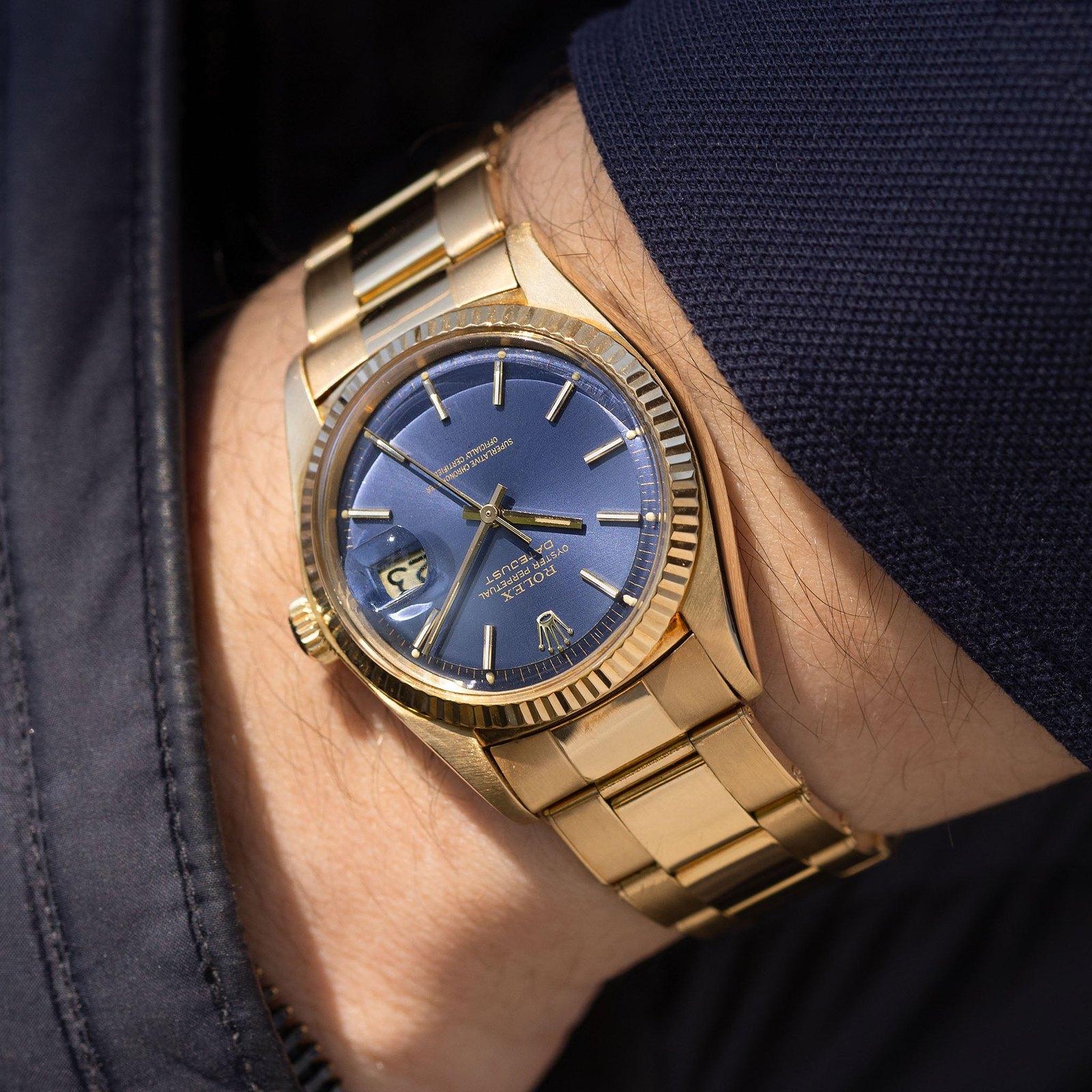
Rolex Datejust 1601/8 Blue Soleil Dial in 18k Yellow Gold with Original Papers, 1977
- Maker / attribution
- Rolex (maker)
- Date
- 1977
- Historical period
- Quartz Revolution (1969 – 1990)
- Country of origin
- Switzerland
- Object type
- Wristwatch
- Materials / technique
- 18k yellow gold
- Dimensions
- Case 36 mm
- Stock no.
- W-3725
- Credit line
- Dealer listing, Bulang & Sons (W-3725)
- Catalogue title (original)
- Rolex Datejust 1601/8 Blue Soleil Dial in 18k Yellow Gold with Original Papers (English)
View the source record (dealer listing) ↗ (opens another website in a new tab)Suggest a correction
Record summary
Catalogued by Bulang & Sons (dealer), Copenhagen (stock number W-3725), this is a wristwatch by Rolex, made in Switzerland, dated 1977. The Atlas places it in the Quartz Revolution period (1969 – 1990) of its Wristwatches collection. Materials and techniques recorded by the source: 18k yellow gold. Recorded dimensions: Case 36 mm. The record is illustrated with 6 photographs.
Assembled from the source record's structured fields. Dates and attributions are given as the source states them; where a field is missing the Atlas leaves it blank rather than estimating.
Catalogue description
Dealer description — Bulang & Sons
Introduced in 1945 to celebrate the 40th anniversary of Rolex, the Rolex Datejust quickly established itself as one of the brand’s most important creations—going on to become a true cornerstone of modern watchmaking. At the time, it represented a series of firsts. It was the world’s first self-winding, waterproof chronometer wristwatch to feature a date window that changed automatically at midnight—something we now take for granted, yet a remarkable innovation in its day. Originally launched exclusively in 18k yellow gold and in a 36mm case, the Datejust also introduced the now-iconic Jubilee bracelet. With its elegant five-link construction, it was designed specifically for the model and has since become inseparable from its identity. A few years later, in 1953, Rolex added another defining feature: the Cyclops lens. Placed above the date window, it enhanced legibility in a simple yet effective way—an idea so successful that it remains a signature element of Rolex design to this day. Presented here is a lovely reference 1601/8—the “/8” indicating its construction in 18k yellow gold. The case remains in beautiful condition, complemented by a crisp fluted bezel that gives the watch its unmistakable presence. What makes this example particularly appealing is its pairing with a rarer riveted Oyster bracelet, in excellent condition, fitted with solid end links marked “76” and a clasp stamped “3 69.” A combination that feels just a little different, and all the more charming because of it. The soleil-finished blue dial brings everything together. Its deep tone contrasts beautifully with the applied stick markers, each with a fine white topping, while the gold printed text and softly aged beige lume add warmth and character. A combination we don’t come across all too often—and one that works effortlessly well. There is something about a yellow gold Datejust on an Oyster bracelet with a blue dial—it feels both refined and relaxed at the same time. A slightly unexpected combination, and exactly the kind we enjoy. Specifications: Rolex Datejust reference 1601/8 36mm 18kt yellow gold case, plexi crystal Serial 506xxxx dating to 1977 Blue soleil finished pie-pan style dial Slow set movement 18k Yellow gold Oyster bracelet with solid end links Rolex sale paper stating sale in 1988, Italy, green paper holder and booklet Fully serviced by our watchmaker
Historical context
Quartz Revolution (1969 – 1990)
Seiko's Astron begins mass quartz timekeeping; traditional industries contract sharply.
Quartz and digital watches transformed the market after 1969. Swiss employment collapsed, Japanese and Hong Kong production soared, and the Swatch (1983) helped the Swiss industry recover; mechanical watches survived as luxury goods.
Read the period in the timelineMore wristwatches from this periodEarlier: Modern Mechanical Horology
Atlas type guide
Calendar, moon-phase and perpetual calendar watches
Calendar complications range from a simple date to the perpetual calendar, which automatically allows for months of different lengths and leap years until 2100. Pocket watches with perpetual calendars were made in the eighteenth and nineteenth centuries; Patek Philippe made the first perpetual calendar wristwatch in 1925, and series production followed in 1941. The annual calendar (Patek Philippe, 1996) needs correction only once a year.
Moon-phase displays use a disc with two moons and 59 teeth advanced daily, approximating the 29.5-day lunation; more precise trains reduce the error to one day in over a century.
What to look for
- Apertures or subsidiary dials for day, date, month and leap year.
- Moon disc under a 'bosom' shaped aperture.
- Recessed correctors on the case band for setting the calendar.
Dating clues
- Triple-date wristwatches: popular c. 1940–1955.
- Perpetual calendar wristwatches: from 1925 (unique) and 1941 (series).
General guidance written by the Atlas editors about this kind of object. It is not a statement about this particular piece; for that, rely on the source record above and on physical examination.
Related records

Movements & Components · c. 1970s
Rolex watch movement, c. 1970s
Antiquorum auction archive, Geneva

Pocket Watches · 1982
Fake Rolex watch, gold coloured metal, possibly made in Taiwan, 1982; part of a casual outfit, UK, 1982-84.
Victoria and Albert Museum, London

Wristwatches · c. 1920s
Rolex wristwatch, c. 1920s
Antiquorum auction archive, Geneva

Wristwatches · c. 1920s
Rolex wristwatch, ref. 6194, c. 1920s
Antiquorum auction archive, Geneva

Wristwatches · 1970
Wristwatch by Heno, Switzerland, 1970
Museum Rotterdam

Wristwatches · 1960–1986
'Tri-Compax' calendar chronograph wristwatch in gold case, by Universal, Geneva, Switzerland, 1960–1986.
Science Museum Group, London

Wristwatches · 1969–1970
Beta 21 Quartz wristwatch movement, made in Switzerland, 1970.
Science Museum Group, London

Wristwatches · c. 1969
Omega Speedmaster Moonwatch, ref. 145022-69st, c. 1969
Antiquorum auction archive, Geneva