
Wristwatches · Wristwatch
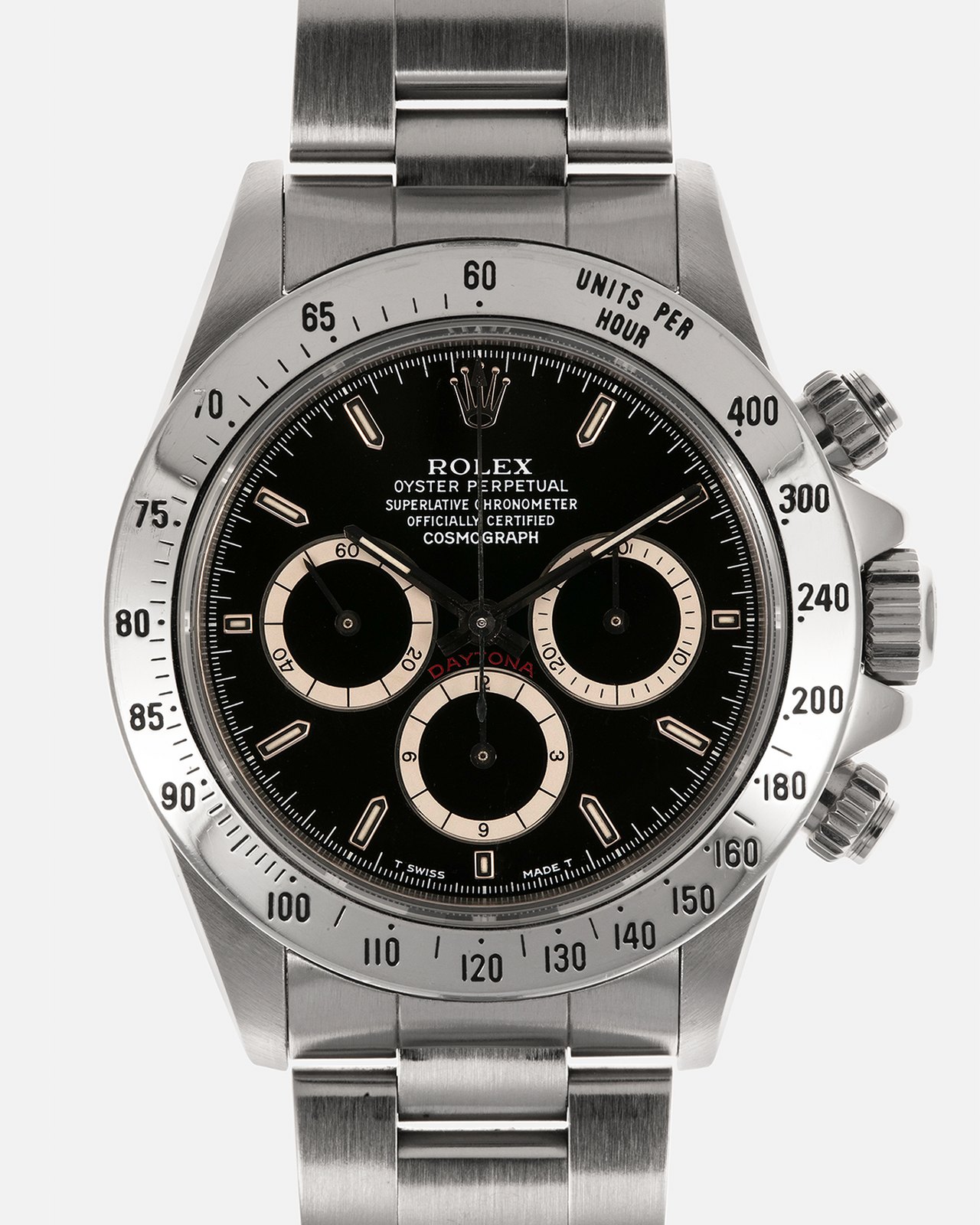
Rolex Cosmograph Zenith Daytona 16520 Inverted 6, 1991
- Maker / attribution
- Rolex (maker)
- Date
- 1991
- Historical period
- Mechanical Renaissance (1990 – 2010)
- Country of origin
- Switzerland
- Object type
- Wristwatch
- Dimensions
- Case 40 mm
- Stock no.
- Product 7394280800343
- Credit line
- Dealer listing, S.Song Watches (product 7394280800343)
- Catalogue title (original)
- Rolex Cosmograph Zenith Daytona 16520 Inverted 6 (English)
View the source record (dealer listing) ↗ (opens another website in a new tab)Suggest a correction
Record summary
Catalogued by S.Song Watches (dealer), Seattle (stock number Product 7394280800343), this is a wristwatch by Rolex, made in Switzerland, dated 1991. The Atlas places it in the Mechanical Renaissance period (1990 – 2010) of its Wristwatches collection. Recorded dimensions: Case 40 mm. The record is illustrated with 6 photographs.
Assembled from the source record's structured fields. Dates and attributions are given as the source states them; where a field is missing the Atlas leaves it blank rather than estimating.
Catalogue description
Dealer description — S.Song Watches
I really don’t think I need to go too much into the Daytona, as pretty much everyone, watch enthusiast or not, knows or has at least heard about this iconic watch. It has always been the case that the ultimate Rolex is ironically not a solid gold President Day-Date, but the Cosmograph Daytona. With long waitlists at authorized dealers these days, not even entertaining you unless you’ve bought another (or a few) Rolex before, the Daytona is without a doubt the most desirable and hardest-to-get Rolex on the market today. Period. However, I believe it remains crucial to briefly reiterate the Rolex Cosmograph Daytona's origin story. In 1959, the Daytona International Speedway emerged as the swiftest racing track in the United States, and in 1962, it became renowned for hosting the esteemed “Rolex 24 At Daytona” endurance race. Recognizing the significance of this racing venue, Rolex was designated as the official timepiece/timekeeper of the Daytona International Speedway. In 1963, Rolex solidified its connection to the illustrious racetrack by christening its newly introduced racing chronograph as the Cosmograph Daytona. The example offered here today is an N-serial 16520 with a black dial, widely known among collectors as the “Zenith Daytona”. For context, Rolex didn’t introduce an in-house self-winding movement for the Daytona until the year 2000. Earlier references of the Daytona (such as the Paul Newman and John Player Specials) were powered by outsourced Valjoux movements. When the 16520 debuted at Baselworld in 1988, it featured a heavily modified self-winding Cal. 4030, based on the high-beat Zenith El Primero 400 movement. What makes this particular piece even more special is that it comes with a Mk 3 ‘Inverted 6’ dial, produced by Rolex between 1991 and 1993. This dial can be easily identified by the 5 lines of text spaced evenly beneath the Rolex coronet, as well as the distinctive sub-dial at 6:00, where the ‘6’ is inverted to appear as a ‘9.’ Additionally, the font on this sub-dial has a subtle yet noticeable difference compared to the other sub-dials. One of the reasons why the 16520 was so desirable among collectors was primarily because it had a limited production run of only 12 years. It was eventually succeeded by the 116520 in 2000, which housed a new in-house, self-winding Cal. 4130. With its 40mm case size, the 16520 sits perfectly on the wrist and possesses a sophisticated design language that aligns with other legendary creations like the 911 Porsche and Fender Stratocaster. It features an exquisite black dial complemented by contrasting sub-dials and a highly polished bezel. Positioned prominently in the centre is the iconic red "Daytona" inscription, just above the 12-hour counter sub-dial. Without a doubt, the Rolex Daytona has solidified its position as the flagship and iconic model of Rolex, thanks in part to its remarkable history and association with renowned individuals throughout the years. On the wrist, with all of the hype and history aside, it is just a downright handsome watch, plain and simple. The Zenith Daytona also represents a significant era in the history of Rolex's iconic Daytona line when dial and bezel variations were relatively frequent. Arguably, it also marks the final generation of Daytonas before Rolex embarked on a path of embracing a more refined, standardized and commercially oriented incarnation that we commonly see today. That being said, the Rolex Cosmograph Daytona is undoubtedly an exceptional watch to own and wear, and I believe it’s a timepiece that every serious collector should consider adding to their collection at some point, whether modern or vintage.
Historical context
Mechanical Renaissance (1990 – 2010)
Mechanical watches return as cultural objects; independent watchmaking flourishes.
Mechanical watches returned as cultural and luxury objects. Complications, tourbillons and new materials proliferated; independent watchmakers such as George Daniels, F.P. Journe and Philippe Dufour revived artisanal watchmaking; collecting vintage watches became a major field.
Read the period in the timelineMore wristwatches from this periodEarlier: Quartz Revolution
Atlas type guide
Wristwatches
Bracelet watches were worn by women from the early nineteenth century — Breguet made one for Caroline Murat, Queen of Naples, in 1810–12 — but the wristwatch only became a man's instrument with military use and aviation in the early twentieth century. Between the World Wars it overtook the pocket watch; the 1920s and 1930s brought rectangular Art Deco cases, water-resistant cases and the first automatic winding systems.
After 1945 the wristwatch became a carrier of identity — dress watches, sports and dive watches, chronographs, calendars — produced by Swiss, American, Japanese, German, Soviet and Chinese industries. The quartz revolution after 1969 and the mechanical renaissance since the 1990s, including the rise of independent watchmakers, complete the story.
What to look for
- The reference number (between the lugs or inside the case back) and serial number, the starting point for dating.
- The calibre: its maker and number are often stamped under the dial or on the bridge.
- Originality of dial, hands and crown — refinished ('redial') dials are common.
- Case material marks: 18K/750, 14K/585, stainless steel, gold-filled, plated.
Dating clues
- Wire-lug cases: before c. 1925.
- Water-resistant screw-down cases: from 1926.
- Quartz movements: from 1969; sapphire crystals widespread after c. 1980.
General guidance written by the Atlas editors about this kind of object. It is not a statement about this particular piece; for that, rely on the source record above and on physical examination.
Related records

Movements & Components · c. 1970s
Rolex watch movement, c. 1970s
Antiquorum auction archive, Geneva

Pocket Watches · 1982
Fake Rolex watch, gold coloured metal, possibly made in Taiwan, 1982; part of a casual outfit, UK, 1982-84.
Victoria and Albert Museum, London

Wristwatches · c. 1920s
Rolex wristwatch, c. 1920s
Antiquorum auction archive, Geneva

Wristwatches · c. 1920s
Rolex wristwatch, ref. 6194, c. 1920s
Antiquorum auction archive, Geneva

Wristwatches · 2008
Wristwatch by Breitling?, 2008
Museum Rotterdam

Wristwatches · c. 1990s
Audemars Piguet Bamboo, c. 1990s
Antiquorum auction archive, Geneva

Wristwatches · c. 1990
Audemars Piguet Huitieme Perpetual Calendar, ref. 25696PT, c. 1990
Antiquorum auction archive, Geneva

Wristwatches · c. 1990
Breitling Chronomat, ref. b13050.1, c. 1990
Antiquorum auction archive, Geneva